
Welcome to Bohring. Here, we look at the universe, life, and science education through a physicist’s lens. If you’re new here, consider joining our community of curious minds:
Part 4 in Physicist’s Toolkit
How to solve physics problems?
When self-studying physics, you can face a roadblock before you even start calculating. It’s the moment you read a problem, understand the words, but have absolutely no idea what equation to write down first.
To do that, you have to run a continuous, bi-directional translation loop between physical intuition (what the universe is doing) and mathematical structures (how we write it down).
My aim here is to give you a general step-by-step framework for setting up any physics problem, using concrete examples to show how it works in practice.
Before deriving anything, you must form a qualitative picture. Developing physical intuition means systematically breaking a system down using three specific tools:
When faced with a complex physical scenario, push the variables to their absolute extremes—zero and infinity. Ask yourself: What must happen to the physical world if this parameter vanishes or explodes?
Example: You are looking at the gravitational force between a point mass and a massive rod of length L at a distance r. Don’t worry about integrals yet.
Take the limit r → ∞: If you move infinitely far away, that giant rod should look like a tiny, single point. Therefore, whatever mathematical formula you eventually derive must collapse back into Newton’s standard 1/r2 law. If it doesn’t, your setup is wrong.
Take the limit L → 0: If the rod shrinks to zero length, it becomes a point mass. Again, the math must yield the point-mass formula.
By testing limits first, you can establish the boundaries that your mathematics is forced to respect.
Note: Passing a limiting check is a necessary condition, not a sufficient proof. Passing your limits does not mean your derivation is definitely correct—it just means it isn’t definitely wrong.
For instance, if you made an algebraic error and derived the force of a rod to be
\(F = \frac{GMm}{r^2}\left(1+\frac{L^2}{r^2}\right)\)
It still perfectly collapses to GMm/r2 when the length L→0. Limits are filters to catch catastrophic errors early; they are not a substitute for rigorous execution.
Never try to solve a complex problem in its full, ugly glory on the first pass. A Toy Model” is a stripped-down, idealized version of reality that preserves only the one physical mechanism you actually care about. If the core physics doesn’t work in the toy model, it won’t work in the complex one.
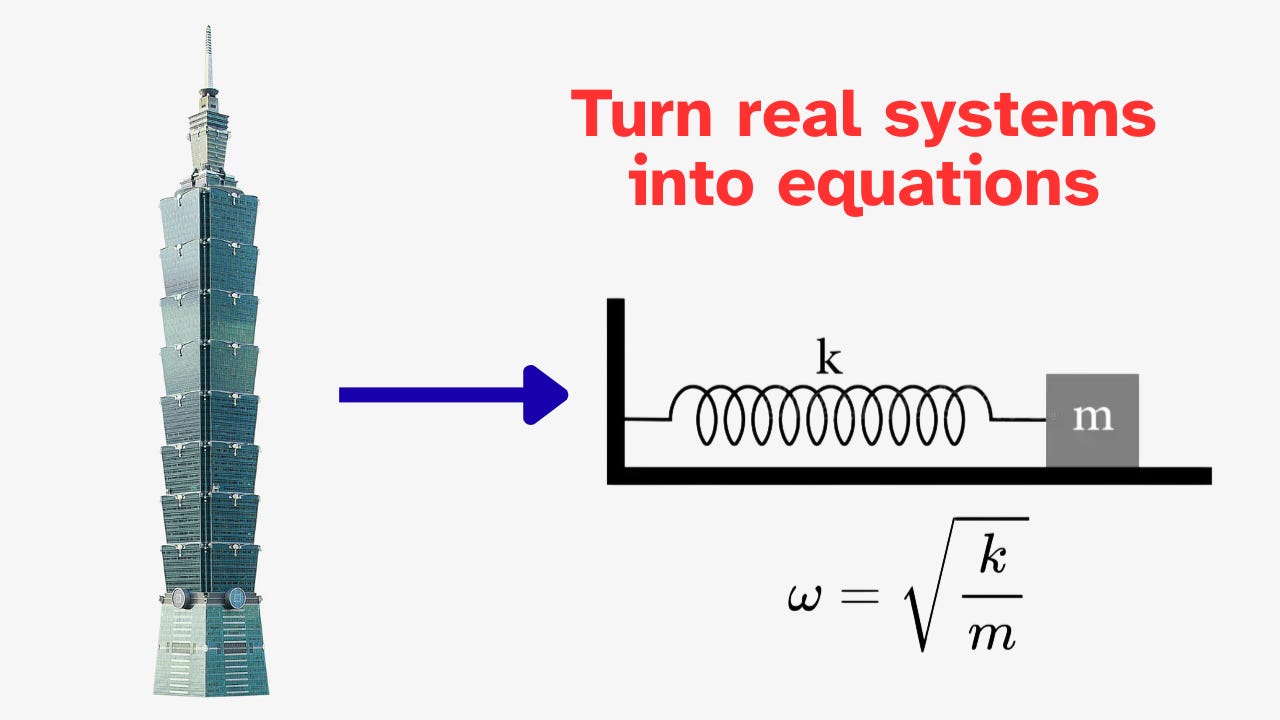
Example: Wobbling Skyscraper
Imagine you are an engineer trying to calculate how a 100-story skyscraper sways during a high-wind storm or an earthquake. A real skyscraper has varying structural steel density, thousands of glass panes, concrete elevator shafts, and complex aerodynamic corners.
Toy model: Strip all of it away. Treat the entire skyscraper as a single, rigid mass M sitting on top of a giant, flexible vertical spring with a stiffness constant k. By reducing a massive building to a simple harmonic oscillator (a mass on a spring), you instantly unlock the core physics: the building has a natural resonant frequency,
\(ω = \sqrt{\frac{k}{m}}\)
The math immediately tells you that if the wind or earthquake shakes the ground at that specific frequency ω, the building will tear itself apart. By replacing a complex architectural marvel with a freshman-physics toy model, you isolate the danger of resonance. Once you understand how to control the resonance of the simple spring-mass system, you can add the flesh of real-world architecture back in.
Units represent the fundamental physical reality of the quantities you are manipulating. Before you spend twenty minutes grinding through a messy algebraic calculation, check the units of your setup. If the dimensions don’t match what you are looking for, the calculation won’t be fruitful from the beginning.
Example: You are trying to find the gravitational force of that massive rod. Suppose your initial setup or a mid-way algebraic slip leaves you with the expression:
\(F = \frac{GMm}{d+L}\)
Stop right there. Do not solve further.
You know that a gravitational force must have the dimensions of Newton’s constant times mass squared over distance squared ([G][M]2/[L]2). The denominator of your expression (d+L) has the dimensions of length ([L]). Your expression has the units of G⋅[M]2/[L]. That is not a force.
Physicists use dimensional analysis constantly as a real-time error detector. If you treat units as an afterthought to be tacked onto the final answer, you will waste hours calculating nonsense. Check them at the start, in the middle, and at the end.
A note to my free community:
Ready to bridge the gap between intuition and calculus? Forming a mental picture is only half the battle. The real friction happens when you have to pick up the pen and translate that picture into rigorous mathematical notation.
In the rest of this premium guide for paid community members, I discuss how to put to use what strategies we’ve discussed till now:
Translate to math: A deep, step-by-step breakdown of a classic calculus problem (the uniform rod), showing exactly how real-world geometry dictates your integration limits.
Reading math backwards: 4 questions you need to ask any raw equation to extract its physical story.
To unlock the rest of the post, support my mission to provide independent science education. Access the full archive of monthly Physicist’s Toolkit deep dives and participate in the chat. Upgrade to a paid membership below:
Comments
Nothing yet. Say the first thing.
Sign in to join the conversation.