
Welcome to Bohring. Here, we look at the universe and life through a physicist’s lens. If you're new here, consider joining our community of curious minds:
Part 1 in Interpretations of Quantum Mechanics
What does ‘interpretation of quantum mechanics’ mean?
An interpretation of quantum mechanics is a philosophical framework that explains how the maths of quantum physics translates into physical reality. While the quantum math is universally agreed upon and incredibly accurate, interpretations answer the conceptual questions about what is actually happening at the microscopic level.
The central mystery is the measurement problem: when you observe or measure a quantum particle, its wave collapses into a single, definite reality. Interpretations attempt to explain how and why this happens.
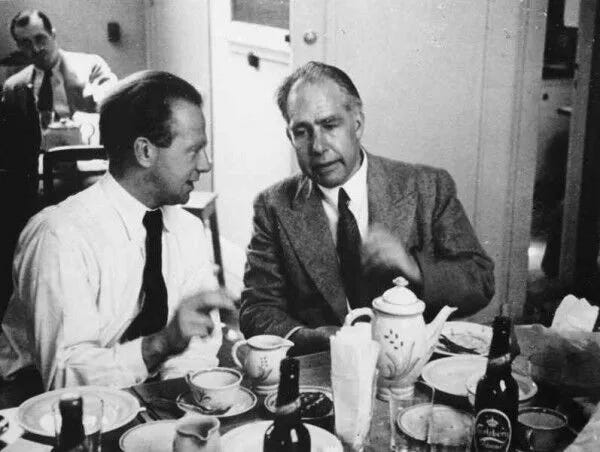
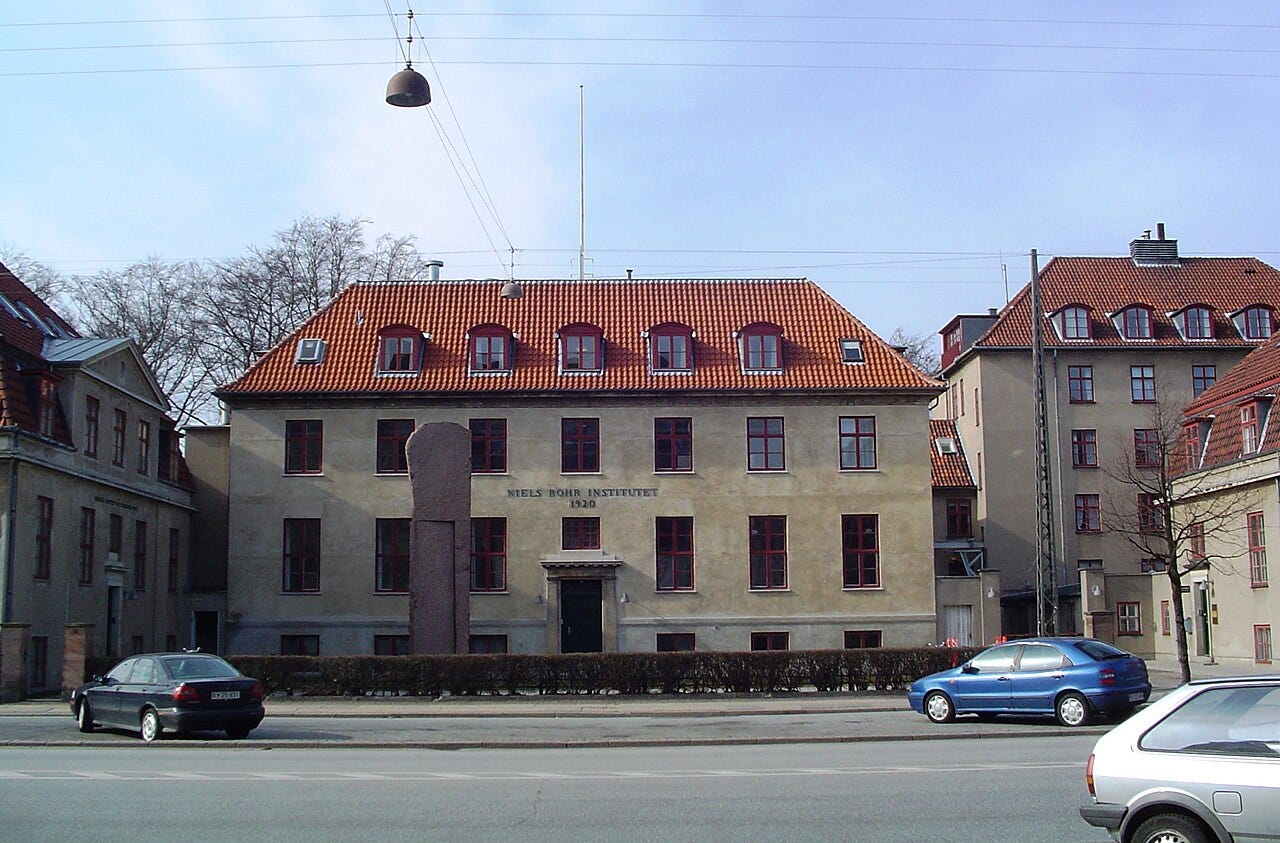
The Copenhagen interpretation is the most widely taught and historically dominant framework for understanding quantum mechanics. It was formulated in the 1920s primarily by Niels Bohr and Werner Heisenberg at the Institute for Theoretical Physics (now the Niels Bohr Institute) in Copenhagen.
At its core, the Copenhagen interpretation addresses the following crisis:
How can a smooth, deterministic mathematical equation (the Schrödinger equation) describe a physical reality that appears fundamentally probabilistic, discrete, and dependent on the act of measurement?
Here I will attempt to give you an adequate conceptual, mathematical, and philosophical understanding of this problem.
Copenhagen interpretation rejects the classical notion that a physical system possesses definitive, objective properties independent of an observer.
In classical mechanics, an object’s state is defined by its position and momentum (x and p).
In quantum mechanics, the state of a system is contained within its wave function, denoted as ψ.
Important Note: Many popular science writers get it wrong by claiming Copenhagen is subjective. It is strictly objective, but it is an operational or relational objectivity, not a classical objectivity.
Classical Objectivity means properties exist independently of everything.
Operational Objectivity means properties are objectively recorded by classical instruments but don’t exist prior to the interaction.
The Copenhagen interpretation asserts a non-realist view of the wave function. It states that ψ is not a physical, material wave moving through space (it is unlike a sound wave or an electromagnetic wave) but an abstract mathematical tool (a “probability amplitude”) that contains all the statistical information we can possibly know about a system.
Now, if ψ isn’t physical, how does it connect to reality?
Max Born bridged this gap, and his rule is a core pillar of the Copenhagen view. The probability P(x, t) of finding a particle at a specific position x and time t is given by the absolute square of the wave function:
\(P(x, t) = |\psi(x, t)|^2\)
Crucially, Copenhagen insists that,
This probability is ontological, not epistemic.
In case you are unfamiliar with these terms:
Ontologically, the uncertainty is a fundamental fact of how reality is built.
Epistemic means the uncertainty is just a temporary limitation of what we happen to know.
In classical physics, if we say there is a 50% chance a coin toss results in heads, it is because we lack information (epistemic probability). The coin is definitely heads or tails; we just don’t know it yet.
In the Copenhagen view, a quantum particle is not described as having a definite position before measurement. Instead, quantum mechanics provides only the probabilities of the various positions that may be observed. In this sense, the uncertainty is not merely in our knowledge of reality—it is part of the way reality itself is described.
Before a measurement is made, a quantum system evolves smoothly and deterministically according to the time-dependent Schrödinger equation:
\(i\hbar \frac{\partial}{\partial t}\psi(x,t) = \hat{H}\psi(x,t)\)
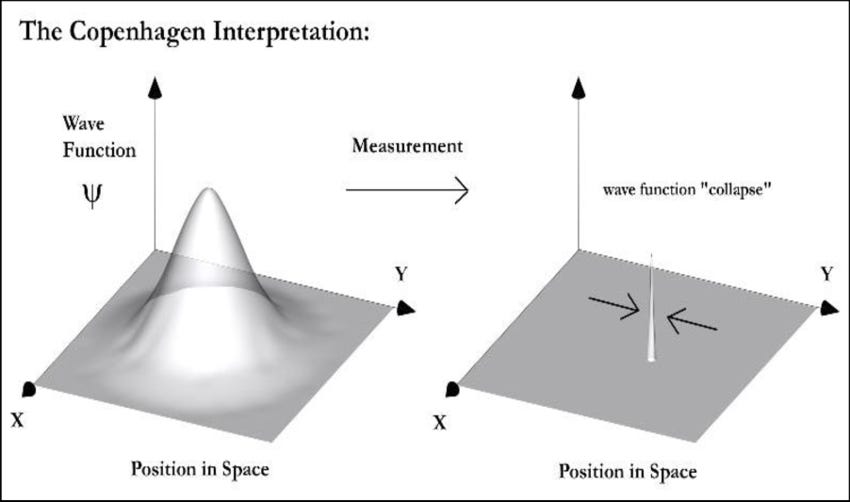
However, the moment a measurement is performed by a classical observer, this smooth evolution is violently interrupted. The wave function instantly and discontinuously collapses from a linear superposition of multiple possible outcomes into a single, definitive eigenstate corresponding to the measured value.
If an electron is in a superposition of being in spin up |↑⟩ and spin down |↓⟩, the act of looking at it forces nature to make a random choice. Once the choice is made, the wave function is altered: it becomes a sharp spike at the detected configuration, and all other probabilities vanish. This transition is completely random and probabilistic.
The philosophical weight of Copenhagen rests heavily on how we resolve the apparent contradictions of the quantum world, namely, why things sometimes act like waves and other times like particles.
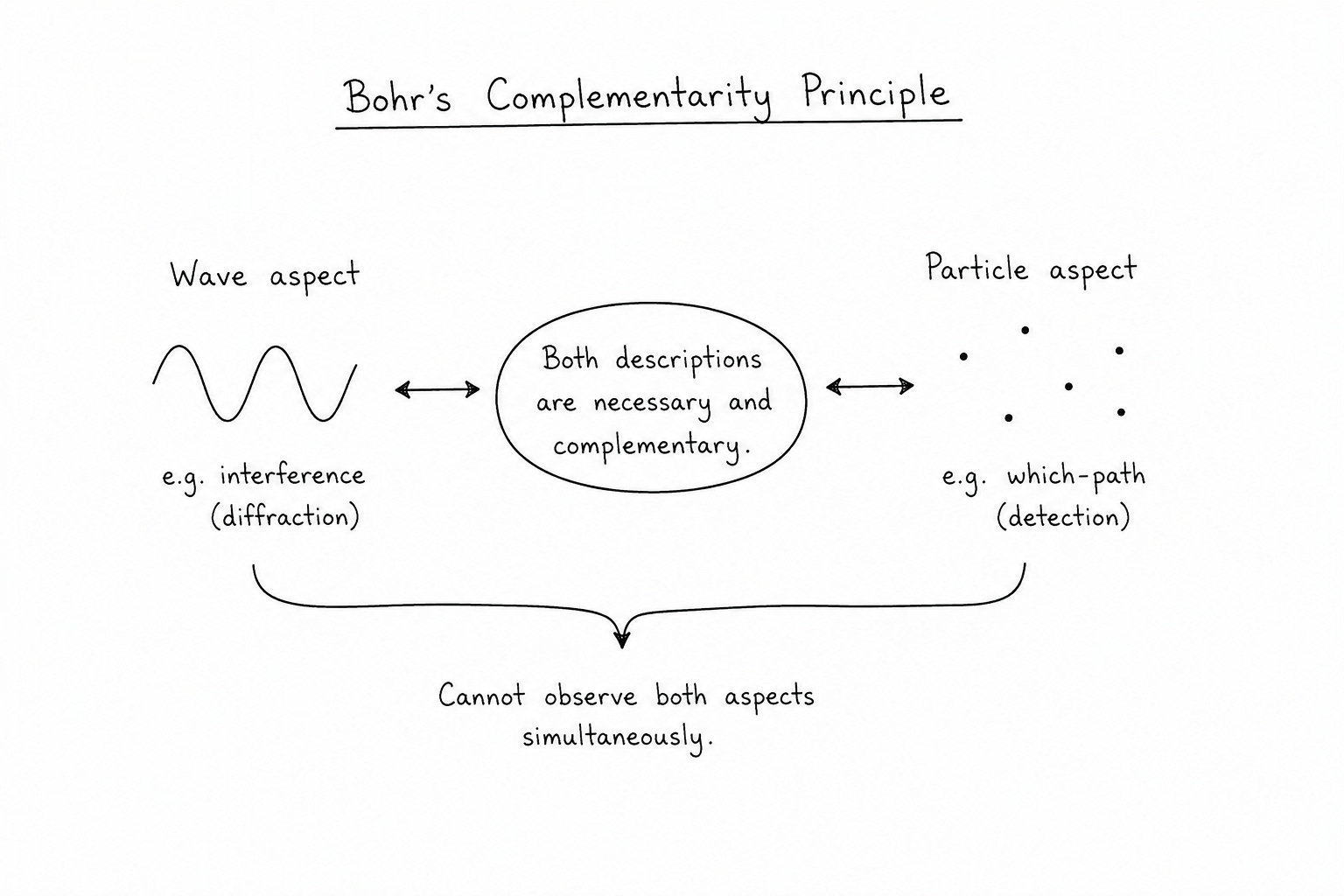
Bohr introduced the Principle of Complementarity to resolve the wave-particle duality paradox. He argued that ‘wave’ and ‘particle’ are classical concepts that we use to describe our experiences, but they are mutually exclusive descriptions of the same underlying quantum reality.
An experiment designed to look for wave-like behavior (like the double-slit experiment) will reveal wave properties (like interference).
An experiment designed to look for particle-like behavior (like the photoelectric effect) will reveal particle properties (like a localized hit on a detector).
According to Bohr, you cannot observe both simultaneously because the experimental apparatus itself is inextricably linked to the quantum system. The properties we measure are not properties of the isolated particle; they are properties of the interaction between the particle and the measuring device.
Now consider Heisenberg’s Uncertainty Principle, often written as:
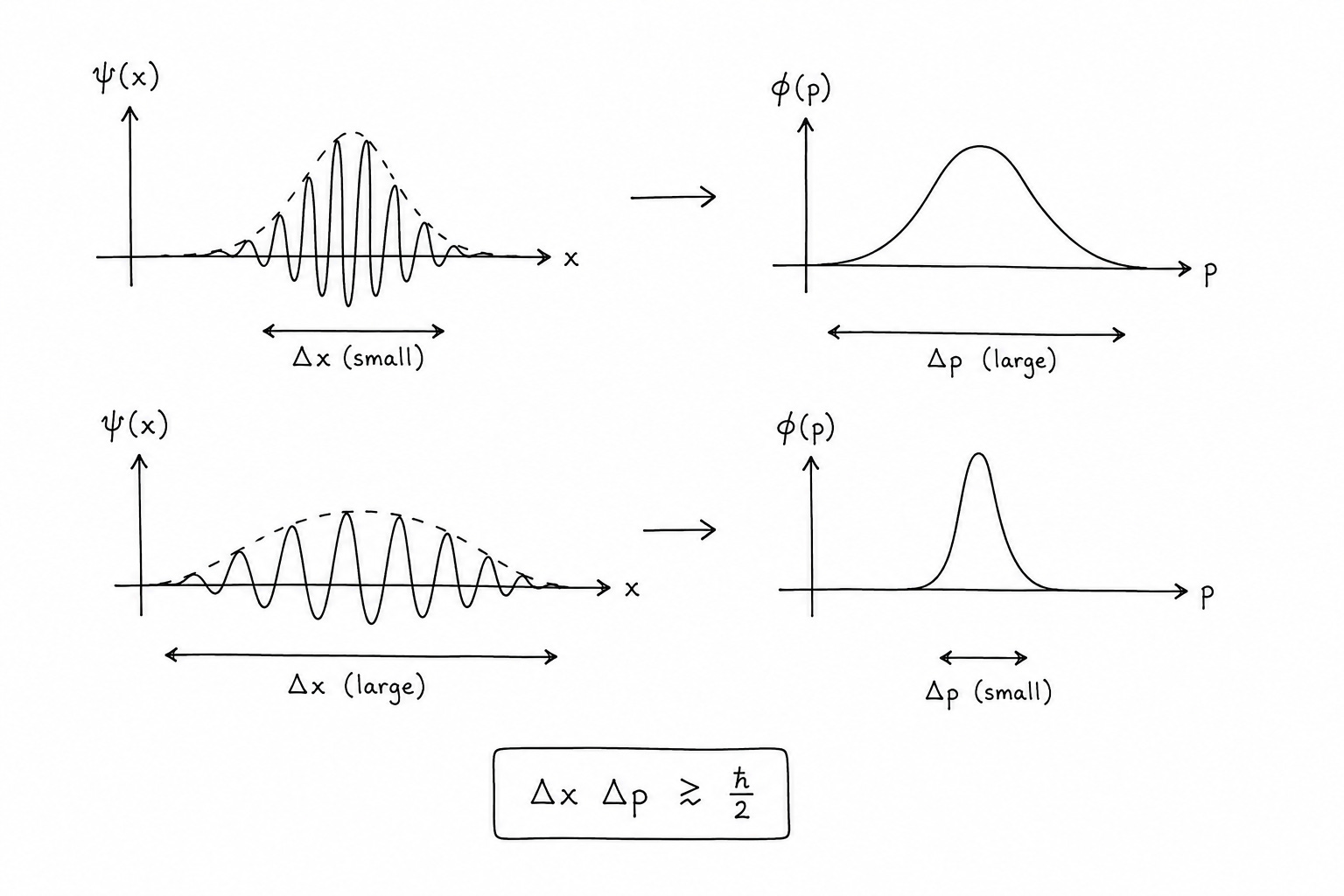
\(\Delta x \cdot \Delta p \ge \frac{\hbar}{2}\)
A common misconception is that this is a limitation of our instruments—that bumping a particle with light to measure its position (x) inevitably disturbs its momentum (p).
The Copenhagen interpretation explicitly rejects this disturbance explanation as the fundamental cause. It states that the uncertainty is a fundamental property of nature. A quantum particle does not possess a well-defined position and a well-defined momentum simultaneously. If you prepare a state where the position is highly localized (small Δx), the concept of momentum becomes inherently fuzzy and undefined for that state (large Δp), regardless of how perfect your laboratory equipment is.
This post is public, so feel free to share it.
If classical physics is wrong at the atomic level, why does it work so perfectly for baseballs, planets, and steam engines?
To solve this, Bohr formulated the Correspondence Principle. It states that:
Quantum mechanics must reproduce the predictions of classical physics when the system becomes large.
Specifically, as the quantum numbers (n) become very large, or when you look at a macroscopic system containing trillions of particles, the quantum fluctuations average out, and the strange, probabilistic equations smoothly transition back into deterministic, classical laws.
The principle proves that Copenhagen doesn’t create two separate, warring universes. Instead, it shows that classical reality is simply the grand, large-scale limit of an underlying quantum reality. It gave physicists the confidence that they were just widening the scope of physics without breaking it.
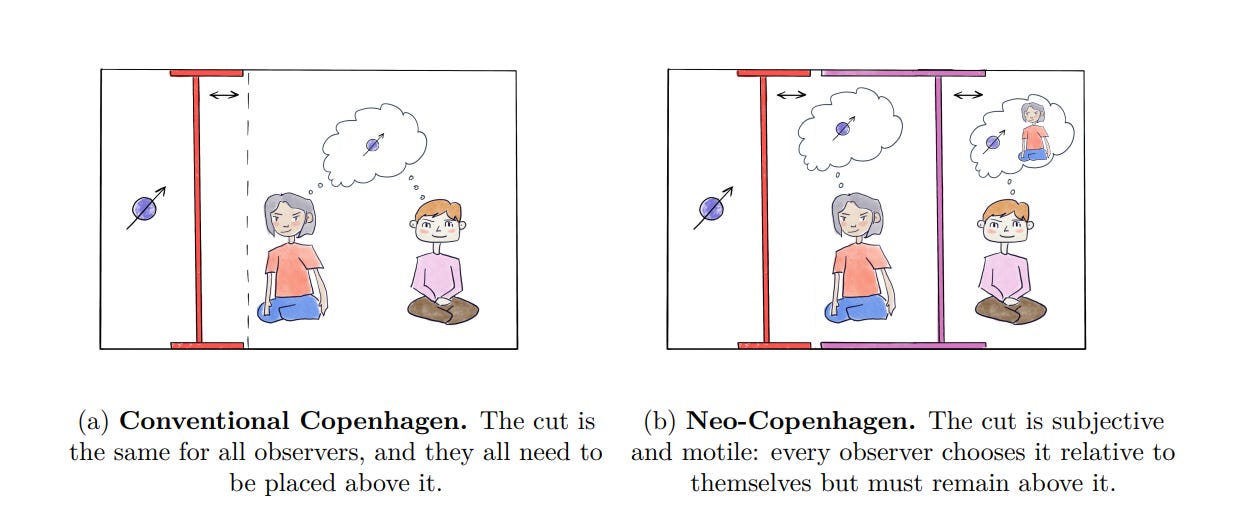
One of the most debated aspects of the Copenhagen interpretation is where quantum mechanics stops and classical physics begins. This boundary is known as the Heisenberg Cut. The Correspondence Principle provides the logical justification for this cut.
Copenhagen requires the existence of a macroscopic world. To make a measurement, you need a classical apparatus (a pointer, a digital screen, a clicking Geiger counter) that obeys classical physics and records permanent, irreversible data.
System is governed by quantum mechanics (superposition, wave functions, etc.).
Apparatus/Observer is treated as classical.
When the quantum system interacts with the classical apparatus, the measurement is complete, and the wave function collapses.
Now, where exactly do you place this cut?
Copenhagen is intentionally pragmatic about this. You can place the cut wherever it is convenient, as long as the measuring device is large enough to be treated classically. It doesn’t mean Bohr believed macro-objects are exempt from quantum laws; rather, he believed that to practice physics at all, we must assume a stable, shared classical reality from which we report our data.
Because the Copenhagen interpretation defies classical intuition, it sparked fierce resistance, most notably from Albert Einstein and Erwin Schrödinger.
Schrödinger actually designed his famous cat thought experiment to mock the Copenhagen interpretation, not defend it.
Imagine a cat sealed in a box with a radioactive atom, a Geiger counter, a vial of poison, and a hammer.

If the atom decays, the Geiger counter triggers the hammer, breaking the vial and killing the cat. If the atom doesn’t decay, the cat lives. According to the Schrödinger equation, after one hour, the atom is in a linear superposition of decayed and non-decayed states:
\(\psi = \frac{1}{\sqrt{2}} (\psi_{\text{decayed}} + \psi_{\text{not decayed}})\)
Because the cat’s fate is entangled with the atom, the Copenhagen interpretation, if applied blindly without a ‘cut’, suggests that until the box is opened, the cat is in a macroscopic superposition of being both alive and dead at the same time.
Copenhagen’s Response: Bohr and his contemporaries would argue that you don’t need a human to open the box to collapse the wave function. The Geiger counter is a macroscopic, thermodynamic device. The moment the alpha particle interacts with the gas inside the Geiger counter, an irreversible, classical recording event occurs. The Heisenberg cut is crossed inside the counter itself, long before the poison or the cat is involved. The cat is never in a superposition.
Albert Einstein famously declared:
“God does not play dice with the universe”
and spent his life looking for ‘hidden variables’—underlying, deterministic rules that quantum mechanics was simply missing. In 1935, Einstein, Boris Podolsky, and Nathan Rosen proposed the EPR paradox.
Imagine a source that emits two entangled particles (A and B) with opposite spins, moving in opposite directions. If you measure the spin of A along the z-axis and find it to be |↑⟩, the wave function collapses, and you instantly know B must have a spin |↓⟩, even if B is light-years away.
Einstein argued that because no signal can travel faster than light (locality), B must have had a |↓⟩ spin all along. Therefore, the Copenhagen view that the state was undecided until measurement must be incomplete.
Copenhagen’s Response: Bohr countered the EPR paradox by asserting that an entangled pair of particles forms a single, non-separable quantum system with no independent realities prior to measurement. While Copenhagen maintains that physical signals cannot travel faster than light, it accepts this fundamental non-separability. Therefore, measuring particle A doesn’t "send a signal" to particle B across space; rather, the act of measurement instantaneously defines the properties of the entire system as a holistic unit.
Decades later, John Bell developed his mathematical inequalities, and subsequent experiments proved Einstein wrong: local hidden variables do not exist. Nature genuinely decides the outcome at the moment of measurement.
Bohring is entirely reader-supported. The deep-dive physics series and philosophical essays are made possible by the “Deep Divers”—the paid community members who value independent science communication.
If you’re currently on the free tier, consider upgrading to a paid subscription to unlock exclusive deep dives, archives, and chat:
The philosophical position of the Copenhagen interpretation shifts the goal of physics away from defining “what reality actually is” to “what we can reliably say about nature based on observation.”
In case you are unfamiliar:
Realism is the classical view that physical objects possess definite, intrinsic properties that exist independently of whether anyone is looking or measuring them.
Instrumentalism is the view that a scientific theory or mathematical equation (like the wave function) is not a literal description of an underlying hidden reality, but merely a tool used to calculate and predict observations.
Positivism is the philosophical stance that a physical theory should strictly limit itself to quantities that can be directly observed or measured, treating speculation about unobservable truths as scientifically meaningless.
So, what is the electron doing when we aren’t looking at it? According to the Copenhagen interpretation, this question is unscientific and meaningless. Because you cannot test or observe an unmeasured system, speculating on its objective reality is a philosophical dead end.
Physicist David Mermin later summarized this pragmatic attitude with the famous phrase: “Shut up and calculate.” Don’t worry about the underlying metaphysics; the mathematics works, the probabilities are accurate, and it successfully predicts the behavior of semiconductors, lasers, and particles.
For decades, physics did exactly that. But as we will see in the rest of this series, not everyone was content to keep quiet. The alternatives to Copenhagen would challenge our view of reality in even wilder ways.
Thank you for reading. If my reflections on life or physics resonated with you today and you’d like to support my independent writing without committing to a monthly subscription, you can drop a small tip in my digital jar. It keeps me motivated.
Next Time…
We will discuss the Statistical Interpretation of Quantum Mechanics.
You Can Also Read:
Comments
Nothing yet. Say the first thing.
Sign in to join the conversation.