
Words: Eilidh Duffy
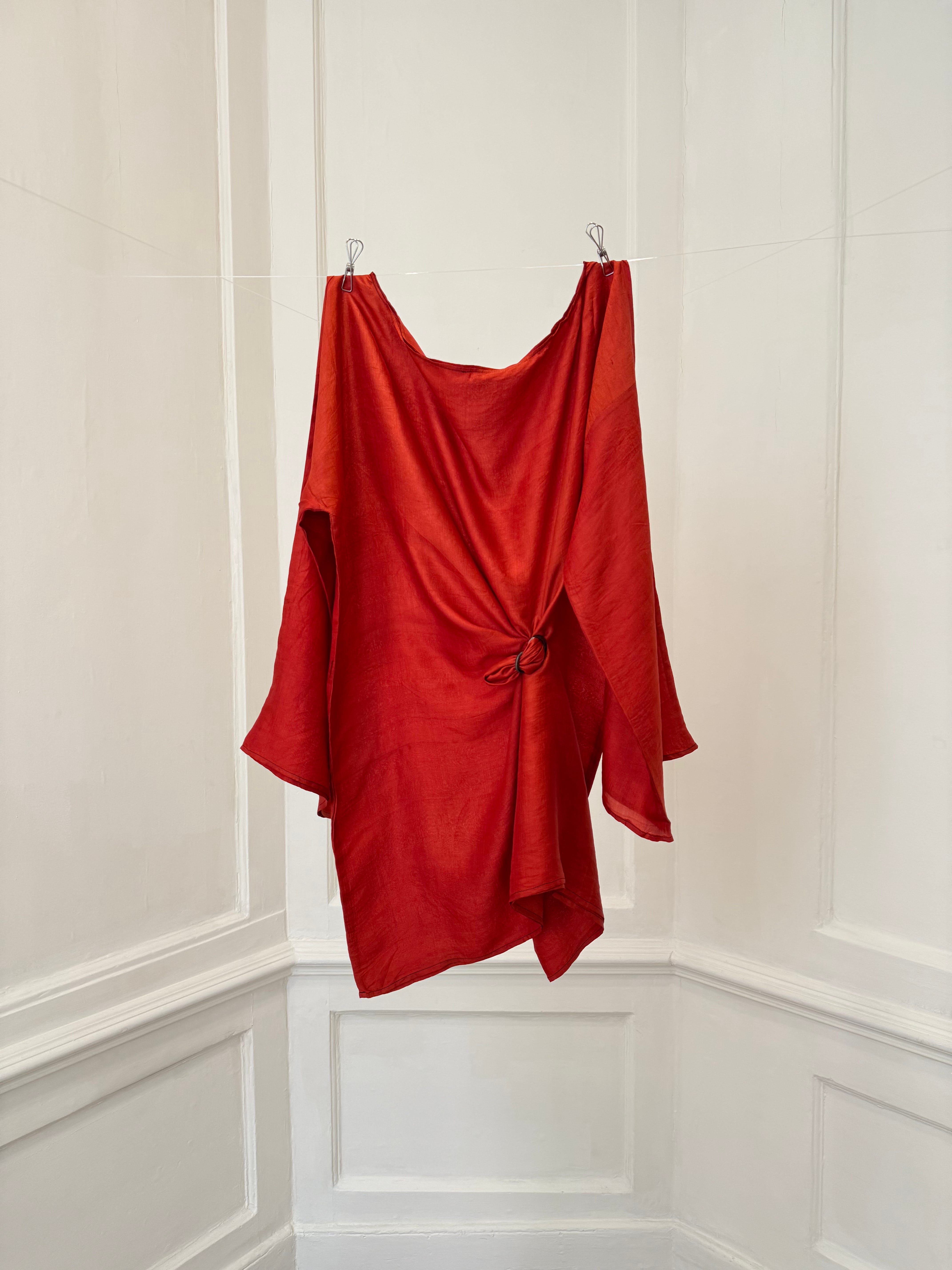
“It’s the least finished word, and it kind of looks like stitching – you can have it go on and on and on and on.” I’m with Minna Bunting on the ground floor of a grand townhouse just off Soho Square on Wednesday morning and she is explaining the idea behind the name of her new label. Light and air stream in from two heavy sash windows, illuminating a zig-zag bunting of ecru, azure, chocolatey black, and terracotta silks. Except, actually, it’s not bunting, but large, languid pieces of draped, modular fabrics, some with sleeves and some without, others just big rectangles with a couple of slits.
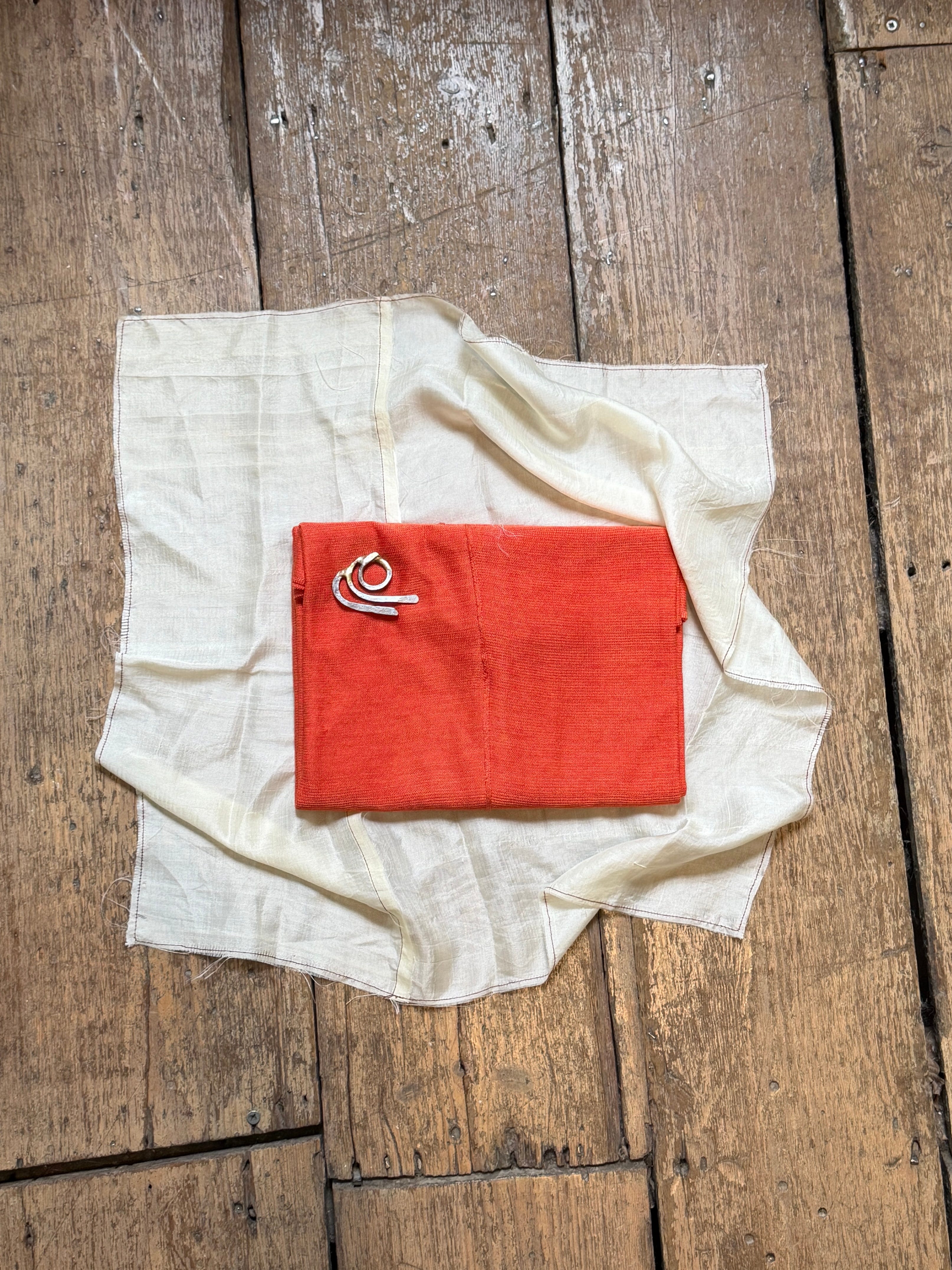
These are the designs that make up Etc.’s first offering to the world, a tight set of nine shapes, all based upon rectangles and squares. There are tunics, vests, and wraparound dresses woven in West Bengal, dyed on a rooftop in Jaipur, then minimally cut and sewn before being shipped directly to the showroom. There are knitted pieces, too. Little tabards and skirts, made in Italy from lush Japanese silk yarn. Differences between one shape and another might be the addition of a half sleeve, or full sleeve, or the length of the front and back panels. The pieces are gloriously simple: it’s clothing that has been reduced to the fewest elements possible, with the distinct purpose of remaining infinitely changeable. Just like the term, et cetera.
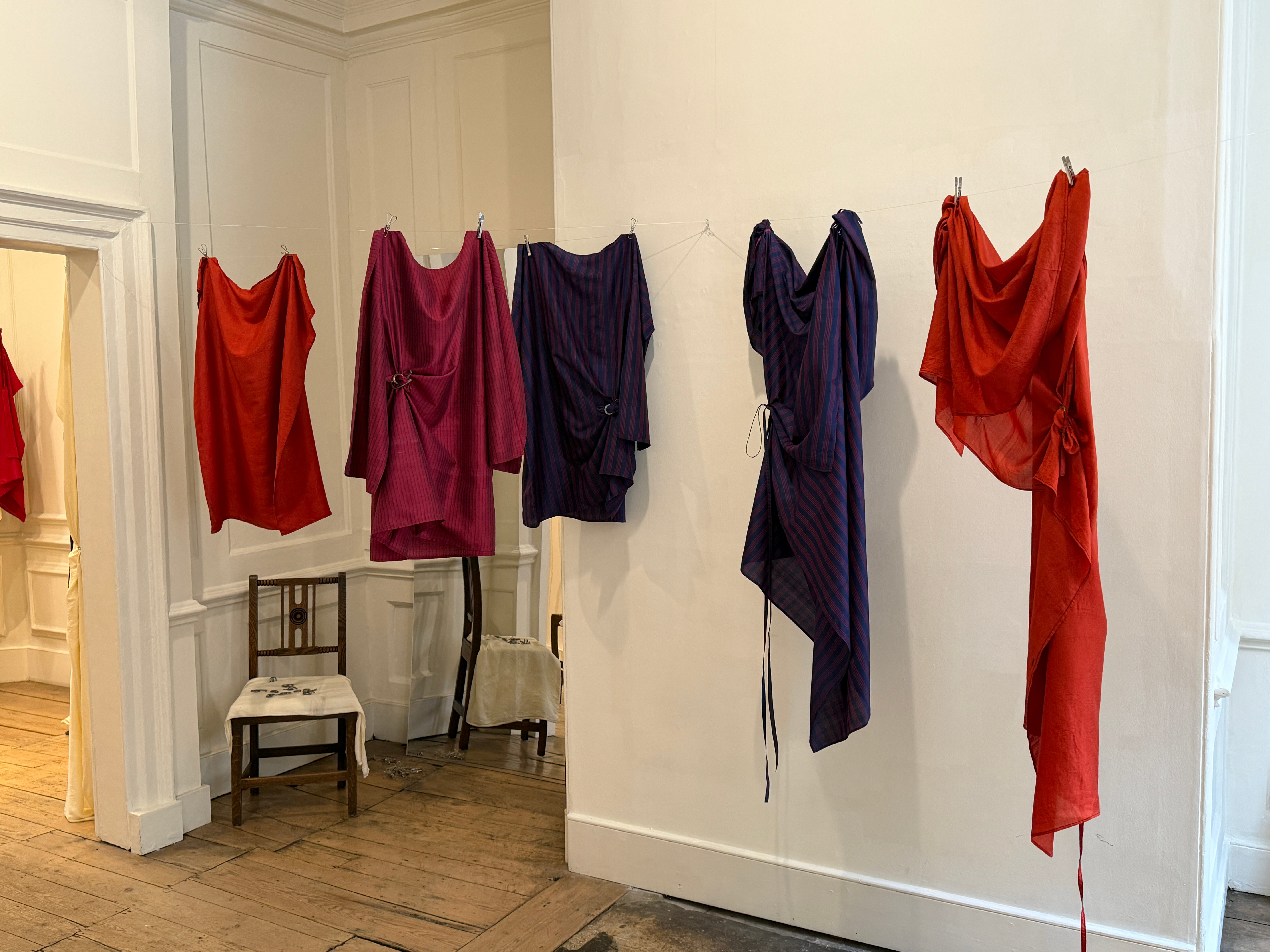
For the past few weeks Minna has been at 60 Frith Street sharing the last two years of her work for the first time. The space itself, usually Frith Street Gallery, has been loaned to her for the month, with the addition of scenography by a friend, Sarah Bakarat of Also Associates. The intervention in the space is minimal. Transparent wires criss-cross across two rooms like clothing lines in Neapolitan alleyways. The only furniture on show are a couple of chairs and a few mirrors which, without backing, have slowly been hunching over into themselves, warping their fronts and gradually altering their reflective capacities.
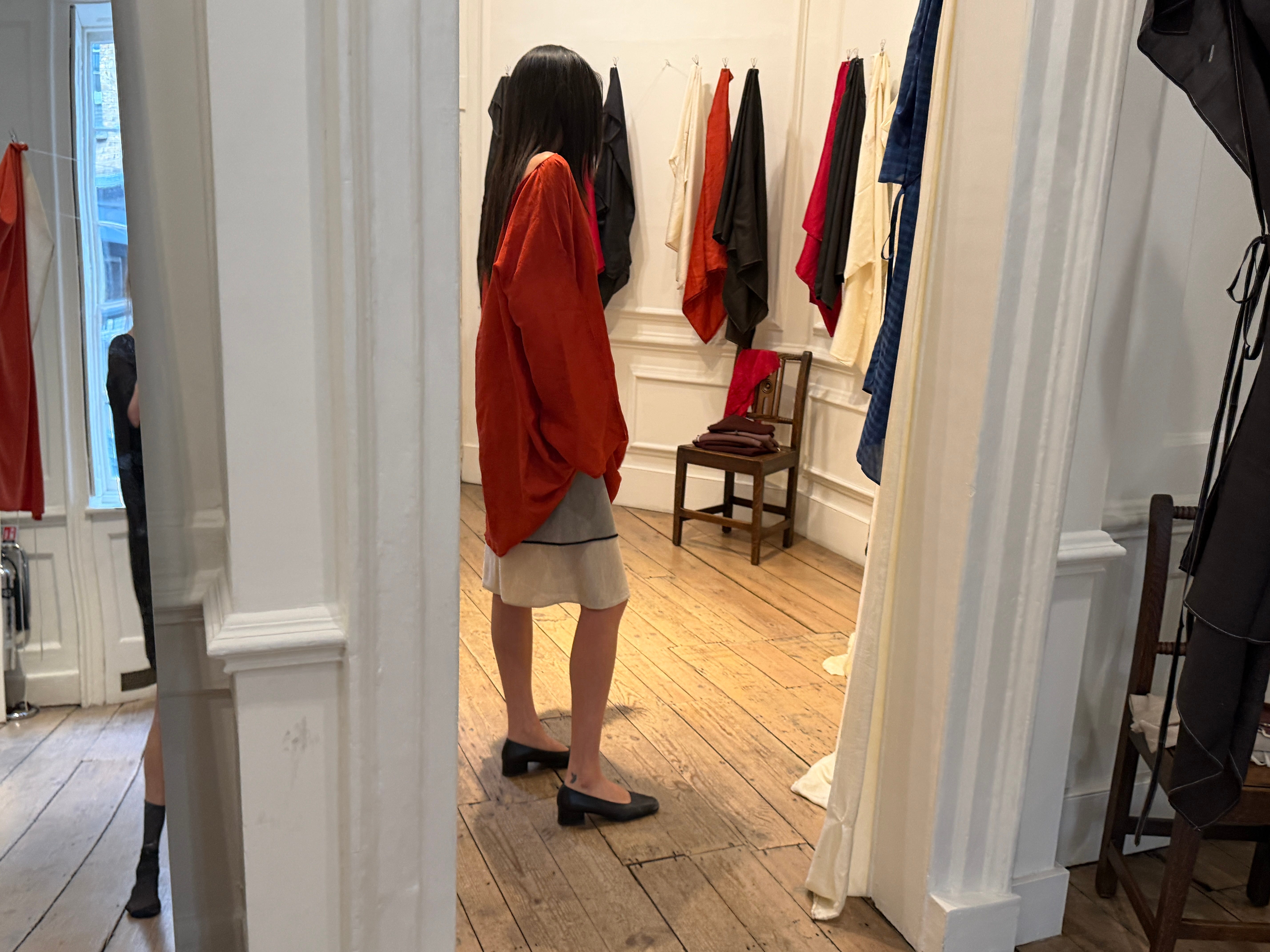
I’d first visited Minna a week before and stayed for nearly three hours, unclipping pieces of silk lolling from the clothesline, wrapping them round my body and, due to the mirror situation – which, if Minna hadn’t apologised about, I’d have thought was very conceptual and deliberate – attempting to tune into how they actually felt to wear. They all felt insane, kind of like wearing liquid air, and I left with a butter yellow tunic I’ve been wearing almost every day since.
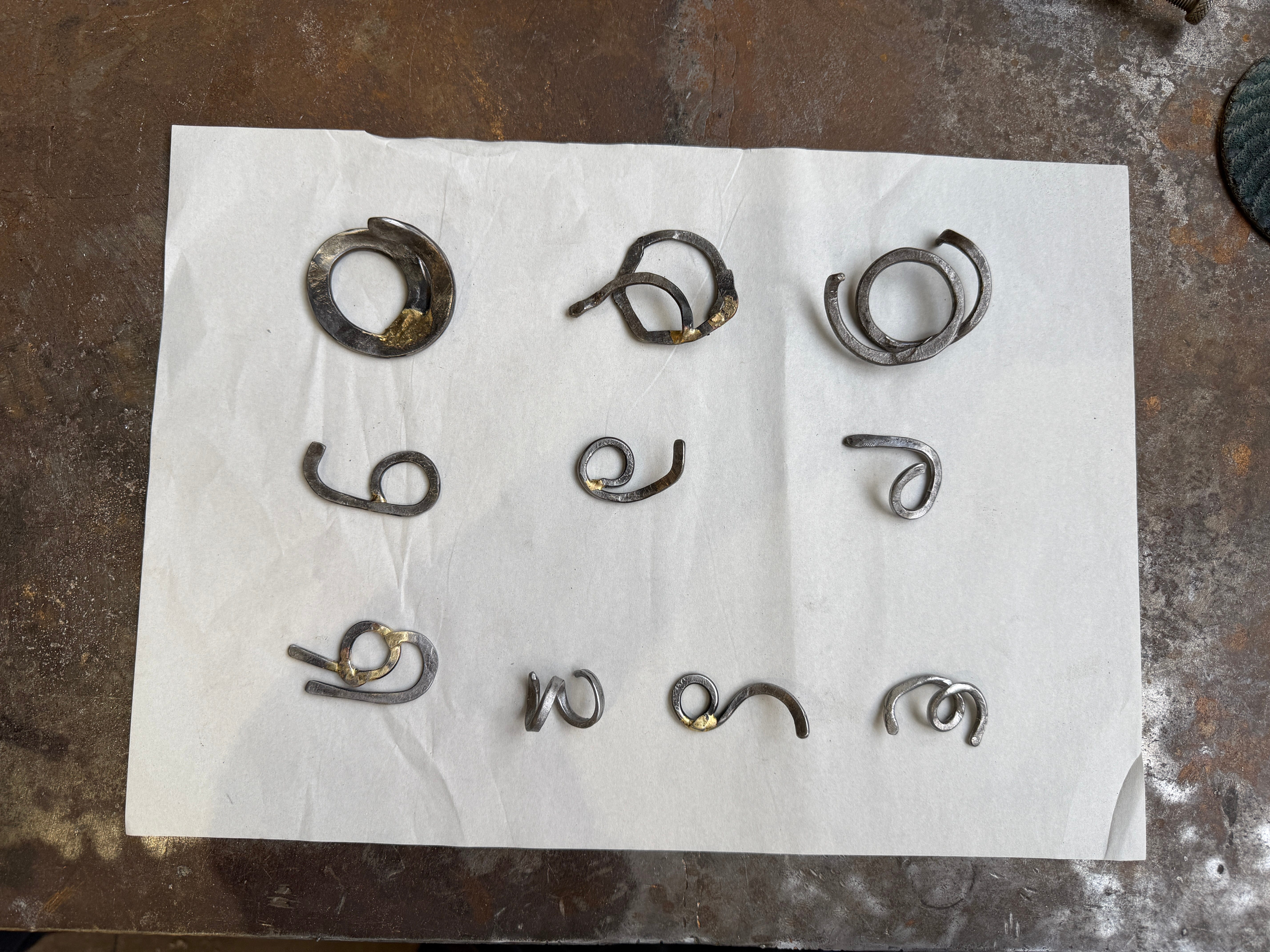
The only materials that give any aesthetic suggestions away, aside from the garments themselves, are a handmade book documenting the designs and their variations, and the block printed label on the garments themselves. “I really don’t want people to have a preconceived idea of how they should look,” Minna explains the lack of imagery to accompany the label’s debut. “A lot of this project is about intuitive dressing, and seeing the body as an instrument that knows what it wants – getting people to tap into that headspace rather than being given something and told how to wear it.”
Minna cut her teeth in fashion at an underwear label she co-founded with a friend in 2017 which she eventually left at the end of 2023. After a short break, during which she swore off the rag trade forever, she heard through a couple of friends about a course being hosted in Jaipur taught by Susan Cianciolo, artist and former designer of legendary New York label RUN. It changed Minna’s whole perspective on making, and sparked the initial idea for Etc. In homage, tomorrow she hosts a workshop with Cianciolo, co-organised with Wonderful Workshops, who’s flown to London specially for the event.
The showroom opened almost three weeks ago, but has still managed to stay a bit of an ‘if-you-know’ kind of affair, with only 490 followers at the time of writing. But that’s just how Minna has wanted it to go. “I hate the word launch, it just makes me feel like it will go up, then down – and really you want to go like that.” She draws a gradual line in the air with her finger. “It’s been very word of mouth,” she smiles, “but that just means it’s reaching the right people.”
Eilidh: So the first thing I wanted to ask you about was what kind of training you had. Did you go to fashion school?
Minna: I have no training at all. I used to have an underwear business, and I learned design on the job. I was working with incredibly talented pattern cutters, but I was sourcing the fabric and then we were translating in the shapes together. I was dealing with such intricate garments and such small pieces. A bra can have, like, up to 48 components. So it really taught me about function and fabric. You can find beautiful vintage leavers lace, but actually there’s only certain parts in the bra where it will actually work. Underwear has to be very utilitarian, so I think I was learning a lot about that – but subconsciously. Where you need stretch, where you need rigidity. It was about the feeling of the garment on the body.
How many years were you doing that?
Seven years. Seven years of pants! I started it straight out of university.
What were you doing at university, if it wasn’t fashion?
I studied business. It’s funny because I got into an art foundation in London, and then suddenly decided I was going to travel and work for a year. Then I ended up doing business for no other reason than I felt it was broad, and I like learning about things that are real and current.
Why did you decide to enter into the rag trade, of all things?
With underwear, I actually didn’t see it as fashion. I’ve always been interested in the more psychological side of dressing. How people interact with an object. I was 22 when I started the brand, so who knows if it was actually this deep at the time, but I’m interested in how something makes a person feel. Whether it’s a bra or underwear – or a tunic.
Last time we spoke, you mentioned that when you left your last brand, you swore never to do another label. Now, three years later, you’re doing something new. What changed?
I had been feeling that the world is so full of stuff. I’d made this rule for myself, though, where I was like: if I ever make something again, I have to imagine I’m going to live with it for the rest of my life. Have it with me in my room forever. Then that was the test to see if it was good enough or not. I thought it was.
That feeling, of there being too much stuff in the world. Where did that come from?
I was actually moving house at the time, which is probably the best time to reflect on everything you have. I was shocked by the whole thing. I felt that all the clothes I owned were very specific. I had this coat for that occasion, that kind of thing. I felt like all my garments were very situational. I started thinking about why we accumulate more and more stuff, what we’re looking for when we do that, and how I was consuming. Questioning all of it. I wanted to create something that was able to transfer, that could be many different things. I think that’s what started the whole versatility side of it. This idea that the less you interfere with an object, or the more simple an object is, the more you can do with it.
I then became very interested in this idea of subtracting. How can we simplify everything as much as possible, reduce it to its most core form? And then put the design or the creation back in the wearer’s hands. Businesses need to keep selling stuff, so they’ll keep finding a reason to sell you something. I thought: what if I can create something that is so simple that it is infinitely interpretable? That’s such a beautiful thing you don’t need a billion things, you just need this one. That was how I wanted it to feel.
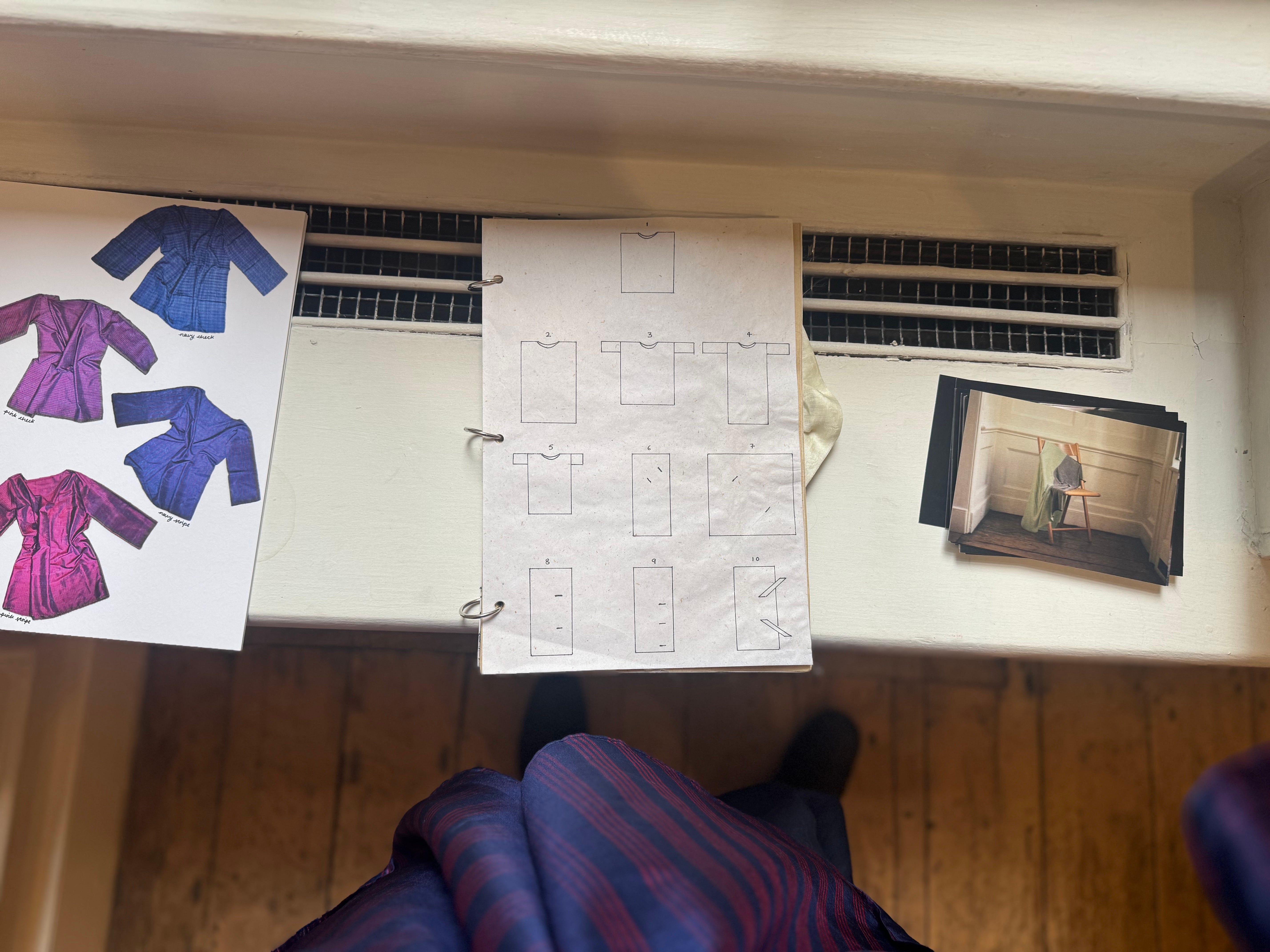
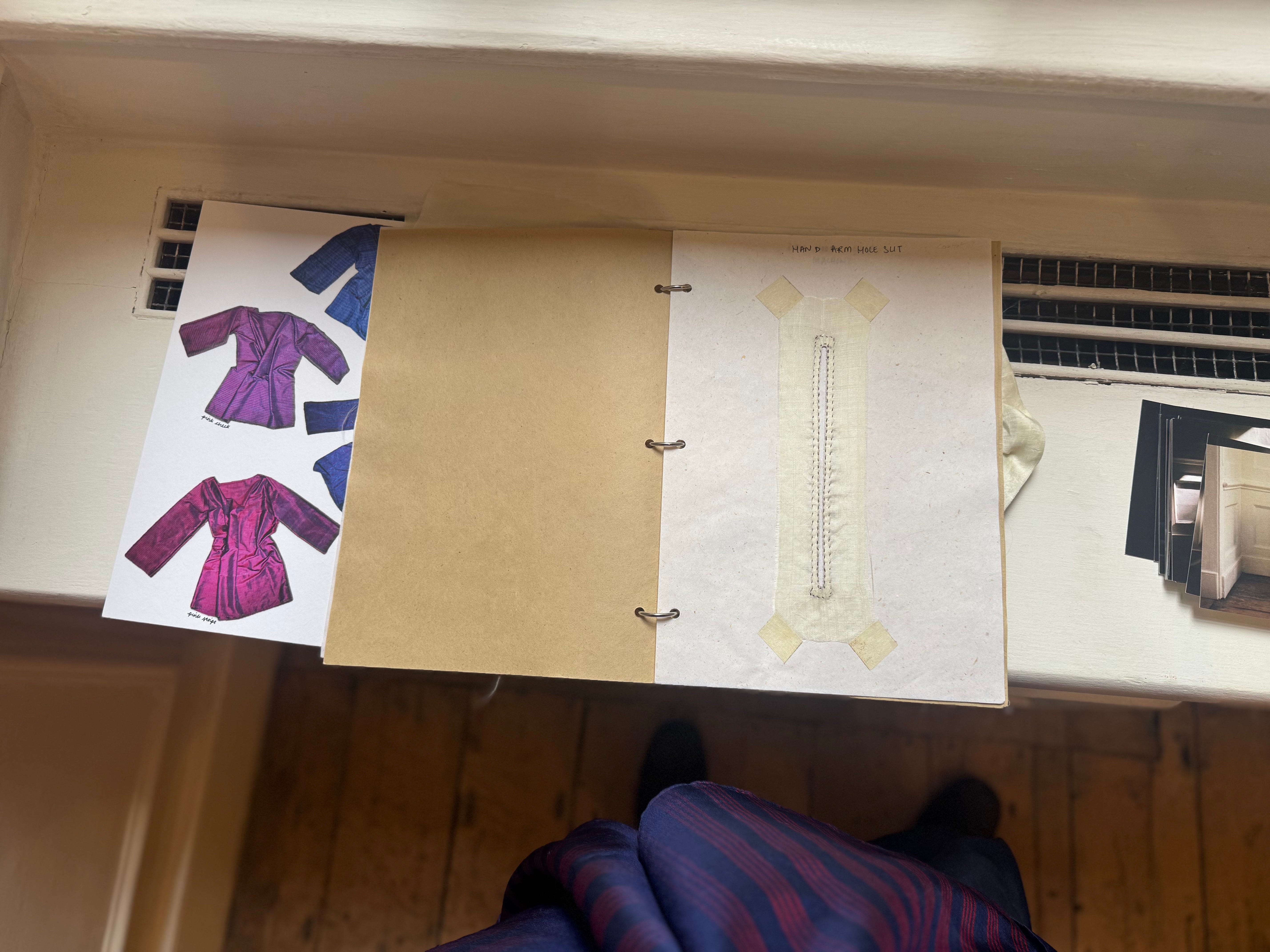
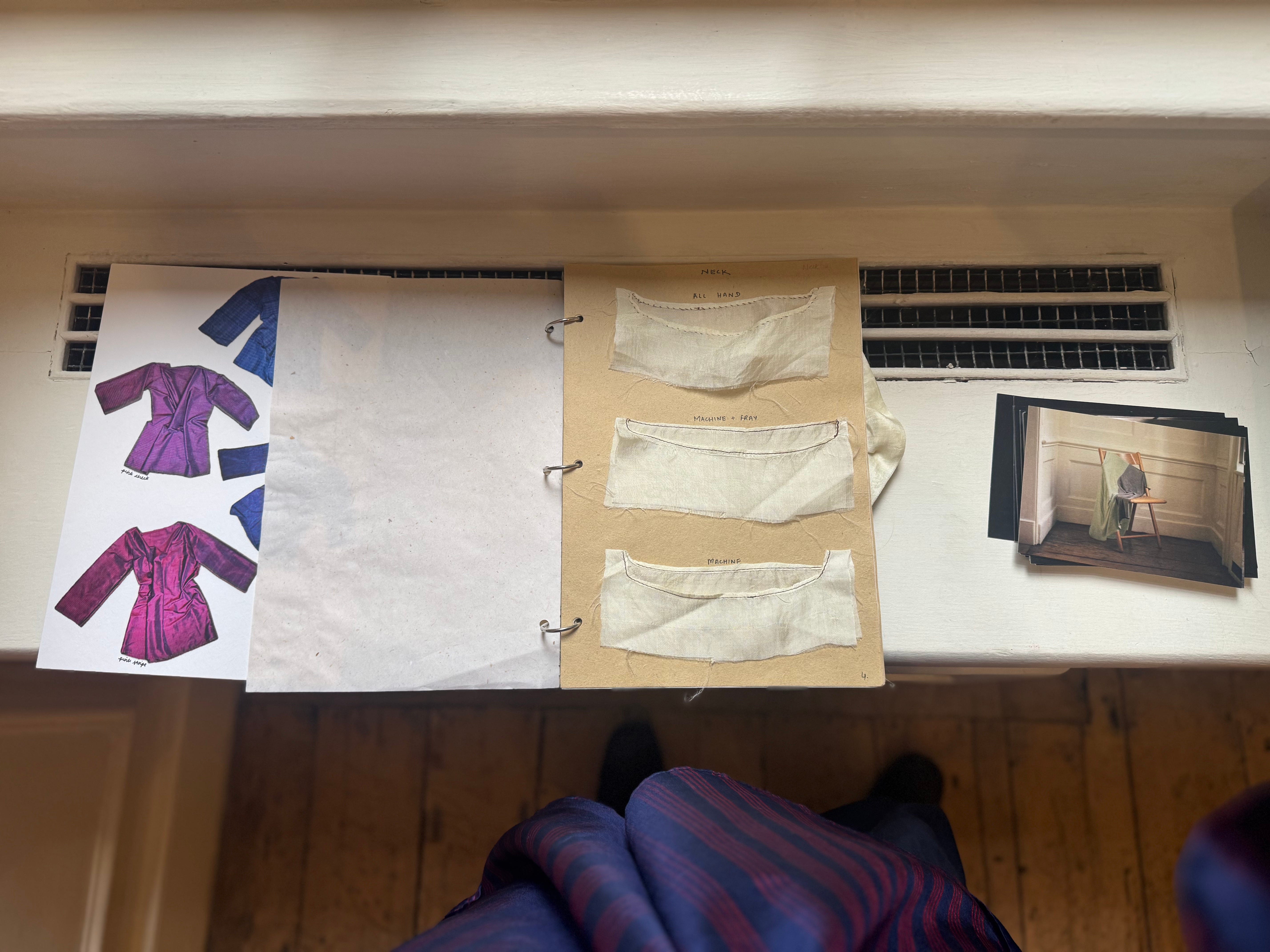
You know, there are people who look at some forms of contemporary art and are like, ‘Oh, I could do that!’ And actually, in most instances it takes a lot of skill. I feel like the Etc. pieces are similar. They are all based on rectangles and squares, and maybe someone could just pick up a piece of fabric and do a more DIY version, but they are also very precise and they have a lot of very distinctive character. How did you land on these exact shapes?
For the first four months or so I just played with fabric, wrapping them, knotting them on my body. I also worked with a lot of friends, seeing what silhouettes we could create. From there I worked backwards. There is a level of security and guidance people need from something, but I still wanted to have as little interference as possible.
I worked with a close friend of mine, Nicolas Mezes, who’s an amazing designer, and we literally sat on the floor for months, testing how little we could interfere with the fabric. We were looking for the minimum amount of intervention in this rectangle, so that people could make a silhouette easily, but still have freedom with it. Some days we thought it was genius, other days we were like, ‘It’s just a fucking square!’ Patience was a huge part of it.
Cut-wise, we’ve approached it with this attitude of working with cloth rather than against it. But it requires such skill to work with this kind of silk. It’s so slippery. So I work with a man called Somya and his tailor Ramdayal Ji and seamstress Veer Singh in Jaipur to cut and sew the pieces.
The design itself is very much based on historical design. I was really interested in this idea of what clothing design was before ‘references’, when people were creating for solely utilitarian purposes. How did they make that garment?
That’s probably the most Bog thing you could possibly say.
Right! There’s something very primal about it, which I also find super exciting. You can obviously see the silhouettes are incredibly simple, and so there’s an element to this project where you need to directly interact with it and play with it. I felt like a sense of familiarity was probably important in order to encourage people to work with the garment too. In a weird way, I also wanted people to feel that even if they can’t actually buy my pieces, maybe they can go and make something. If someone wants to copy it, I think that’s cool.
Ok so I have to know – what kind of historical periods were you actually looking at?
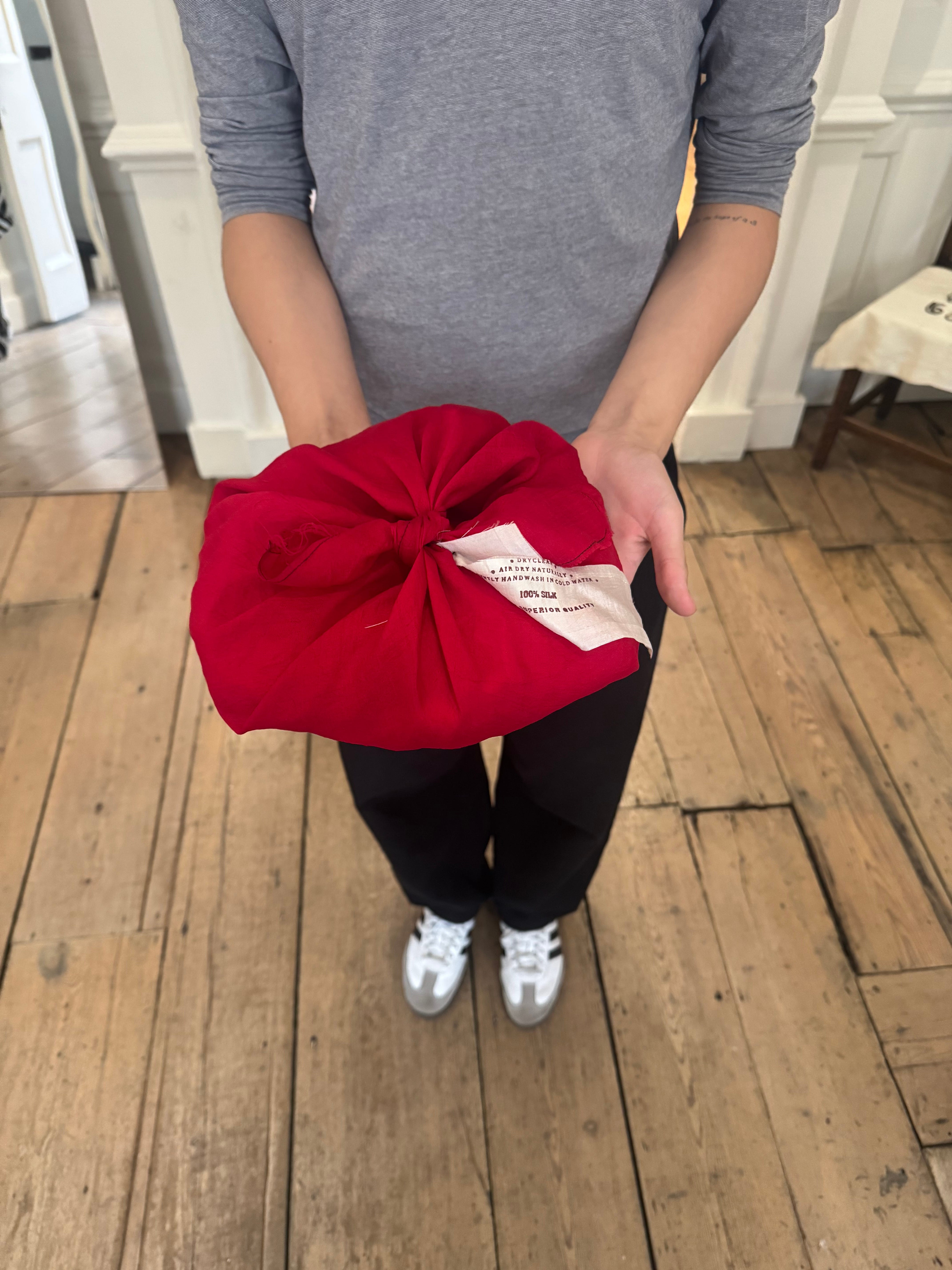
I have this book on Ancient Egyptian garments. On the front of the book is a tunic. It’s one of the oldest garments ever discovered. And it’s kind of a dress but also not a dress. I just thought: ‘that’s it.’ That’s as far as I would go with actually designing something. I didn’t want there to be an inside, outside, front, back, anything like that. I actually don’t see myself as having designed anything, really. It’s almost just reimagining something that already exists. Most of my efforts have been put into developing the textiles.
It also sparked this idea in me that everything can be derived from a square. It’s zero waste, because as soon as you start adding curves, you have fabric that is redundant. And I was really looking at the positionings of armholes – they’re not meant to sit right on your shoulder, they should be able to let your armpit breathe and so be a bit further away. There’s something incredibly relaxing about treating garments as shapes with dimensions or rectangles or squares. They’re uncomplicated.
When I was in Jaipur, I remember a woman described fabric as having nine lives, and she said, you know, it can start as a garment, it can end up on cattle, you can swaddle a baby in it, and then it can end up as a dish rag. When she said that, it changed everything for me. This idea of versatility and endless resourcefulness.
Now we’re on the subject of Jaipur, how did you end up at the workshop with Susan that led to you designing again?
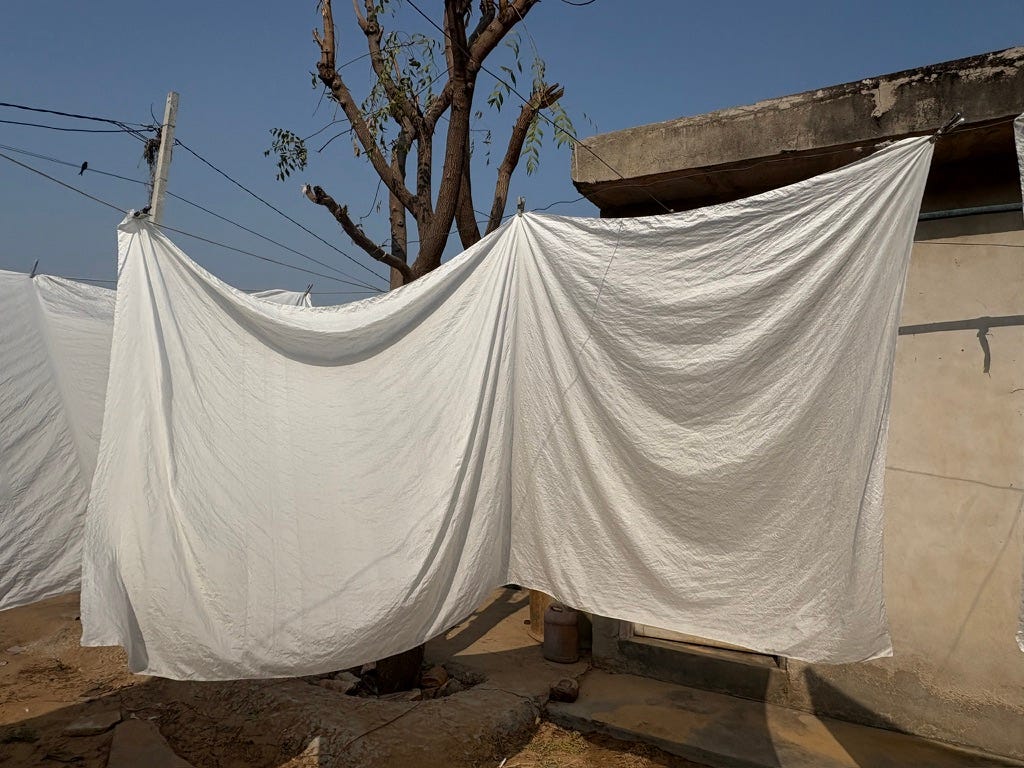
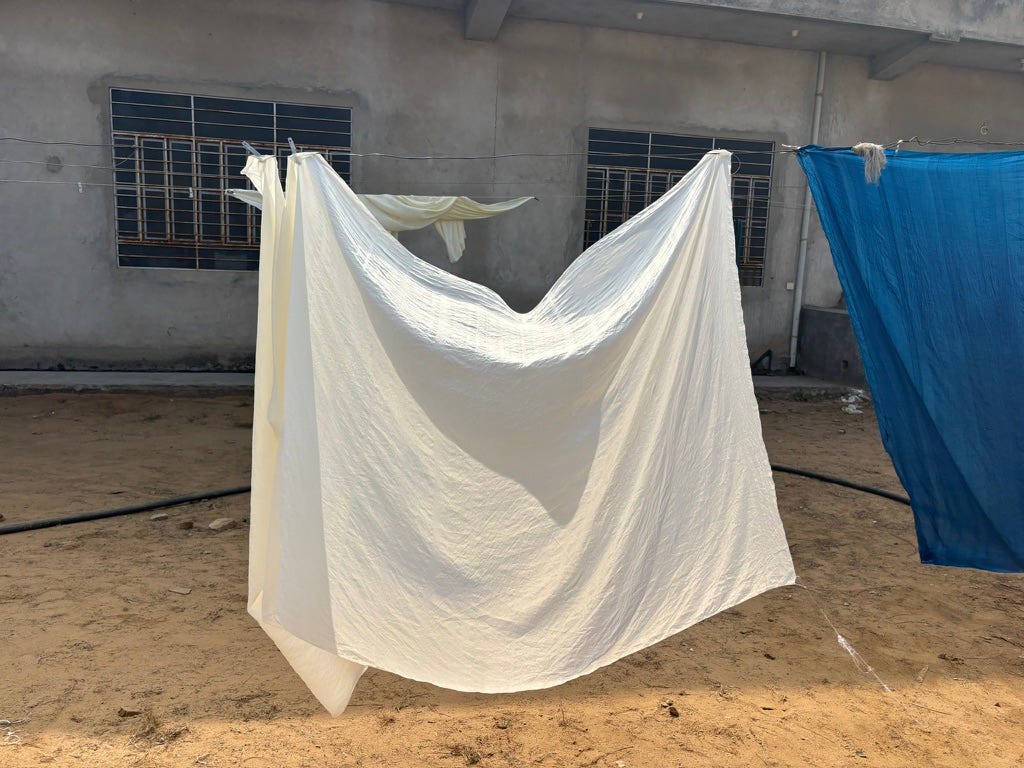
A friend had shared it with me online, and then that week I bumped into three friends over from Barcelona who, totally by chance, had signed up to the workshop. I had no idea what it was but had a really good feeling about it. Because it was with Susan, I was happy to go in quite blind. It was all about reimagining textiles. The workshop kind of included everything from Ayurvedic dyeing to weaving with local artisans.
Susan has been incredibly influential to me, of course. Both her as a person and her work. The way she makes and displays things is incredibly approachable. People feel that they can join in. I hope that the narrative around the garments is not just like, ‘Where is that from?’ I also hope people ask, ‘How did you do that?’ Skill sharing or a language rather than a branded thing.
Let’s talk about the textiles.
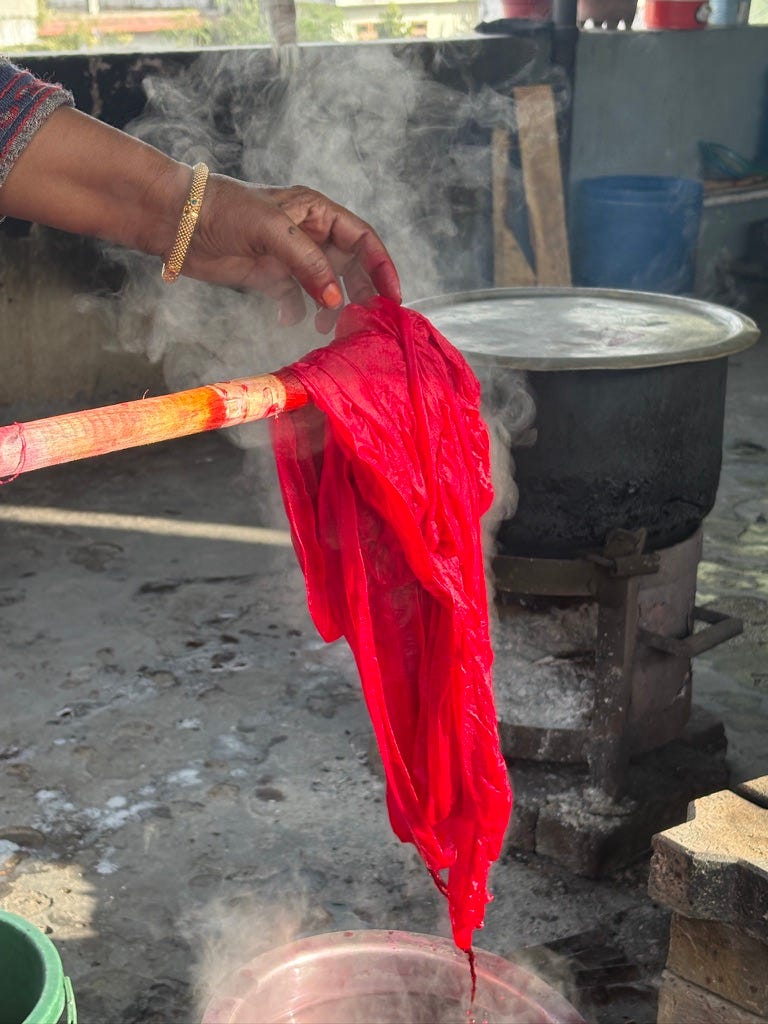
All the weaving is done in West Bengal, then all the dyeing is done in Jaipur. My dyer Zubaida Ji does all her dyeing on her rooftop in Jaipur. She is the coolest lady. I can’t speak Hindi, she can’t speak English, but we communicate through body language. She works a lot with hand dyeing and natural dyes. I also did some dyeing in Bagru with an amazing guy called Deepak. I spent days there with him perfecting the colours. I also worked with some artisans who specialise in a specific technique, where they wrap string around the fabric and dye it, then remove it.
And how did you connect with these artisans? Was it like word of mouth?
Stella, my fairy godmother who runs the workshops in Jaipur, put me in touch with them. Most of the artisans I work with have been doing this for hundreds of years. It’s very much a family tradition.
I can imagine there’s quite a lot of back and forth with the people you work with.
Yes, it’s very collaborative. You know, I’m not a designer, and the way I work with people is always incredibly collaborative. I’m working with people who know their craft so much better than I ever could. They’ve been dyeing for 40 years. So, for me, I think a lot of it was coming to understand the limitations. For example, you’ll never get the same colour match because the weather changes throughout the year. The stripes will never be absolutely perfect, the string may have broken. I love that kind of imperfection.
*The Etc. showroom is at 60 Frith Street and has just been extended until the 12th of July. Usual hours are Tuesday-Sunday 12.30-7pm
Ciao for now!
Want more?
Comments
Nothing yet. Say the first thing.
Sign in to join the conversation.