
Body Type is the newsletter for people who think about their bodies a lot, but in a smart way. Here are my most popular posts.
➡️ Follow me on Instagram.
➡️ Pre-order my book, The Forever Project.
I watch this video and feel my brain matter leaking from both eardrums:
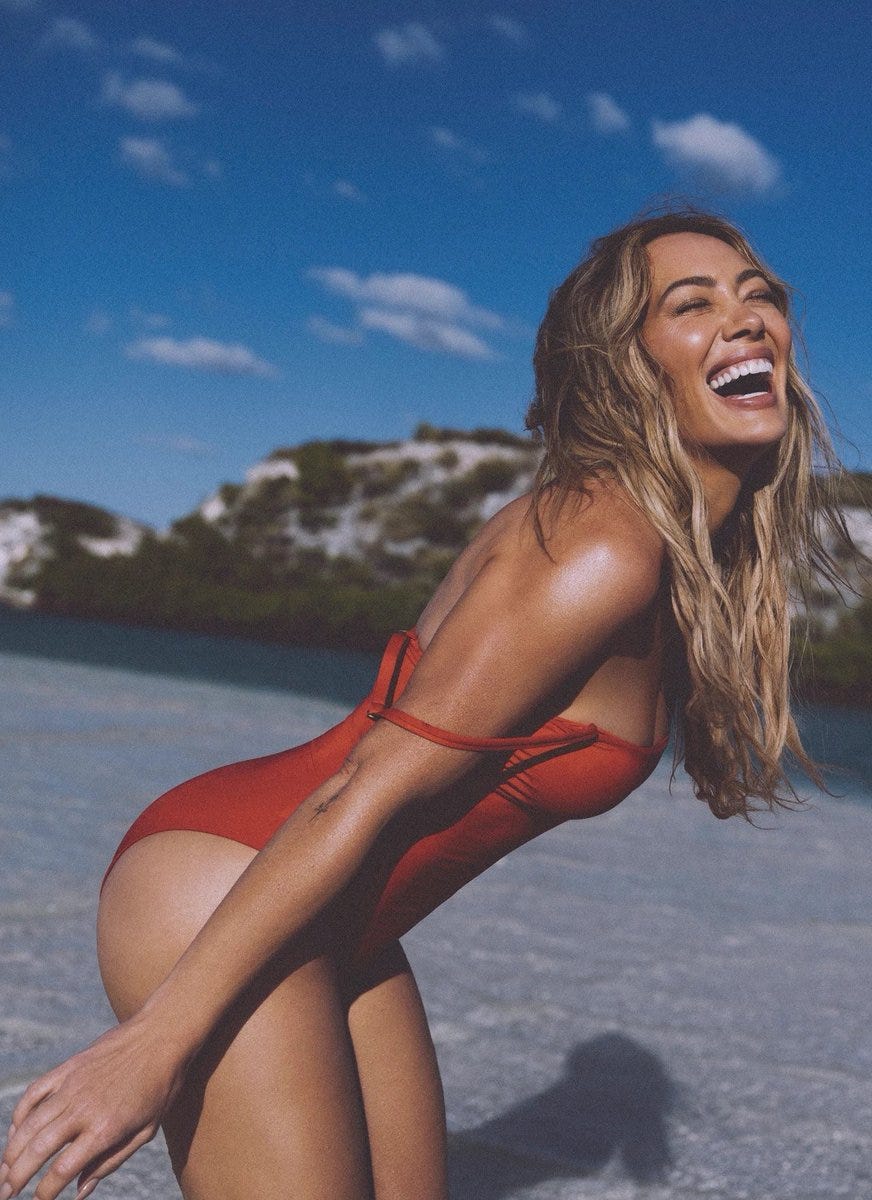
“Skinny is everywhere” — so here’s a picture of a woman who is objectively small, slender, slim, and lean, to counteract that. This, it is increasingly suggested to me, is something radical. Some of the commenters are also not entirely buying it:
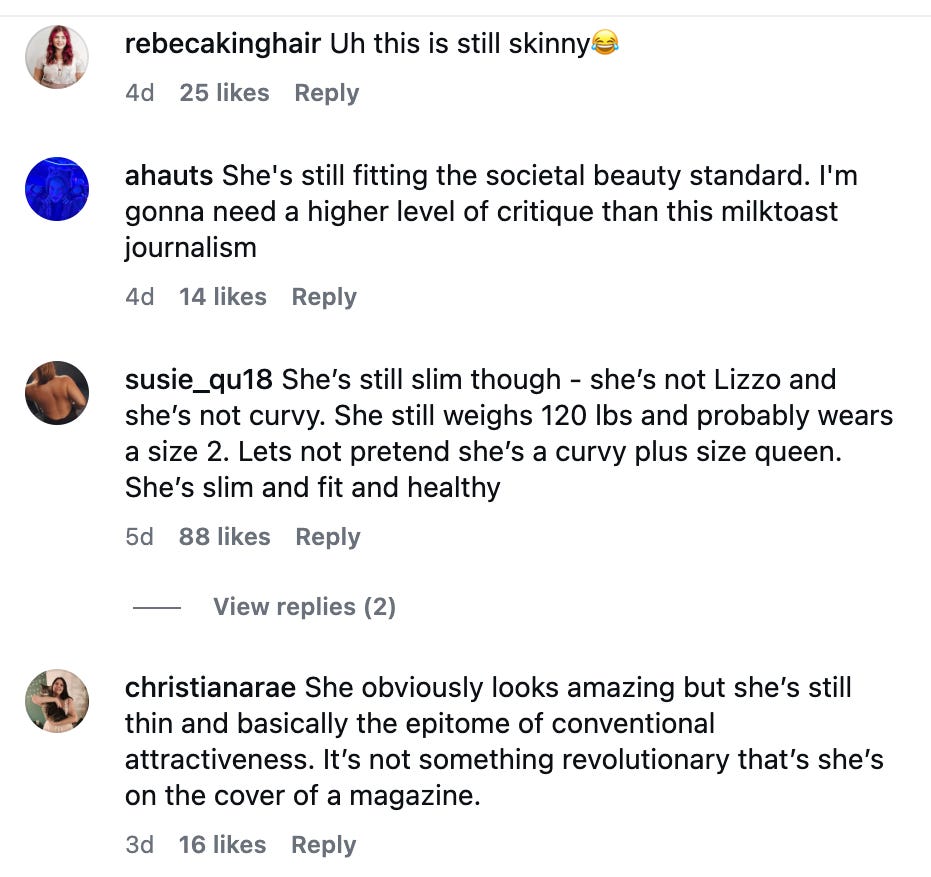
Look, I get that there’s a difference between slim/slender/thin and emaciated, which is what influencers like Dani are decrying. Good! She also says that Hilary Duff pushes back against the “fragile look,” which, OK, also great. Don’t want my women frail and fragile, no siree; I’m on board there.
But the entirety of the “stronger not smaller” push from Ladder — the one Hilary is the face of — seems based on the pretense that “small” is no longer a consideration for Hilary, for Ladder’s clients, for many American women at large. And yet Hilary, many of the coaches, and many of Ladder’s clients are objectively small. What gives?
(Relevant aside: Here’s an Instagram video from me — and feat. ’s research — about most Americans’ “ideal” body. Guess what: It’s slim/slender/thin, or The Artist Formerly Known as Small.)
I think some people are using this moment for some good ol’ fashioned health hierarchy positioning: We’re seeing more extraordinarily thin public-facing women lately (not good) and some women are leveraging that, even subconsciously, to say something akin to:
“Now THAT’S skinny! That’s the bad and unhealthy body standard! Whereas I — a 115-pound size 2 with visible abs — could never be accused of trying to hew to or perpetuating a body standard. I’m strong, OK1, which absolves me totally of any suspicion that I intentionally keep my body fat low!”
If shockingly thin, almost certainly unwell women are what “skinny” is, women who are clearly still slim/slender/small can make content about how bad that alleged body standard is — even though these slender content creators are what many Americans in 2026 consider the female body ideal. Many of them seem unaware of this, or unwilling to cop to it; maybe that’s because if the female body standard is allegedly harmful and toxic, what does it say about you if you fit it?
Here’s the thing, though: Striving for and attaining more muscular definition, and not being visibly starving and malnourished, does not automatically make you something other than small; and it does not absolve you of your potential desire for lower body fat or the efforts you take to achieve or maintain it. But being small or lean, or fitting a body standard, also doesn’t mean you’re doing anything wrong.
I think some influencers and fitness/wellness people are attempting to beat the “small” allegations because so many women only know of smallness or leanness as something achieved through starving or otherwise harming yourself. It’s like they want you to pay no attention to their obviously slender body because they’re afraid if you think about it too much, you’ll come to the conclusion that they must be doing something untoward to maintain it.
Of course that’s common, but I don’t believe this is always the case, and I don’t think the desire for lower body fat is necessarily something for which you need absolution. I’m no 115-pounder and if I ever am it’s because I’m a corpse, but when I was the smallest, leanest, and lightest I’ve been as an adult five years ago — 150 pounds at 5’6”, wearing a size 4 in most things, and with a body fat percentage around 20 — I was the healthiest I’ve ever been, as I define it. I was doing sane, well-programmed CrossFit and teaching indoor cycling, eating constantly and never feeling deprived, sleeping like a sedated infant, and practically rocketing off the walls with boundless energy when I woke up.
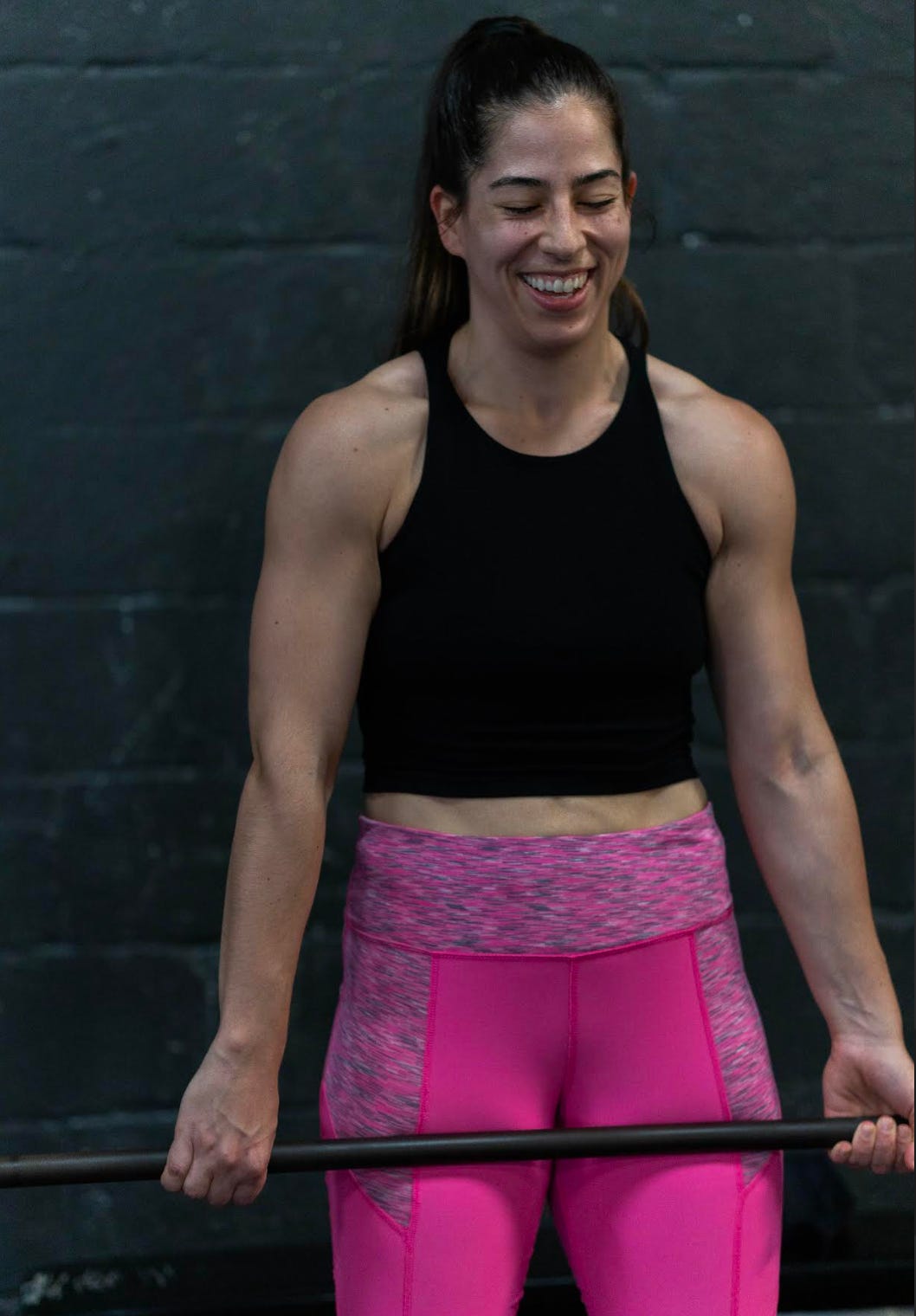
If I looked that way again right now, I wouldn’t be telling you, “No, no, I’m not lean and fit and smaller than the average woman! Can’t have you thinking that, because the only way to be those ways is to torture myself into it like a bad feminist diet culture devotee!”
No, dawg — I’d be telling you that I’m lean and fit and relatively small because my Easy Mode life made it easy to be, and I like doing what it takes to be that way (plus genetics and age, etc.). Do I wish I looked that way again right now? For sure, and I’m trying to now that I don’t have an entire book to write like I did last year, because I worked hard for those muscles and you can see them better when there’s less fat. As long as trying to look that way again doesn’t cause me any outsized stress, harm me, or disrupt my life, I’ll do it — but I’m also older, life is different, and it just might not be realistic. That’s fine. We’ll see.
There are plenty of people like me a few years ago, but unfortunately there are also plenty of people who do torture themselves into fitting something closer to the current body standard. We can’t always know the difference and have to take people at their word, which is I suppose why some people would rather pretend they’re not playing the game at all even if they’re playing it in a way that’s right for them.
It’s just the disingenuousness of all this that I cannot stand. Ladder (and they’re not the only program doing this, to be sure) seems to want to sneak clients in the back door with some “Egads! Getting smaller?? At this time, when fascism is making women take up less space!??! We would never promote such things, bestie!”-ass messaging that gives women cultural cover for their actual “lose weight” and “get toned”2 goals — which are in fact right there on Ladder’s website when you start the signup process!
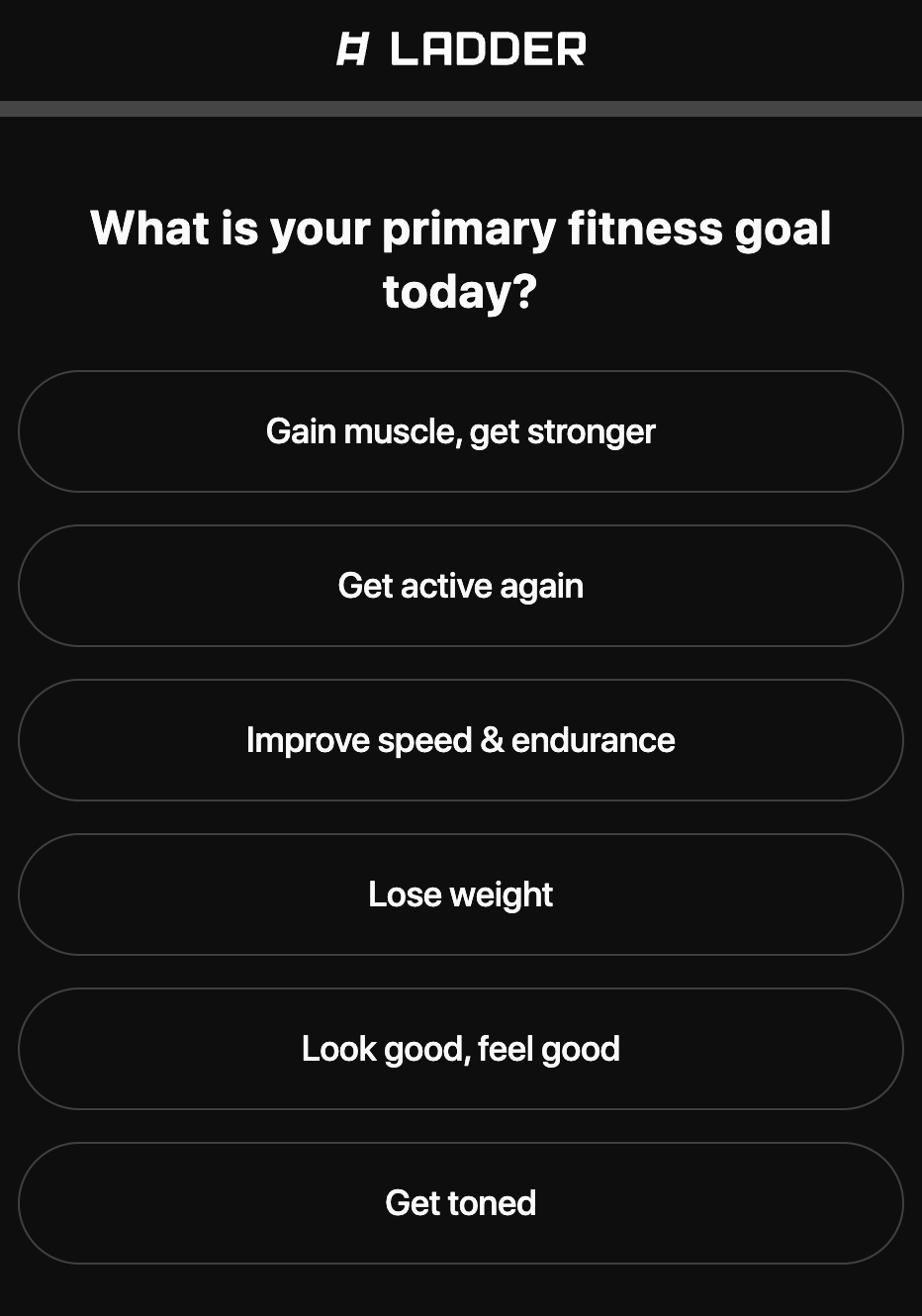
Throwing your Not Smaller! marketing around before whisking me off to an alley where you open your trenchcoat to reveal your finest Get Smaller options? I sincerely wish you would not play in my face like this, but alas.
I think we all know that many Americans want to have less fat than they do. I’m not saying that’s necessarily good, that this pursuit comes without harms, that the desire is not undercut by all sorts of insidious beliefs — of course these things can be true. I’ve written about this before:
The way I managed to make my relationship to body fat feel less fraught — though certainly not entirely perfect — was to stop thinking about it all the goddamn time, because I started thinking about strength and musculature much more instead. That doesn’t mean I lost all preoccupation with it, clearly, but it does mean that I started to think of fat loss as a sort of side effect of strength training and getting more muscular (and having a better relationship with food), which was way more fun and interesting.
If fitness brands and influencers wanted to do the same for their customers and audience, they’d take anything re: body fat out of their messaging entirely; no “stronger not smaller,” no “strong not skinny” — just focus on the “strong” part. The relative size of the exerciser doesn’t have to have anything to do with the benefits of strength training, which is what they seem to be trying to suggest, but they keep using descriptors of relative body size! It is almost as if …. the brands and influencers … are not being entirely honest with us …!!!
It’s all starting to feel a little doth protest too much, gang. The “We’re not about being small!” brand uses small women for promotion and offers weight loss to its customers. The “Thinness as a beauty standard is going to kill us all!” influencer is obviously thin herself. It’s feeling a little like some of the louder voices in the conversation have something of a guilty conscience.
Maybe we all do, in some way or another. Maybe “stronger not smaller even though here’s a small lady representing a brand selling smallness among other things” is an unsurprising place for a millennial-centric fitness campaign to arrive, given how millennials tend to think of themselves:
I suppose that when I see size-2 fitness influencers moving the “skinny” goalposts, what I suspect they’re doing is ensuring there’s cultural allowance for them to remain thinner than average without being accused of being unhealthy or disordered. Maybe I can’t blame them for this; they’re a little screwed up from how they grew up, just like I am. As I wrote in my millennial post:
The millennial condition of always wanting to be a little thinner than we are isn’t yet another thing we must try in vain to optimize or therapize entirely away. It’s so much bigger than us. We carry around this desire because of the influence of the entire media landscape, long-held societal and culture values, and our peers and family members. To deny that those forces have had lasting effects on us to this day is to deny their immense power, and that’s a mistake — future generations will not be spared their own body image curses if we don’t keep our eyes trained on exactly what’s causing them.
I worry that “stronger not smaller” or “strong not skinny,” if the representatives of those messages are mostly small/skinny women, will only cause us more issues. There’s something dishonest about it and for me, dishonesty is one of the more ruinous elements of modern body culture.
If you liked this post, please click the “like” button, share it, repost it on Notes, or leave a comment!
It bears repeating: You can be strong and small/slender/thin/skinny.
Which, once again for the nosebleeds, only means “less body fat relative to muscle mass.”
Comments
Nothing yet. Say the first thing.
Sign in to join the conversation.