
She came into my office frustrated. Not with one thing—but with herself.
She described feeling inconsistent in every area of her life. Some weeks she felt motivated, calm, grounded, even hopeful. Other weeks she felt anxious, heavy, reactive, tearful, and completely disconnected from her body.
Her words were familiar.
“I can never stick to anything.”
“I don’t know why I’m like this.”
“I’ll be doing fine and then it all falls apart.”
“I must just not have enough discipline.”
Alongside the anxiety and depressive symptoms she came in for, she was also struggling with her eating and her relationship with movement. Food felt intuitive and balanced at times—then suddenly chaotic. Workouts felt empowering one week and impossible the next. And no matter how hard she tried to “do better,” it always felt temporary.
What she didn’t realize yet was this:
Her body wasn’t failing her.
It was communicating.
In Body-Led Mental Health, we talk a lot about how the nervous system interprets the unknown as unsafe. When internal experiences feel unpredictable—mood shifts, appetite changes, energy crashes, emotional reactivity—the brain does what it’s designed to do: it sounds the alarm.
Something is wrong. We are not safe. So we compensate. We grip tighter. We overcontrol. We blame ourselves. We search for rules, plans, and fixes.
But what if the problem isn’t inconsistency?
What if the problem is a lack of context?
Early in our work together, we shifted away from trying to “fix” her symptoms and instead focused on understanding her body and what it was trying to tell her.
We began tracking her cycle for a few months. Not obsessively. Not perfectly.
Just curiously.
We looked at her: Mood. Energy. Anxiety. Appetite. Cravings. Sleep. Irritability. Focus. And slowly—over a few months—something powerful happened. Patterns emerged. Things started making sense, and slowly but surely, shame started to lift.
We saw things I see often in my sessions:
Around day 19 of her cycle, things reliably intensified. This was the window when her patience thinned, her thoughts turned sharp, and everything felt like too much. One month, she came into session shaken after nearly quitting her job in the middle of the day.
She had felt flooded, overwhelmed, furious, and convinced she was done.
Then she paused. She checked her cycle tracker. Day 19.
Instead of resigning, she decided to wait a few days to see how she felt. Not because the weekend was going to help necessarily. But because we have paid enough attention and have learned that this tension softens for her again around day 21. Things don’t feel as tight and frustrating . She feels more in tune with her deeper emotions vs being pulled by the rollercoaster of emotions that were going on internally in her body on day 19.
That’s the shift. She didn’t need to quit. She didn’t need to look for a new job. She needed to assert her boundaries on Monday. But when she felt more regulated and assured of herself. Being mindful of where she was at in her cycle allowed her to ride the waves vs trying to go against them!
When the unknown becomes known, the nervous system doesn’t have to panic.
The same clarity began to unfold around food.
During her follicular phase, she felt naturally more connected to hunger and fullness cues. Meals were satisfying. Cravings were quieter. Eating felt intuitive without effort.
But….during her luteal phase, everything changed.
Hunger felt louder.
Satiation felt harder to reach.
She felt disconnected from fullness and this ultimately led to frustrated with herself.
Previously, this was where self-judgment took over.
“I must be bingeing.”
“I’m out of control.”
“I was doing so well—why did I mess it up?”
But once we layered in hormonal education, the story changed. Instead of labeling these experiences as disordered, we made sense of them.
Her body needed more fuel later in the month.
Her metabolism was shifting and it actually made sense as to why.
Her brain chemistry was changing and once we understood that, we could plan for it.
While she worked with her dietitian to support her nutrition during these changing phases, she stopped calling the behaviors disordered….and instead planned for her shifting metabolic needs.
She wasn’t failing.
She was learning that as her cycle changed, and so did her hunger and fullness. This was one of the biggest pieces of work we did in reducing shame about herself!
This is the heart of body-led work.
Not control.
Not perfection.
Not rigid plans.
Understanding.
When we can name what’s happening, we stop fighting ourselves.
When we can anticipate patterns, we can respond instead of react.
When the body becomes predictable, it becomes safer to live inside.
The equation shifts:
Unknown = Unsafe
Known = Safer
Not perfect. Not always easy. But no longer terrifying.
As a therapist, I’m not allowed to see friends, family members, or anyone who exists in my personal life. Ethical boundaries are clear—and necessary. But….they limit who I get to help, even when I can see someone I love struggling in ways I understand deeply.
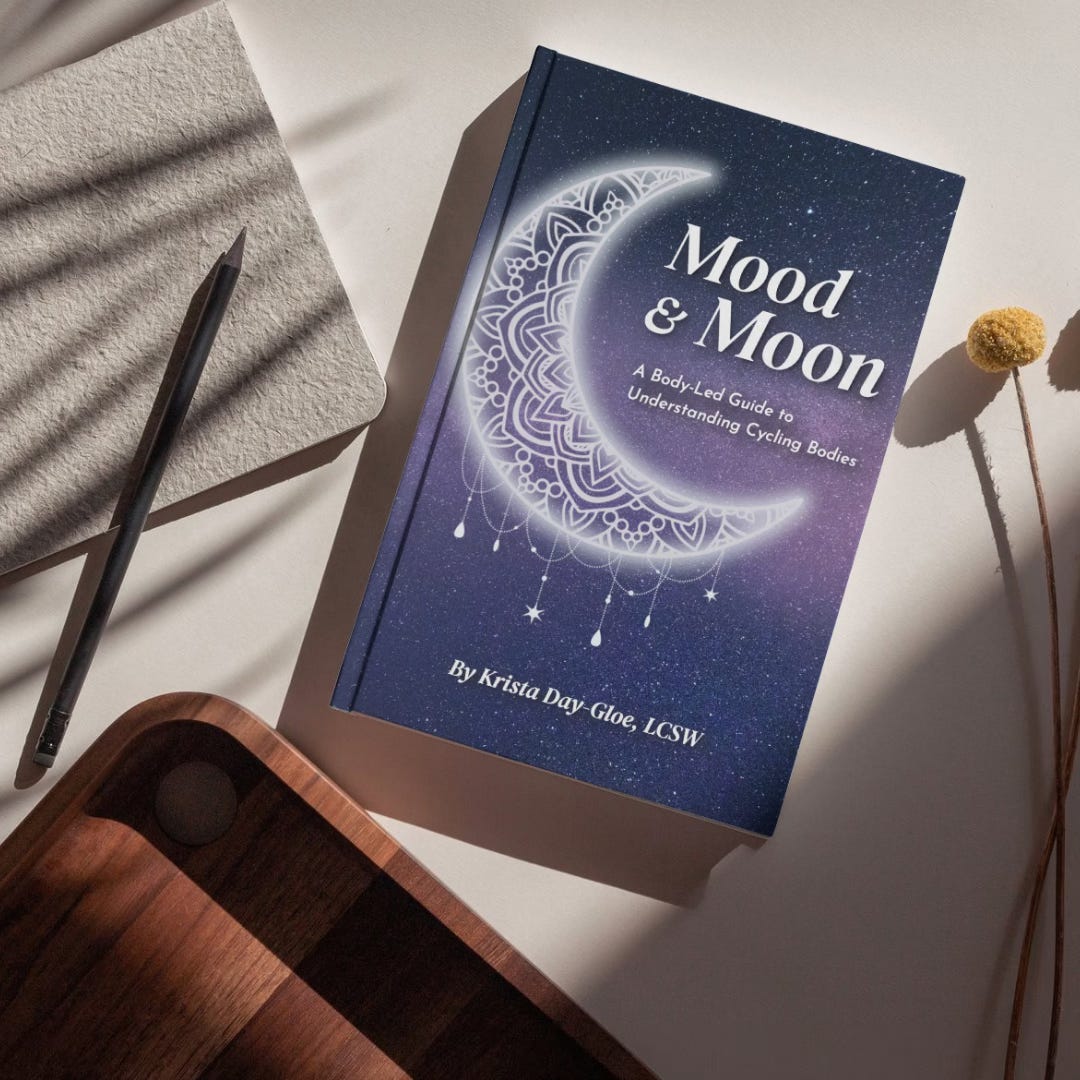
But over time, I realized something important: while I couldn’t sit across from my friends or family in the therapy room, I could still support them through education, language, and shared understanding. Writing became a bridge. Blogs like this became a way to reach beyond the confines of my office and offer what I couldn’t ethically provide one-on-one.
Then something else started happening.
After conferences—after teaching clinicians about hormones, nervous system patterns, and body-led mental health—people would linger. They’d ask where they could learn this for themselves. Not as professionals. As humans.
They wanted the language.
They wanted the framework.
They wanted to stop blaming themselves for experiences that finally made sense.
That’s where Mood & Moon came from.
It wasn’t created to track harder or do more.
It was created to help people stop blaming themselves for biology they were never taught to understand.
To see patterns over time.
To notice instead of judge.
To learn when to push—and when to soften.
Because when someone finally pauses and says,
“Oh.
That makes sense.”
Everything changes.
If this story feels familiar—if you’ve spent years blaming yourself for patterns you were never taught to understand—Mood & Moon was created for you.
You can learn more about the workbook here.
Comments
Nothing yet. Say the first thing.
Sign in to join the conversation.