
Let’s talk about body confidence.
I was on vacation swimming in my aunt’s pool and decided to post a video of me in a bathing suit.
The post accidentally popped off.
Yes, I’m a superfat person in a two piece bathing suit.
Yes, at one point in my life – this would have been radical (I never believed I would be that “body positive” person).
I sent the video to a sometimes fun-time guy I’d been seeing. And his reaction made me smirk:
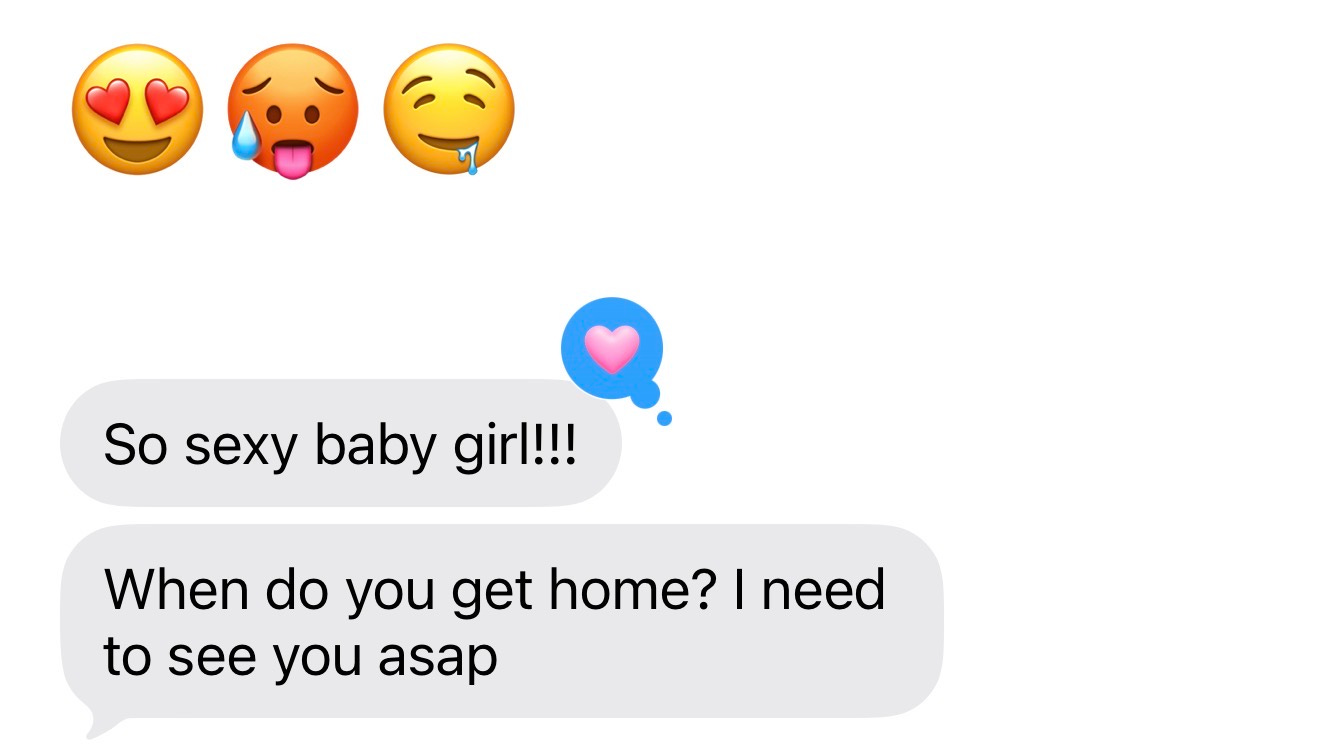
I thought to myself, if you could have told 26 year old Bri that not only would she be wanted + desired in her fattest body — but that she wouldn’t actively hate her body any more, I would have never believed you.
I fervently believed that my fat body was disgusting. That it was something to be ashamed of and change. I also knew that this was a taboo thing to say. It was more widely accepted to talk about wanting to improve your health.
So that was my line.
“I’m losing weight but it’s for my health.” I call this a red herring; one of the most widely used objections to existing in a large body is the fear of health. This is one of the 3 most common barriers to body acceptance.
We’d be here for days if I sat and listed all the ways I tried to “improve” my health over the years. But my weight loss story always ended the same.
I stayed tried and true to a diet for an exceedingly long time (6 months + beyond, NEVER cheating once. I’m a Scorpio and I have ADHD – try and tell me I can’t do something and watch me prove you wrong).
My weight would only fluctuate slightly. And then I would become so frustrated, I’d give up.
And every time I gave up, it became harder and harder to get back on the bandwagon.
I remember having bariatric surgery at just 19 years old.
The year was 2010.
I was so ashamed of having this procedure because I felt like I was “cheating” or “giving up” so I didn’t really tell people unless I had to.
Like when I’d get a piece of food lodged in my chest and would have to go throw up immediately after a meal. Or I’d order food and only be able to eat 1/4 of it.
I remember implementing a lot of actual behavior health changes (some disordered, some not). I started working out consistently. I swapped sandwiches for salads (cause I couldn’t eat bread without getting sick/ or it getting stuck) and was really satisfied with how differently I began to feel.
I remember driving back to my bariatric doctors appointment, so excited to revel in the behavior changes I’d made and to see how much weight I lost.
When I stepped on the scale, I was disappointed with how little the scale changed.
I hoped my doctor would have celebrated my changes, the little weight loss I experienced – anything.
But instead he said, “Well, it’s not much weight loss as I was hoping to see at this point.”
I felt crushed. I don’t think I was naked, but I remember feeling that way.
I cried the entire way home, thinking about what changes I would still need to make in order to “do better.”
There’s more to this story and you can check it out on episode 21 of the Body Grievers® Club podcast, Bri’s Body Image Breaking Point, where I talk all about my bariatric surgery experience.
I remember the people around me started to notice the body changes. And as people do, they started complementing me.
They‘d say You look so good. I’d think Did I look bad before?
You’re so skinny. You must have a seeing problem.
Good job, girl. You’re just saying that.
You’re an inspiration. What happens if I regain this weight?
I had lost about ¼ of the the weight they told me I should be able to lose. And I felt like a failure. How could I fail even at bariatric surgery. I was smaller. But I thought being smaller would mean I would hate my body less.
I asked a loved one who also had bariatric surgery when did body image stuff come and they said to me, “There is no surgery for that.”
I was at my smallest BMI and the most self conscious and depressed I had ever been. Of course, everything needs to be considered in context: my parents were getting divorced, I didn’t tell anyone that either. I started my job as an RA and my undiagnosed ADHD made work/ life balance hard.
But all that time, the hatred of my body size weighed me down (no pun intended) like an albatross around my neck.
I would look at photos of myself and think – it’s not good enough yet or you’re still so gross.
Fast forward to 2016.
I had an epiphany the year before while in the middle of my graduate program to become a mental health counselor and working an internship in eating disorder recovery – that there is not one year of my life I can solidly remember NOT being on a diet, weight loss journey or “health journey.”
I realized that I had put my life on hold. And I was waiting till I “lost the weight.”
I was waiting to go on my fist date.
To go on vacation + wear a bathing suit on the beach.
To be seen in photos.
There are months and years at a time where I have no photos of me because of the grief of being in them.
And in 2015 I hit my second breaking point. And said – what if I just started living my life on purpose. I can still do the “health promoting things” I want, but what if I live my life also.
And that’s exactly what I did.
I went on my first date at 25. I went on vacation, wore a bathing suit + took a picture in it. And you know how I felt?
Fucking terrified + sad as fuck.
There is a common misconception that the way we become confident is doing the thing (which has truth to it). But why the hell would you feel any differently?
This is why body connection is so pivotal to healing your relationship to your body.
So many of us have lived in a state of disconnection as a means to survival, that we only learn to connect to our body when bad shit is happening.
When we feel pain or discomfort, our brain signals a fire alarm to our body letting us know it senses danger.
But the reality is our brains hear the alarm and thinks “STOP DROP AND ROLL” when the reality is we just need a battery change.
Confidence is not never experiencing body discomfort. It’s not unending peace + never caring what people may think about you. Confidence is not the absence of struggle.
But it is the certainty – or to be without doubt – that whether we need to stop, drop and roll or change they batteries, you are equipped to handle what comes your way.
You are without doubt that you are a human being worthy of respect, human decency + equity.
Unfortunately for fat people, this is not the case.
In Kate Mann’s book, Unshrinking she says, “Imposter syndrome is a social reality for fat people”. Where most people might feel a little nervous going on a date, the fat persons fear that someone will reject them because of their body is a very possible reality.
That fear has a basis.
What we have to do is decide if we are cosigning that belief system.
For years, I believed that there was no way any man could want me because of my body. I always thought maybe in spite of my body, I could sucker some poor guy into wanting to be with me. As I got older, and began dabbling with more online dating – I became aware and feared being fetishized because of my body.
The difference between appreciating my body and fetishizing my body is like how I feel about a man with a beard. It does not disappoint but it’s certainly not a deal breaker for me. Unfortunately some of the online spaces, it definitely propped up men with fetishes — thus supporting my belief that it was the only way to be desired.
Fast forward to 2026.
I’m still very single — and still very unfortunately attracted to men 🙁 (relax not all men but like.. c’mon).
But for the first time in my entire life and actively dating and playing the field – I have absolutely no concerns that I can find a man who is attracted to me.
And you know what that does to my first date jitters?
ABSOLUTELY FUCKING NOTHING.
I imagined that dating while feeling confident meant I was gonna be fearless. But all it means is that I’m human with a regular sized fear of being rejected. And my body is no longer the scapegoat for why someone may not like me.
Because if my body did disqualify me, that is not a person I’d want to be with anyway.I like to say the trash has a great way of taking itself out.
So how did I go from 2010 Bri to 2016 Bri to finally get here to 2026 Bri –
I don’t love the word confidence. I much prefer the word self assurance.
Self assurance means
Without doubt, to be certain of
Here’s four things I would do if I wanted to become more self assured
1.I would build CURIOUS objective awareness around how I speak to and about myself.
I used to start small.
When I’d make a mistake I’d say to myself, you’re such an idiot.
I began recognizing that this isn’t kind or a way I would speak to anyone else.
The more I paid attention, the more I realized how overly critical I was to myself.
And the criticism wasn’t actually resolving the wound.
2. I got clear on my values + explored how to align more with them
I had a therapist who would always ask me this question, “does that belief bring you closer or further from your values”. Alright, Maggie – obviously me saying that I’m disgusting is not bringing me closer to the values I care about. But I still FEEL disgusting.
I got in the habit of actively thought stopping, implementing a shift in how I spoke to and about myself even if it didn’t result in the way I wanted.
For example – When I’d be running late. In a prior time, I’d berate myself for being late. When I noticed the berating, I’d stop and say, “what is it that I’m feeling right now? Is the way I’m speaking to and about myself going to help me stop running late?”. When I recognized where the problem was – I exited the loop of self criticism (even if I wasn’t yet ready to enter the loop of positive reframes).
3. I began contrasting and comparing where I felt confident vs when I felt insecure
I liken confidence to a chair (and as most fat people know, not every chair is supportive).
If your body trust was a chair, what kind of chair would it be? Would it be a solid cement bench or one of those flimsy lawn chairs that will snap the second you hover over it.
What are the “cement chairs” in your life?
What are the things you are most confident in and why?
My cement bench would be my clinical skills.
I am without doubt that I am an excellent provider. It is a skillset that comes easy to me + one I really love being able to use to help others.
Why am I confident in my therapeutic skills?
For one thing– I have studied and practiced these skills for nearly 10 years. I wasn’t always confident. I remember before my very first client in eating disorder recovery I locked myself in the bathroom and had a talk with myself in the mirror. I was terrified. I am no longer terrified. That does not mean I never make mistakes, get it wrong, cause harm. But I trust my skill and myself enough to repair when I’m wrong + continue to provide beneficial support
So time, practice, research + an embodiment of my methodology.
There is plenty of research to support that debating isn’t actually productive. When people hold positions and beliefs about something — information isn’t going to change their mind.
This is why when I receive the criticism, “but what about health”— my beliefs are no longer shaken.
When I first learned about Health At Every Size – I would try and explain it to people – and as soon as they brought up criticism I would second guess everything I believed.
This is because there was a still a deep fear that “maybe I’m wrong”.
Today, I don’t care if I’m wrong. I’m not, but even if I am wrong, I can fully stand behind my approach.
My approach is the most trauma informed + the most value aligned beliefs I could live by.
Early in my career, I witnessed people near death in an effort to hold on to their eating disorders.
I remember the devastation I felt as existing as a fat person.
That I was damned to wear a scarlet letter of shame.
No one would ever know how hard I’d tried to shrink my body. To be the good girl.
And I know there are people who would wish death over ever experiencing that shame.
I had to reckon that if wanted to be a provider who lived in alignment with my values — then my baseline approach needed to be what would be safest for my most disordered client.
That meant— If I wouldn’t use a weight loss centered approach for my most disordered client, then I couldn’t use weight loss for myself either.
And that left me emotionally raw and naked — like a turtle without a shell.
Choosing NOT to pursue weight loss FORCED me to reckon with all the fears, anxieties + shame I’d shoved under the rug for years.
(For reference, I don’t actually recommend raw dogging it like this…)
But it does lead me to my fourth suggestion:
4. Begin experimenting with exposure in a trauma informed way.
I use the example of wearing a 2 piece bathing suit because just 7 years ago — I failed at an experiment where I tried to wear a crop top for the first time.
In 2019, I had realized that I hadn’t been struggling with body grief like I had in the past. So I asked myself what would still feel like a “HELL NO.”
Then one of my body grievers told me she was doing a boudoir photo shoot. (Whoop there it is).
My entire body screamed, absolutely fucking not.
So I distressed scaled it. On a scale of 1 to 10 (low medium high for my girlies who hate a likert scale).
And it was a 10. Absolutely MayDay. Stop Drop and Roll.
If I was coaching a client – I would ask them, what is something that feels charged but isn’t a ten.
And that’s when I determined wearing a crop top or 2 piece would provide that midrange activation I needed. The thought of wearing one was about a 5.
So I went and bought the top.
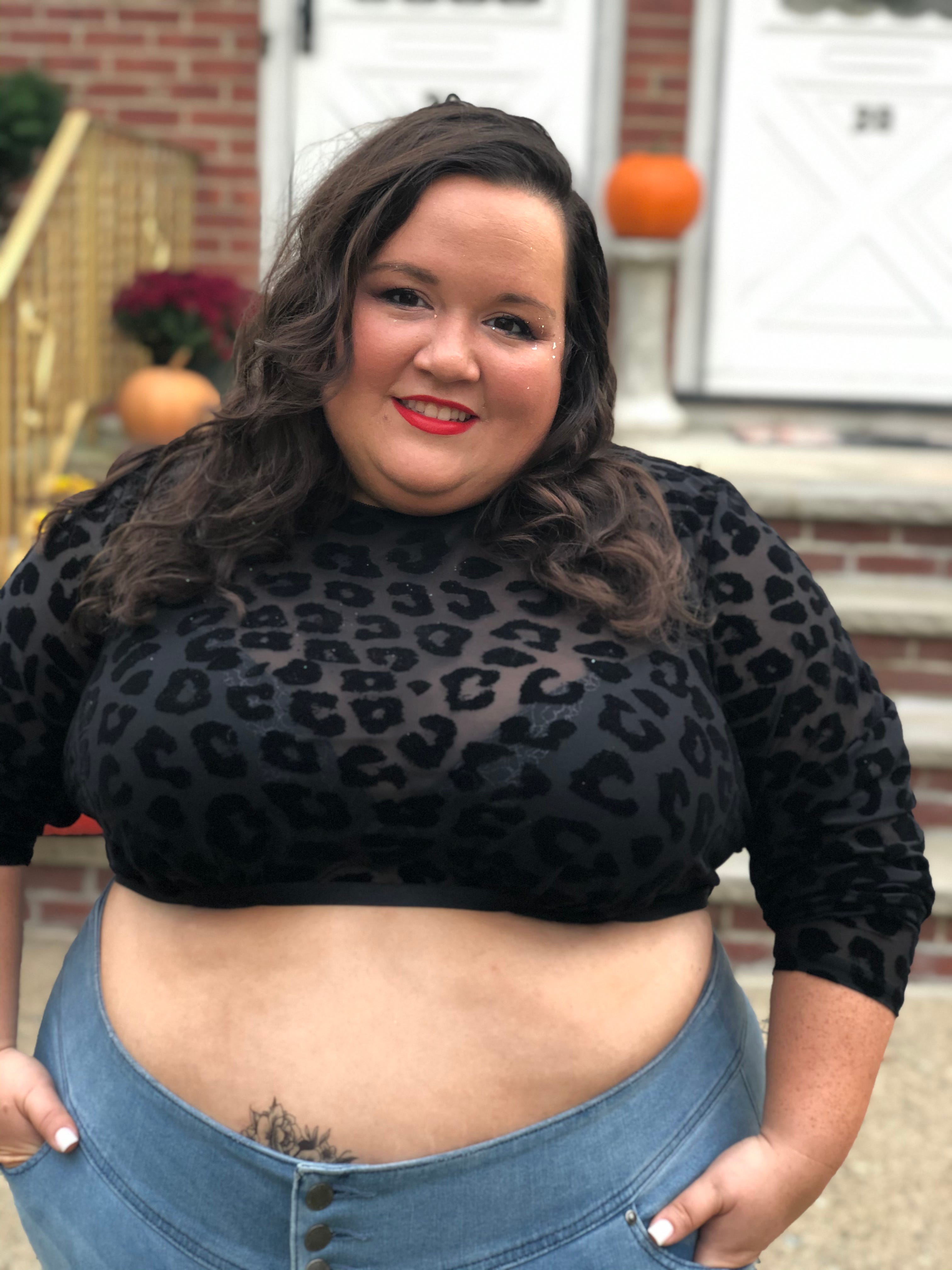
I did all the things I thought would help make it easier.
I got a fake tan, got a fake tattoo to cover my bariatric surgery scars that were visible. I did my hair and makeup.
And when I put the shirt on – I immediately felt the distress level change. We went from a 5 to off the charts. We call this being outside your window of tolerance.
I then did what I would never recommend anyone else do.
I decided to push through.
I believed if I could just get over my initial discomfort, I’d be fine. But it never wore off.
I explain more of what was going through my mind in this post.
My college bestie looked at me and said, “I think you need to change”. I looked at her said, “why cause it looks bad?” and she said, “no — cause you look so uncomfortable”.
But changing meant failure in my mind.
It took so much convincing, but I finally did.
And while I felt relief. I was so frustrated with myself for not being able to complete this exposure.
Flash forward to 2020.
I had learned from the mistakes I made the first time.
I decided to wear a 2 piece bathing suit to my godmothers house — a place I have historically always felt safe.
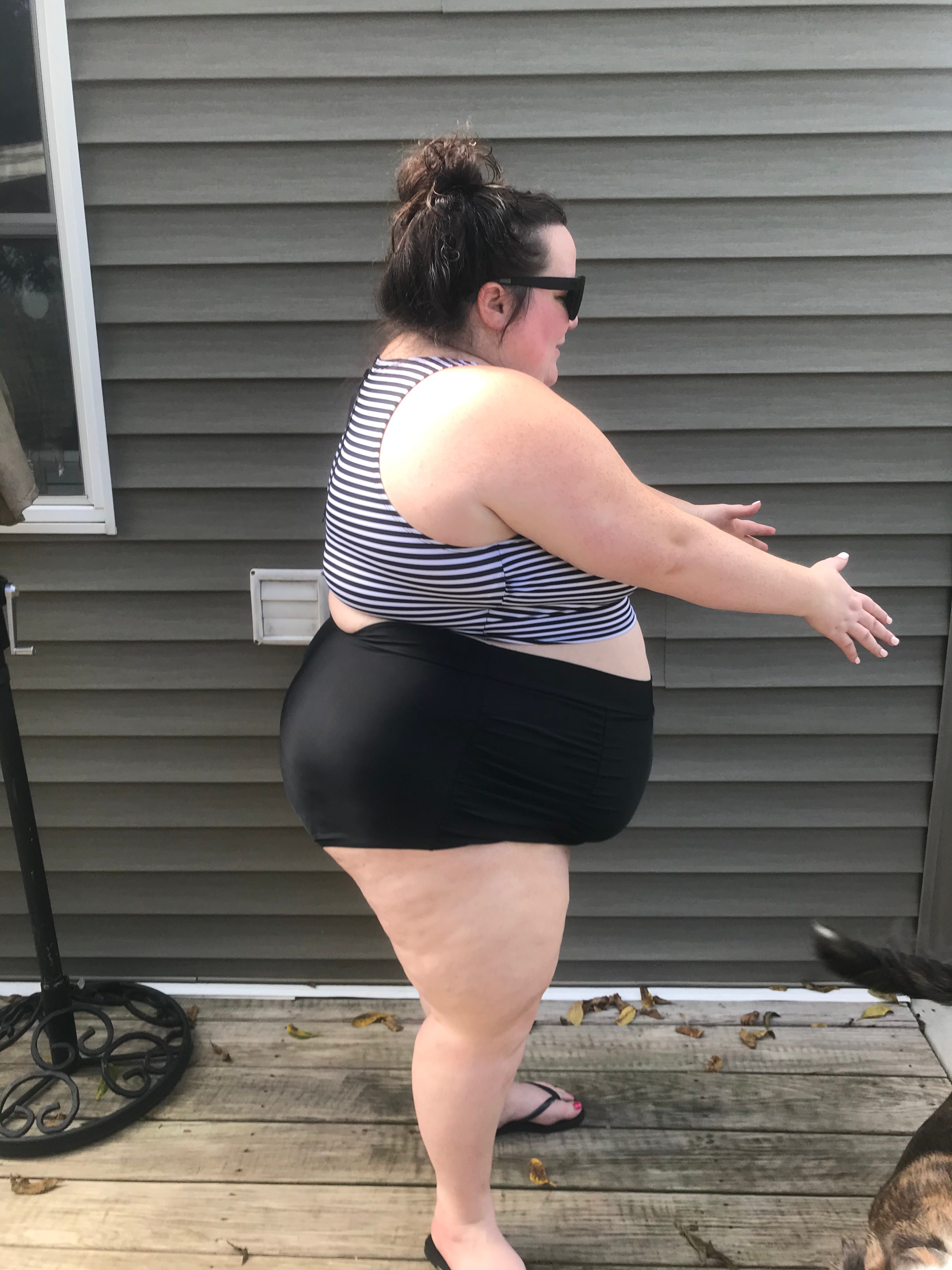
The activation in showing up in that bathing suit was moderately high but it was tolerable.
Of course I decided I needed to document it.
And you know what happened when I saw those pictures?
A flood of shame. Activation level from 5 to off the charts. And remember, I’m already Body Image with Bri when this happened.
So much so I wrote this:
My heart sank a little when I noticed my stomach protruding - a part of my body I still aim to make peace with with.
I covered up my belly in the photo with my thumb, imagining what it would be like to look like that.
I began mentally photoshopping all the parts of my body I would change that would make me more conventionally pretty.
It saddens me.
Saddens me that even I get sucked into the grief of my body.
The grief of what others may think of me when they see my body.
In that moment, staring at my screen, my body is filled with heat in my chest. It bubbles up in the back of my throat as I hold back tears.
“It’s okay-” I whisper silently to myself.
It’s only a photo.
Just a millisecond in time.
I allow myself to sit in the suck.
If you were to ask me today what would be a “Hell No” about my body – I probably don’t have too many.
There is movement I absolutely detest. I don’t love going to the doctors. I can notice glimpses of grief– like the other day when I saw this video compilation of girlfriends surprising their boyfriends, and boyfriends lifting them up and spinning them around. I grieve that will probably never be my story.
Clothes shopping specifically as a fat person is an absolute pain in my ass.
I probably wouldn’t be a fan of a naked spa. But I could do it if I needed to.
I still have reminiscence of body grief.
Like when I’m around people who are historically fatphobic, I can become very aware of my size, my clothes, what I’m eating.
I grieve that I can’t fit on airplane seats – and will have to buy 2 or first class in order to fit.
I grieve that my health will always be questioned because I still exist in a fat body.
But the distress no longer puts me on the bench.
I am still able to show up and live my life to the fullest.
And though clothes shopping is harder, I’ve still cultivated a closet full of clothes I love.
Even though I have to buy 2 seats or upgrade to first class, I still get the joy of traveling and getting new experiences.
Even though I know my health will be questioned, I am without doubt that I am doing EVERYTHING in my power to promote my health– regardless of whether or not those efforts are recognized.
Building up your confidence brick by brick requires body trust which requires body connection + what we call in the clinical world unconditional positive regard. Or as I would say in my jersey way – you have to be less of a dick to yourself.
Start by naming all the things you feel confident in.
Name the things you’d like to feel more confident in.
Highlight what gap is keeping you from that self assurance.
Confidence does not come in the absence of criticism or unsafety.
It comes from the inner knowing and self trust that you are resourceful enough to handle even the worst case scenario.
Resourcefulness is not resilience. It’s not showy + flashy like a superhero. It’s a quiet surrender, a gut check, an innate sense that this will absolutely suck, there is nothing we can do in our immediate future that can change it, and most importantly we will survive.
Comments
Nothing yet. Say the first thing.
Sign in to join the conversation.