
I find that there are about three common barriers that hold people back my from radical body acceptance message:
What will others think of me? [The fear of judgment]
What if I’m uncomfortable? [The fear of discomfort]
What if I’m unhealthy? [The fear of health]
The desire to be healthy is often the leading motivation for most people on a weight-loss journey.
At least, that’s what they say is their motivation.
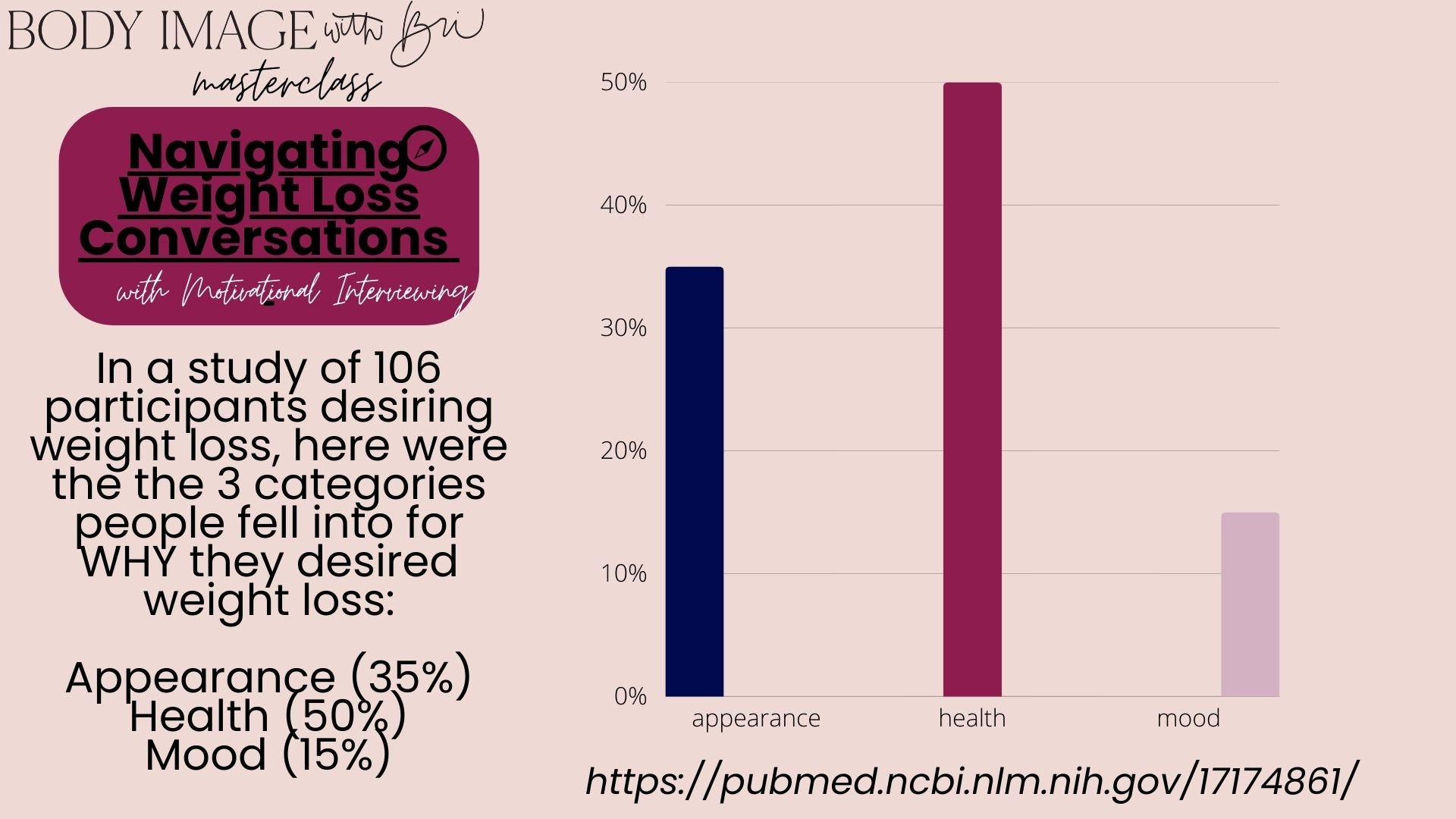
I believe for many folks, they truly believe they are in pursuit of health.
But here’s a quick litmus test to determine if health is your only motivation:
If the behaviors you are doing to improve your health doesn’t guarantee you weight loss—would you continue what you’re doing?
If the answer is no—then health is not your only motivator.
Which is fine—but we can’t accurately “solve a problem” if we aren’t acknowledging our own expectations. It sets us up for failure.
Another health litmus test:
How long can you sustain the behaviors you are engaging in?
But the cost is that I will never be able to control my body size at the same time.
I’m not a doctor, and I’ll never claim that anything I write or say is a replacement for medical advice.
I am, however, a trained mental health counselor with over 10 years of experience in eating disorder recovery.
I know the sexier thing to do is present a list of easily digestible resources + materials with
evidence to support my claims on how health + weight are correlated but not a direct cause of each other…
But like I tell my clients:
If you need to arm yourself with research for a conversation, you’ve already lost.
My approach isn’t going to be for the many.
My approach will be unlike anything you’ve ever learned before.
And my content most likely piss you off a little.
Here’s the buy-in you will need for my radical body acceptance + body image work to meaningfully impact you:
Body image is not just how you feel about your body
or liking what you see in the mirror or photos.
That’s just one aspect (ps. There are four.)
Body positivity was never about loving the skin you’re in.
It was a social justice movement started in the 1960s as a form of protest for equal treatment for ALL bodies.
All bodies are deserving of human decency, respect, and quality medical care. But to this day, that isn’t the case.
Here are some NOT so fun facts of research I’ve accumulated over the years:
Only six cities and one state have laws protecting Americans against height and weight discrimination:
Women considered ob*se earned 5% less than women considered normal weight
While biases towards sexual orientation, race and skin tone decreased, studies show an INCREASE in weight bias.
“Ob*sity is associated with a wide range of negative characteristics. Ob*se people are perceived among others as unattractive, unlikable, weak-willed, and alienated from their sexuality”
30 million Americans suffer from an eating disorder. [About 30 million Americans are diagnosed with diabetes. Which one did your doctor warn you about…]
Less than 6% of people with an eating disorder are medically underweight
Every 52 minutes someone dies as a direct result of an eating disorder.
Almost half of Americans said they would be willing to give up a year of their life to avoid being fat; 15% said they would give up 10 or more years of life.
91% of women are unhappy with their bodies and resort to dieting to change their bodies,
even though only 5% of these women naturally have the “ideal body” represented in American media,
and the average pant size for women in the US is a size 16–18, which is considered “plus size”.
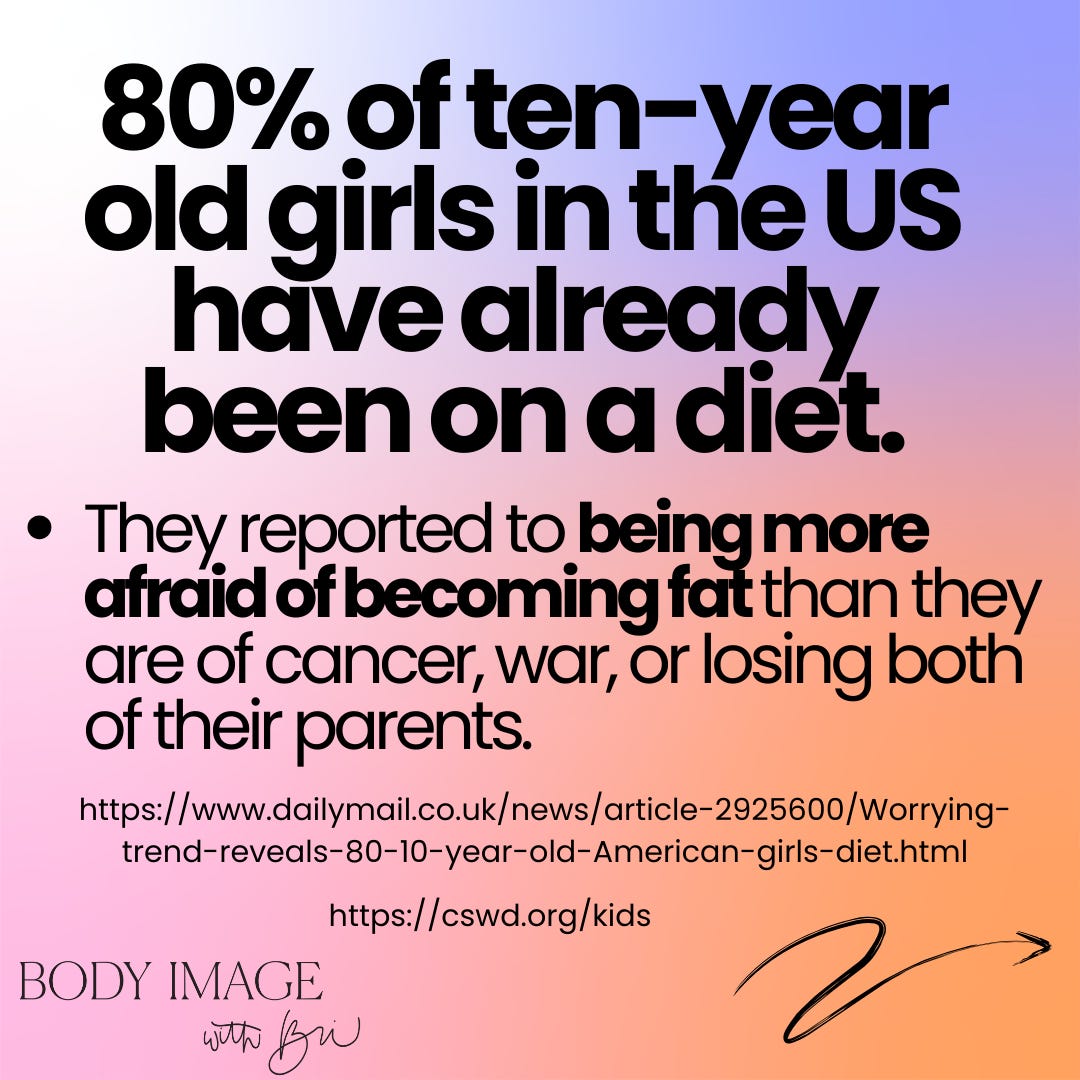
80% of ten-year-old girls in the US have already been on a diet.
They reported being more afraid of becoming fat than they are of cancer, war, or losing both of their parents.
My approach to healing body image is taught from the lens of how I would treat my most disordered eating disorder client.
My origin story began many years before I reached this crossroads in my personal and professional life:
I was working in eating disorder recovery as a therapist.
I cosigned 90% of the body positive message (the whitewashed version).
I just couldn’t believe I could ever be healthy in a fat body.
There would be days I would leave work thinking, “Do I have an eating disorder?”
My clients and I struggled with the same things…at the same time…
How can I eat food with sugar + gluten + processed ingredients without it significantly impacting my health?
What happens if I eat like this every day and I end up gaining more weight?
How can I ever be healthy in a fat body?
Text within this block will maintain its original spacing when published
Deb Burgard, a pioneer of Health At Every Size, is famously known for saying:
“what was being diagnosed in them was being prescribed to me”.
I’d love to tell you it was a light bulb moment.
That one day all the clinical information just clicked into place.
But it didn’t. In fact much of the clinical work failed me.
Working in eating disorder recovery forced me to face what I had successfully avoided my entire life.
I somehow volunteered that I was on a weight-loss journey for my health.
I expected my therapist to respond with the typical accolades like, “Good for you!” or “what are you doing for weight loss?”
But instead she asked, “How much weight do you need to lose to be healthy?”
I remember getting pissed. The fuck kind of question is that?
In my pre-scripted answer, I said, “I don’t care about how much weight I lose, I just know I need to lose weight in order to be healthy.”
Taken aback, I remember rattling off something along the lines of eating fruits and vegetables, exercising regularly, and not being “out of control” around food.
She pushed back, “Based on that definition though, wouldn’t you say you are healthy now then?”
I was eating fruits and vegetables + exercising (albeit abusively + restrictively).
I was excellent at resisting food (I used to think I was really disciplined at times. Now I know I was just really good at having an eating disorder).
But no, I was not healthy. I couldn’t be healthy.
Because if I went to the doctor, they wouldn’t even believe that I’m healthy.
They’d make judgments the second I walked in the room (they were already doing this at this time).
If I had been coaching me, I would have said, “Doesn’t it sound like you want the protection of the privilege of being smaller when you go to the doctors?” Isn’t it wrong that your health won’t be believed because of your doctor’s implicit bias?
My therapist held the cognitive dissonance for me and didn’t let me avoid it.
“Let’s just say for argument’s sake, your weight is important to you. From this moment on, if you never lose another pound, why would that be so bad?”
And the dam broke;
I burst into tears reciting the fears of my heart that I’d never spoken out loud.
No one will take me seriously as a therapist.
How could I help anyone if I couldn’t help myself?Everyone in my life who has been waiting me for to lose weight would be so disappointed in me. I was the type of girl who could dig deep and accomplish anything I set my mind to. Weight loss was the only thing that bested me.
The loss of never being able to finally prove it to the world that I was disciplined, and dedicated, and healthy.
And my biggest fear: I would lose love. No one would love me in a fat body.
I heard the dissonance—
At the time, I had friends that loved me so deeply. I had friends in larger bodies who were married and in love and fell in love while they were fat.
This dissonance—when your head knows one thing, but your body tells you another. I call this the head-to-heart disconnect.
I know I shouldn’t care what people think of me, but I still do.
I know that it’s what’s on the inside that matters, but I still care.
I know that my worth and value isn’t measured in pounds, and yet I still don’t want to be fat.
My therapist let me sit in the tears for a moment. And then she asked:
“Do you truly believe that your weight is the thing keeping you from being successful in life? That people will love you more if you were thinner?”
I knew the right answer. The right answer was no. But my head knowledge didn’t transfer to my heart.
I told her the core belief motivating my fears:
“Not only will no one else love me, but I won’t ever be able to love myself till I’m thin.”
She told me she would diagnose me with depression in the area of body image. She said this because it sounded like I was hopeless.
I was hopeless.
But I was also angry at myself that I felt this way;
That this belief only existed for me—and no one else.
I was sad; I was sad that this was the one area in my life that I felt like I had no control.
I was ashamed. How could I, a therapist-to-be, work with clients with eating disorders and feel this way about my own body?
I wanted this feeling to end. I wanted the sadness to just go away. I wanted to skip this part and go straight to the being healed part.
And then it dawned on me.
Hopeless. Angry. Sadness. Shame.
All those feelings combined as one.
I began scouring the internet to find something, anything where someone was talking about body image in a way that didn’t’ make me wanna throw my phone in anger.
I didn’t want to think about why I should be grateful for my body.
I didn’t wanna say meaningless bullshit affirmations.
I didn’t want to love my body.
I didn’t want to believe that I have to jiggle my fattness online for thousands to prove that supposed body love.
I wanted to be angry. And cry. And grieve.
It did not feel like that place existed.
I felt I was in an impossible situation.
Either I was forced to continue to take the path forged for me— and continue on this never ending cycle of attempting to control my body—
or I was to take the road less traveled.
The road that all my thin colleagues were encouraging our clients to take:
Trust your body.
Let your body do what it does.
Listen to your body.
And if you gain weight, it doesn’t impact your humanity.
The grief of seeing a photo of yourself and feeling unrecognizable.
The shame of losing movements that were once effortless.
The pit in your chest when you are unsure that a seatbelt
will close or a chair will hold you.
The debilitating anxiety of going to a new doctor, unsure of how brazen their fat shaming will be.
No one talks about the quiet grievances; of feeling like no one will ever swipe right on a dating site because of how you look…
Or the moment you realize the new pants you just bought don’t fit… again.
The anguish of fearing that your body has re-gained weight…
and the gravitational pull to the scale to measure your hard work and daily enoughness.
And intentional weight loss to improve your health, your mood, or appearance—is a just a heart-wrenching, hopelessly, anxiety-filled anguish + disappointment that feels a lot like dopamine Russian roulette.
You keep trying to do all the things to control your body in hopes of getting that hit more often than not, ending up with an empty barrel.
After years of trying and failing, I was just so tired.
I couldn’t keep living like this.
The euphoria I felt when my body conformed paled in comparison
to the shame I felt when my body failed me.
It felt like no matter how hard I tried, it was never enough.
That even when I was my most disordered (and also strongest + smallest)—
it still was never enough—
for me, for my doctors, for the world.
So I decided to get off the fucking merry-go-round.
I chose the path less traveled.
To grieve size of the body I had …
…to let go of all the aspirations and dreams I hoped I’d one day have
That ONCE I was in a smaller body… THEN…
I’d fall in love
Invest in cute clothes
Be kind to myself
Have really great sex with someone who finds me desirable
Let myself eat whatever I want because it sounds good— not because my macros or meal plan say I can.
I just had to get to smaller first. THEN I was entitled to joy. Then I was allowed to live.
I had to grieve that my body size might actually disqualify me from being seen as attractive to some people (those people are trash, by the way).
I had to grieve that my body might prevent me from being able to fit in public spaces like theaters and airplanes and chairs, from being seen as a leading lady in a play or book or even in the eyes of eligible bachelors.
I had to grieve that my size would be an invitation for open season on judgment.
That when I experienced ridicule at the hands of a doctor, they would always be excused because they are supposedly concerned for my health
I had to grieve that for as long as I existed in this body, people would believe they know (and have the right to comment on) my health just by looking at me.
I had to grieve that somehow, despite being a master’s-educated professional, I would still be seen as lazy, weak-willed and undisciplined.
My body size would be the bud of every joke, and the worst fear people can imagine.
That regardless of my valiant, extensive and expensive efforts to shrink my body, my reward of living in a smaller body was always destined to be short-lived.
I had to grieve that I might forever be trapped in this fat suit, knowing it might mean no one would ever get to see the real me.
I was wholly convinced I could never feel at home in this fat body.
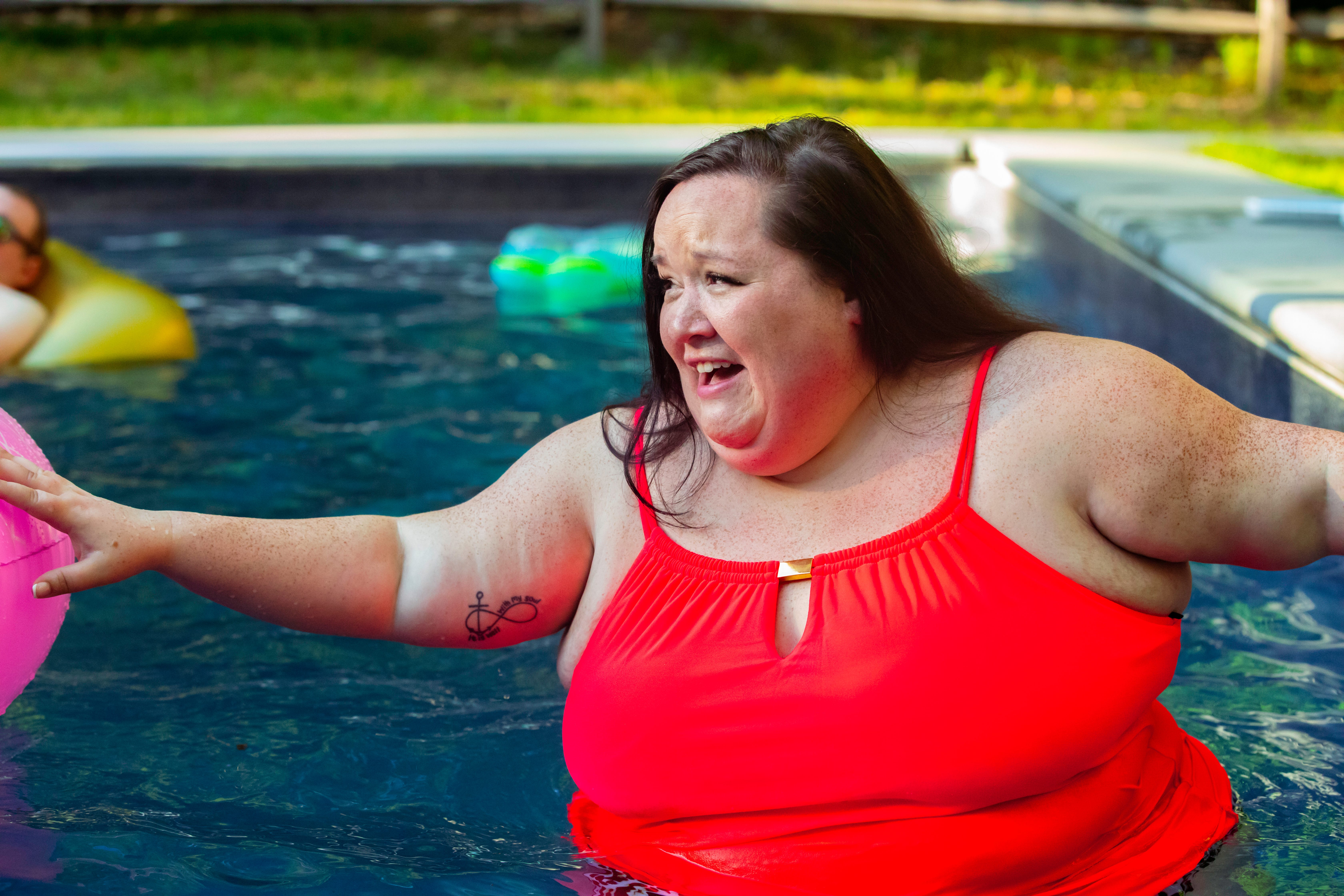
Today—
I am more at home in myself than I have ever been. And my body size has very little to do with it.
Through years of therapy (whether it be as a client or a practitioner) I forged my way through the uncharted terrain of body image exploration [including exposures, rewiring my thoughts and shifting my core beliefs] to navigate through through the heartache of unavoidable grief.
And in no uncertain amount of time—I became radically liberated from my body + it’s grief.
I am liberated from the societal expectations to be small and not take up space.
I am liberated from my internalized anti-fatness that stopped me from attempting to live the life I wanted—and getting to live that life in this body, without asking for permission or waiting for anyone else to join me.
I am liberated from the belief that I have to love my body in order to love myself. And this is where Sonya Renee Taylor, author of The Body is Not an Apology, brings in the idea of radical self love.
This is where Da’Shaun Harrison, author of Belly of the Beast, tells us that self love isn’t enough to liberate the collective from the systems of oppression—including white supremacy, fatphobia, ableism, etc.—in which body hatred was built on.
I want you to imagine you are standing on a cliff. We’ll call this cliff Diet Culture although, it has aptly rebranded as “Wellness Culture”.
This cliff promises you beauty, praise, health,
confidence, success, love, freedom,
and that hit of dopamine that you crave.
But there are also rules.
On the Wellness Culture Cliff,
you have to eat a certain way, move a certain way.
Kind of like taxes in the US: we’re not going to tell you exactly how,
but you can choose wrong.
You have to be doing something to make sure you are
in control of your body at all times.
Across the way you see me.
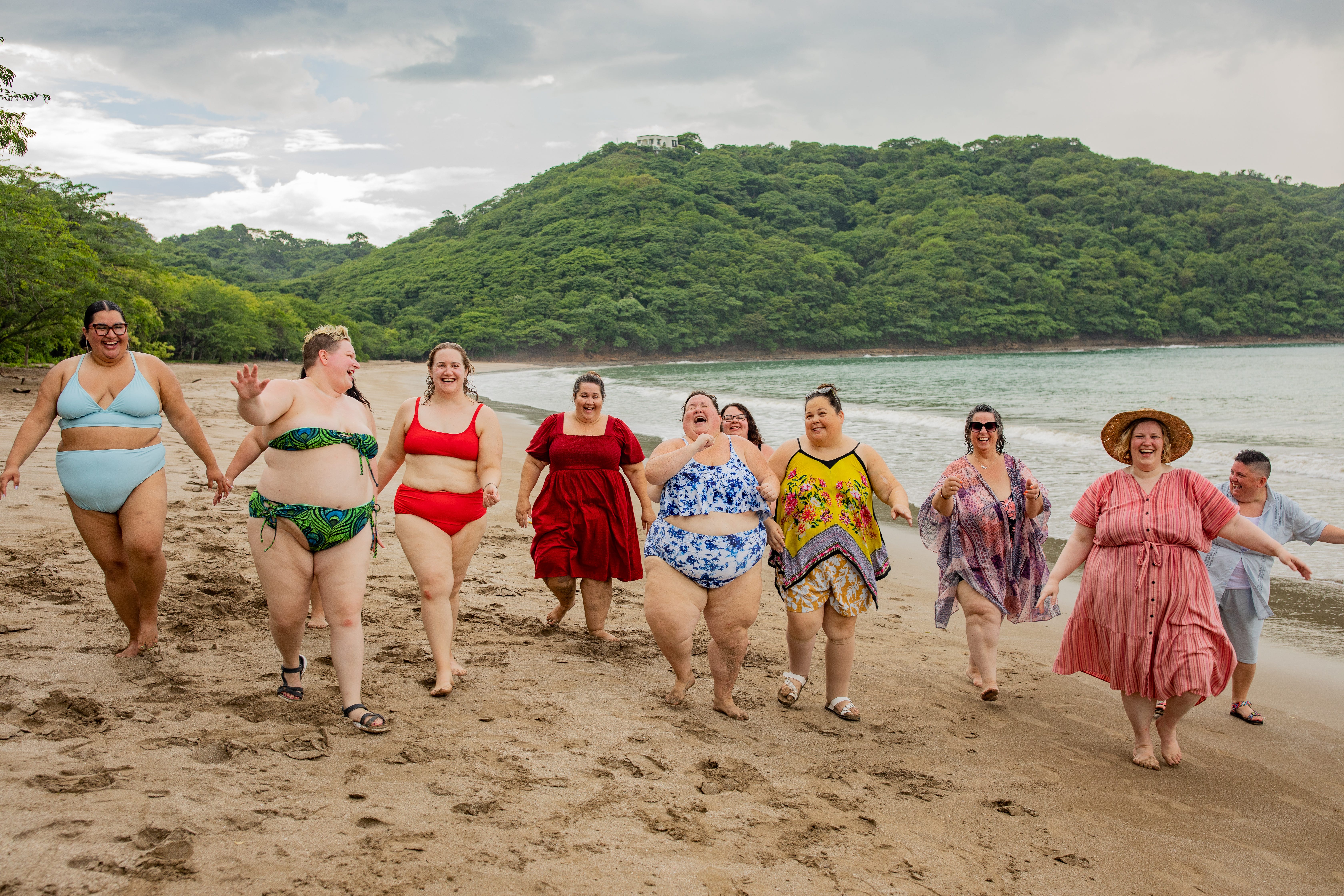
I’m on the other side of the cliff. We’ll call this side the Body Liberation Cliff.
I’m on the “bad” side of the cliff.
The rebels on my side are out here spreading false information,
glorifying obesity—
telling people they don’t need to lose weight to be healthy,
telling people they don’t even have to pursue health.
On this cliff there are no rules about bodies except that we treat every human with decency, respect, dignity + autonomy.
There are no good or bad bodies. The pursuit of health is welcomed to all who desire it. We believe all bodies deserve unbiased medical care. But if they don’t (or more likely it’s inaccessible to them) they still deserved to be treated with dignity.
And we don’t judge the people on the Wellness Culture Cliff,
’cause we believe that they are in a cult, and that capitalism continues to fund and fuel their cliff and FEAR them into ever leaving.
On the Body Liberation Cliff, we eat what we want, we wear what we want (even though YES, it’s harder to find clothes in our size).
We travel—even though we may need a seatbelt extender.
We go to events—even if we have to bring our own chair.
We go on dates, fall in love, have really great sex…
have incredible jobs, have beautiful families and friendships.
And every time you go to take step a towards my side of the cliff, you realize there is a large chasm inbetween.
The chasm is so dark, you can’t see what’s down below. So of course, in order to protect you, your mind conjures up the worst possible scenario.
Certain Death.
Alienation.
Undesirability.
Discomfort.
Shame.
Health problems.
So as much as you want to join us on this cliff, there are legitimate things holding you back.
The deep chasm between Wellness Culture + Body liberation is dark, unknowable–
But navigating it also survivable.
[Bri enters the chat].
I am not asking you to leap on to the Body Liberation Cliff yet.
I’m not asking you to have 100% buy-in to this side. It took me years + a masters degree + lots of therapy to get here.
I’m not even asking you not to desire weight loss or not desire the things the Wellness Cliff promises you.
I’m just asking you to climb down into the cave of the unknown, knowing you can always turn back to Wellness Culture—often for the right price.
Just come into the chasm.
Sit in the place between Radical Body Acceptance,
between the promises of Wellness Culture and the freedom of Body Liberation.
And it f*ckin sucks. I’m not gonna sugarcoat it for you.
This is gonna be painful, and daunting, and expose your deepest fears you’ve never said out loud.
But in conjunction with that pain is joy, and connection and freedom like you’ve never felt before. It’s both and.
We don’t need to storm the cave. We can take our time. We get to listen to our body when it says “stop trying to proceed forward” or “this pain is too much right now”.
We get to navigate body image beliefs and body grief in a way that aligns to our nervous systems, not overwhelms it. This is how we learn to trust our body, maybe even for the first time.
Grieving your body is going to be hard.
BUT HERE’S THE GOOD NEWS.
Grieving your body doesn’t mean it will always be devastating to the nervous system.
I used to grieve seeing the silhouette of my large belly. I used to grieve that my niece and nephew wouldn’t ever sit comfortably in my lap. That I’ll never be small enough for my future spouse to carry me over the threshold on our wedding night.
In 2014 that grief felt insurmountable.
Today, though I still bare the scars, that wound doesn’t hold the sting it once did.
Body Image + Food Noise does not require a static-y low hum in the background of your life for the rest of time.
There is a world where food stops being about counting, and ingredients and how they are grown and cared for, and formulas + instead get to be memories, and nostalgia, satiation and nourishment.
There is a world where you don’t have borrow brain space to think and feel badly about your body and yourself.
You can to be part of the memories in every iteration of your body, and realign to the values that matter most to you. It doesn’t mean you will NEVER feel connected to your body—
it just means you’ll stop interpreting the connection as something bad every time you feel it.
You are not alone in your body grief.
I know more than most about the depths of body grief.
It’s so dark in here, you can’t see your hand in front of you, never mind the light that’s supposedly at the end of this thing.
But you don’t need to see the light for healing to be possible.
All you need is a willingness to travel the road not taken.
And reach your out hand. I’ll be there ready to hold you.
My eyes have already adjusted to the darkness.
And I have flashlights and shovels and ropes to navigate this rocky body grief terrain.
I am also bringing size-inclusive camping chairs and a community of badass body grievers® who are stuck in the between– just like you.
And we’ll stay here as long as you need.
For as long as your eyes need to adjust to the darkness.
And even though Wellness Culture will, I won’t promise you results.
In good faith, I cannot promise what will happen.
But I can promise that that no matter how dark the cave feels, no matter how far the light at the end of the tunnel seems, no matter what obstacles we face—you don’t have to face it alone.
You don’t have to understand the whole picture to begin the healing puzzle.
You don’t have to unlearn everything all at once to start healing.
But you do have to start.
Start with saying the quiet part out loud.
And saying it out loud (in therapy, writing in a journal, talking to a friend) will not radically heal you.
You don’t need to start with body liberation to heal your body image.
You definitely don’t need to start with body love (or ever get there at all…).
You don’t even need to start with radical body acceptance.
Comments
Nothing yet. Say the first thing.
Sign in to join the conversation.