
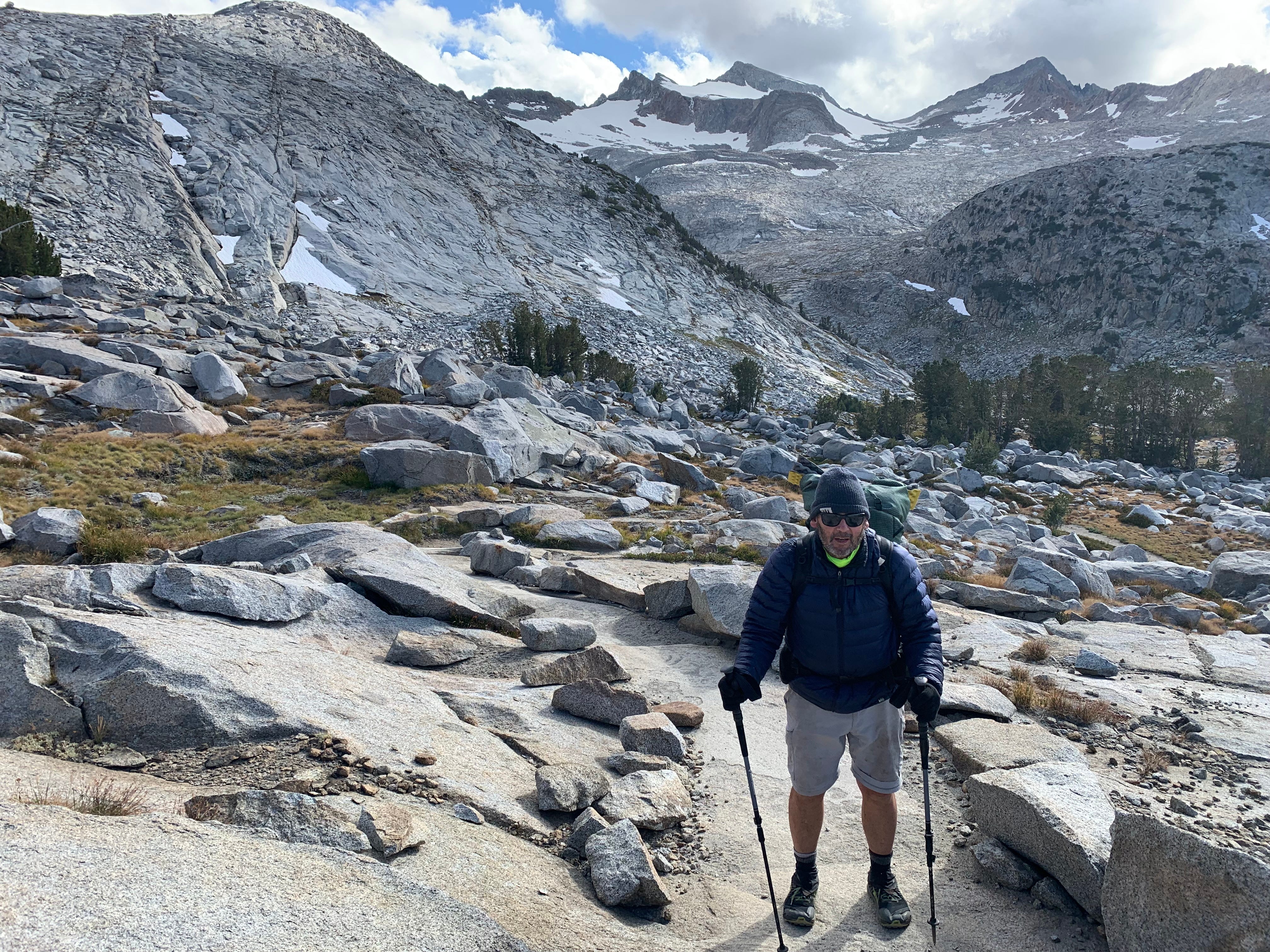
PREVIOUSLY ON “AS THE OREGON BOYS HIKE”:
In August 2025, near the “this-will-never-end” finish of an 11-mile trek down from California’s 14,505-foot Mt. Whitney — 99 switchback in one stretch — my brother-in-law Glenn makes some reference to “next year’s hike.” In a staccato blast, I tell him there won’t be a “next year” —at least for me.
“I’m done,” I say. “You’ll need to find a new partner.”
Though 11 years older, we had basically replicated a 2014 trip, hiking 155 miles over 12 days over eight mountain passes. At age 73 (Glenn) and 71 (me). As we finished, I had less energy than a smoked salmon. Glenn had fallen and broken his hand on Day Two, but soldiered on. I had spent many an afternoon thinking: When Glenn starts talking about the 2026 trip, remember your sense of warmed-over death right now. Say no.
But over the winter, my “no” became a “yes.” Week after week, as I sat in my office and wrote, I kept seeing a guy far older than me walking down our street — no, shuffling down our street — with trekking poles and a small backpack. And each time he came by I thought: He’s doing what he can do. Good for him. And I began thinking: You still have your health. Why waste it?
I offered Glenn an “I’m in” with one qualification. I wanted a much-scaled-down version of our 2025 death march. Since completing the entire 2,650-mile Pacific Crest Trail in 2022, we had, by summer’s end, not only done the 155-mile stretch of the John Muir Trail from McGee Pass to Whitney, but roughly half of Oregon again, only this time north to south, Bridge of the Gods on the Columbia River to Elk Lake (2023 and 2024).
“How about Elk to Crater Lake?” I asked in January.
He was good with that. We started working on a plan. Then I thought: You know, we could always try for a JMT permit — do the section we haven’t done twice —and then, if we get one, figure it was God’s will — ha! — that we return to the High Sierra.
Glenn liked the idea. So the plan became “Oregon, unless we get permits for California.”
Because we’d missed the first window for a JMT permit — people from all over the world covet this trail — we would have but one chance: try to nail one of 10 permits available for a few dozen JMT trailheads two weeks before our start date.
I trained all winter, despite my right knee getting sorer and sorer — the same knee I had had MCL surgery on in 2017. Finally, I had it x-rayed. A physician’s assistant offered three options: (1) do nothing and, if I chose, keep hiking with the pain; (2) get a knee replacement; or (3) try a hybrid plan — a shot of cortisone now, April, and another before I hike, July, then get the knee replacement after football season in December.
I chose door No. 3. Meanwhile, however, I began talking to a handful of folks who’d had knee replacements. I learned two things: First, these people’s pain level and frequency of pain were far beyond mine. And, second, the recovery from such surgery was far longer — and more painful — than I’d thought.
On July 1, I met with the far-younger-than-me surgeon who was scheduled to operate on me. I told him I was summiting Spencer Butte and Mt. Pisgah twice per workout, with 37 pounds in my pack, and was feeling pain I’d rate only 1-3 on a 10-point scale. What’s more, I had walked dozens of rounds of golf since Jan. 1.
“If you were my father,” he told me — that was a first for me! — “I’d say, ‘Come back when you feel pain in your knee all day, when it’s too painful to sleep at night and when you hike those buttes and feel 5-7 pain the entire way.’”
That settled it. No replacement — at least for now. The knee has continued to feel good — when I’m hiking and when I’m not.
Comments
Nothing yet. Say the first thing.
Sign in to join the conversation.