
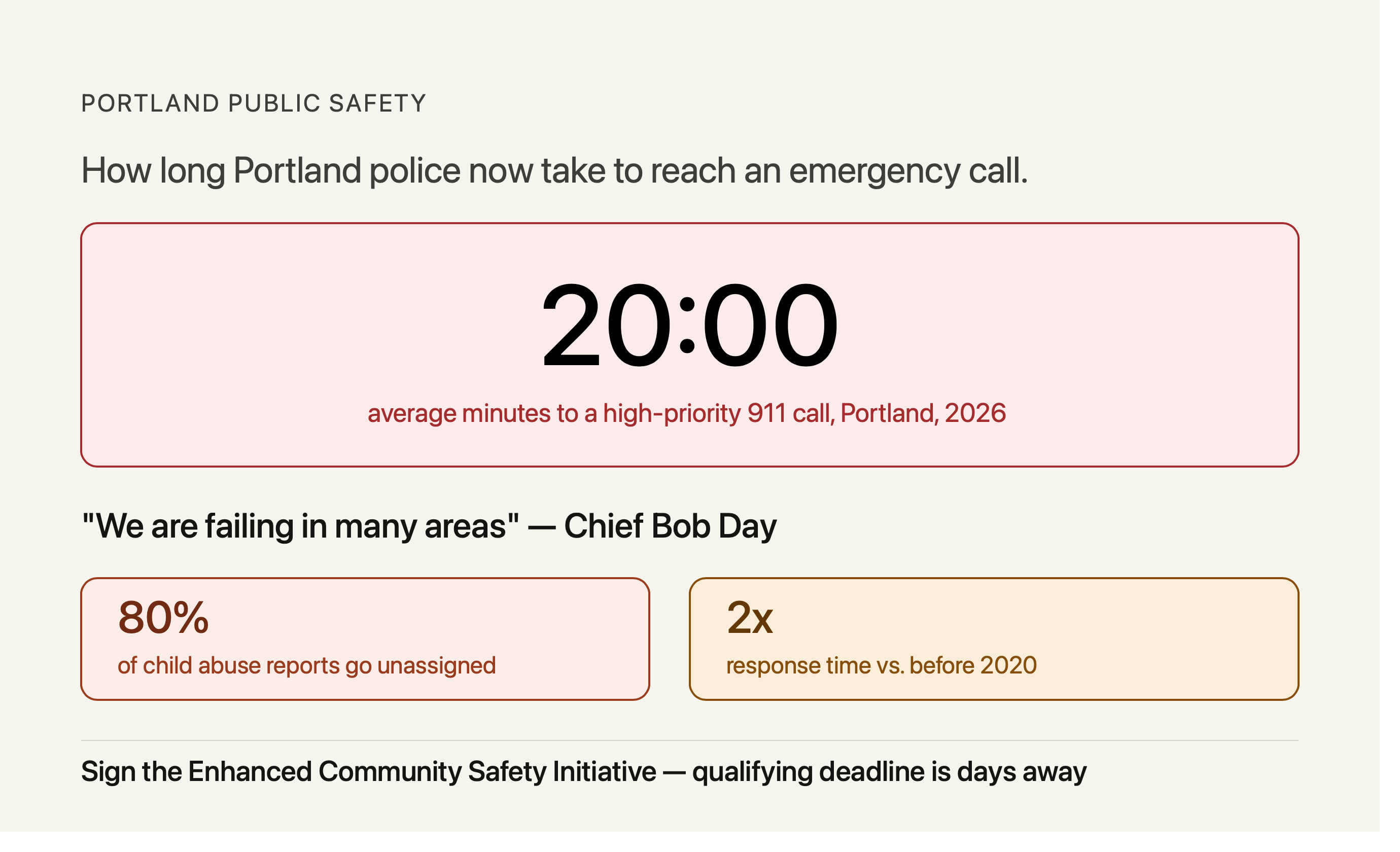
If you called 911 in Portland tonight, the police would take an average of 20 minutes to arrive.
That’s not a guess, and it’s not political spin. It’s the conclusion of a new staffing report commissioned by Portland City Council itself, as reported by The Oregonian/OregonLive.
There is one piece of encouraging news. Dispatchers are doing their part. 911 wait times have dropped thanks to real investment and increased staffing. But the system breaks down at the next link in the chain: once help is promised, it doesn’t show up.
Twenty minutes. Before 2020, that wait averaged eight to ten. The wait has more than doubled, even as the overall number of calls for service has gone down.
“We are failing in many areas.”
Those are the words of Portland’s own Police Chief, Bob Day, on Friday. When the person responsible for a system says it plainly, in public, that’s not a talking point. That’s a warning everyone in this city should take seriously.
Public safety is one of the most fundamental responsibilities any city has. When someone calls because a loved one is in danger, because a violent crime has occurred, or because a child may have been abused, they should be able to expect help to arrive promptly.
The report paints a troubling picture of what happens when there simply aren’t enough officers available.:
About 80% of child abuse reports never get assigned to an investigator.
The vast majority of property crimes go uninvestigated entirely.
Perhaps the most heartbreaking statistic is the first one. Four out of five child abuse reports never receive an assigned investigator. Not because officers don’t care, but because there simply aren’t enough investigators to do the work. The officers who remain are stretched past what any system can sustain and still function. Children deserve better than that. So do the families waiting for answers.
The numbers are stark. The Bureau is authorized for 877 sworn officer positions, but has only 816, and about 100 of those officers are still in training. The gap forces costly overtime, which in turn forces vacancies to stay open to pay for the overtime, creating a cycle that’s difficult to escape.
One of the report’s authors, Nick McDonald, put it plainly: there is no shortcut out of the staffing crisis.
Portland already collects substantial money through a voter-approved tax for the Clean Energy Fund- approximately $200 million annually, nearly seven times the $30 million its proponents told voters in 2018 it would raise.
The Enhanced Community Safety Initiative would dedicate 25 percent of that existing revenue to rebuilding the Police Bureau, hiring approximately 400 additional officers over several years, without raising taxes a single cent.
City Councilor Loretta Smith described the staffing report as a “roadmap” showing what it will realistically take, in both time and resources, to restore the city’s public safety workforce. The Enhanced Community Safety Initiative is a way for Portland to actually follows that roadmap.
There’s a real, fair debate about how much Portland should spend on policing versus everything else, and reasonable people land in different places. That debate is healthy, and it should happen.
But the report establishes one fact that is difficult to ignore: when someone faces a life-threatening emergency today, the average wait for police assistance is 20 minutes. Those minutes matter. They matter to victims of violent crime, to families waiting for help, to children whose abuse must be investigated, and to every neighborhood that expects emergency services to arrive when they are needed most.
None of this reaches the November ballot unless enough Portlanders sign the petition. Signature collection is in its final days.
This is where you come in. It does not matter how strongly you feel about police funding policy once the measure is on the ballot. That conversation belongs to every voter, in either direction, in November. Signing the petition isn’t a vote for the measure. It’s a vote for your own right to decide.
If you believe voters deserve that opportunity, this is the time to act.
Petitions are being circulated by paid and volunteer signature gatherers across the city, including at the Pearl Culinary Farmers Market tomorrow. Stop by, sign, and consider encouraging a friend, neighbor, or family member to do the same.
For more on the initiative, where else to find a petition, and how to help, visit saferportland.com.
Portland has already demonstrated what can happen when the city invests in improving emergency dispatch. Calls are being answered faster than they were just a few years ago. The next challenge is making sure officers are available to answer those calls. Whether the Enhanced Community Safety Initiative is the right solution is ultimately for voters to decide. But voters can only make that decision if the measure qualifies for the ballot. With signature gathering entering its final days, every signature counts.
No posts
Comments
Nothing yet. Say the first thing.
Sign in to join the conversation.