
What’s “rockism”? Without further ado:
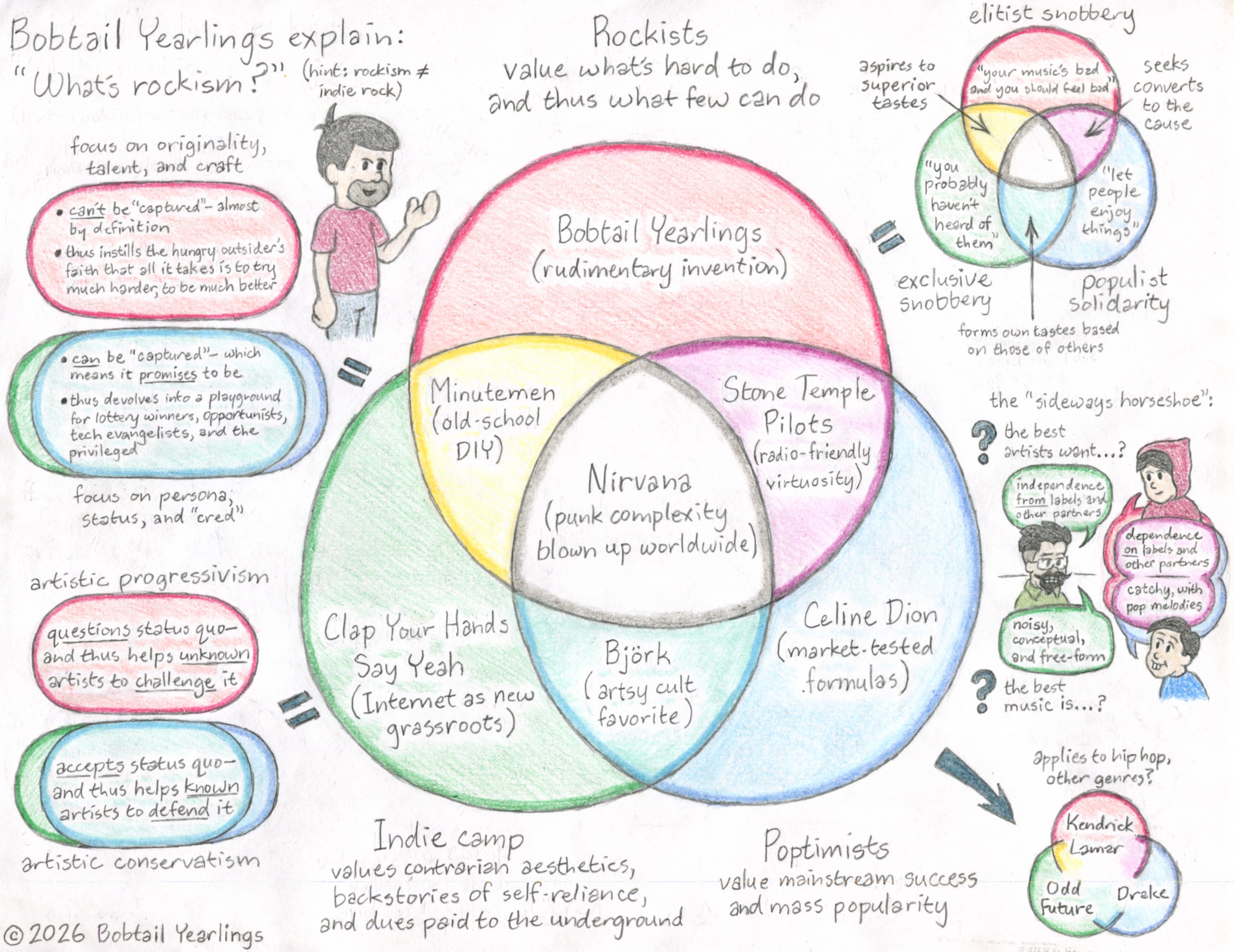
How did I come up with this Venn diagram? I’ll walk you through my line of thinking! To start, let’s observe that rockism is distinct from indie rock, despite many conflating the two: While the former has been utterly defeated, the latter’s ideals are still held aloft in the arts today, alongside “poptimism.” Therefore, rockists make up their own separate camp— even if there’s overlap between all three.
Next, a rockist can’t be some hypothetical bogeyman! There should be a decent chunk of us willing to self-identify as one; otherwise, why even call it out? So this rules out any accusation that a rockist is racist or sexist at heart.
Let’s also agree that it can’t just describe anyone loyal to rock as a sound. After all, every other genre has its loyalists, and we let them be; no one gets bad-mouthed for being a “jazzist.” So rockism isn’t rock loyalism either! There’s more to it than, for instance, preferring loud guitars and drums, or insisting that “real” artists are those who play instruments.
Finally, let’s agree that it can’t be defined by any preference shared by the rival camps. Yes, rockists prize authenticity and praise the live show… but if you haven’t noticed, so do the other two! Such preferences sit in the overlaps; what, then, sets rockism apart?
To extrapolate an answer, we can take any band who was rejected by the opposition, then study why this was the case. Luckily, finding one should be easy, now that indie rock and poptimism have both taken over the arts. We just need to ask: What bands have been hurt by this turn of events? And boy, do I know of one— namely, mine!
See, I’d originally holed up to make Yearling’s Bobtail, my “Ulysses of rock albums,” in faith that, once it was finished, I could win over a gatekeeper or two, who’d then spread the word about “doublespeaker rhyme” and my other inventions. Yet when I reemerged several years later, those elitist gatekeepers I recalled from my youth were nowhere to be found. They’d just… mysteriously vanished.
In their place, the indie camp was raving about the Internet, having declared it the new underground; meanwhile, poptimists were hailing superstars as today’s artistic pioneers. Neither saw any promise in doublespeaker rhyme— not so long as it’s still in a rudimentary stage, anyway. And both were celebrating the demise of some rival way of thinking known as rockism.
Well then… mystery solved! Those gatekeepers I was counting on to be there, who’d vanished? They’re called rockists. And what distinguishes them? They alone will bet on rudimentary invention! Unlike the indie camp, they’re not bothered if it can’t rise up from the bottom— if, instead, it needs to come down from the top, helped by the elites; and unlike poptimists, they don’t mind if it won’t achieve mass popularity.
Now to interpolate! If you’re a rockist, here’s what we can assume about you:
Like the indie camp, you respect the Minutemen for their “econo” work ethic— but in your case, not because it gave them credibility in the ’80s underground.
And like the poptimists, you admire Stone Temple Pilots for their jazz-inflected harmonies— though, again, not because it led to their mainstream success.
However, only you care enough about rudimentary invention to take a chance on low-status no-names like the Bobtail Yearlings.
What core value unites these three preferences? Of course, I already gave away the spoiler in my Venn diagram! So here we are:
Rockists hold out for what’s hard to do. It’s the one measure they trust, above all else, to determine whether an artist or work is worthwhile.
Suddenly, we can see why many conflate rockists with the indie camp: Back when the grassroots was local, building a fanbase on your own took initiative— and so the two often saw eye to eye. But with the grassroots having moved online, today’s indie rock aligns more with poptimism: After all, if everyone now gains fans from the bottom up… then superstars are just indie artists who’ve succeeded more, no?
Okay, so: Earning local support in the ’80s was hard, as was making the album Purple. And if you’ll humor me, the idea for doublespeaker rhyme didn’t come easily either! Bottom line is, if it’s hard enough that just a scant few have the talents, originality, or courage to do it, then doing it is key to winning a rockist’s heart.
Why? Simply put, when millions want what few can have, then we must be told a valid reason why only those few get to have it. And instead of: “Luck, I guess?”— or worse: “Hey, if having greater privilege helped them along… well, what’s it to you?”— it’s far more reassuring to hear: “They alone qualify, because the job truly is that hard!”
This, then, is rockism; this is the standard I was expecting those elitist gatekeepers to uphold, which I couldn’t pin down till they’d vanished— or rather, been banished, as we now know. So I’m doing what I can to bring it back! And if you’re as eager as I am to see a new generation of rockists emerge, some with inventions of their own… then I hope you’ll join me.
These aren’t just feel-good words, by the way; I actually need you to join me! Because, being a rockist— and thus defending the hard thing to do— is itself a hard thing to do. Make no mistake: The rival camps hate our way of thinking; they’re not kidding when they vow to wipe it out! Though, to be fair, we can sympathize…
After all, what makes something harder to do? It’s the fact that it takes up more of one’s lifetime to plan, prepare, and produce. So, unless a greater reward is guaranteed upon success, most artists won’t ever bother; anything that costs more, yet offers no further advantage, is an active dis-advantage. But now, think of what this means: To not favor those few who’ll still do the harder things… is, in effect, to punish them!
Without enough of us holding out for what’s hardest, then, the next Yearling’s Bobtail stands no chance of being heard— as I can attest. Hence the rockist’s ultimatum: “If you’re not with us, then you’re against us.” In our case, it’s just literally true… so how else are we to go about it?! Yet, even we can admit, it’s a foul attitude— and this is why the rival camps hit back with such ferocity…
Still, there’s an ace up our sleeves: The indie camp deplores the elites, right? Much as poptimists do the gatekeepers. In which case, we just need to spread the word:
As the lone defenders of elitist gatekeeping, rockists also stand alone on the right side of history— because historians themselves are elites, and time itself is the final gatekeeper!
So now, if you’re with me… you know what to do. 🙂
No posts
Comments
Nothing yet. Say the first thing.
Sign in to join the conversation.