
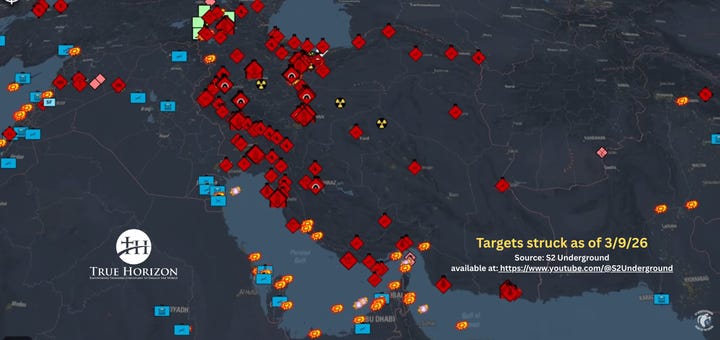
“Operation Epic Fury” — the joint U.S./Israel attack on Iran — kicked off at 1:15 AM eastern time on February 28, 2026. Within a few hours, the Ayatollah Ali Khamenei was killed along with several of the country’s top leaders. Within a few days, the entire military infrastructure, missile production and launch facilities, navy, and security apparatus of the nation of Iran was in shambles.
The justification for this attack on a sovereign nation centered on both its motivational and operational pursuit of nuclear weapons. According to U.S. Special Envoy to Iran, Steve Witkoff on Saturday, February 21st, the Iranians were “probably a week away from having industrial-grade bomb-making material.”
Very few people with a pulse were saddened to hear the news about the decapitation of one of the most notoriously terroristic and brutal theocratic dictatorships on planet Earth. But as Christians who claim to hold to Just War Theory (JWT), what should we be thinking, not only about the decision to strike Iran in this way, but about what will happen as a result?
Both of those are very important questions.
On June 22, 2025, the United States Air Force reached out and touched Iran with “Operation Midnight Hammer.” You may recall that we were told that mission completely “obliterated” any hope for Iran’s quest to obtain nuclear weapons. At the time, I wrote the following:
… anyone with a shred of respect for Just War Theory should have been in a state of existential turmoil [regarding that mission]. Preemptive attacks are very difficult to justify under JWT for one simple reason — going to war is supposed to be a “last resort.”
For that reason, I tread lightly here again. We have been fed intelligence reports in the past (see: “Weapons of Mass Destruction” and the Iraq War in 2003) that were used to justify wars that turned out not only to be started on false premises, but that also became poorly thought-out conflicts that led to disastrous consequences for America, its warfighters, and the people of the other countries involved.
In this case, the intelligence that was reported was that Iran was “very close” to obtaining a nuclear weapon. If that is true (big “if”) — and with all of the above as background — this may be a rare case where JWT does justify a preemptive strike.
The Iran-Hamas-Hezbollah axis is a cesspool of evil that is, and has been, wreaking havoc in the Middle East. Not only so, but the participants would like nothing better than to spread their chaos to the ends of the Earth. If Iran were to obtain a nuclear capability, the threat to any hope for peace in that region — or around the world — would disintegrate.
With all that said, when assessing the decision to launch that mission from a JWT standpoint, it falls well within the boundaries of a morally justifiable preemptive attack based on the following;
The action was meant to avoid a greater threat to millions of human beings.
The action was limited to nuclear facility enrichment and production sites. To the best of our knowledge, there were zero human casualties.
The action was limited in scope and location.
The president specifically stated that we have nothing but love for the people of Iran.
There is no indication that we will continue (as we have in the past) to pursue “regime change,” “nation-building,” insert ourselves into the internal politics of another nation, or put any American troops on the ground for any of those purposes.
If we find that the threat of a nuclear Iran was well-founded — and if all these things remain true — I believe the U.S. attack on Iran fits within the boundaries of just war doctrine. If not, anyone who claims to value JWT needs to stop what they’re doing and be honest with themselves. Do we honor the tenets of JWT or do we mock them?
If the Iranian nuclear program was “completely obliterated” in June, how is it that they were “a week away from having industrial-grade bomb making material” last week?
Or, to put it another way, “Which time were they lying to us?”
This isn’t just a moot point. The United States government executed a preemptive strike on Iran. That’s a big deal when it comes to honoring JWT.
If Iran’s nuclear threat was “completely obliterated” in June, I find it hard to believe they completely resurrected it in eight short months. And if Iran’s nuclear threat was not obliterated in June, why did they tell us it was?
In either case, it makes the decision to initiate preemptive combat operations questionable. And that puts our claim to a just cause on morally rocky ground.
But JWT is not just about the ethics of going to war. There are other considerations that pertain whether the war was begun legitimately or not.
When we think of JWT, most of the emphasis is on the reasons we enter into the conflict (jus ad bello). But JWT consists of much more than that — specifically the morally acceptable way to conduct a war (jus in bello), and the morally defensible plan for its aftermath (jus post bello).
The practices of the United States in the conduct of war does not seem to be of a concern here. No country goes to greater lengths to avoid collateral damage to civilians than the U.S. In fact, there have been many times where that concern acts to the detriment of our own troops.
That said, accidents happen. They already have. We have evidence that an errant munition has already killed 150 girls at a school in Minab, Iran. This is a tragic example of the danger of armed conflict no matter how fastidious you are about conducting it in a morally justified way. In this case, no one suggests or believes that the U.S. deliberately targeted this school. And — unless we learn differently — this accident does not call the morality of the way we are conducting the war into question.
The after-war considerations are another story.

Available for iOS and Android
In my personal opinion, the post-attack considerations of “Epic Fury” are by far the most damning to the defense of this conflict on JWT grounds. In short, no one is complaining about the destruction of one of the most notorious sponsors of terrorism in the world. But there is a huge difference between the autocratic leadership of Iran and the Persian people who used to be aligned with western values of liberty and human rights. We all share hope for the people of Iran to be freed from the shackles of their brutal existence. But what is the plan for them after the shock-and-awe is over?
Here are some things that should have been addressed before the bombs started dropping. Maybe they were but we sure haven’t heard anything about them. Either way, they should be evaluated based on the stated objectives of the operation.
But those objectives are nebulous at best. It’s hard to know if you are adhering to JWT when you don’t know what the goals of the conflict are. But, based on interviews with senior government officials (including the President and Secretary of State), they fall generally within the following categories. Without getting too far down in the weeds …
The elimination and/or prevention of the state of Iran’s ability to obtain nuclear weapons (i.e. nuclear fissile material)
This is notoriously difficult to determine. It’s the reason we are completely unclear about whether or not their nuclear enrichment programs were “completely obliterated” last June or not. If these programs have been moved deep underground, it is impossible to know the extent to which they’ve been damaged. The only way to confirm it is to put inspectors inside those facilities. That would require “boots on the ground” in some capacity. This something we’ve been assured is not on the table, but the specter of it should be too horrific to consider.
The destruction of Iran’s ability to deliver nuclear weapons (i.e. ballistic missiles and launchers)
Before “Epic Fury” began, it was estimated that Iran had about 2,500 missiles in its inventory. As of this writing, they have fired about 500 of those, and launched about 2,000 drone attacks. These attacks have been initiated against 11 different countries (Israel, Kuwait, Saudi Arabia, UAE, Bahrain, Qatar, Oman, Jordan, Iraq, Turkey, and Azerbaijan).
As of today, we know that hundreds of missiles have been intercepted en-route, but there are zero verified reports about how many of Iran’s missiles have been destroyed. However, the numbers must be significant since the regime’s ability to launch missile and drone attacks has been reduced by 90%+ and about 75% of their missile launchers have been eliminated.
The erasure of Iran’s navy — to prevent their ability to obstruct shipping lanes or deliver weapons
Before the conflict, Iran’s navy consisted of 145+ combat vessels (frigates, corvettes, patrol ships, missile boats, and submarines). Of those, at least 30 of their major combatant ships and one submarine have been confirmed sunk. What remains consists of mostly small, fast-attack boats and about 24 submarines.
The final, and most important, goal of this military intervention has been to decapitate the Iranian leadership regime so as to stop its continued exportation of terrorist activities. President Trump has called for the country’s “unconditional surrender.”
How is that going?
In an ideal world, once the senior Shiite theocrats were removed, the liberty-seeking Persian people would rise up and demand a different government. How likely is that to occur?
A majority of the leadership was killed on the first day of the war. That sounded great at first. But when the president called for Iran’s unconditional surrender, the response he got amounted to a giant, “Over our dead bodies!”
Apparently, they meant it.
Shortly thereafter, the Ayatollah Khamenei’s son was installed in his father’s place. Reports about him have suggested that he is his father “on steroids.” The clerical body that announced the new Ayatollah, “did not hesitate for a minute” in choosing a new leader, despite “the brutal aggression of the criminal America and the evil Zionist regime.”
So much for regime change.
Anyone who thinks these folks are going to roll over and play dead, submit to U.S. demands for unconditional surrender, or return to the negotiating table anytime soon, is delusional. If anything, they are going to drag this out as long and as brutally as they can.
Which leaves us with the JWT dilemma — “What comes next?”
By all indications, this conflict is not going to end well or end soon. Iran certainly doesn’t show any inclination to give up. They will crush any internal resistance to their theocracy. They will attempt to engage proxies like Hezbollah and Hamas to do their bidding anywhere, and in any way, they can. There is a good chance they will activate “sleeper cells” to lash out against their enemies both here and in western Europe. Either that, or lone sympathizers will take matters into their own hands.
Apparently, some already have.
As I’ve said before, their theology longs for chaos to usher in a new world under the “Twelfth Imam.”
In the meantime, we are spending what some estimate to be a billion dollars a day executing a war with no end in sight. No big deal, right? I mean, what’s a billion dollars a day when you’re a mere $39 Trillion in debt? We are depleting our weapons and our logistical supply chain with every sortie flown, thereby diminishing our ability to respond to serious threats we face in other places. All this at a time when the conflict is also driving the price of oil through the roof.*
These constitute the real effects of our intervention in Iran. They combine to threaten a painful and ugly existence for all of us, our children, and grandchildren.
For all these reasons, these factors should be part of the moral calculus of engaging in war and considering its repercussions. Weighing the realistic outcomes of war is no less important than considering the justification for entering into it.
JWT is not some antiquated theoretical nonsense that only applies to a less complicated time. Ignoring its implications can be corrosive to any civil society — especially to one that is founded on biblical principles like the Constitutional Republic in which we live.
Declaring war was supposed to be done only after engaging in morally serious deliberations.
Article 1, Section 8 of the Constitution makes that very clear. The power to declare war rests only with Congress, while the responsibility to manage the military belongs to the President (Article 2, Section 2).
Understandably, an immediate threat to the nation could require immediate action. In that case, it was understood that the president could go it alone temporarily if the military was required to defend the nation. But after World War II, presidents began engaging our military in actions that didn’t seem all that “defensive.”
So, in 1973, because of the bickering and infighting that was going on surrounding our involvement in Vietnam, Congress passed the War Powers Act to address this issue. This law requires the president to “notify Congress within 48 hours in writing and include “a full account of the circumstances under which such hostilities were initiated, the estimated scope and duration of such hostilities, and the constitutional and legislative authority under which the introduction of hostilities took place.”
It also requires that “hostilities commenced pursuant to [the Act] shall not be sustained beyond thirty days from the date of their initiation” with another thirty days allowed for withdrawal from the action.
President Nixon vetoed the act. Congress — in a rare display of uniformity — overrode his veto. That’s how important this issue was to them at the time.
Please note that this does not empower the president to engage in war-fighting whenever he wants. That’s unconstitutional.
Nor does it permit him to do whatever he wants for 60 days. That’s not what the War Powers Act says.
A few days ago, a friend texted me to ask why I thought our local congressman “wasn’t standing by the troops.” I wasn’t sure what he meant. Then, I learned that he was prompted to ask me this because our congressman was one of only two Republicans to vote against their own president to limit his actions by invoking the War Powers Act with regard to “Operation Epic Fury.”
This congressman is a West Point graduate who served in the elite 75th Ranger Regiment from 1988-2000 during the first Gulf War. So, it seems like quite a charge to claim he wasn’t “standing by the troops.” He knows more than almost anyone about the costs of going to war.
In fact, I submit he is one who is standing by the troops, regardless of party affiliation. As he put it, “the moral hazard posed by a government no longer constrained by our Constitution is a grave threat.” Equally as irresponsible is “a Congress that is happy to cut checks to fund a war they refuse to authorize.”
In the 80-year timespan since World War II, tens of thousands of Americans have died in various conflicts around the world. Countless more have been maimed and wounded while they — and their families — have suffered as a result. Yet, Congress hasn’t had the integrity to declare war since 1942.
That’s irresponsible moral cowardice.
As a father of five sons who have served on active duty (three of whom still do) at the tip of the spear in every branch of the military except the Coast Guard — in Iraq (multiple times), Afghanistan (multiple times), UAE, South Korea, Indonesia, Syria, Sri Lanka, Taiwan, Egypt and probably other places I don’t even know about — I am sick and tired of politicians who, without any jeopardy to themselves, are happy to catcall or cheer from the sidelines as our young men and women get dragged through the sands of the Middle East. It’s notable that those who bear the brunt of those incursions are rarely the sons or daughters of those who refuse to even take the time to vote.
And let me be clear. I’m not complaining about the mission because I don’t want it to affect my own family. My sons knew the burden of service when the volunteered to join the military. So did every other service member. They took that risk on their own accord and I respect and honor them for doing so.
That’s why they call it “service.”
But they accepted that obligation with the promise that they were serving under the leadership of a morally righteous constitutional system that took their service as seriously as they offered it.
Maybe this war won’t result in “boots on the ground” in Iran. I pray that’s the case. But for those who support our venturing toward another undeclared, undefined, unending war, I also pray that they consider the moral implications that follow.
The least we can do is debate the justice of the cause and the moral weight of its consequences. JWT exists for good reason. The integrity of our republic and the value of human life — both at home and in Iran — are at stake.
* The impact of the price of oil on the world economy — including our friends, allies, and other big players — can be catastrophic. Some respond to this issue by claiming the U.S. currently only receives 5% our our oil from the Persian Gulf region. That’s true. But what about our allies?
The estimated share of oil imports from Persian Gulf / Middle East is as follows:
China: ~45–50%
India: ~55–60%
Japan: ~70–75%
South Korea: ~65–75%
In short, our economy largely depends on a stable petro-dollar, and this conflict threatens to unravel that dominance while — at the same time — the BRICS Alliance (consisting of ten countries: Brazil, China, South Africa , Egypt, Ethiopia, India, Indonesia, Iran, Russia, and the United Arab Emirates) is becoming a larger and more substantial threat to the petro-dollar’s influence on the world economy altogether.
Comments
Nothing yet. Say the first thing.
Sign in to join the conversation.