
This summer, my wife and I were privileged to enjoy a European cruise on the Rhine River from Basel, Switzerland, to Amsterdam. One of the stops we made was in Cologne, Germany. And one of the tours we took was among my favorites of the entire vacation. We learned the history and experienced the grandeur of Kölner Dom — the massive cathedral of Cologne that towers 515 feet above the city. That building holds a history that is a microcosm of how God works in this world in ways we can barely comprehend.
Builders laid the foundation stone for the cathedral on August 15, 1248. It was completed on October 15, 1880, a mere 632 years later. The history of the fits and starts that occurred along the way would fill a book. But the sentiment that describes it is in some ways the same as for every other cathedral like it. Ken Follett captures that idea in his masterpiece novel published in 1989:
“A cathedral is built for the glory of God — but also to stand as a monument to the ambition of those who build it.” ~ Ken Follett, The Pillars of the Earth
Kölner Dom lives up to that description in every way. But here, I’d like to focus on the events surrounding the cathedral during World War 2.
Hitler and the Nazis not only fancied themselves racially superior, but also culturally superior, to the rest of the world. Part of their shtick was to elevate art, architecture, and education as a way to preserve the “true” German values of strength, purity, and heroism.
In the early stages of the war, before the bombing of key German industrial centers began, the Nazi regime knew what would soon be coming their way. So, as part of his effort to preserve the culture, Hitler ordered that all the stained-glass windows in Cologne’s cathedral — and many other German sites like it — be removed from the building. The windows were taken out and stored in underground caves and mines, monasteries, and church basements far away from the industrial center of the city.
It’s important to realize that the Nazis didn’t do this out of any sense of reverence for the holiness of the site. They couldn’t have cared less about that. They took this action for purely cultural and selfish reasons. Their goal was to preserve these masterpieces so that after they won the war, they could flaunt them as a monument to their victory and the gloriousness of their cause.
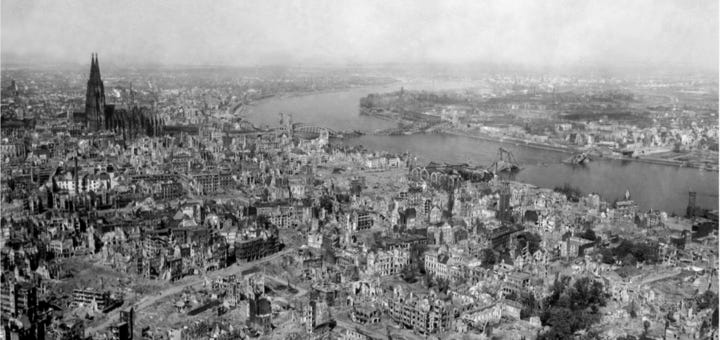
As you can see in the photo above, Kölner Dom juts into the air above every other building on the Cologne skyline. Looking down on the city from above, its distinctive black color and shape made it stand out in an equally obvious way. For this reason, the British Air Force made a decision early-on to never drop bombs on the cathedral.
But just like the Nazis’ reason for saving its windows, the British motivation to spare Kölner Dom was far from reverent. Instead, it was tactical. Having such an unmistakable point of reference on the ground is a gift to a bomber pilot. It’s an easy-to-find reference point he can use to quickly recalibrate his bombing coordinates and thereby locate his intended target, especially on days when partial clouds or smoke may be obscuring the target area.
And the decision paid off.
In the end, Cologne was one of the most heavily bombed cities in Germany. More than 90% of the city was destroyed. Yet, Kölner Dom dominated the skyline even more than it had before. And there’s an important reason it still does.
Because it was near the center of the city, the cathedral was adjacent to several strategically important targets. The Rhine River bridges to its east and the city’s central train station were within the blast radius of some allied bombs. For that reason, and due to the inaccuracy of weapons systems of the time, some stray bombs did cause damage to the cathedral.
One such errant bomb actually struck the north face of the building. The ensuing explosion rocked its walls and, under normal circumstances, would likely have caused it to collapse.
A blast that large on the walls of any structure sends out a shock wave that causes a massive overpressure of the air inside. The walls of buildings are designed to carry enormous forces vertically, but not horizontally. Trapped inside, the force created by the overpressure has no place to go but out. Since the walls are not designed to withstand outward pressure, they simply succumb. They explode horizontally and the entire building becomes a pile of rubble within a matter of seconds.
But Kölner Dom didn’t do that. And there was a very good reason why.
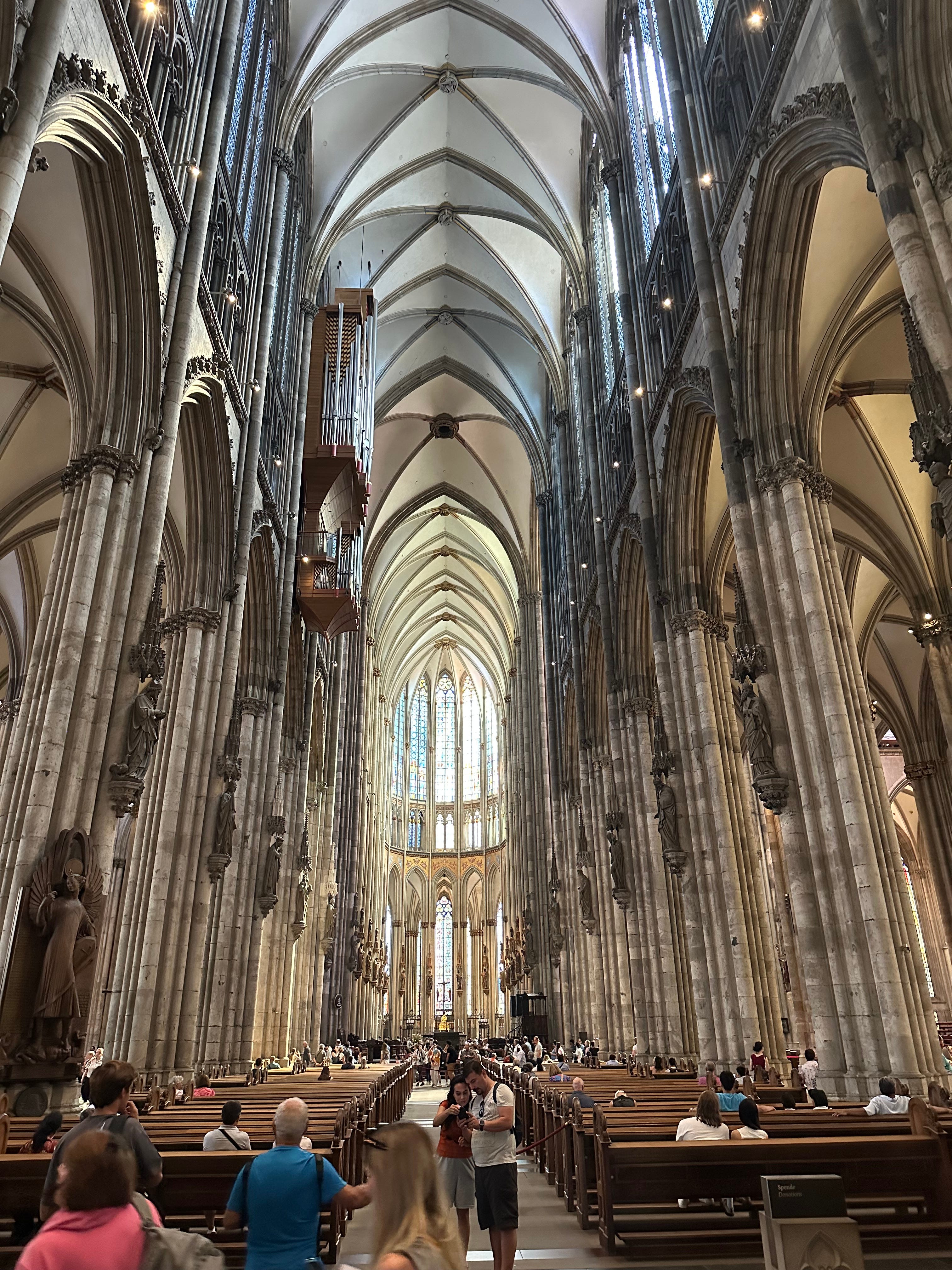
The overpressure wasn’t trapped inside the cathedral’s walls — because Kölner Dom had no windows.
On the day my wife and I visited Cologne, our city tour guide was an Austrian twenty-something young man who was about to finish his PhD in philosophy. Knowledgeable, friendly, and quite a storyteller, he entertained us for almost three hours. But during his time with us, I noticed a distinct angle with which he shared any information about the cathedral, the Christians who built it, or “religious” people in general.
He always referred to them in the third person. His repeated use of “they” told me he was — like most young Europeans today — not one of “them.” Firmly ensconced in the secular, his language led me to believe he was some kind of agnostic or atheist.
Yet, when he told us the story of Kölner Dom, the Nazis, and the British bombers, he concluded the account with this (as close as I can recall):
“It’s ironic that in the midst of the violence, death, and destruction of a World War, the evil intentions of the Nazis, and the errors of some British bomber pilots — that all of it combined to preserve this church. And when you go inside, you will see why. The builders of this cathedral believed that it exists for only one reason — as a support system for the windows. For them, the light shining through inspires all who enter with the overwhelming presence of their God.”
It’s not often you hear young atheists paraphrasing Romans 8:28.
On September 21st, I was reminded of our tour of Cologne. Ten days earlier, we witnessed one of the most horrific scenes ever broadcast live when 31-year-old Charlie Kirk’s neck exploded in gushing red. Predictably, and understandably, the reaction was the same as it always is: “Why would God allow such a horrible thing to happen to such a good man — a man with a wife and two beautiful young children — in his prime?”
We have academic answers to the question. We have pastoral commitments to his loved ones. But still, we never stop asking, “Why?”
We must consider the answers to those kinds of questions before we experience some life-shattering occurrence in our own lives or in the lives of others. And one of those answers is that we cannot see, and may never know, the consequences of the horror or how God may use it sometime in the future, perhaps long after we depart this life.
It’s hard to imagine how the aftershocks of such a horrific event may impact the future in ways we cannot imagine. To claim it will, sounds like a copout. We want answers now. We’re not good at waiting.
But in this case, we only had to wait eleven days.
Who could have imagined that just eleven days after Charlie Kirk’s shooting, over 100 million people around the world would witness another live event broadcast from State Farm Stadium in Glendale, Arizona — an event in which those 100 million people would see some of the most powerful people on the planet boldly and unapologetically proclaim the Gospel to a world focused on their every word.
That’s an impact no previous evangelist has had over the entire span of his or her life.
Who would have imagined that those 100 million people would see that promising young man’s widow show the kind of forgiveness that can only come from Christ offered to a murderer who never asked for it and shows no signs of ever doing so.

God doesn’t waste anything. He will redeem every circumstance. Though it’s hard for us to see or imagine how that is in the midst of the war, destruction, violence, and pain we perpetrate on one another, he is sovereign.
The doubter can deny that at his peril. The believer can bask in the glory of its truth.
Either way, his light will shine — if we only have eyes to see it.

Available for iOS and Android
Comments
Nothing yet. Say the first thing.
Sign in to join the conversation.