
This playlist presents a compelling cross-section of contemporary creative music, bridging the pioneering electric fusion of the late 1960s with the sophisticated and fluid improvisations of 2026. At its core, this selection celebrates the “collaborative impulse” The music here traverses the boundary between the composed and the unscripted. By juxtaposing the foundational studio-as-instrument techniques developed by Miles Davis and Teo Macero with the modern approaches of labels like 577, Adhyâropa, and Libra, this sequence highlights a group of artists who use the jazz idiom not as a static historical artifact, but as an ever-shifting architecture for personal expression and sonic exploration.
AUDIO
PLAYLIST
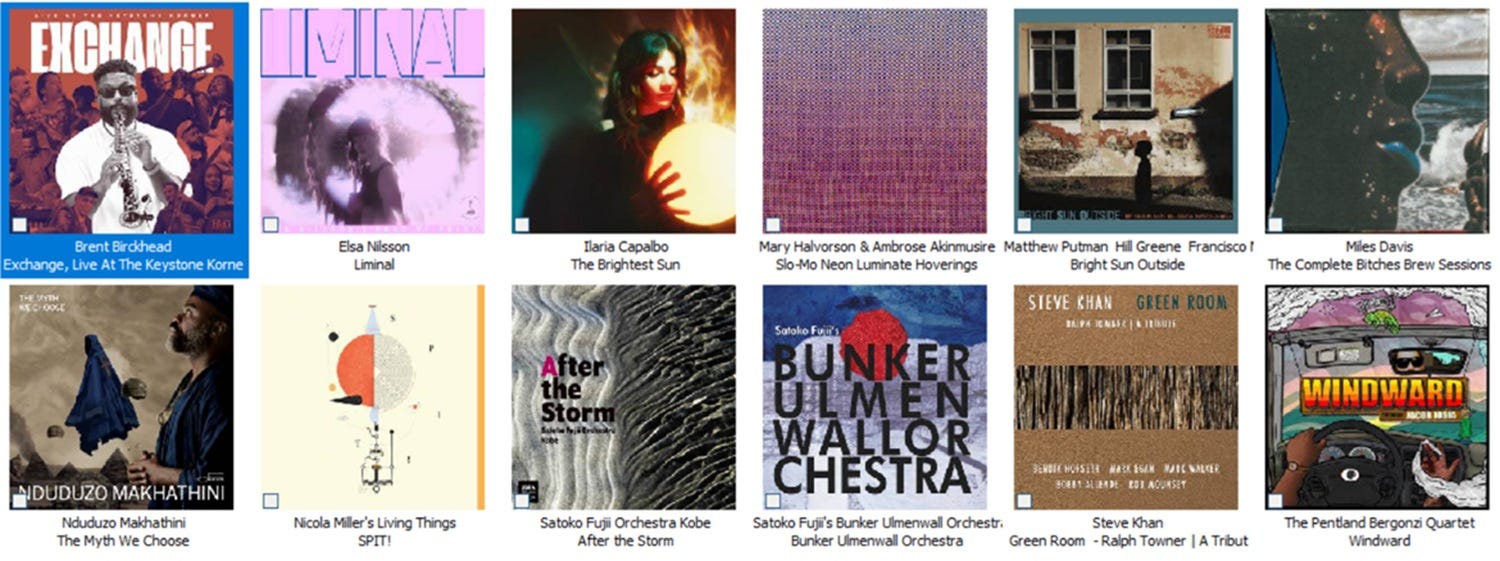
Nduduzo Makhathini “Tethered” from The Myth We Choose (Blue Note Records) 00:00
Matthew Putman, Hill Greene, Francisco Mela “Hidden Secrets” from Bright Sun Outside (577 Records) 05:34
Steve Khan “Green Room” from Green Room - Ralph Towner | A Tribute (Blue Canoe Records) 15:15
The Pentland Bergonzi Quartet “O Hey, Earthling. Salut!” from Windward (GroundTone Records) 23:23
Satoko Fujii Orchestra Kobe “After The Storm 3” from After The Storm (Libra Records) 28:55
Ilaria Capalbo “Ode” from The Brightest Sun (Bluenord Records) 38:57
Nicola Miller’s Living Things “Spit!” from SPIT! (Watch That Ends The Night Records) 44:49
Brent Birckhead “Cacao” from Exchange, Live At The Keystone Korner (Self Released) 54:55
Satoko Fujii’s Bunker Ulmenwall Orchestra “Yamantaka” from Bunker Unmenwall Orchestra (Libra Records) 1:09:10
Mary Halvorson & Ambrose Akinmusire “Slo-Mo Neon Luminate Hoverings” from Slo-Mo Neon Luminate Hoverings (Nonesuch Records) 1:20:45
Elsa Nilsson Band Of Pulses “Andetag” from Liminal (Adhyâropa Records) 1:28:26
Miles Davis “Sanctuary ” from The Complete Bitches Brew Sessions (Columbia/Legacy) 1:35:37
Miles Davis “Recollections” from The Complete Bitches Brew Sessions (Columbia/Legacy) 1:46:31
NOTES
This new album released in June 2026, marks the fourth Blue Note album from the acclaimed South African pianist, composer, and healer Makhathini. Co-produced with his son, Thingo , the double album represents a significant evolution in his sound, weaving his signature spiritual jazz language with contemporary electronic textures, neo-soul influences, and a more prominent use of vocals. Beyond its musical innovation, the project functions as a philosophical "ritual" that interrogates the role of song in shaping cultural memory and legacy, with Makhathini arguing that by consciously curating our musical narratives today, we are effectively designing the myths that will define the future. Featuring his working trio alongside a diverse array of guests such as Shabaka Hutchings and Black Coffee, the album serves as a profound, melody-driven meditation on interconnectedness, forgiveness, and the responsibility of the artist to envision a more hopeful world.
The trio, which marks the first-ever collaboration between Putman and Mela, was recorded at the 577 Records studio in Brooklyn, capturing a series of spontaneous, highly intuitive improvisations. The album showcases a blend of lyrical melodicism and avant-garde exploration, with the instrumentation notably including Mela’s use of both percussion and whistle alongside Greene’s foundational, resonant bass and Putman’s expansive harmonic approach. The recording is recognized for its emphasis on conversational interplay and shared spiritual energy,
A poignant digital-only single released by guitarist Steve Khan as a heartfelt tribute to the legendary multi-instrumentalist and composer Ralph Towner, following Towner’s passing in January 2026. The piece serves as both a musical homage and a reflection of the deep, decades-long friendship between the two guitarists, who first met in New York in 1970. Named after a track from Towner's own discography, the single encapsulates Khan’s profound respect for Towner’s status as a visionary innovator who helped bridge the gap between classical, jazz, and world music. Through this release, Khan honors the legacy of a mentor and peer whose career, defined by his work with the Paul Winter Consort and the pioneering ensemble Oregon, significantly shaped the landscape of modern acoustic music.
A collaborative album by the Pentland/Bergonzi Quartet, featuring tenor saxophonist Jerry Bergonzi, bassist and composer Sean Pentland, pianist Julian Shore, and drummer Richie Barshay. The project originated from a planned German tour that was tragically cancelled following the unexpected death of a close friend and colleague, Sebastian Nay; consequently, the nine-track album serves as a dedicated homage, presenting the repertoire that was originally intended to be performed on that tour. The music is defined by Pentland’s intricate compositions, which integrate complex string-writing influences—ranging from Bartók and Mahler to modern textures—with Bergonzi’s signature harmonic stretching and improvisational mastery. The quartet’s interplay is characterized by a balance of impartial counterpoint and polyrhythmic depth, capturing a solemn yet vibrant musical dialogue intended to honor the memory of their late peer.
The latest expansive project from the Satoko Fujii Orchestra Kobe, a large ensemble that showcases Fujii’s distinct approach to big band composition and avant-garde arrangement. Consistent with her broader work, the album navigates the space between rigorous, structured composition and the wild, unpredictable energy of free improvisation, utilizing the orchestra’s diverse instrumentation to create shifting textures and complex harmonic layers. As a project, it reflects Fujii’s ongoing commitment to pushing the boundaries of the jazz orchestra format, balancing delicate, introspective passages with the raw, explosive power characteristic of the Kobe ensemble’s performances. The album stands as a significant addition to her discography of large-scale works, continuing her legacy of blending traditional big band influences with the bold, non-conformist spirit of contemporary creative music.
The second album from the Stockholm-based Italian bassist and composer Ilaria Capalbo. Recorded at Ingrid Studios in Stockholm, the project features a quintet consisting of Capalbo on double and electric bass, Thomas Backman (alto sax, clarinets), Fredrik Nordström (tenor/baritone sax), Andreas Hourdakis (guitar), and Fredrik Rundqvist (drums). Inspired by the transformative experience of motherhood, the compositions were crafted in fragmented, raw sessions, moving away from the more structured approach of her 2022 debut, Karthago. The music integrates influences from contemporary jazz, free improvisation, indie, and experimental rock, characterized by shifting dynamics that flow between intimate, delicate melodic themes and eruptive, high-energy textures. The ensemble, which gained international attention after their performance at jazzahead! 2025, emphasizes spontaneous, conversational interplay, reflecting Capalbo’s focus on the vulnerability and radical shifts in identity inherent to her creative process.
Celebrated Canadian saxophonist and composer Miller launched her debut, Living Things in 2024 with the Cacophonous Revival imprint. Now, the award-winning artist has assembled the same band for a second outing. Miller’s all-star ensemble includes Doug Tielli on trombone , bassist Nicholas D’Amato , drummer Nick Fraser as well as bass clarinetist and saxophonist Frank Gratkowski . Gratkowski also served as Miller’s mentor throughout her Masters’.
SPIT! is a more extrovert affair than its predecessor foreground both layered, intricate avant-jazz ensemble writing and fiery improvisation alongside everyone’s keen ears for texture and timbre. The preview track/ lead single which is the first of the three-part “Telecommunications” series—exemplifies these traits, beginning in total abstraction and subsequently converging on slow groove. This serves as a foundation for both Miller’s careful compositional approach and also impassioned spontaneity from her and her bandmates.
A vibrant live album from saxophonist, flutist, and bass clarinetist Birckhead. Recorded at the historic Keystone Korner in Baltimore, the project serves as the culmination of Birckhead’s ongoing “Exchange” performance series, which was designed to foster collaboration and highlight the diversity of the Baltimore jazz community. Produced by NEA Jazz Master Todd Barkan, the album features a revolving cast of talented musicians—including pianist José André Montaño, bassist Romeir Mendez, drummer Devron Dennis, and percussionist Themba Mkhatshwa—alongside guest appearances from artists such as Sean Jones, Warren Wolf, and Imani-Grace Cooper. The record moves fluidly across genres, blending traditional jazz, R&B, Latin, and African rhythms to create a communal, high-energy atmosphere that emphasizes the raw, spontaneous dialogue between the performers and their audience. Through a mix of original compositions and soulful reinterpretations of classics, the album functions as a tribute to Baltimore’s rich jazz heritage and a testament to the power of music as an inclusive, living experience.
A sprawling two-disc set that documents a performance at the renowned Bunker Ulmenwall jazz club in Bielefeld, Germany. The album is uniquely structured: the first disc features an expansive rendition of Fujii’s epic composition “Shiki,” a multi-part work exploring the cycles of life, while the second disc departs from Fujii’s singular leadership to showcase compositions by four members of the ensemble—Andreas Kaling, Natsuki Tamura, Luise Volkmann, and Fujii herself. By allowing different band members to take the podium, the project shifts the focus from a traditional composer-led big band to a communal exploration of sound, utilizing the orchestra’s diverse instrumentation to bridge the gap between structured orchestration and spontaneous, avant-garde improvisation. It stands as a profound testament to Fujii’s collaborative philosophy, highlighting the unique voices within the ensemble while maintaining the high-intensity, boundary-pushing energy that has become a hallmark of her large-scale projects.
The project represents the culmination of a creative partnership that began in 2009, following two previous, unrealized attempts to capture their duo chemistry on record. The music—comprised of four compositions by each artist and one collaborative piece—was rehearsed in January 2025 and recorded the following day at Sear Sound in New York City. The album is notable for its expansive, impressionistic textures, marked by Halvorson’s signature use of delay and effects, and the introduction of effects processing to Akinmusire’s trumpet playing. Characterized by a profound ease of communication and a shared aesthetic of patient, microtonal exploration, the record captures an intimate improvisational dialogue that shifts fluidly between calm, reflective passages and moments of jarring, dissonant beauty.
The latest studio album from flutist and composer Nilsson’s project, Band of Pulses. Featuring a quartet that includes pianist Santiago Leibson, bassist Marty Kenney, and drummer Rodrigo Recabarren, the album serves as a deep dive into the psychological and physical experience of “liminal spaces”—the transitional periods between states of being. The music utilizes the unique textural combination of flutes (with effects) and a rhythmically adventurous ensemble to explore complex themes of personal and societal change. By blending elements of contemporary jazz with fluid, modular compositional structures, the album emphasizes the “pulse” as a bridge between structured melodic development and spontaneous, non-linear improvisation, capturing a sense of fragility and the possibility of renewal.
Released in 1998 these tracks are from an expansive four-disc box set that documents the transformative period of Miles Davis’s career between August 1969 and February 1970. While it includes the iconic double album in its entirety, the collection serves primarily as an architectural study of Davis’s transition into electric jazz fusion, featuring previously unreleased takes, outtakes, and session fragments that reveal the studio alchemy of Davis and producer Teo Macero. The set captures a period of intense experimentation characterized by large, shifting ensembles, multiple electric keyboardists, and the pioneering use of tape editing and post-production effects. By mapping the evolutionary path from the improvisational sketches of the Bitches Brew sessions to the subsequent studio explorations that birthed albums like Big Fun and Live-Evil, the box set provides an essential, exhaustive look at the creative process that effectively dismantled traditional jazz boundaries and laid the foundation for the fusion movement. "Sanctuary" and "Recollections" represent two distinct facets of the expansive improvisational landscape documented in the box set . "Sanctuary," a composition by Wayne Shorter, was recorded on August 19, 1969, during the core Bitches Brew studio sessions; it is notable for its ethereal, spacious quality and was included on the original 1970 double album, serving as a contemplative, ballad-like anchor amidst the project’s more aggressive, rhythmically dense material. Conversely, "Recollections," a composition by Joe Zawinul, reflects the experimental spirit of the broader sessions; it appears in this collection as an 18-minute-plus track (originally intended for the Big Fun album) that showcases the ensemble’s ability to sustain long-form, atmospheric interaction. While "Sanctuary" serves as a landmark example of Davis’s 1969 studio fusion, "Recollections" highlights the fertile, post-album recording period (early 1970) where the group continued to push the boundaries of collective improvisation, deep texture, and electric-acoustic layering.
Thanks for reading Different Noises! Subscribe for free to receive new posts and support my work.
Comments
Nothing yet. Say the first thing.
Sign in to join the conversation.