
A quietly adventurous thread runs through this edition of World of Jazz, tracing how improvisers and composers adapt their music into something reflective yet forward leaning. Most of the selections are selected from extant releases that show where exploratory music is heading — flute driven improvisations, spacious rhythmic architectures, pointed small group dialogues and electronic inflections. The playlist also includes two earlier innovators, a specific reminder that today’s practitioners are working inside a continuum shaped by those players who expanded the language of jazz decades ago.
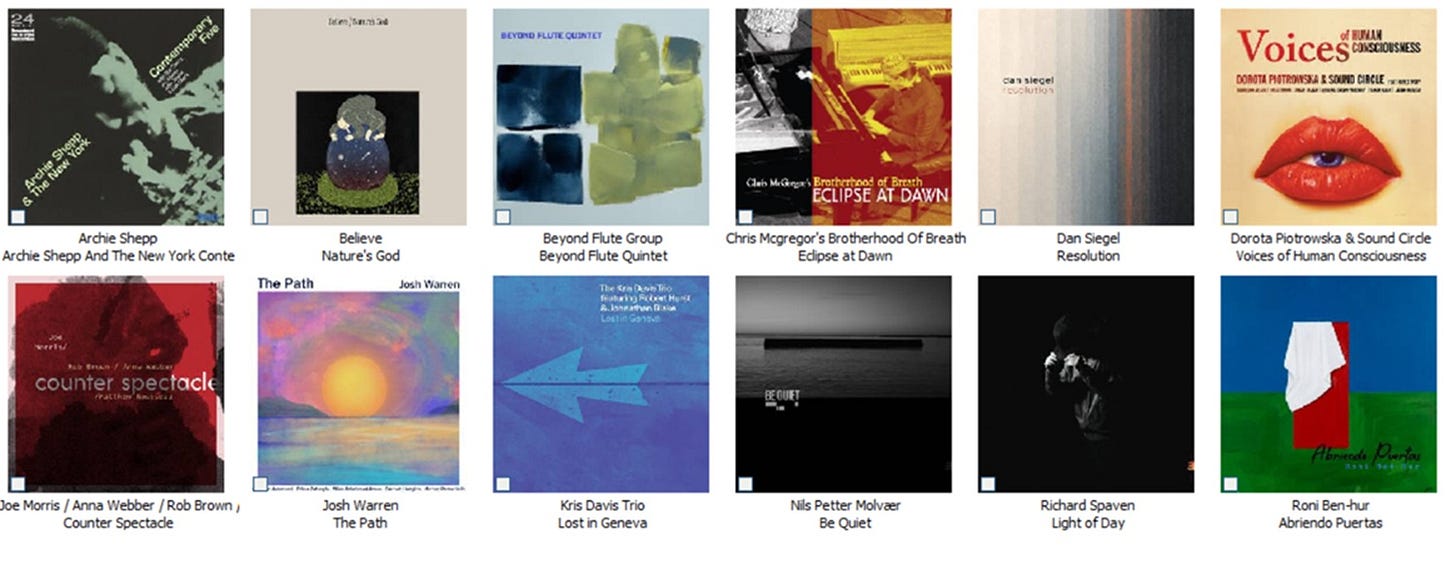
From Norwegian fjords to Arabic rhythms; Polish lyricism to the traditions of American jazz this album brings together talented musicians from different backgrounds who aren’t afraid to let improvised musical dialogue lead their work and break conventions. Brought together by bandleader Dorota Piotrowska, this album features improvised compositions by Piotrowska, Greg Osby, Hildegunn Øiseth, Tarek Yamani and work from Ameen Saleem, Sanem Kalfa, Barbaro Crespo and Leszek Możdżer. Recorded over three days in Poland, at 432 Hz, Piotrowska and her ensemble prove that powerful musical experiences are a reflection of the technical mastery and cultural richness of those involved. The international collective, from the USA, Poland, Lebanon, Cuba, Norway, and Turkey create a unique sonic space in which improvised music becomes a universal language of communication. Truly a perfect album for a show called World of Jazz.
Rooted in the jazz tradition but drawing influences from all over the map,
Josh Warren is an award-winning Canadian bassist, composer, and arranger
originally hailing from Victoria, BC. Since moving to Toronto to study with Canada’s finest, he’s shared the stage and recorded with a plethora of Grammy-nominated and JUNO award winning musicians and performed all across the country, playing at iconic venues and major festivals from coast to coast. His debut album engineered and mixed by Patric McGroarty) features an award-winning cast of young lions on the Canadian jazz scene, and blends the jazz tradition with shades of Pat Metheny, Stevie Wonder and Snarky Puppy. Eclectic, groove-oriented and interactive, this record is a musical coming-of-age, with the core idea of “The Path” representing the journey of growing into who you’re meant to be.
This 2026 11th Street Music session captures Cheryl Pyle’s latest flute‑forward ensemble in full exploratory flow, with Pyle and fellow flute players Sylvain Leroux and Mary Cherney weaving shifting timbral layers around the contrasting reed voices of Michael Eaton and Ras Burnett; the result is a vivid, textural improvisation document that highlights the group’s unusual instrumentation and its commitment to open‑form, conversational interplay.
Laurence Pike (drums/percussion), Clayton Thomas (bass), Novak Manojlovic (piano), Peter Farrar (saxophone) make up the astonishing jazz/improv quartet Believe. Based in Sydney, Australia this release is the second volume of a two-album release in collaboration with New York’s Relative Pitch Records and Melbourne’s Ramble Records. John Shand of The Sydney Morning Herald wrote of the first release,“I know of no more sophisticated activity of which humans are capable than freely improvising at this level.” ‘Nature’s God’ captures another dimension to a band that is fast becoming one of the most respected creative musical groups in Australia. The band connects the spectrum of contemporary creative sound making with the fluid, anything is possible momentum of free jazz. When benchmarks are Albert Ayler and The Necks, and you intend to play for the universe, not the algorithm, the remarkable is possible. For the past three and half years the quartet has committed to a musical process of learning, exploring, experimenting and growing in public.
Roni Ben-Hur-guitar, Alejandro Falcón-piano, Pedro Pablo Gutiérrez-acoustic bass, Ruy López-Nussa-drums, Octavio Rodríguez Rivera-percussion, Emir Santa Cruz-tenor saxophone, and, Osdalgia Lesmes-vocals. Abriendo Puertas is part of Cuban Notes, a recording series co-produced by Johanan “Jo” Bickhardt, founder of Dot Time Records, and guitarist Roni Ben-Hur. This release was recorded in Havana, in collaboration with Cuban musicians, and approaches that countries music as a way of thinking and of inhabiting the world.
After four decades of recording, pianist, keyboardist, composer, and producer Dan Siegel stopped trying to perfect everything. On Resolution, his forthcoming nine-song contemporary jazz album due September 11, Siegel left more of the original performances intact and stopped ironing out every imperfection. “I have a tendency to overwork things, to iron out all the little kinks,” he says. “That kind of leaves it without humanity — a little too perfect and polished. This is a little bit raw and rough around the edges in places.” The title came from the opening track, where Siegel hears “something sort of grand” in the ending and a sense of resolve by the time the tune lands. Built around modal harmony, the piece gradually settles into place. Resolution centers on Siegel alongside bassist Brian Bromberg and drummer Jay Bellerose. Guests include percussionist Lenny Castro, vibraphonist Craig Fundyga, guitarists Dean Parks, Allen Hinds, and Matt Hornbeck, steel guitarist Greg Liesz, accordionist Patrick Warren, alto saxophonists Alex Hahn and Chris Sullivan, tenor saxophonists Tristan Cappel and Jacob Scesney, drummer Jimmy Branly on “Give or Take,” and vocals by longtime collaborator Rogerio Jardim.
Spaven’s new one sets out a clear statement of identity from a drummer who has shaped the intersection of jazz, hip hop and club‑derived rhythm for over twenty years. The album centres his control of pulse, density and feel, with grooves acting as the structural core around which harmony, texture and form are built. Across nine tracks — featuring collaborators including Oli Rockberger, Petter Eldh, Stuart McCallum, Verneri Pohjola, Nils Petter Molvær, Wildchild and John Metcalfe — Spaven moves between atmospheric detail, broken‑beat precision and eclectic ensemble writing. The result is a focused, inside‑out set where technique serves expression and the music maintains a steady centre of gravity even as it shifts across styles.
Nils Petter Molvær’s Be Quiet brings together nine duo encounters recorded in locations from Bangkok and Rome to Berlin, Munich and London, each shaped by the collaborator’s own sonic world and Molvær’s unmistakable trumpet voice. Working with artists including Chang Jing, Martux_m, Miki Yui, John Paul Jones, Marilyn Mazur, Imogen Heap, Soheil Shayesteh, Alva Noto and Anja Lechner, the album moves through electronica, ambient detail and improvised interplay, favouring close‑up textures and real‑time responsiveness. Accompanied by a documentary from Per Manning, the project captures Molvær stepping into different environments and disciplines, building a set that stays intimate, spatial and in constant motion.
Kris Davis’ Lost in Geneva documents the deep rapport she’s built with Robert Hurst and Johnathan Blake after several years of intensive touring, presenting a trio that’s settled, alert and able to reshape material from the inside. The album mixes new Davis compositions with pieces by Hurst, Blake and Morton Feldman, highlighting the group’s focus on detail, structure and collective discovery. Across the set the trio moves between groove‑centred writing, open improvisation and reimagined earlier works, showing how their shared language has sharpened through constant performance. Lost in Geneva marks the trio’s second release and captures the clarity, flexibility and close‑knit interplay that have earned them significant acclaim on stage.
Recorded live at London’s ICA in 1970, Eclipse At Dawn captures the Brotherhood of Breath at full, combustible stretch: McGregor’s South African rhythmic drive meeting the raw, free‑wheeling energy of the British avant‑garde. The set moves between township‑rooted themes, eruptive horn writing and open improvisation, with the band’s trademark mix of jubilation and volatility. What comes through most clearly is the collective force of the ensemble — a sound that can pivot from tight, dancing riffs to explosive freedom without losing its momentum — making Eclipse At Dawn one of the most vivid documents of the group’s early period.
This new release emerges from Joe Morris’ renewed commitment to Free Music as a form of ethical and imaginative resistance — a practice he frames as supporting non‑violence, justice, and the possibility of clearer thought in a distorted world. The quartet’s music reflects that stance not through messaging but through method: spontaneous, alert, and built to change, with composed cues acting only as points of departure. Morris’ guitar sets the structural tension, Anna Webber’s reeds bring pattern and edge, Rob Brown adds a more lyrical, mobile counterline, and Matthew Russeau keeps the whole thing responsive and grounded. The result is exactly what Morris describes as a “continuous beginning” — music that stays open, forward‑leaning and ready to remake itself with every performance, a counter‑spectacle expressed through collective sound rather than rhetoric.
This set was recorded in Copenhagen in 1963 and originally released on Sonet (Denmark). It’s one of the core documents of the group’s brief but pivotal existence — a band that linked the emerging New York avant‑garde with the Scandinavian free‑jazz scene, and gave Shepp, Don Cherry and John Tchicai a platform to push past post‑bop structures while still working inside tight ensemble writing. The album mixes sharp, riff‑based themes with open improvisation, showing the group’s balance of discipline and volatility. Cherry’s bright, clipped phrasing, Tchicai’s dry, linear tone and Shepp’s broader, more vocalised approach create a three‑way front line that’s already distinctive, supported by a rhythm section that keeps the music taut and forward‑moving.
Comments
Nothing yet. Say the first thing.
Sign in to join the conversation.