
The “peace president” strikes again, unleashing military violence in the capital of another country, without the legally required authorization by Congress, and kidnapping the president of that country. If there were any justice in the world, this action would lead to a trial before the International Criminal Court in the Hague for the “peace president” and his “secretary of war,” who is always looking for ways to increase the lethality and “warrior ethos” of the American military.
Of course, the United States does not recognize the ICC, just as it has declined to sign the Treaty on the Prohibition of Nuclear Weapons, already signed by 95 countries. In those two dimensions, we are already an outlaw nation. This attack on Caracas and the kidnapping of President Nicolás Maduro is the most naked form of regime change, by a nation that has never learned the lesson that regime change brings unintended consequences. It will take time for the details of those consequences to become apparent, but it is already clear that this action has made us even more of an outlaw nation.
Leaders of other nations in the region—Mexico’s Claudia Sheinbaum, Colombia’s Gustavo Petro, and Brazil’s Luiz Inácio Lula da Silva—have already criticized the attack on Caracas. Lula put is this way: “Attacking countries, in blatant violation of international law, is the first step towards a world of violence, chaos and instability, where the law of the strongest prevails over multilateralism.”
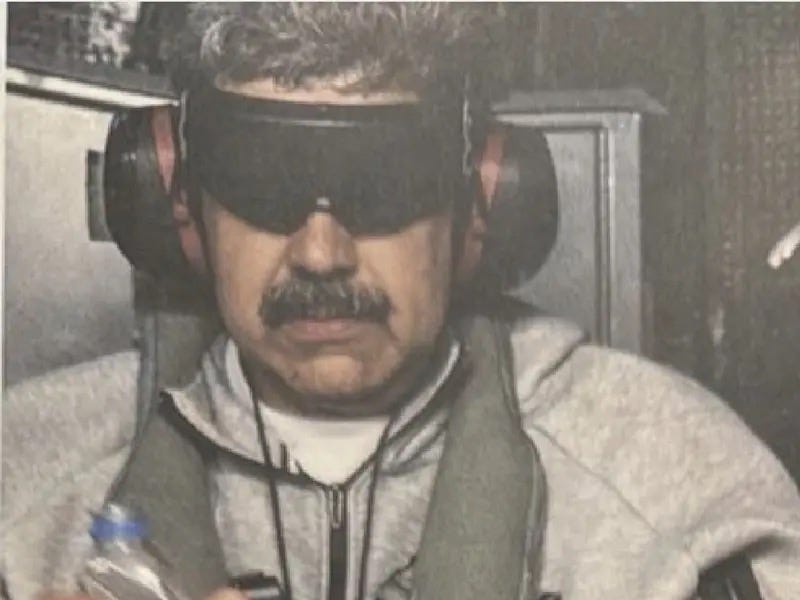
It didn’t take long for Trump to make public a photo of Maduro, wearing an eye mask and headphones and a gray track suit, on the USS Iwo Jima, an amphibious assault ship. Maduro looks anything but presidential in that photo. No one is arguing that Maduro is a good guy. He is a ruthless autocrat who stole the 2024 election and has done a lot of damage to his own country. But it is not the role of the United States to depose him unilaterally and violently. Early reports about the attack on Caracas said that the United States had “captured” him. In his Substack column, America’s Undoing, Corbin Trent took issue with that choice of verb:
Capture is what happens when you execute an arrest warrant. Capture is what happens when there’s an ICC indictment. Capture is what happens when the UN Security Council authorizes military action. Capture is what happens when Congress declares war.
None of those things happened here.
The word is kidnapping.
The bigger question than verb choice is Trump’s very different treatment of Maduro and Juan Orlando Hernández, the former president of Honduras, who has actually been convicted of far more dangerous drug offenses than anything alleged against Maduro—or the tiny boats that American forces have destroyed at sea, on the unproven, untested-in-court allegation that they were carrying drugs aimed for the United States.
Hernández was serving a 45-year prison sentence for drug-trafficking, such as conspiring to import hundreds of tons of cocaine into the United States and using and carrying firearms. Trump’s response to that dangerous, armed drug thug was to give him a full and complete pardon last month. His response to Maduro, not convicted of anything on the scale of the crimes of Hernández, was to kidnap him and force him to stand trial on drug charges. Could it be that the pardon of Hernández had anything to do with a flow of cash into Trump’s coffers? At some future time, historians—and possibly prosecutors—will outline for us the hidden quid pro quo of Trump’s many pardons. For now, we will have to watch as a jury in the Southern District of New York weighs the indictment of Maduro, proudly announced by underperforming United States Attorney General Pam Bondi.
No matter what happens at Maduro’s trial, the bigger question is this: Are drugs really the dominant reason for Trump’s obsession with Venezuela, or is it that nation’s vast oil reserves, which Trump somehow believes was “stolen” from America? The “peace president” left little doubt that the United States will have its hands on Venezuelan oil. “We have the greatest oil companies in the world—the biggest, the greatest—and we’re going to be very much involved,” he blurted.
Of course, oil was at the heart of another American game of regime change: Iran. On August 19, 1953, a coup arranged by the United States Central Intelligence Agency and the British government removed the democratically elected prime minister of Iran, Mohammad Mosaddegh. As I wrote in a column in late October, warning about the prospect of regime change in Venezuela: “The British enjoyed an immensely favorable concession for extracting Iran’s oil, approved over the years by the Iranian monarchy. So Mosaddegh’s move to nationalize the oil industry and give Iran a fairer share of the proceeds was a major problem for London. For the CIA, in a postwar era when the agency imagined communists everywhere, Mosaddegh’s embrace of democracy looked like the forerunner of a communist Iran.”
The CIA’s Kermit Roosevelt Jr., grandson of Theodore Roosevelt, made sure that Mosaddegh would no longer be in power. In the aftermath, American companies got to share in the profits from Iranian oil, the shah was reliably pro-American, and the Shah’s brutal secret service, SAVAK, suppressed any anti-shah activity. That ended abruptly with the Iranian revolution in 1979, the taking of American hostages that heavily influenced the 1980 presidential election in Ronald Reagan’s favor, and many future consequences, including last summer’s bombing of Iranian nuclear facilities, ordered by Trump.
It is impossible to know whether the kidnapping of Maduro and his wife and the attacks on Venezuelan facilities will lead to the same kind of long-term effects as the regime change that America arranged in Iran. In the coming weeks, we will learn more about the physical damage on the ground and the number of Venezuelans killed or injured. We will begin to get an idea of how Trump plans to influence the now-decapitated Venezuelan government. Here’s what he said in a Mar-a-Lago press conference, in the hours after the attack and kidnapping: “We’re going to run the country until such time as we can do a safe, proper and judicious transition. It has to be judicious, because that's what we are all about.”
Oh, is “judicious” what we’re all about, when we bomb little boats without proof that they are carrying drugs, not fish? Were we “judicious” in attacking another country without running the idea past Congress? Will the “judicious” running of Venezuela mean American boots on the ground in a long-lasting conflict between young American troops and insurgents, like the one in Iraq? Will it unleash major clashes between the Venezuelan military and other forces? Will Trump’s intervention end with Venezuela or spread to its neighboring nation, Colombia?
So many questions, so early in the new year. One answer seems sure: This is definitely not the start of something good. The person responsible for all the evils yet to arise out of this naked exercise of regime change is the one who lusts after a Nobel Peace Prize, who claims to have ended wars, but now seems hell-bent on starting at least one.
Comments
Nothing yet. Say the first thing.
Sign in to join the conversation.