
Amid the usual flurry of Trump distractions—those flood-the-zone outrages designed to distract our attention from the Epstein story that refuses to go away—the end of New START is getting far too little attention.
The New Strategic Arms Reduction Treaty between the United States and Russia limited the number of strategic nuclear weapons each country can have to 1,550. President Barack Obama had signed the treaty for the United States in 2010, and it entered into force on February 5, 2011. Just before the treaty was to expire, the month after the inauguration of President Joseph R. Biden, the two countries agreed to extend it for five years, to February 5, 2026. Last month, asked about the coming expiration, Trump showed dramatically less urgency than the Biden administration had in extending the treaty five years ago. “If it expires, it expires,” Trump nonchalantly told reporters for the New York Times.
On Wednesday, the day before the expiration, Secretary of State Marco Rubio said he had no announcements to make about the treaty, and he added that Trump would “opine on it later.” On the day of the expiration, Trump unsurprisingly referred to the expired treaty as a “a badly negotiated deal.” Of course. Trump sees himself as the master of the art of the deal—not Obama. He went on to say that “we should have our nuclear experts work on a new, improved, and modernized treaty that can last long into the future.”
It’s unclear whether Trump and Chinese President Xi Jinping will begin serious discussions about limiting nuclear arsenals—either bilaterally or trilaterally, with Russia. Will Trump and his buddy Vladimir Putin work on a new treaty? Putin did suggest last September that the two nations should continue to live by the limits of New START for now and work on an agreement about strategic, intermediate-range, and short-range nuclear weapons. In his comments after the expiration of New START, Trump said nothing about keeping the arsenals of Russia and the United States at their current levels.
Speculating on next steps, Tom Nichols wrote in The Atlantic:
A more likely outcome is that Trump will sign off on more money for more nuclear arms. Such an expansion would be pointless; the United States has more than enough nuclear firepower to deter both Beijing and Moscow. Put another way, America has the ability to destroy both the Russian and Chinese governments and most of their infrastructure with a relative handful of weapons. More bombs will not lead to more security.
A less safe planet
What we know for sure is this: The treaty’s expiration makes the world less safe. In a video commenting on the expiration of New START, Melissa Parke, executive director of the International Campaign to Abolish Nuclear Weapons (ICAN), said that this is “the first time since the early 1970s that there’s been no treaty of any kind constraining the world’s two largest nuclear arsenals, and there’s nothing being negotiated to replace it. Look, it’s extremely serious, because between them, these two countries hold 87 percent of the world’s nuclear weapons, and when legal limits disappear, they will be free to build and deploy more, with very little transparency.”
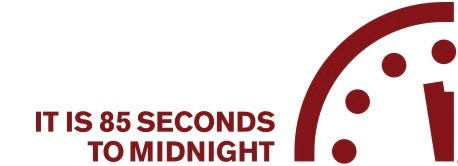
On January 27, the Science and Security Board of the Bulletin of the Atomic Scientists set its Doomsday Clock at 85 seconds to midnight—four seconds closer to doom than the last time the Bulletin reset the clock and “the closest it has ever been to catastrophe,” the Bulletin said. In a long statement on the reasons for its global pessimism, including such threats as climate change and runaway artificial intelligence, the Bulletin included the expiration for New START:
Meanwhile, competition among major powers has become a full-blown arms race, as evidenced by increasing numbers of nuclear warheads and platforms in China, and the modernization of nuclear delivery systems in the United States, Russia, and China. The United States plans to deploy a new, multilayered missile defense system, Golden Dome, that will include space-based interceptors, increasing the probability of conflict in space and likely fueling a new space-based arms race. As these worrying trends continued, countries with nuclear weapons failed to talk about strategic stability or arms control, much less nuclear disarmament, and questions about US extended deterrence commitments to traditional allies in Europe and Asia led some countries without nuclear weapons to consider acquiring them. As we publish this statement, the last major agreement limiting the numbers of strategic nuclear weapons deployed by the United States and Russia, New START, is set to expire, ending nearly 60 years of efforts to constrain nuclear competition between the world’s two largest nuclear countries. In addition, the US administration may be considering the resumption of explosive nuclear testing, further accelerating a renewed nuclear arms race.
Trump has spoken about a resumption of nuclear testing, but it’s not clear what he means: exploding actual warheads, testing new rockets, or something else. Whatever he means—and deciphering what Trump actually means is one of the bewildering challenges of this moment in history—any new nuclear tests are a profoundly bad idea. Even this nation’s existing weapons are dangerous, not just to adversaries, but to the United States. Eric Schlosser describes some of the dangers in his book, Command and Control: Nuclear Weapons, the Damascus Accident, and the Illusion of Safety.
A terrifying nuclear near-miss
Another scary book is David Hoffman’s The Dead Hand: The Untold Story of the Cold War Arms Race and Its Dangerous Legacy, which won a 2010 Pulitzer Prize. One of its harrowing tales involves a Russian officer named Stanislav Petrov. On September 26, 1983, he was working in a command center near Moscow, equipped with a computer able to detect the launch of American missiles. In the middle of the night, a siren sounded, and a wall panel lit up with the word, LAUNCH, followed by another warning, MISSILE ATTACK. That could have set off a retaliatory Russian launch of missiles aimed at the United States. But Petrov reasoned that a real American attack would involve hundreds of missiles, not the handful that the computer system seemed to be detecting. So Petrov told his commanders that it was a false alarm, and he became known as “the man who saved the world.”
More missiles, of course, would mean more opportunities for nuclear near-misses—or maybe even an actual planet-ending nuclear exchange. With the nuclear launch codes in the control of a malignantly narcissistic, cognitively impaired, praise-me-extravagantly-or-else president, ooh, do we worry!
In my childhood, a Cold War drill had students hiding under their desks in the event of a nuclear attack. Later in my life, in the army, we joked about the only realistic response to a coming nuclear attack: “Bend down, put your head between your knees, and kiss your ass goodbye.” During my year in Korea, 1968, I should have thought more seriously about nuclear weapons. I was an intelligence officer in the 4th United States Army Missile Command, which had nuclear-capable Honest John rockets. Our classified files contained targeting documents. But I never knew whether those targets were to be attacked with “conventional” weapons or nukes. Near Camp Page, where the unit was housed, was something called the Maximum Security Area. I never set foot in it, and I didn’t know whether it contained nuclear weapons, but I’m pretty sure that it wasn’t for ice cream. I still blame myself for not being more vigilant and learning whether my unit had nukes or not. These days, I use that nuclear guilt from my past to sharpen my focus on today’s dangers.
In that spirit, I recently attended a Zoom gathering of Back from the Brink, a grassroots organization with hubs around the country. It urges the United States to lead a global effort to prevent nuclear war by pursuing global, verifiable elimination of nuclear arsenals; renouncing the option of using nuclear weapons first; ending any American president’s sole, unchecked authority to launch a nuclear attack; taking US nukes off hair-trigger alert, and canceling the plan to replace the whole American arsenal with enhanced weapons. They all sound like excellent, planet-saving ideas to me.
This week, on the eve of New START’s expiration, I had a long Zoom chat with Jeremy Love, who does organizing and outreach for Back from the Brink. We discovered that we share a loathing for the false notion that dropping two nuclear bombs on Japan was necessary to avoid the death of many thousands of Americans in an invasion of the Japanese homeland. An excellent book disproves that idea: The Decision to Use the Atomic Bomb: And the Architecture of an American Myth, by Gar Alperovitz. Dropping those bombs was more about scaring the Soviet Union than about inducing the Japanese to surrender, which America could have done without destroying Hiroshima and Nagasaki.
As we talked, Jeremy recalled a chilling conversation by American military leaders about nuclear war, reported in Fred Kaplan’s book, The Bomb: Presidents, Generals, and the Secret History of Nuclear War. Both of us recalled Air Force General Curtis “Bombs Away” LeMay, the commander of the Strategic Air Command. This conversation involved LeMay’s successor at SAC, General Thomas Power, and William Kaufmann, a nuclear weapons analyst who was far less bomb-happy than Power. Here’s how Kaplan reported that exchange:
There was a cruelty to Power’s zest for bombing cities. Even LeMay privately referred to his protégé as a “sadist.” When Bill Kaufmann briefed him on the counterforce strategy at SAC headquarters, Power reacted with fury. “Why do you want us to restrain ourselves?” he screamed. “Why are you so concerned with saving their lives? The whole idea is to kill the bastards!” After a bit more of this tirade, Power said, “Look. At the end of the war, if there are two Americans and one Russian, we win!”
Kaufmann snapped back, “You’d better make sure that they’re a man and a woman.” Power stormed out of the room.
Jeremy and I also talked about another book, The Doomsday Machine: Confessions of a Nuclear War Planner, by Daniel Ellsberg. He was a military analyst best known for releasing to multiple newspapers a collection of documents that became known as the Pentagon Papers, unveiling the nation’s wrongheaded decision-making about the war Vietnam. In The Doomsday Machine, Ellsberg wrote about other documents he had copied, about the nation’s nuclear strategy. Working in the Pentagon in the early Sixties, he saw a Top Secret document containing a graph that answered a question from President John F. Kennedy to the Joint Chiefs of Staff: How many people would die in the Soviet Union and China, in a general nuclear war? In the book, Ellsberg wrote:
The total death toll as calculated by the Joint Chiefs, from a U.S. first strike aimed at the Soviet Union, its Warsaw Pact satellites, and China, would be roughly six hundred million dead. A hundred Holocausts.
I remember what I thought when I first held the single sheet with the graph on it. I thought, This piece of paper should not exist. It should never have existed. Not in America. Not anywhere, ever. It depicted evil beyond any human project ever. There should be nothing on earth, nothing real, that it referred to….
From that day on, I have had one overriding life purpose: to prevent the execution of any such plan.
An action idea on nukes
If you are wondering what you can do to “prevent the execution of any such plan,” you could start by contacting your member of Congress and United States senator to suggest that they support H. Res. 317 and S. Res. 323. The House resolution is entitled “Urging the United States to lead the world back from the brink of nuclear war and halt and reverse the nuclear arms race.” Read the text of the House resolution here.
Both resolutions would put the nation on the path to adopting the policies that Back from the Brink is pursuing—and more. If you want to go beyond those calls to your legislators, you might think about joining an existing Back from the Brink hub here or starting a new one.
If you are having trouble generating the energy that you need for this uphill struggle, just repeat these five horrifying words to yourself as a motivational mantra: Trump has the nuclear codes.
Comments
Nothing yet. Say the first thing.
Sign in to join the conversation.