
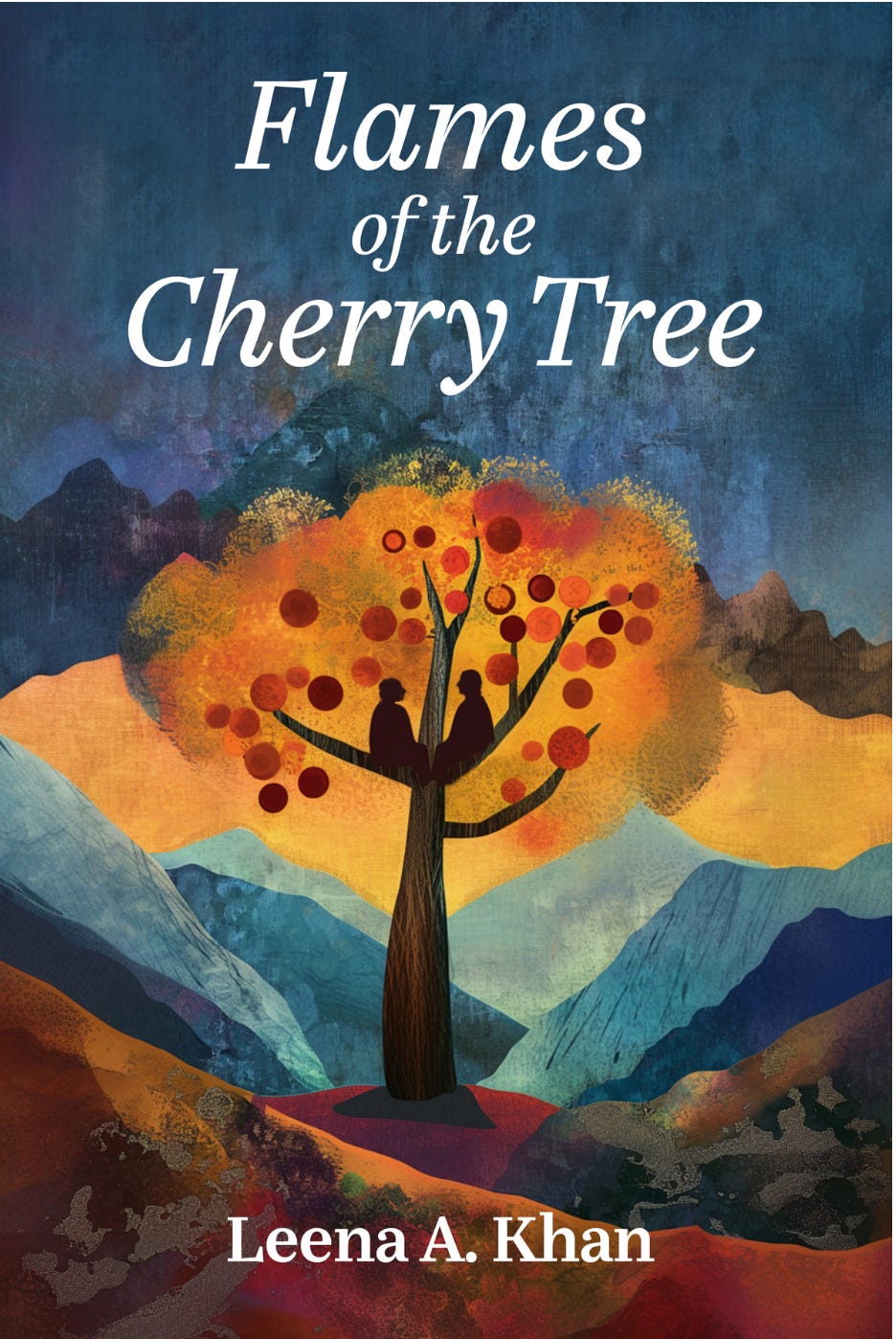
In my imagination, I’m a baseball scout, sitting unproductively through hundreds of high school games, then finally, gloriously, spotting a future five-tool player in the major leagues: someone who can hit, hit with power, field, run, and throw. That daydream of discovery carries over into my paragraph-manufacturing life, where I can actually experience finding the literary equivalent of a five-tool player. Take, for example, Leena Khan.
She is the granddaughter of my friend Faroque Khan, the founder and chairman of the Interfaith Institute of Long Island, where I am a member of the board. In the course of our correspondence recently, he mentioned that Leena had published a novel, and she would be speaking at a book launch in Cambridge, Massachusetts. I had commitments here on Long Island that prevented me from attending that event. But I went online and bought Leena’s book, Flames of the Cherry Tree, and she and I set up an interview to discuss how she came to write it.
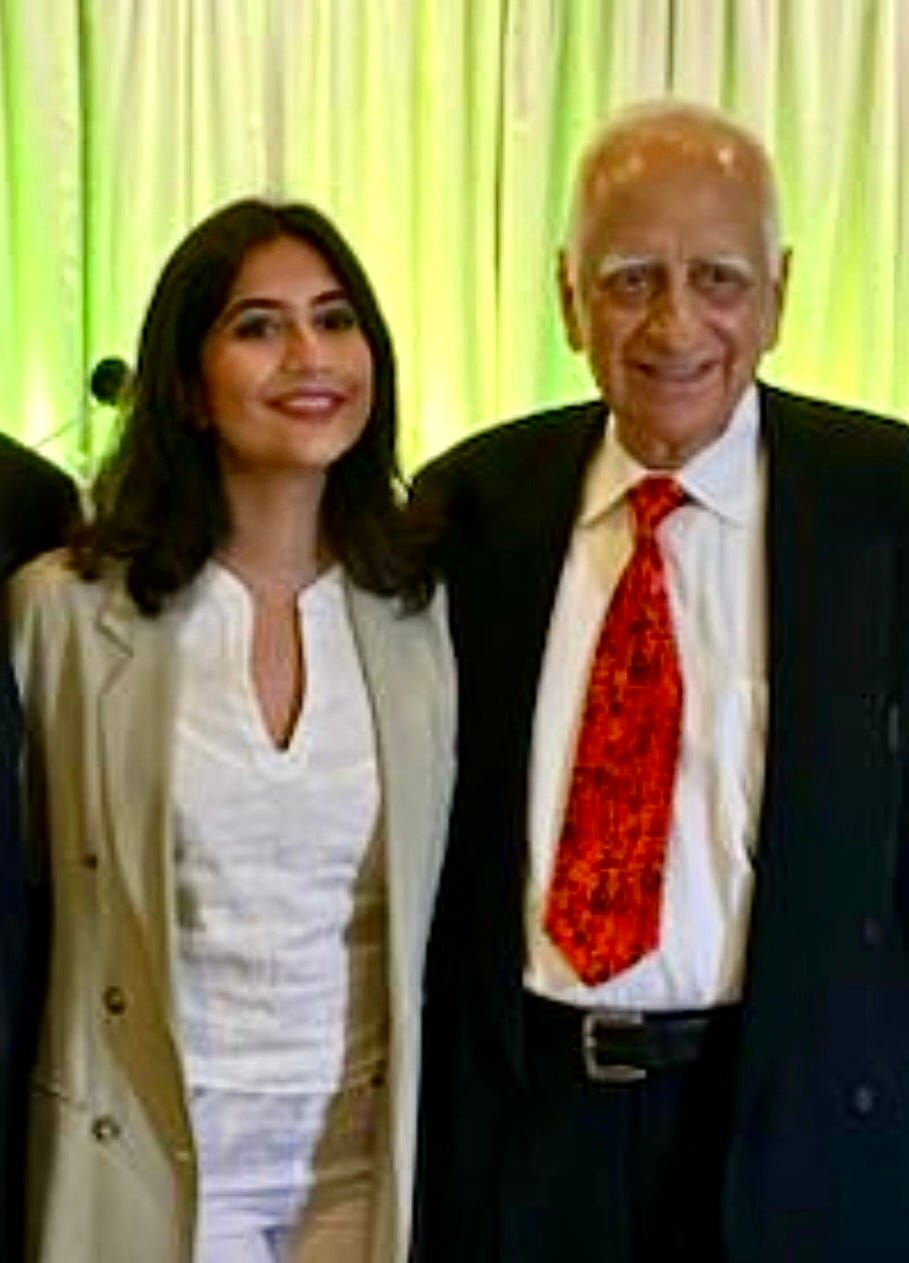
In the process, I learned that she is a graduate of Georgetown University and a first-year student at Harvard Law School. How is it possible that someone that young could already have published a highly literary novel of historical fiction, I wondered. This is how she describes the book in her Substack column, Library of Leena:
The year is 1940, and the winds of change stir in the valley of Kashmir. Aafreen Khan is a young girl that dreams to be a doctor like her beloved grandfather, defying the boundaries of convention as a Muslim and a woman in a country rigged against her. But as the partition of India looms closer, Kashmir reels under the weight of greed and power, and Aafreen is swept into the whirlwind of a story much larger than her own. When love, loss, and revolution reshape her entire world, Aafreen learns the terrible truth of what it means to survive.
Flames of the Cherry Tree is a sweeping, intimate portrait of a young woman’s coming-of-age against the backdrop of colonialism, rebellion, and the violent birth of today’s occupied Kashmir. At once tender and unflinching, it traces the story of one family through oppression and resistance, illuminating the forgotten histories that have shaped Kashmir and the hope that survives in its people.
Kashmir is a staggeringly beautiful place with mountainous scenery and mountainous political problems. President Bill Clinton once called it “the world’s most dangerous place,” because it is the subject of continuing territorial dispute between two nuclear-armed countries, India and Pakistan. Whether his assessment is still true or not, if you check the US Department of State’s travel website, you’ll get this warning about visiting there:
Do not travel to this area except for visits to the eastern Ladakh region and its capital, Leh, due to terrorism and civil unrest.
Terrorist attacks and violent civil unrest are possible. Violence happens sporadically in this area and is common along the Line of Control (LOC) between India and Pakistan.
Violence also occurs in tourist spots in the Kashmir Valley: Srinagar, Gulmarg, and Pahalgam.
The Indian government does not allow foreign tourists to visit certain areas along the LOC.
Review our information on travel to high-risk areas.
The book’s narrator is Aafreen Khan, a young Kashmiri student whose grandfather in the book is also Faroque Khan. The affectionate term that Aafreen uses for the fictional Faroque is Dadaji, the same word Leena uses to refer to the real Faroque. Her love for my friend Faroque is obvious throughout the book. When Aafreen makes clear that she wants to be a doctor, just like her grandfather, the fictional Faroque feels pride, just as the real-life Faroque does. “Dadaji smiled proudly,” Aafreen said. “His approval was addictive; it made me feel invincible, as if the world could hurl its worst at me and I would still stand tall. I kept the real reason I wanted to be a doctor tucked into a silent corner of my heart—it was, of course, to be just like Dadaji.”
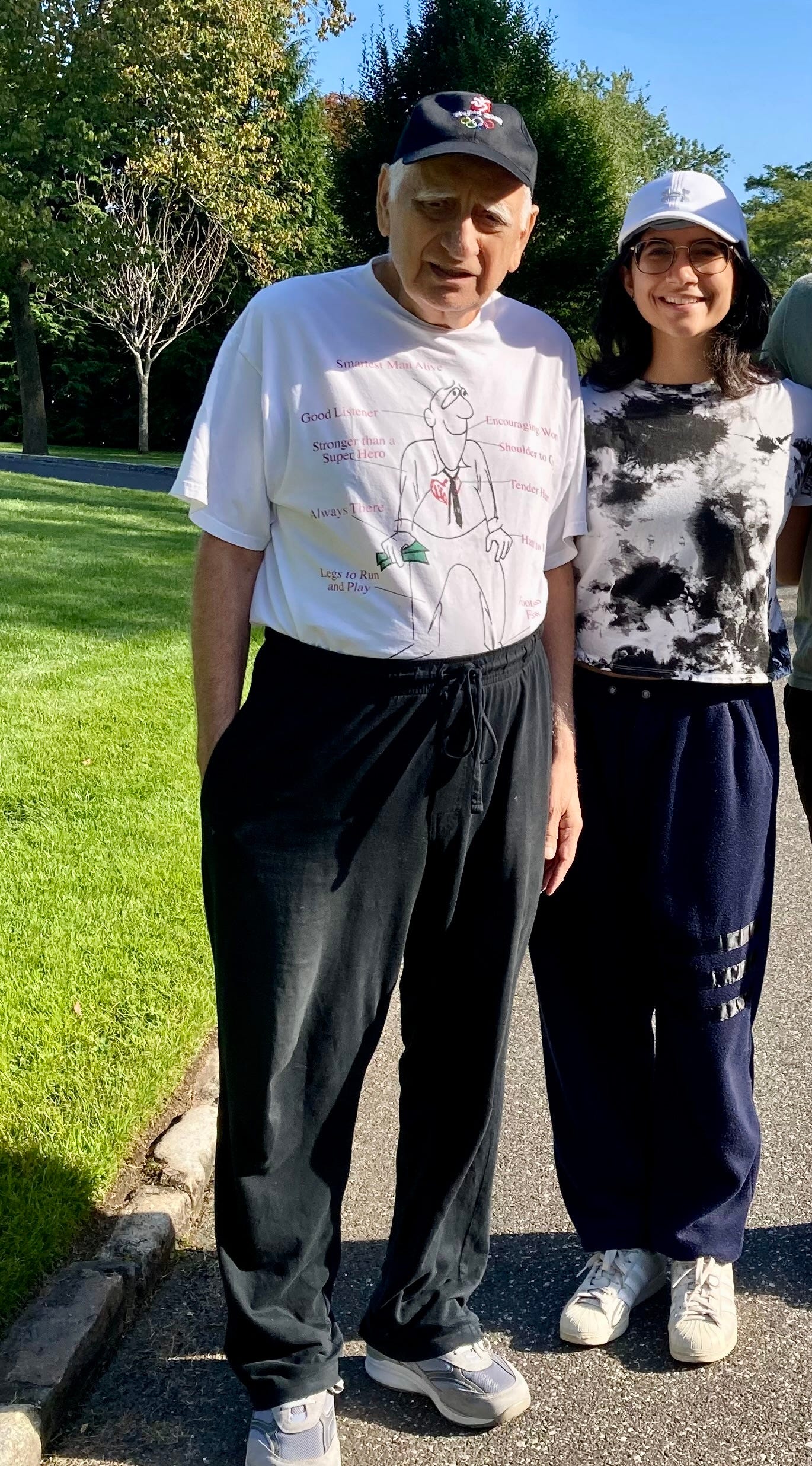
As a child, Leena lived in Riyadh, Saudi Arabia, where her father, Arif, a physician, worked. But on visits to her grandparents on Long Island, she and her Dadaji would often take walks, and he’d tell her about his own years growing up in Kashmir. “Definitely, the springboard from which I jumped into learning about Kashmir was my grandparents,” Leena said. “But I’ve done a lot of academic research on my own, specifically related to this book.”
You can see the result of that research in the afterword to the book, where Leena offers a nonfiction account of the complicated reality that is Kashmir. That description is filled with footnotes, which demonstrate how much research she has done, in addition to listening to her grandparents, Faroque and Arfa. I’ve read plenty of novels, but this is the first one that I can recall ending in a heavily footnoted account of the sources the author consulted in the name of accuracy.
As a Georgetown undergraduate, Leena founded a campus chapter of Stand With Kashmir, a national grassroots organization for Kashmiris who focus on human rights issues in Indian-occupied Kashmir. “So I interacted a lot with Kashmiri history and politics through that prism.”
Of course, it’s one thing to study history and another entirely to be able to write historical fiction with characters who come alive. Leena was able to do that because, like her grandfather, she is an avid reader. In my conversations with Faroque, I am always impressed by the scope of his reading. As a physician and the founder of the Interfaith Institute, he has a wide array of interests, and Leena has followed in his footsteps as a reader.
“I’ve loved reading from a young age,” Leena said. “When I was, I think like six or seven years old, my rebellion against my parents was, after that time when they’d shut off the lights, I’d have a little bedside lamp and open it and just read late into the night, because once I loved the story, I just couldn’t put it down. So I’ve always loved literature and reading, and so that is what has sparked the urge to tell a story of my own, especially when I started appreciating writing in a more mature context, in the sense of literary devices and seeing how words can draw out emotions and can cause you to empathize with people you otherwise wouldn’t have. So I really wanted to do that for Kashmir, as sort of an ode to my heritage and to my grandparents, but also just because I love storytelling, and I think it’s so fun to create characters and build a world.”
The writers she cited as influencing her work include Susan Abulhawa, a Palestinian-American novelist; Khaled Hosseini, author of The Kite Runner and other novels; and Marjane Satrapi, an Iranian author who wrote about her childhood in Iran. “I love learning about history, but it’s a much more fun endeavor to learn about history through a narrative story where I can connect with characters and build a relationship with time and place,” Leena said. “So I love historical fiction.”
She paints a nuanced picture of the central character, Aafreen, who definitely has a mind of her own. Leena acknowledges that there’s an autobiographical element in her depiction of Aafreen. “There’s no specific character from my personal life that I would say she represents,” Leena said. “I think there’s a lot of myself in her. There’s a lot of who I aspire to be. I kind of wrote the type of person that I want to be. I think she’s very brave. She’s very strong-willed. She holds strong to her principles. Those are things that I want readers to look up to and manifest it in themselves by inspiration from her character, which is also flawed. She’s very stubborn. She’s a little bit naive. And I think those are flaws that I’ve taken from myself and put into her as well. I think maybe I’ve written a bit of myself into her, but she’s her own person.”
Leena graduated from Georgetown in the spring of 2023. Then she had a job as a paralegal. From there, she landed a research fellowship in Jordan. It was during the brief gap between the paralegal job and the research fellowship that she began writing the novel. “I spent some time traveling, visiting family and friends, but in the meantime, the story was basically all I thought about,” Leena said. “I would have an idea and quickly write it down while I was running. Or if I was listening to music, something would inspire me. If I saw a beautiful landscape, something would inspire me. So it was kind of like a constant, every hour of every day process. Even when I wasn’t physically sitting down and writing, I was thinking about the story.”
Then, once she had finished the manuscript, she faced the daunting challenge of getting it published. “I looked up a bunch of literary agencies, tried to find people online that I felt would connect with my story, and just cold-emailed dozens and dozens and dozens of people,” she recalled. “When I did get a reply, the only replies that I got were, ‘I like your idea, but I don’t know how to market this,’ or ‘I like your idea, but it’s not suitable for my type of work.’ ” So she started contacting publishers directly. That turned out to be something of a slog, too, but she ultimately received a good-news email from Daraja Press. “They’re a small, nonprofit publishing house, based in Canada, that focuses on uplifting marginalized voices. They’re very anti-colonial.”
In the novel, Aafreen’s father died soon after her birth. During a protest against the Dogra regime that ruled Kashmir, the Dogra police shot and killed him. Aafreen’s mother, widowed at age 18, never remarried. Aafreen’s grandfather, Dadaji, a widower, took Aafreen and her mother into his mansion, Khan Manzil.
“I was a rare only child to a single mother and a working grandfather, yet I never felt the loneliness of my fate,” Aafreen says, as she begins to introduce her neighbor and her love interest, Hussein, one of nine children. “Hussein lived across the dirt road and showed up at our doorstep the first day that I moved in, armed with chubby cheeks, a rowdy laugh, and a limitless appetite for play. Being his best friend was not a choice, it was simply a fact of life, one that I never questioned and always cherished.”
Aafreen is deeply studious. “Academic validation was my drug—I felt a rush of sweet satisfaction with every right answer, a zap of joy through my body when a concept made sense,” Aafreen says. But she is also something of a romantic, and the novel traces the development of her love for Hussein and the complications and tragedies that they learn to survive. It also provides a glimpse of the complexities of Kashmir. In the body of the novel, dramatic developments that affect the characters paint part of the picture, and the deeply researched afterword gives the reader guidance in understanding the forces in the region. In writing the novel, Leena wanted readers to gain a fuller sense of Kashmir’s history.
“I think today the common understanding of Kashmir in our modern context is that it’s a strip of land—half of it is under Pakistan, half of it is under India—and these two superpowers have been fighting over it,” Leena said. “But the history as to how that situation came about is very underrepresented, in terms of common knowledge and media representation. People think that the ‘plight’ of Kashmiris under occupation is a relatively new concept since the advent of India and Pakistan as nation states, which was in 1947, relatively recently. But previous to that, Kashmir was under the rule of a very oppressive regime, the Dogra dynasty, and that’s the time period in which my novel takes place. And so, I kind of wanted to share with readers the idea that Kashmiris have been struggling for self-determination and for a common identity as a nation-state since way before the advent of India and Pakistan.”
The narrative explores the relationships among societal groupings. She writes lovingly of someone who works for her grandfather, but is far more than an employee. “We had many servants at Khan Manzil, but Faizal bhai was like family,” Aafreen says. “He was older than even Dadaji, and had helped to raise my grandfather in this very home.” And Leena describes the unfairness that Aafreen found around her. “My book mentions the begar system, for example, which was a form of forced slavery or forced labor that specifically targeted Muslims,” Leena said. “I mean Sikhs and Hindus, which were the other two minority religions present in the region, were largely exempted from that. Muslims were discriminated against, in terms of education opportunities, access to government jobs, and the like. So I really wanted to set the foundation for why modern-day Kashmir exists in the situation that it does and showcase that there’s much deeper history to it.”
Aafreen sees those complications and pains and feels deeply troubled by it all. In one sad episode toward the end of the book, she says: “I wonder for a moment if it is worth staying alive in this heinous world. Where neighbor kills neighbor, where friend turns on friend. Where massacres can operate with absolute impunity. I wonder if the cycle of violence will ever end.”
Leena managed to craft an account of Kashmir that carries the reader along. But she has never been there. “As I was growing up, my parents always thought it was not good to go, because of the militancy. They were afraid of its being unsafe, et cetera, especially because Kashmir is one of the most militarized zones in the world. But I will be going as an adult.” Sometime in the next year or two, she will visit the land of her family’s origins. In 2028, she’ll graduate from Harvard Law. “I will be practicing international human rights law.”
So young, and already a skillful researcher, a voracious reader, a published novelist, an organizer of Stand With Kashmir, and soon, an international human rights lawyer. Leena is clearly a five-tool player! Whether you enjoy romance novels or historical fiction, you’ll find Flames of the Cherry Tree a moving experience, and you’ll be able to say you scouted Leena early in her career.
No posts
Comments
Nothing yet. Say the first thing.
Sign in to join the conversation.