
By Bob Danna, author of My Curious Life, Bot-Bob (Bob’s Agentic AI digital twin), and Claude
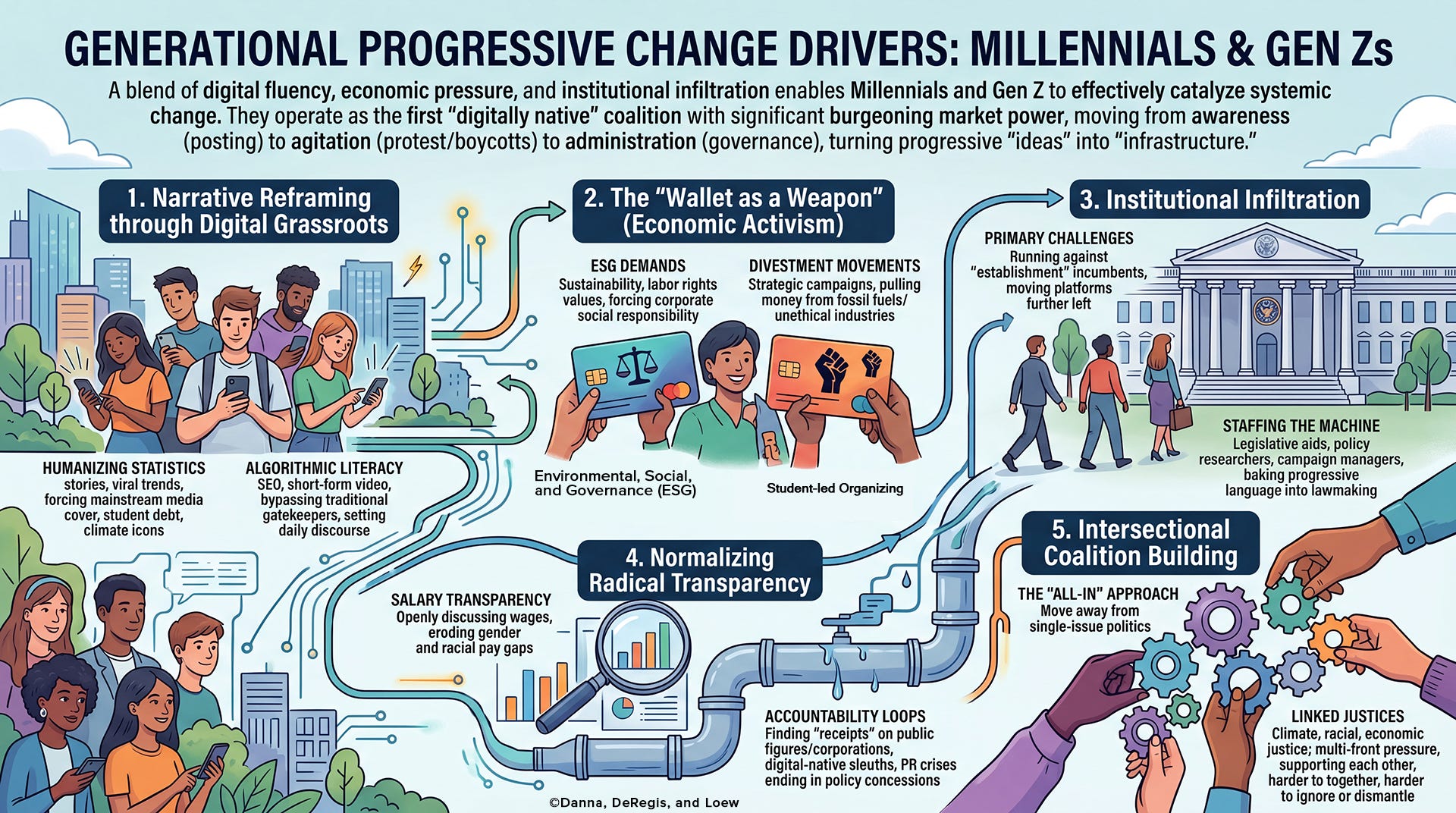
Something fundamental is shifting in how political and economic change gets made in America. It is not happening primarily in legislative chambers or corporate boardrooms — at least not yet. It is happening in group chats, on social feeds, in student union meetings, and in the quiet act of moving money. Millennials and GenZ, the first genuinely digitally native coalition in history, are no longer just the subjects of policy. They are becoming its architects. Again, , , and I created an infographic for you to use as you have conversations with your family, friends, and colleagues. Please find a copy at the end of this article.
Thanks for reading! Subscribe for free to receive new posts and support my work.
From Posting to Power
The first and most visible engine of this generational shift is narrative reframing through digital grassroots organizing. Where legacy media once set the agenda, young activists now use algorithmic fluency — SEO strategy, short-form video, viral storytelling — to bypass traditional gatekeepers entirely. Student debt horror stories, climate timelines, and racial justice statistics are no longer just policy abstractions; they are personalized, emotionally resonant content that sets daily discourse before the morning news cycle even begins. The result is a generation that does not wait to be heard. It manufactures its own megaphone.
The Wallet as a Weapon
Narrative alone, of course, does not move capital. That requires economic pressure — and here too, younger generations are proving surprisingly sophisticated. Environmental, Social and Governance (ESG) demands are pushing corporations to account for sustainability, labor rights, and governance as conditions of doing business with a new generation of consumers and employees. Meanwhile, student-led divestment campaigns are pulling billions from fossil fuels and ethically compromised industries with strategic discipline that would impress any Wall Street activist investor. The message is clear: market power has a conscience, and that conscience is generational.
Taking the Levers from the Inside
Perhaps the most consequential and least celebrated shift is institutional infiltration — the quiet but deliberate movement of progressive young professionals into the machinery of governance itself. As legislative aides, policy researchers, and campaign managers, they are not merely advising on policy; they are drafting it, embedding progressive language into the code of law. Yes, they face structural headwinds: entrenched incumbents, moderate platforms, institutional inertia. But inside every bureaucracy, a generation is learning the plumbing. And plumbers, ultimately, control the flow.
Radical Transparency as a Political Tool
Two additional forces amplify all of the above. The normalization of radical transparency — openly discussing wages, surfacing pay inequities, and deploying accountability loops to find the “receipts” on public figures and corporations — has made hypocrisy increasingly expensive. When a company’s sustainability pledge contradicts its lobbying record, digital-native investigators will find the gap and make it a PR crisis. Power that previously operated in the shadows now operates under a microscope.
The Coalition That Cannot Be Fragmented
Finally, intersectional coalition building ties all of these threads together. By refusing to treat climate justice, racial equity, and economic fairness as separate causes, Millennials and GenZ have built a multi-front movement that is structurally harder to divide and harder to dismiss. Single-issue politics can be horse-traded away. Linked justices cannot.
The arc from awareness to agitation to administration is not inevitable. It requires sustained energy, strategic patience, and a willingness to do the unglamorous work of governance.
But the infrastructure is being built. And infrastructure, once built, tends to last.
Thanks for reading! Subscribe for free to receive new posts and support my work.
Comments
Nothing yet. Say the first thing.
Sign in to join the conversation.