
Everyone writing with AI eventually hits the same wall. You give it a prompt, and what comes back is smooth, competent, and average. It’s not wrong. It’s just not you.
We hear this constantly – usually from clients, usually about their brand. “I can’t make AI sound like us.” Or worse: they get it just right once, and then doesn’t work the next time, or works for nobody else. We had a few theories about why this is, but this week we decided to put some parameters around it and investigate exactly what’s happening. The answer turned out to be more interesting than the problem – and it points at something much bigger than tone of voice.
We all know tone of voice matters for brand building and keeping our writing distinct, but unless you’re a content designer, it’s tricky to describe exactly what it is and what its function is. Unless you have intimate knowledge of designing one, it’s just one of those things you see floating around a shared cloud drive.
Your voice is who you are. It stays constant. Your tone flexes depending on who you’re talking to and when. You don’t speak to your boss the way you speak to your best friend. Same voice, different tone, every single time – and you do it without thinking.
Then there’s style: the mechanical stuff. Sentence case or title case. “Who” or “whom”. En dashes, not em dashes (we feel quite strongly on that one – en dashes forever!). Small choices, made on purpose, that add up to something recognisable. They give your writing the rhythm that sounds, even somehow smells like you.
That’s the first clue to why this is hard. You don’t have one tone to capture. You have one voice and a hundred tones, most of which have never been written down. It looks simple from the outside and turns out to be all taste and tacit knowledge on the inside.
An AI model wants to be plausible. And its safest bet for plausible is to find the average – the most likely version of whatever you asked for, drawn from everything it has ever read and been trained on.
That’s fine for a lot of tasks. It’s fatal for voice. Because a distinctive voice sits a long way from average – that’s literally the whole point of having one.
Now look at how most of us try to fix it: we stack adjectives. “Be professional, punchy and wry.” But to an AI model, a word isn’t a feeling – it’s a coordinate. Ask for a ‘punchy’ line and the model has no fixed definition of punchy. Across thousands of dimensions it reinterprets the word and, where the instruction is ambiguous, falls back to the statistical centre. And “punchy” means wildly different things to different people. You say ‘wry’ and you’re thinking Margaret Atwood; it’s thinking Jeremy Clarkson. Faced with that ambiguity, the model shrugs and slides back to the centre. Every adjective gets pulled into the same average — competent, smooth, interchangeable.
To sound like you, you have to drag the model off the average.
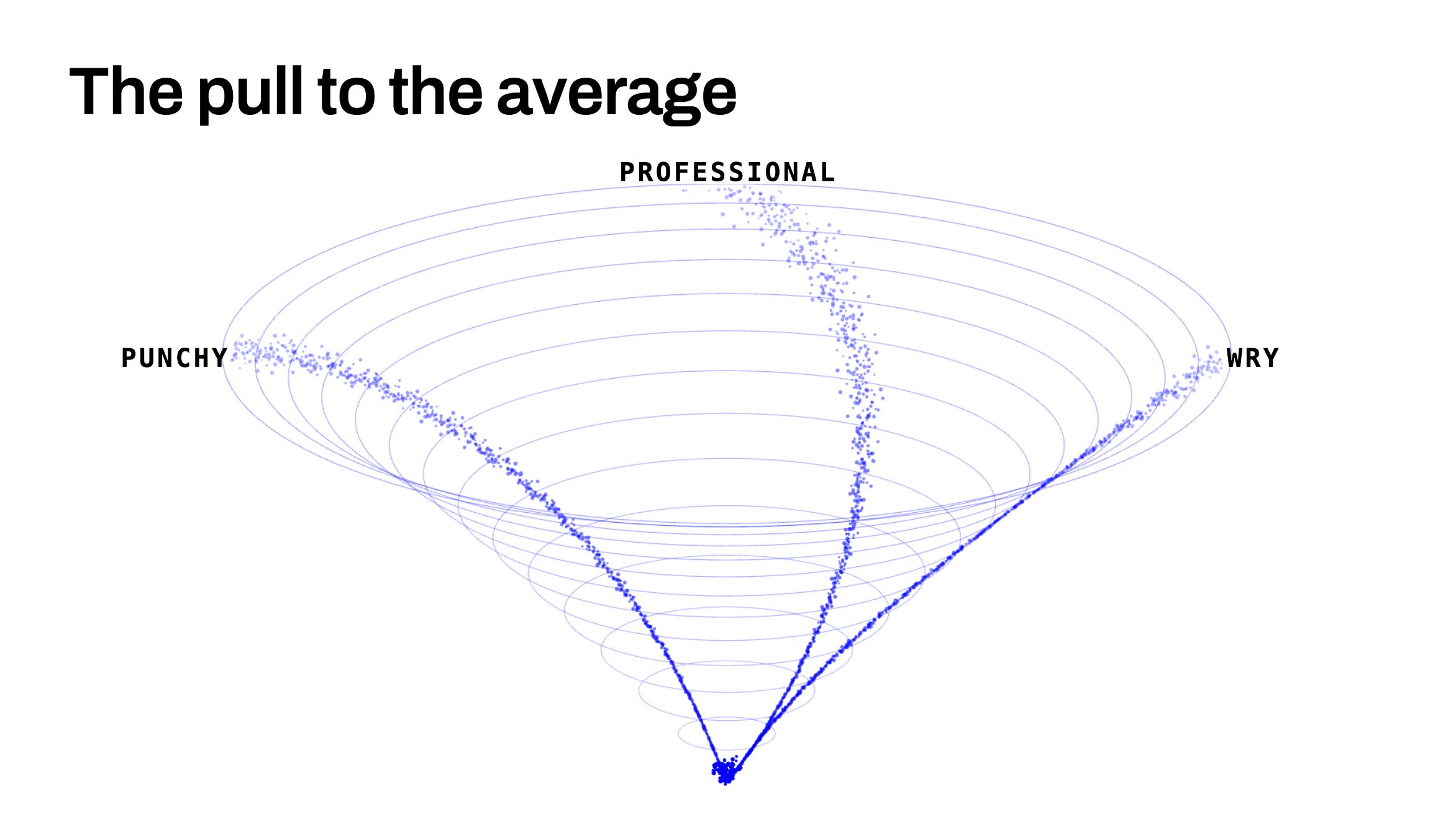
A quick aside on the average, because it’s worth saying: sounding average isn’t always failure. Santander sounds like a bank and gets on fine – but that’s because they’re not competing on brand. If your voice is part of how you win – a Monzo, an Innocent Drinks, a Brewdog – average is exactly what you can’t afford.
The other thing to mention here is that from a mathematical perspective, AI simply has hella variables going on in order to give you an answer. It’s got its training data, its context window, the files you loaded into it, whatever you’ve said to it in the past, the time period it’s trained up to. And it’s just guessing at what weight to put all this data at – so when you say ‘make it punchy, make it compelling’ it’s a complete mixed bag about what you’re going to get, and it’ll be different every time.
To back up our theories, we didn’t want opinions, we wanted evidence. So we looked at how people who write for a living – across journalism, PR, fiction (the romance and fantasy writers who produce at real volume) and brand copywriting – are getting tone of voice out of AI. The tools they sell, the methods they swear by, the workflows they describe.
Then we graded the evidence behind each one. This was quite a fascinating task because no one is out here measuring whether the voice is actually right. You just see it and feel it. You can measure how much editing you have to do afterwards, but that’s effort, not quality. Quality is easy to feel, hard to measure. I’d say this indicates it’s an artform not a formulaic science.
The methods people use sorted into a handful of approaches, and the real difference between them is where you put the voice. Some try to capture it in the prompt itself. Some store it in material you reuse every time – a guide, a markdown file, a set of examples, a saved project, context. And a few go all the way and train it into the AI, so the voice becomes part of how the model writes by default.
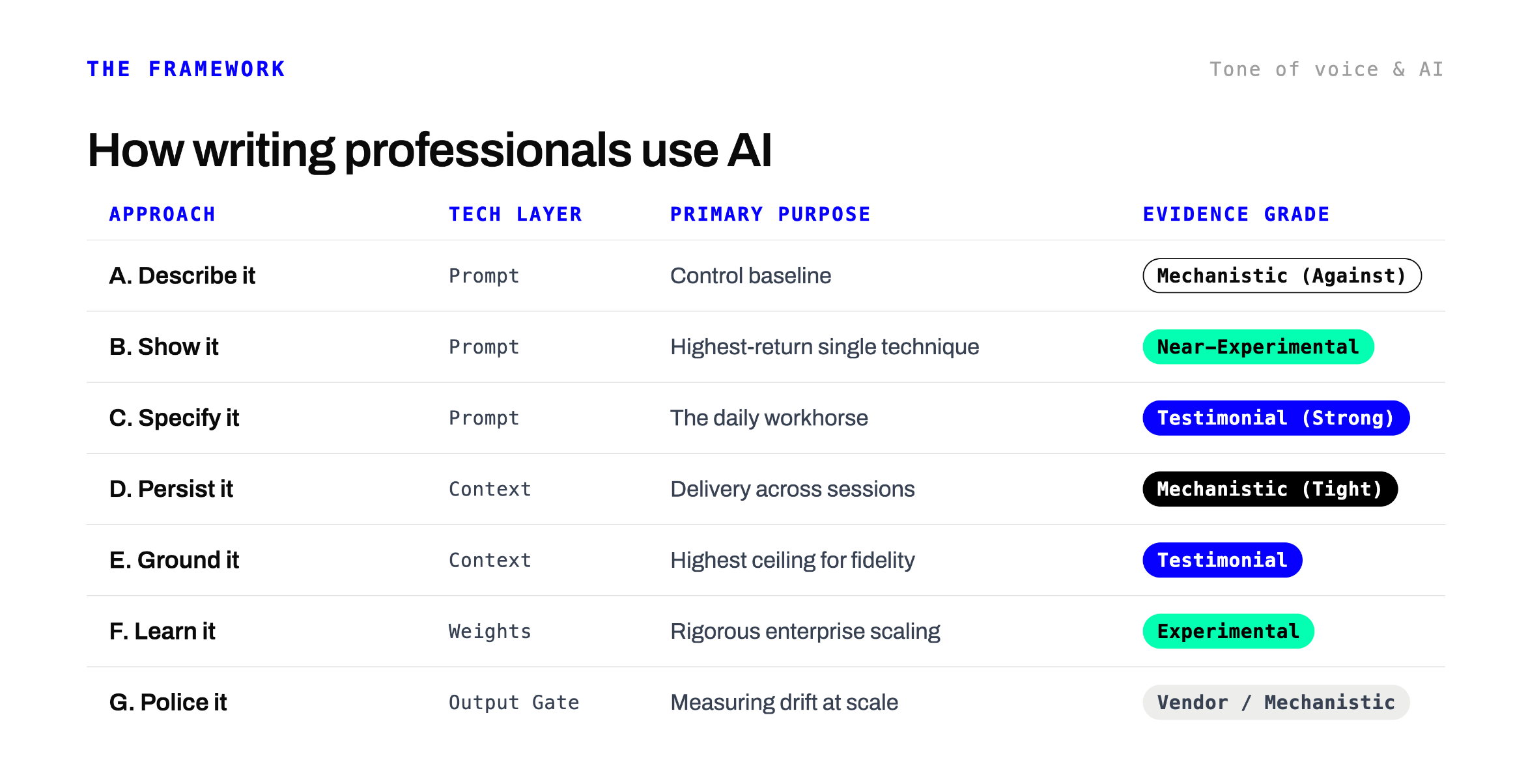
Above is a table showing seven approaches writing professionals use to get voice consistency from AI, sorted by tech layer (prompt, context, weights, output gate) and by how strong the evidence is.
A. Describe it is the control baseline — and the evidence runs against it.
B. Show it is the highest-return single technique.
C. Specify it is the daily workhorse.
D. Persist it handles delivery across sessions.
E. Ground it has the highest ceiling for fidelity.
F. Learn it (fine-tuning the weights) is for rigorous enterprise scaling.
G. Police it is the output gate for measuring drift at scale.
Three findings, and the first is the one to take away.
Show, don’t tell. Give the model a strong on-brand example, then an explicitly off-brand one. That contrast fences off the right territory and blocks the pull to the bland centre. We do this instinctively in design – the mood board that says “like this, not like that”. It’s the single highest-return move available to you, because it shows the style of a thing by excluding something.

Then teach it over time. Take those examples and your rules and load them as a reusable pack – a project, a Skill, even just a block of plain text you bring to every prompt. When it gets something wrong, show it the edit and let it learn. (Big enterprises can go further and train a model on their own voice. A few claim to have cracked it – we looked hard for evidence that it works reliably for their clients and couldn’t find it. For almost everyone, a well-fed system is the smarter bet.)
Show it enough. Give it too few examples and it overfits – grabs the most distinctive thing in your sample and won’t let go. Antony recently fed Claude a newsletter draft built around a metaphor about a cave, and everything afterwards was caves and journeys into the unknown. A couple of examples isn’t a voice, it’s a caricature.
Tone of voice is just an unusually clear example of every hard, taste-based problem we’re now handing to AI. It can’t be reduced to a single instruction. It needs context, examples, a system, and a human at the point where taste gets applied. At the time of writing, there isn’t a perfect prompt or a silver bullet. If you write as part of your job or need to create a lot of copy that is on-brand then what is actually useful is a tone of voice system that you prompt – examples, do’s and don’ts, hard and fast rules – even if that “system” is just a tidy block of text you reuse.
Do that, and the job changes. The machine takes on the structural heavy lifting and hands you a draft that’s close to being right. It won’t be 100% right, but at least you can spend your time where it counts: on judgement, on taste, on the decisions only you can make.
When you do this, you shrink the decision space. Not so the machine decides for you, but so you make fewer, better decisions and stop making extra work for yourself by having to edit a load of off-brand or just simply off copy.
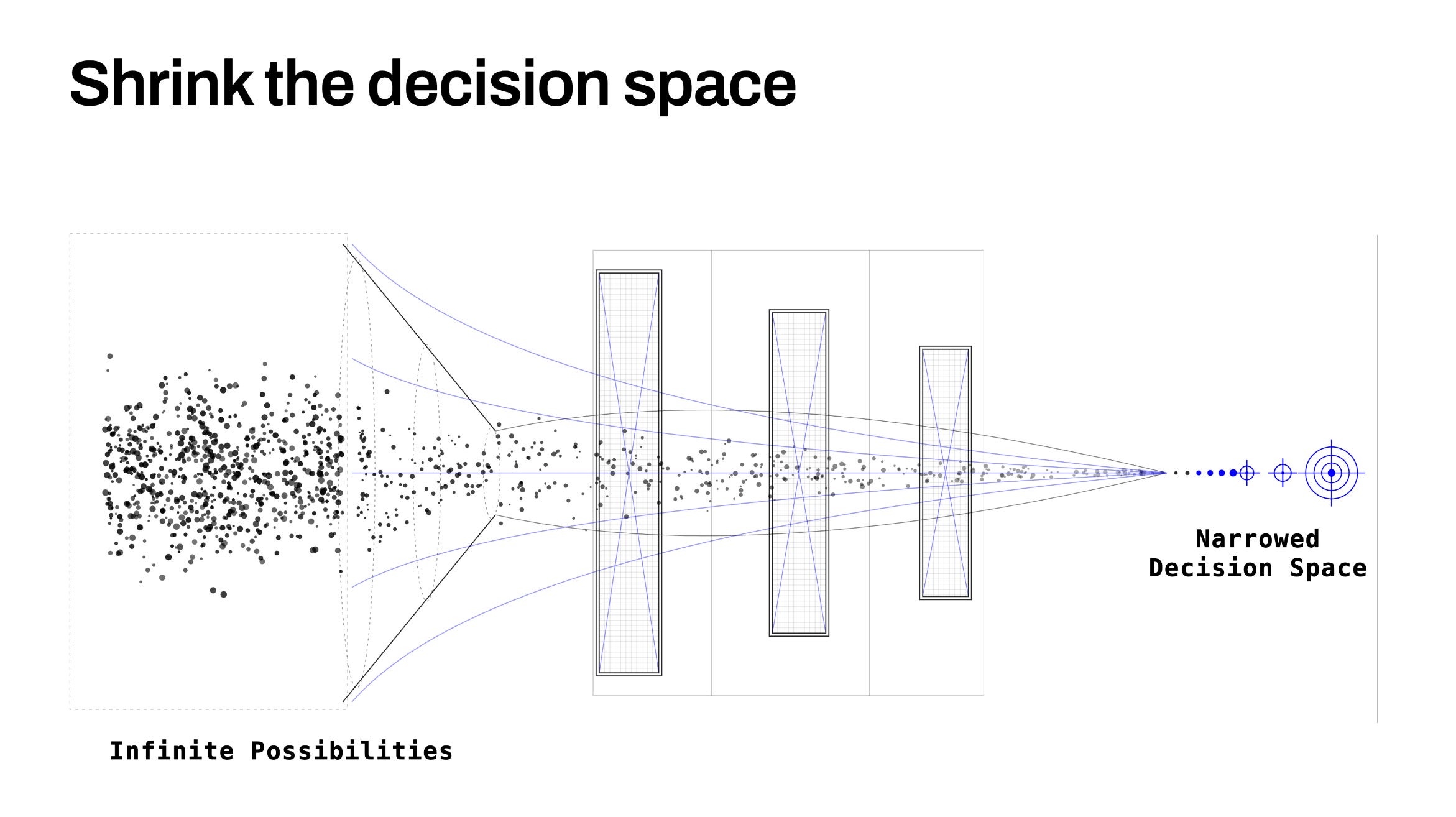
The one thing to take away: stop describing how you sound, and start showing it the difference. Do this, not that. Then keep teaching it.
This began as a Brilliant Noise webinar. Want the slides and the research behind it? Get it all here.
Comments
Nothing yet. Say the first thing.
Sign in to join the conversation.