

There’s a new kind of model in town. And it takes time to think before it speaks. We could all probably learn from that sometimes.
You might have noticed if you hang out with AI chatbots regularly, that some of the newer models popping up like ChatGPT o3-mini have started to ‘think’ before giving you a response. But does that mean you get better results? For certain tasks: yes, exponentially, but for general tasks: not necessarily.
Most AI models generate responses to our questions based on patterns in their data (the models). Reasoning models take a different approach. They work through problems logically, step by step, refining their answers as they go. This makes them more explainable, reliable, and suited for complex research and challenges.
Unlike previous AI models, which are essentially black boxes, reasoning models attempt to show their workings-out; they can weigh options, self-correct, and justify conclusions. Standard AI models can recognise patterns, but reasoning models excel at applying logic to unique or multi-step problems, making them valuable for complex problems with a lot of component parts, like business strategy, detailed research analysis, planning, and data analysis.
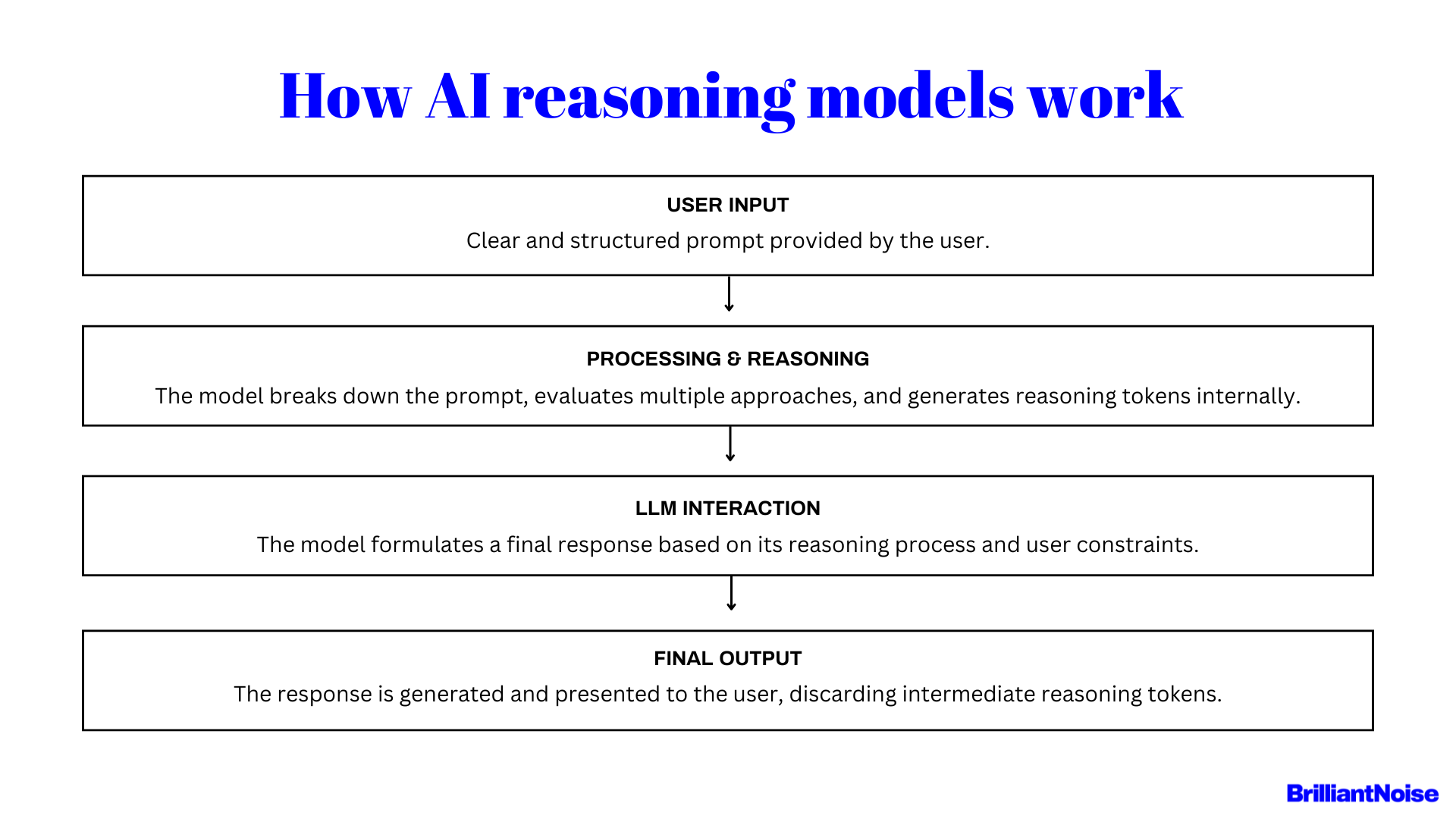
Think of different AI models as different tools in a toolbox. Other models are available, but we will use ChatGPT, the most commonly used, as our example.
Some models are built for speed and pattern recognition (e.g. standard models like ChatGPT 4o), some are designed for logic and step-by-step reasoning (like ChatGPT o3-mini).
In February 2025, when we are writing, ChatGPT 4o is the default model you are using when you open that app, its name displayed on the top left of the screen. You can access other models by clicking on the arrow to the left of the model name.
Select the type of model based on the task you’re doing (o1 and o3 mini are the reasoning ones in ChatGPT).
Example 1: AI in finance – A standard AI like ChatGPT 4o can scan massive datasets to detect spending trends. A reasoning AI can then apply financial rules to make personalised investment recommendations with clear justifications.
Example 2: AI in marketing – Standard AI can segment customers based on past behaviour, while reasoning AI can analyse why those customers behave that way and suggest tailored strategies.
Example 3: AI in customer service – A chatbot can quickly retrieve answers from a knowledge base, but a reasoning AI can solve multi-step queries, like troubleshooting tech issues or explaining policy decisions.
When to use which:
Fast, data-driven tasks? Use standard AI models (like ChatGPT 4o). You won’t get better results using a reasoning model if the task is simple.
Need logic, explanation, or deep analysis? Use reasoning AI.
Complex, multi-step task? Consider breaking down the task (Goblin Tools is great for that) and use AI to tell you which model to use at each step. E.g you can get fast insights from standard AI, and refined solutions from reasoning AI.
Expect AI reasoning models to be smarter, but slower at first. Previous models generate responses instantly, but reasoning models take a little more time to process information. The trade-off is more trustworthy, well-reasoned outputs.
We suspect this may become the norm for all models going forward. As they become better at reasoning and garnering information from us by using their context window, the ‘better’ we will deem them at more tasks. The better they are, the more investment they get into the research and development. Until before you know it, we have altogether smarter models who use reasoning before ‘guessing’ what we want.
If you found this useful, share with a colleague or friend!
Comments
Nothing yet. Say the first thing.
Sign in to join the conversation.