
This week’s guest piece comes from our Creative Director, Steph, who’s been exploring how AI is fundamentally changing the way we generate, develop and evaluate ideas. While the tools and tempo may be shifting, Steph makes a compelling case for why human taste, process and imagination remain the defining forces behind meaningful creative work.
One of the things I learned early on in my experimenting is that generative AI puts us into a directorial role instead of a production one.
With AI on the creative team, the challenge becomes using an analytical approach to sharpen the ideas and the output. But in order to do that, you need experience and extensive knowledge of the thing you’re trying to create. This could be camera settings, art direction, style and tone, content and UX design, or strategic thinking. You also need to have a mental catalog of examples to use as reference points and to know what good actually looks like. This comes only from having developed taste in the thing you’re trying to actualise with AI.
As humans we’re so much better at spotting problems and threats than we are at imagining solutions. And it’s this, I think, that’s triggered when we use AI within the creative process. You prompt, it produces something. You judge. You find the problems. You feedback. We go again. This change in creative gears is where our taste and experience really comes into its own. You know there’s something off with the copy that ChatGPT has produced, or the image from Midjourney, but can you articulate it? Can you get it to do better with the way you prompt it? But people ‘good’ at prompting AI are usually those who know not only what to ask for, but how. They’re good communicators. They have references. They have examples. They know how to take the lead. They have taste.
For example, when you strive to write well, it’s really bloody hard. Everyone knows staring at a blank page is a special kind of torture. Even after you have words on the page – the outcome is never good enough, improvements can always be made. You know it’s shit because you’ve read enough books to understand your writing is rubbish in comparison. This is good. This means you have taste.
Editing on the other hand – while still a ferocious skill – triggers a different part of the brain. You go from student to tutor. Get the red pen out and find ways to make the writing better. It’s a procrastination killer. You’re no longer staring into the abyss of a blank page, you have something to react against and tear apart. You can imagine ways to make it better. You will find issues to fix.
Imagine you’re a senior creative leader in a creative agency. A junior designer has sent you some work and it’s not what you’d hoped for. Navigating the task of giving feedback is a formidable skill. As a wise Account Director once said to me ‘It’s a little bit of someone’s soul they’re showing you’. How you respond to other people’s creative work is so crucial to the overall health of your project and creative team. You need to be quick, specific and most importantly, kind.
Now, instead of dealing with a junior creative, you’re dealing with an egoless (for now?) AI. How kind you need to be is debatable. But we all need to work out how to ask for something else when it disappoints. To do that, you have to have vision, adaptability, taste, ideas and sterling communication skills. Congratulations, you are now a Creative Director.
Technology and creativity have always been linked. Perhaps because there’s something inherently imaginative about how humans use tools. But a healthy dose of scepticism is a must when working with AI. That discernment is a cornerstone of taste – it means you spot bullshit when you see it – but also when we work through the frustration, strangeness, horror even, when thinking and working with AI, we might get to a place where there is more room for innovation and playfulness which can feed our creativity.
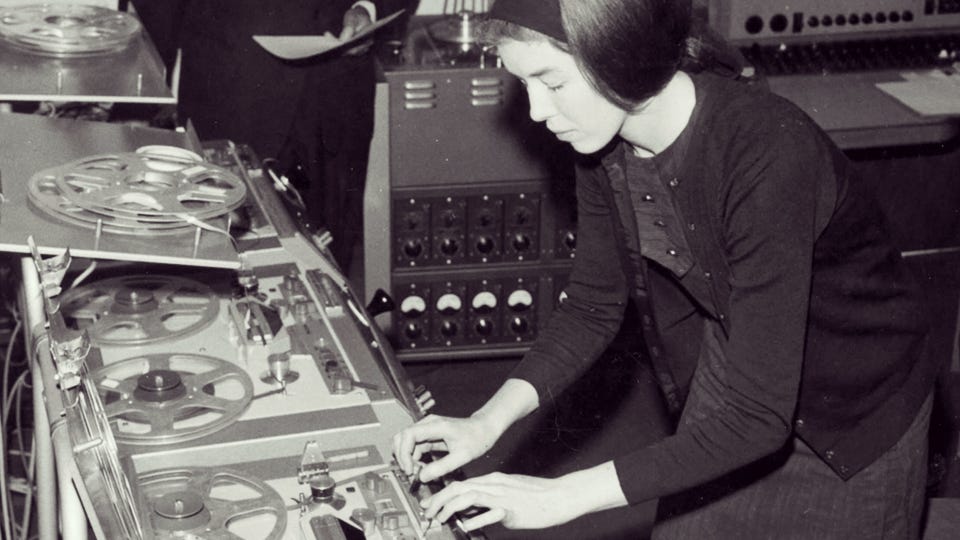
While working in the BBC Radiophonic Workshop in the very early 60s, Delia Derbyshire started to experiment with radio equipment like oscillators, tapes and sine wave generators, and she started to produce sounds that were previously unheard. Her experiments led to her writing the iconic Doctor Who theme in 1963 and many of the sounds that go into the modern day synthesiser – and by doing so paved the way for modern electronic music. So technology doesn’t just solve problems – it can open new realms of expression, often reshaping what creativity even means.
But for all the benefits, we have to put the work into knowing what we’re looking for AI to provide for us before we can hope to use it effectively within the creative process. And we have to be even more prudent and bullish about the creative vision we’re trying to realise. Creative direction isn’t just about saying yes or no. It’s about having a point of view. AI makes process, vision, and taste more important.
Just because AI can have ideas doesn’t mean it knows they’re good or bad. That’s up to us. In an age of AI abundance, there is a strong case for taste as a uniquely defining human creative skill. We’re not being replaced – we’re being promoted. To editors. To curators. To directors. To creative leaders.
Right now, the most powerful thing we can do is learn how to work with this technology in a way that expands our creativity, not contracts it.
Thanks for reading. If you have a friend or colleague who might find this interesting, please share.
This piece is one thought from a longer story. In a longer essay, Is creativity changing?, I explore the changing nature of ideas, the value of taste, the need for creative process, and what it really means to lead with imagination in an AI-enabled world. You can read it here.
Comments
Nothing yet. Say the first thing.
Sign in to join the conversation.