
Every now and then in football, a club will appoint two coaches in a shared head-coach role, despite the track record of failure that is associated with it as a long-term plan. Former giants of the East German Oberliga, 1. FC Magdeburg, is one such club that is choosing to try things differently. Notable examples of joint-managers or joint-head coaches for anyone reading that is more familiar with the Premier League are Liverpool in 1998 and Bolton Wanderers in 1995, with neither club sticking to it by the halfway point of the season, returning to a singular point of authority. Most recently, Lincoln City chose to try the joint structure after achieving promotion to the Championship this season and having their manager poached by Bristol City.
But in Germany, the structure remains a novelty only used in emergencies, such as Bayer Leverkusen in 2011-12, who appointed Sami Hyypiä and Sascha Lewandowski to see out the final few games of the season, with Hyppiä then becoming permanent manager in the summer. 2. Bundesliga side SV Sandhausen also appointed Gerhard Kleppinger and Stefan Kulovits in a joint-manager role in February 2021, and they saved the team from relegation. However, both were then dismissed in September, only seven games into the new season. With a lack of a proven strategy for successful head coaching duos, Magdeburg’s decision looks like a risky one. Here, we take a look at who the coaches are, why the club is doing this, and how they will aim to make it a success story.
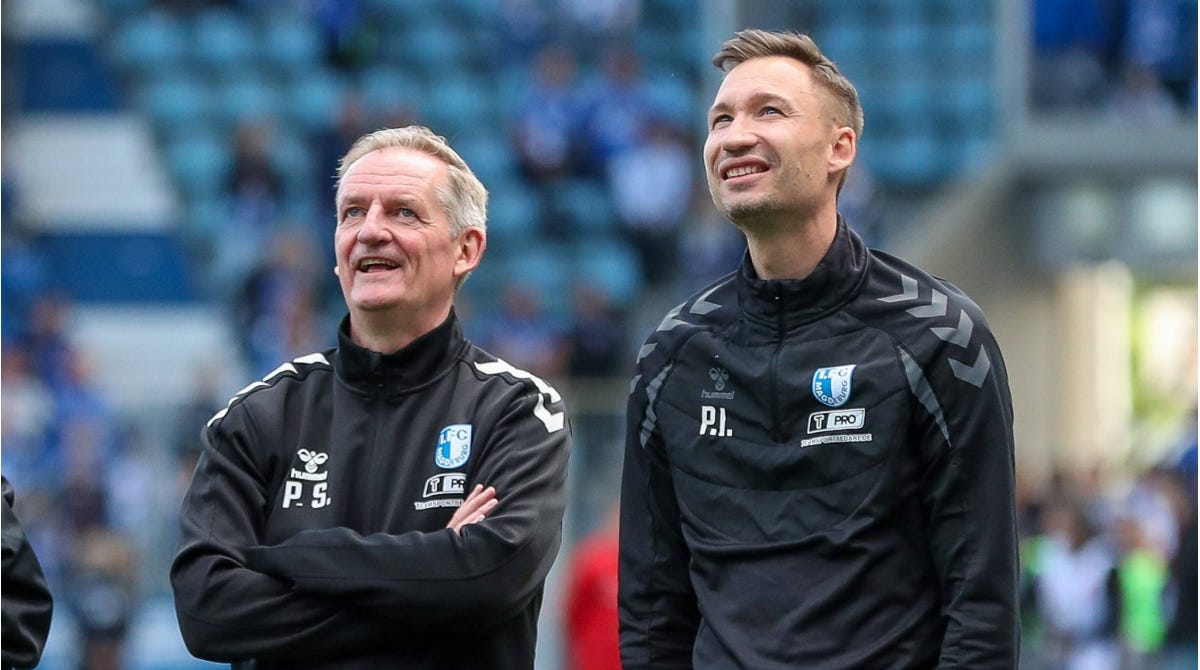
Petrik Sander and Pascal Ibold
Magdeburg’s joint-managers are two men at extremely different stages of their coaching careers. Petrik Sander made his name at Energie Cottbus in the mid-2000s, achieving promotion to the Bundesliga and keeping them there until being dismissed in September 2007. Sander has since taken on various short-term roles in the lower divisions before joining Magdeburg as the head coach of the reserves in 2022. Now 65 years old, Sander is making his return to first-team management seven years after his last stint, which was at lowly FSV Budissa Bautzen as they were relegated to the fifth tier.
Pascal Ibold is 36 years of age and was the joint-manager of the reserve team alongside Sander since 2022, as well as Assistant Manager of the first team as they returned to the 2. Bundesliga as 3. Liga champions in 2021-22 under Christian Titz. Ibold, unlike Sander, never played professionally and has been a coach at youth and senior level for several other teams in the former East Germany before joining Magdeburg in 2018.
Why make the gamble now?
After Titz left for Hannover 96 in the summer of 2025, Magdeburg began the new season under Markus Fiedler. Fiedler had been the manager of VfB Stuttgart II for two seasons, getting the reserves of Die Roten promoted to the 3. Liga and avoiding relegation in 15th place. However, after eight league games, Magdeburg had one solitary win and seven defeats, leaving them at the bottom of the table.
Having appointed the manager of a different reserve team, the club evidently realised that they should have just promoted the managers of their own reserve team, bringing the duo in on an interim basis. It is worth nothing that having only achieved his UEFA A Licence and awaiting his Pro Licence, Ibold was not eligible to be appointed as a permanent head coach, and this may be the mitigating factor here. Sander, with his charisma and significant experience, seems to be there as the ‘motivator’, whereas Ibold is the tactician that sets up the game plans for players to execute. Sander is also able to provide mentorship to Ibold as he gets to grips with his debut first-team managerial role and the pressure that comes with it. This has led to speculation that Ibold will soon take over the role in his own right, although the club’s announcement that they were extending the contracts of both for next season means that this is not a dead certainty.
Turning Magdeburg’s season around
At first, the duo didn’t change much in the set-up, keeping hold of the 3-4-3 system, achieving a draw and a win in the first two games without conceding. However, three consecutive losses followed and they began to find themselves adrift, with a four-point deficit to safety.
Barış Atik, their talismanic left-winger who has scored reliably since joining in 2021, had failed to find the net so far and the on-loan Maximilian Breunig was struggling in front of goal as well. The managers needed to find goals from somewhere, and thus produced a personnel change that absolutely nobody could have seen coming.
Mateusz Żukowski was yet to make his debut for the club after being signed for just €250,000 from Śląsk Wrocław in his native Poland, having suffered relegation to the second tier with them the previous season. A right-back by trade, he began the season as the second-choice wing-back behind Eldin Džogović. Making his debut in the match against Fortuna Düsseldorf in November under the new permanent manager duo, fans may have been surprised to see him as an advanced right-winger in the 3-4-3. What they saw happen in the next match at home to 1. FC Nürnberg made shockwaves inside the 27,000-strong Avnet Arena, as well as across the league.
Playing as a number nine, Żukowski bagged two goals as Magdeburg ran out 3:0 winners, showing incredible poacher’s instinct to find space in the six-yard box to get on the end of crosses from Atik and Alexander Nollenberger respectively.
From then on, the 24-year-old was the undisputed first-choice to play up front, and was outscored only by Noel Futkeu of Greuther Fürth. With 17 goals in just 21 games, Żukowski won the club’s Player of the Season award for dragging Magdeburg out of the relegation zone, as they headed into the final matchday in 12th place. The warning signs never fully disappearing, they dropped to 14th with a defeat in their last match, only two points clear of the automatic relegation places.
Żukowski is now worth €6million according to Transfermarkt, and even made his senior debut for Poland in a post-season friendly defeat against Ukraine, coming on at half-time for none other than Robert Lewandowski. Having overperformed his xG by 3.73 goals, Żukowski has shown that he can deliver and clubs higher up the table, or potentially in the Bundesliga, will be keeping an eye on him.
Atik’s form also picked up during the winter, finishing the season with six goals and eleven assists, another achievement of Sander and Ibold’s that is worthy of praise.
How will they approach next season?
The joint-managerial reign has already lasted longer than those of Liverpool, Bolton, Bayer Leverkusen and Sandhausen that I mentioned at the top of this article. Usually, clubs will use the off-season to bring clarity to their internal structure, but this is not the case for Magdeburg.
Although they will continue for now with ‘two up top’, it would be surprising if they go down this route again once this era eventually comes to an end. These anomalies of modern football do tend to run out of steam very quickly, after all. Managers must be ruthless, especially when in charge of clubs trying to stay afloat, and eventually cracks will begin to form. Having such a vocal fanbase that have seen better times, and averaging attendances of 25,000, the pressure will come unless results are solid at the start of the new season. It is a far greater challenge than the relative comfort of leading the reserve team, where any cracks in the coaching relationship can be papered over due to the lack of external scrutiny being applied.
Despite the 3-4-3 being the team’s preferred setup, Magdeburg often switched to a 4-3-3 when up against teams that used their own back three, rather than going man-for-man. This requires defenders that can fit the profile of both a centre-back and full-back when needed. With eight senior players already out the door for next season, as well as four players returning to their parent clubs following their loans expiring, significant recruitment will be needed which may give us a better indicator of how the managerial pair intend to set up.
Ibold’s career to this point has been one of steady growth in order to prepare himself for a full managerial career, and this is his first real chance to make a name for himself. Sander’s career began with huge relative success but was fizzling out for well over a decade before this second chance arrived with Magdeburg. Both will be desperate to make the most of it. Only time will tell if one ends up coming out on top.
No posts
Comments
Nothing yet. Say the first thing.
Sign in to join the conversation.