
In picking his squad for the World Cup in North America, Germany manager Julian Nagelsmann probably didn’t have to spend too long deliberating which strikers to take. We all knew that as long as they were fit, Kai Havertz, Nick Woltemade and Deniz Undav would be on the plane.
But what happens when all three of your choices for the number 9 position prefer to operate as a ‘9.5’? How will Nagelsmann decide who to start, and for what reasons? And what happened to Germany’s other forward options that could have been called up?
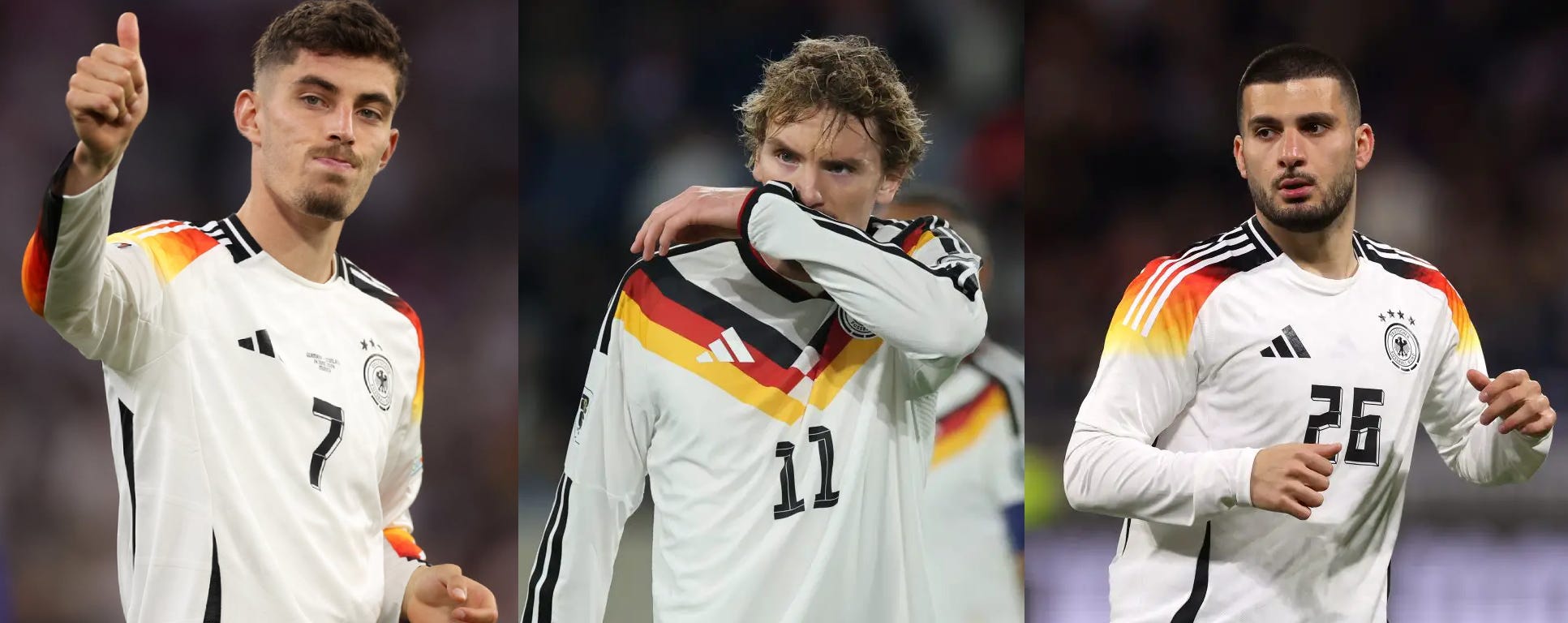
24 months ago, as Germany were knocked out of the quarter-finals of Euro 2024, Nick Woltemade was miles away from Nagelsmann’s plans. Released by Werder Bremen, his hometown team he joined as an 8-year-old, Woltemade was picked up by VfB Stuttgart as a third-choice or potentially fourth-choice striker.
12 months ago, everything had changed. Woltemade had scored 12 Bundesliga goals, adding five more in the DFB-Pokal to win that competition’s Golden Boot, including the opening goal of the final as Stuttgart lifted to coveted trophy. More importantly, he was on the radar of big clubs for big money.
Following six goals and another top scorer award at the Euro U-21s last summer, Newcastle swooped for £65million, and Woltemade was firmly in Nagelsmann’s plans.
Now 24 years old, the 6ft6 man has netted four times for the senior team in 11 appearances. Despite a tricky start to life in England, where new manager Eddie Howe began using him as a number 8 in the second half of the season, he was an easy pick for a call-up this summer.
Woltemade’s unique physical profile for players at the elite level belies his technical profile. With such quick feet and propensity for showing flair, Woltemade is an affable character with plenty of quality. He tends to apply neat finishes, a dink here and a header there, rather than blasting a shot from 20 yards. This led to his shooting stats nosediving after moving to a deeper role, as he is less inclined to take shots from there. According to data available at one-versus-one.com, he only shot twice from outside the box - though both of those were within the penalty arc. In 1,914 minutes, which equates to just over 21 full 90-minute appearances, he only had 32 shots. With eight league goals, this gives him a respectable shot conversion rate of 25%. However, most elite coaches would want a striker that gets more shots off.
Herein lies the issue for Nagelsmann. With his on-the-ball ability, Woltemade loves to show for the ball in deeper areas of the pitch. While not the fastest or strongest, he can help link attacking moves with a habit of first-touch passes and body feints to wrong-foot his man. When your job is to stand in the box and wait for crosses, you don’t get to showcase this sort of talent. Having rapid wingers that make runs in behind at Newcastle may have allowed Woltemade to play this way, Nagelsmann’s starting XI just won’t have this as an option. But if you also don’t want to shoot from outside the box, why spend so much time there as a lone striker?
I expect Jamal Musiala and Florian Wirtz to start together, possibly with Lennart Karl on the right, or maybe Leroy Sané. If Woltemade shows for the ball, this quartet could produce lovely intricate passing moves. But my worry is that it will muddy the attack, with too many players getting in each other’s way, with none of them possessing a natural instinct to make the runs that an ‘old-school’ number 9 would.
These players love to take on their man, shift the ball into any gap they can find, try to curl a shot around a defender. Except with Germany likely to dominate possession in their group stage fixtures against teams sitting deep, how possible is this?
So how about using 29-year-old Stuttgart captain Deniz Undav. Woltemade’s former club teammate in 2024/25, Undav offers a different skill set and physical profile.
Undav joins Woltemade in Germany’s list of World Cup debutants. Undav also spent time in Werder Bremen’s academy, although being much older than Woltemade, I assume they were unaware of each other even though they overlapped for two years.
Standing at 5ft10 but with a stocky build, the former Brighton and Hove Albion man ended 2025/26 as the highest-scoring German player in Europe’s top leagues, with 19 in the Bundesliga and 25 in all competitions for his club. He also has six goals in eight appearances for the senior team, having never appeared at youth level.
For the last three seasons, Sebastian Hoeneß has deployed Undav as a lone 9, as one of two 9s, and as a 10 for his club. In his first season, he struck up a solid partnership with Serhou Guirassy, the duo combining for 46 league goals. With the arrival of Woltemade and Ermedin Demirović to replace Guirassy, Undav made the transition to being more of a second striker, playing just off his strike partner.
Undav’s powerful running style makes him a nuisance for defenders to directly engage with. He pairs this with a fantastic ability to avoid being picked up, allowing Demirović to occupy defenders before arriving at the perfect time to receive a pass inside the penalty area. Undav has played as a lone striker at times this season, usually successfully, such as his Player of the Match performance in a 5:2 win at Augsburg, or in their 4:1 win at Bayer Leverkusen.
He recorded a G+A of 1.04 per 90 minutes played, which is extremely impressive. His pressing ability is certainly superior to the other options, but I can’t imagine Germany will have to press much in the early phase of the competition. Footystats.org has his conversion rate at only 15%, though, which puts him in the 74th percentile of all Bundesliga players, so Woltemade has him beat there.
As he is probably third-choice to start at the moment, how will he cope coming off the bench if Germany are chasing a goal? Especially in a congested final third where he may not have that space to arrive in? His lack of aerial presence is also a drawback in this game state that must be considered, something that Nagelsmann’s other options do have.
With all that in mind, we come to the biggest of the three names, Kai Havertz. Fresh off the back of a Premier League title, and becoming only the third player to score in a Champions League final (since the 1992 rebrand) for two different clubs, Havertz has that star quality you need in a World Cup winning side.
But it’s also no secret that Arsenal brought in Viktor Gyökeres last summer because Havertz couldn’t be utilised as a poacher-type against low blocks, and because of constant struggles with injury and fitness. There’s no doubting his quality when fit and confident, but you cannot rely on him for a full season, and sometimes not even the duration of an international tournament. He only started seven league games this season, with 12 appearances in total in the competition. With two goals and three assists, he will need to work on his sharpness in order to be ready to make a full contribution to this World Cup campaign.
When Havertz signed for Arsenal, there was talk of him being deployed as a left-sided centre midfielder, although after some early poor performances it was clear that this wasn’t the role for him. His attacking movement is certainly more intelligent than the others, and he knows where the space is, but he can be let down by his composure when finishing chances. Undav on the other hand, is ice cool in front of goal. Havertz also doesn’t mind coming deep for the ball, but will Musiala and Wirtz be able to rotate positions with him to maintain that balance and fluidity in the attacking structure?
Havertz has the big game experience needed, though. If I had to guess now, I would say Nagelsmann picks him to start in the group stage matches, to try and build his confidence ahead of the knockout fixtures (if they can actually get through their group this time).
Germany’s big target man at the Euros, and the 2022 World Cup, Niclas Füllkrug, has fallen way off Nagelsmann’s radar. The 33-year-old struggled at West Ham United since leaving Borussia Dortmund in 2024. Injuries have plagued him, but the Premier League didn’t seem to suit him either. One solitary goal in 20 games for Milan since joining on loan in January hasn’t helped his chances of a recall.
Nagelsmann has, however, called up Maximilian Beier, who played as a striker for TSG Hoffenheim and does know where the goal is. Since moving to BVB as one of Füllkrug’s replacements, he has had to play as a wide man on either flank to accommodate Guirassy through the middle. Putting him in as a 9 would be a big risk due to his lack of playing time there at club level in the last two years.
Several other advanced wingers could have been brought along, such as Serge Gnabry, Karim Adeyemi, Kevin Schade or Said El Mala, but none have really been a preference of Nagelsmann despite being called up to squads previously.
The only true number 9 that is available but missing is Jonathan Burkardt. The Eintracht Frankfurt man sustained an injury in November that kept him out until late February, and struggled in a dysfunctional Albert Riera team for the rest of the season. His considerable frustration at the lack of game time led to a confrontation with the manager, which perhaps didn’t enamour him to Nagelsmann.
Either way, on form and ability, Nagelsmann has chosen his three best strikers. Should any of them step up and embody the role of a traditional centre-forward, Germany could have a deep run in this tournament. If they want to continue playing in their usual 9.5 roles, though, Das Team may struggle to score the goals they need to be true contenders for the biggest trophy of them all.
No posts
Comments
Nothing yet. Say the first thing.
Sign in to join the conversation.