
OK, first of all, I just want to note how entertained I am by asking Gemini to generate pictures for these articles! This one came with AN EXTRA ARM :D Also, they didn’t quite get our faces right but somehow completely duplicated our offices in the background.
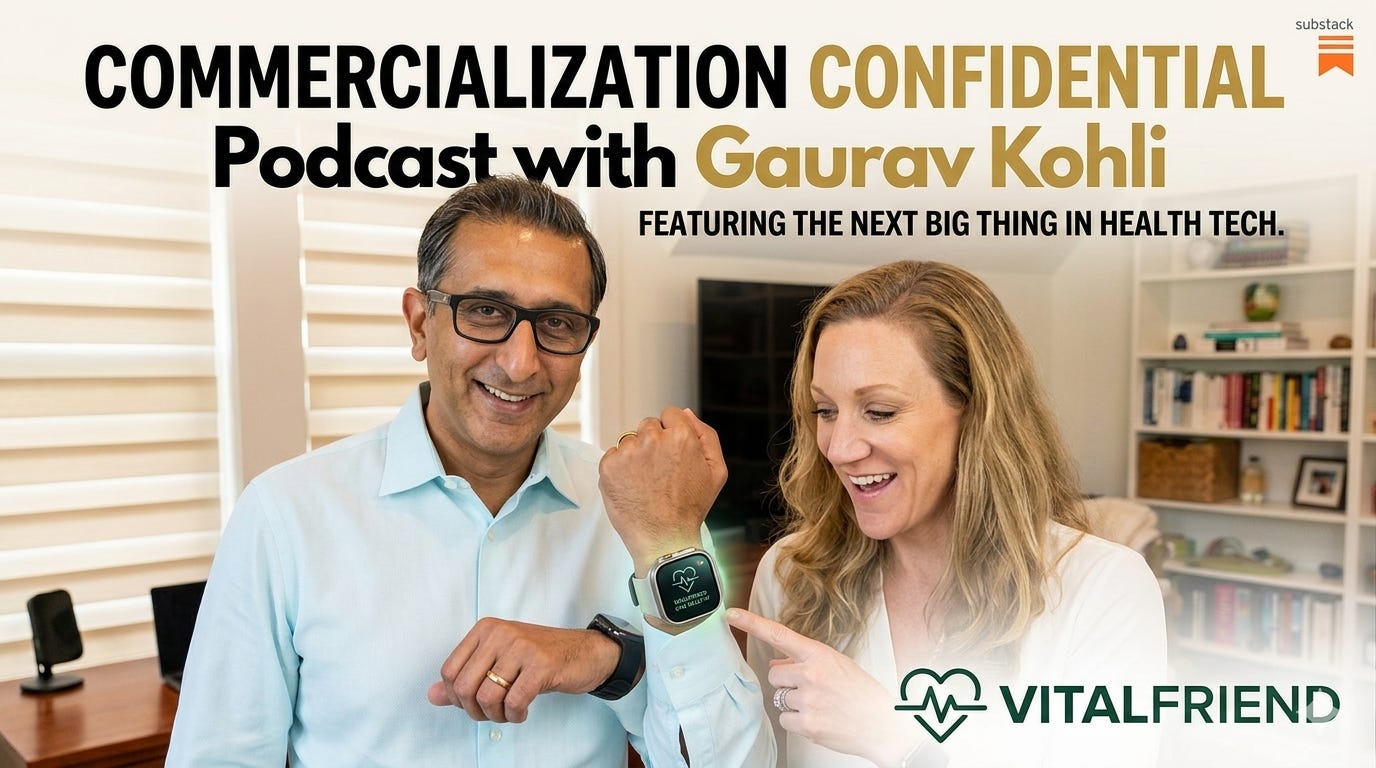
In this episode I sit down with Gaurav Kohli, founder and CEO of Vital Friend, the company behind BUDDI — the world’s first and only FDA-cleared continuous medical watch designed for senior care. BUDDI uses oscillometric technology with an inflatable/deflatable cuff on the wrist (yes, on the wrist) to continuously monitor blood pressure, heart rate, HRV, oxygen saturation, and temperature 24 hours a day, including during sleep. The name BUDDI stands for Biometric Unified Data Delivery Interface, which I appreciate as both a name and an acronym.
Vital Friend launched BUDDI in May 2025. Eleven months later, they’re revenue positive - which, in the world of Class II medical devices billing through Medicare, is a remarkable pace. What I found most interesting about Gaurav’s story isn’t actually the technology (though it’s cool). It’s the commercialization model they’ve built around it: a frictionless, insurance-covered, B2B sale into assisted living facilities where Vital Friend essentially just shows up.
As always, three ways to absorb this one:
Gaurav and I met over breakfast at LSI earlier this year, and it was exactly the type of serendipitous encounter that is why we go to conferences like this in the first place!
I’m sure, reader, that you’re well aware I’ve covered the world of blood pressure wearables pretty extensively in The Device Files. So it should come as no surprise that I was chatting with some folks the first morning at breakfast about wearable BP. That’s when Gaurav, across a large circular table, said “check out this wristband,” and came over to slap BUDDI on my wrist. It basically looks just like an Apple Watch and started inflating almost immediately. But, surprisingly you could barely feel it and it was super comfortable – sort of like a thin band of scuba material inflating on one side of the wrist.
The first thing out of my mouth was “I think I could sleep through this.” Gaurav nodded, “Yes, people do sleep through it, and that’s the whole point. It doesn’t disturb the patient, and it doesn’t mess up the reading the way being woken up to take vitals does in a hospital.”
Then he started swiping through the screens showing what BUDDI actually captures continuously (blood pressure, heart rate, HRV, oxygen, temperature) and told me he was already on the market and cash flow positive. I knew right then I needed to get him on the podcast.
Three things made this conversation worth having.
The product itself is a solid design.
They went from concept to market faster than I’ve ever heard of a device getting to market. And
The commercial model they’ve built around it is, I think, the real innovation.
I think the biggest part of this rapid success is in Gaurav’s experience. He’s founded four startups before this one.
Vital Friend started where a lot of the best healthcare companies start, with a personal problem. Gaurav’s parents are in India, and as they got older he wanted a way to know how they were doing day to day. That was the original use case for BUDDI. From there it expanded into a bigger question of what continuous health monitoring could look like for aging parents and the caregivers trying to support them.
The technology is impressive on its own (the deep-sleep nocturnal BP capture is something almost no other consumer wearable can do). But the more interesting part is actually the commercial model Vital Friend built around it:
B2B sale into senior care. Specifically assisted living, then expanding into skilled nursing, independent living, and concierge physicians. They evaluated B2C, physician practices, and fitness/longevity centers and explicitly chose senior care because of the monitoring gap (assisted living isn’t 24/7 monitored the way hospitals are).
100% covered by insurance. Medicare, Medicaid, Medi-Cal, private insurance, and VA. The facility doesn’t pay. The patient doesn’t pay. Vital Friend bills under existing CPT codes for remote patient monitoring (RPM), chronic care management (CCM), transitional care management (TCM), and remote therapeutic monitoring (RTM).
White-glove monitoring service. Real doctors on the Vital Friend staff watch the data, leave notes on patient profiles, and do a monthly tele-visit with every patient. As Gaurav put it, “We’re not just a wearable. We’re a medical watch with real doctors behind you.”
Frictionless adoption. It only involves handing someone the BUDDI device. No contract for the facility, no upfront cost, no risk. If the patient is ok wearing it and stays adherent for the remote monitoring, they can keep using it and the staff just bills insurance directly.
The result: launched May 2025, revenue positive within 11 months, currently live in Florida and California with Texas on the way.
So, what lessons can we learn from VitalFriend?





Before any of the features, the personalization options, the color choices, the customization - your base product has to work.
For Vital Friend, that means accurate blood pressure. If BUDDI’s BP readings aren’t clinically reliable, none of the other features matter. As Gaurav put it,
“It’s not a fitness device. It’s a medical device to get that clinically validated data. My blood pressure has to work.”
Once the base product was bulletproof, then came the iteration: color, loop styles, customization, even putting their own logo on the watch face so seniors can call the company directly for help. That last one they just figured out a month ago, after realizing patients were calling random numbers on packaging instead of the watch itself. Small thing, but it’s the kind of thing you only learn from users wearing it in the real world.
The takeaway for founders: don’t ship features when you haven’t nailed the fundamental promise.
The original commercial plan was to charge family members $30 per month to monitor their parents, but Vital Friend made the call early to walk away from that model entirely because they recognized the opportunity to make uptake virtually frictionless.
BUDDI is 100% covered by insurance. The facility pays nothing. The patient pays nothing. The family pays nothing. Vital Friend shows up at the assisted living facility, puts the device on the residents who qualify, monitors them remotely under existing reimbursement codes, and bills the insurance directly. If a resident doesn’t like it, they return BUDDI the next day. No penalty, no contract, no risk to the facility. As Gaurav put it:
“It’s a beautiful sales model. I call it the Google of healthcare. We just show up.”
That model isn’t the easy path, it’s actually the harder one. Going “full frictionless” has Vital Friend providing an entire support system for clinical care and billing. Its also playing in a reimbursement category that’s already earned a reputation for fraud, which means senior care facilities were initially worried about adoption. No one wanted to trigger an audit.
Which is where the second piece of this takeaway comes in. While implementing RPM with their first customers, the Vital Friend team kept uncovering examples of how the system gets abused across the industry – things like padded call times, edited dates, vague diagnostic justifications, devices billed for patients who weren’t actually wearing them. So, they built their platform to make every one of those abuses structurally impossible.
In the Vital Friend system:
Dates can’t be edited after the fact
Calls auto-disconnect at the qualifying minute mark, even if the doctor is still mid-conversation
Readings have to come from the device itself; no manual workarounds
Patients can log in and see exactly which CPT codes are being billed on their behalf
Diagnostic codes are strictly tied to conditions where the FDA-cleared vitals actually apply — Vital Friend’s oxygen reading isn’t yet FDA cleared, so they won’t enroll a hypoxia patient under insurance (cash pay or no enrollment)
An internal AI auto-generates the compliance report for the biller
The net effect is that Vital Friend is de-risking itself against any future insurance audit. As Gaurav described his approach to building in a regulated industry:
“We said we’re going to apply every single rule of healthcare, but we’re going to move fast. We’re not going to break that rule to go fast.”
That was very refreshing to hear from someone who has grown up in the “move fast and break things” world of Silicon Valley.
This one I’ve been seeing across multiple episodes now, and it’s becoming a real theme in commercialization stories. Your first site isn’t just your first customer, it’s your retention case study, your product feedback loop, and (if you do it right) your loudest ambassador.
Vital Friend was deliberate about who they picked first. Gaurav specifically wanted a facility he could measure long-term retention against, because if your first customer from month one isn’t still with you in month eleven, something is structurally wrong with the product, the service, or the fit.
Their first facility is in Florida. Gaurav and his co-founder are in California. They moved to Florida for a month to live next to the facility, sit with the nurses, talk to the owners, watch how the device fit into daily workflows, and iterate the platform in real time based on what they saw. That woman who runs the facility is still their customer today, and Gaurav describes her as the company’s ambassador because she promotes BUDDI to everyone she meets.
The average medical device takes 5.7 years to reach reimbursement. Vital Friend hit it in eleven months. And they did it by not trying to create their own CPT code.
This is one of those things I see all the time in my consulting work. A founder has built something genuinely novel. They look at the existing CPT codes and decide none of them really capture what their product does. So, they commit to the multi-year process of getting CMS to create a new code that actually fits and spend many years building up to that coverage.
Gaurav’s frame on this is “You don’t ask ‘which code should they create for me?’ You ask ‘which existing code can I make my product fit?’”
Vital Friend looked at every CPT code in the remote patient monitoring family and reverse-engineered their qualification criteria and clinical workflow to slot cleanly into what already exists. They bill under five existing codes today. They’ll pursue their own code eventually. But that’s a project for year four, not year one.
A unique code can be a long-term moat, but sometimes the better play is to start with an existing code and start generating the cash flow that lets you survive long enough to create it.
Most startups don’t hire a full C-suite from day one. Vital Friend did, and Gaurav credits the team with most of what’s gone right in the first year.
The roster, in his telling: people from Napster, Meta, Facebook, Google, and Genentech. Eight successful exits among them. Every member of the C-suite has been CEO of their own startup before.
The point isn’t just resumes. It’s the combination of two things that don’t usually go together:
C-suite-level pattern recognition. Multiple ex-CEOs in a room means decisions get pressure-tested fast and the team has seen most of the failure modes before they happen.
Willingness to roll up sleeves. None of them is sitting in a corner office. They’re operating like a startup team, because they understand from their own startup experience that you have to.
One thing you’d always do again: Put the device in real users’ hands constantly, all the time, collecting data and iterating from what people actually experience. “We make perfection out there, putting it in the hands of people,” Gaurav said. Not in the lab.
One thing you’d never do again: Try to explain or demo the product without a side-by-side comparison to other wearables. They learned that simply showing the BP working live next to a competitor saves enormous amounts of time and immediately closes the credibility gap.
Favorite KPI: Patient adherence. Everything else flows from it — retention, adoption, family engagement, clinical value, billing success. If patients aren’t wearing the device, none of the rest matters. (Note: if a patient stops wearing BUDDI consistently, Vital Friend actually takes the device back. They won’t bill insurance for someone who isn’t engaged.)
Most unexpected growth lever: The save-a-life stories. The 2am BP alert that woke up the on-staff monitoring team, who called a resident, who took her medication, and went back to sleep. The diabetic patient whose heart rate started dropping overnight; the team called him, he had a spoon of sugar, life saved. The independent living resident with stage 4 kidney failure who started his own blog about BUDDI inside his facility. In senior living, word of mouth from one believer drives more adoption than any sales call. The clinical wins create the marketing.
Thanks to Gaurav for joining me on The Device Files: Commercialization Confidential and for being such a generous storyteller. The frictionless, insurance-paid, white-glove commercialization model Vital Friend has built is one of the more original playbooks I’ve seen in the wearables space, and I suspect we’ll be seeing pieces of it copied across the category over the next few years.
See you next month!

Blythe Karow is a strategic management consultant and founder of The Karow Advisory Group. She writes The Device Files, a Substack publication on MedTech strategy, market access, and commercialization.
We’re aiming to release one episode per month and I’m actively looking for people who might be good podcast contributors.
If you or someone you know has commercialized:
As a startup, OR
In a completely new market area where your company did not have relationships in the past
And that commercialization isn’t so out of date as to not be relevant, please reach out. I’d love to highlight more leaders on the podcast.
No posts
Comments
Nothing yet. Say the first thing.
Sign in to join the conversation.