
Should I simply share the next 10x stock?
This is often what garners the most attention in social media sphere. It’s the mentality of, “how can I get rich quick?” From my perspective, there’s nothing wrong with it. It gains clicks, views, engagement and it’s exciting. At the end of the day, people like to feel excited about investing. But today, I wan’t to talk about durability. How do you stay in the game? How do you compound results? How do you ensure that you generate multi-decade returns that truly lead to generational wealth?
It’s shifting the mindset from a lottery ticket, gambling like, mindset to one that of a professional, accredited, investor.
Investing, from how I’ve learned it, is less about IQ (depth of knowledge about a particular industry/product) or making one correct choice (although that does help). Investing, is a discipline, it’s a process. There’s a clear, defined process with rules that the most successful investors implement on a day to day basis to ensure they are:
Defining and sticking to their strategy
Managing risk
Growing their portfolio effectively
Picking the correct investments
When I got to thinking about exactly how “I”, personally, ensure my durability, I knew how to break down this strategy. There are concepts that all investors should know about that I believe are universally accurate among traders, trend investors and long term investors. These principles can be defined into four parts: Defining ones strategy, position sizing, risk & managing risk, and picking the correct stocks to go into your portfolio.
Truthfully, each of these principles are important enough to be their own article, which is why I will break down my portfolio management process into four parts. So if you find yourself enjoying the content of this article, be sure to look for parts 2, 3 and 4 as I bring this all to life.
Part 1: Defining my Strategy - this article
Part 2: The Importance of Position Sizing - Next article
Part 3: Risk & Risk Management - the most necessary to discuss
Part 4: Picking Stocks Correctly - this will be the most fun to talk about
Before I go into the other 3 parts of this 4 part article, I do want to ensure that I am putting the correct context into parts 2, 3 and 4 (which is the purpose of this article). How I position size, manage risk and pick stocks will be reflective of my own strategy, and I will be using parts of my portfolio as an example throughout the process. In order for me to share the meat and potato’s of my strategy, I must first define and share my strategy.
There are many different portfolio management strategies in the financial markets. I see various approaches like day trading, options trading, long term investing, trend trading or even macro trading. For me, personally, the thing that always resonated, and made the most sense, was a combination of CANSLIM methodology (Book: How to Make Money in Stocks), written by William O’Neil, and Peter Lynch’s growth stock strategy best depicted by his books One Up on Wall Street and Beating the Street.
At the end of the day, after reading all three books, the combination strategy resulted in two glaringly obvious commonalities:
Earnings and a companies ability to produce quality earnings directly impacted and the stock price of a stock
There are macroeconomic trends and business trends that heavily influence the buying and selling environment in the broader economy
For example, during the latest stock market bubble, we saw Zoom’s stock price drop to $55/share during the COVID lock downs but then the stock ran to nearly $500/share, which is a near 1,000% gain, a fantastic trade. This happened for two reasons: 1.) The world was locked down and people needed to virtually communicate somehow. 2.) Everyone (businesses, classrooms and individuals) needed a way to communicate and Zoom was the solution. With Zoom being the solution, the companies Revenue and EPS surged during 2020 to mid 2021.
Now, Zoom suffered a fairly dismal fate as competition flooded the market and the economy opened back up. The story changed, consumer buying behaviors changed and Zoom’s revenue and EPS have flatlined as they are only now remembered as a COVID darling. Despite this, the two principles discussed above remained true despite it’s non-structural tail winds that influenced Revenue and EPS.
In part 3, I will properly discuss story identification as it’s coupled with risk and risk management strategies in my portfolio management process.
To provide another, more recent example, and one that I am a direct beneficial of, is Palantir. Unlike Zoom, I do believe Palantir’s price surge is significantly more structural (despite elevated valuation) but the idea is all the same. Let’s tie this into the two frameworks of thought that I mentioned above:
Palantir directly benefitting from a change in macro trends: In early 2023, X (formerly Twitter) was taken by storm. There was a brand new technology, called ChatGPT, that could write poems and interact with you. Overnight, it felt like our lives would never be the same. AI was mentioned on every earnings call, Nvidia started to rally in a near euphoric fashion (right after a catastrophic bear market that hated innovation) and every hyper-scaler began major initiatives on “AI” and AI projects. However, there was one major problem that plagued companies developing an AI strategy, they had a poor data strategy.
Palantir’s revenue and EPS surged as a direct result of changing macro trends: Palantir had the solution to a poor data strategy and this was directly linked to a product they have been developing for sometime. They called this “The Ontology”, or Foundry, which is essentially a way for your business and business functions to be recorded, organized and monitored throughout the enterprise. In other words, this is your businesses data and Palantir had a way to integrate an LLM to your business so you could interact with your businesses data to generate insights, predictions or risks in your business. As a result, Palantir’s sales and EPS has surged since 2023 and the tail wind even continues today.
With our example of Palantir, their macroeconomic tail winds have continued for the better part of 3 years, and even to this day, their demand appears structural which has created a nice floor in their stock price. On a side note, I do believe their stock is likely to trade sideways for some time but demand is real. Years of gains were effectively pulled forward within a couple months to reflect years of growth and now, this is my biggest winner and first 100 bagger stock. This company reflected a perfect confluence of macroeconomic forces shifting that directly impacted the top and bottom line of the company.
I attempt to find multi-bagger stocks to hold for years. Stocks (companies) who have years of revenue growth and earnings growth ahead of them. I do this by following the story of the stock to ensure that it correlates with, and matches, the macroeconomic picture and business trends of the future.
This is the link to my portfolio if you’d like to follow. My latest article is slightly outdated as I now bought two new positions.
Opening Up: 3 Year Portfolio Performance
·
Jan 5
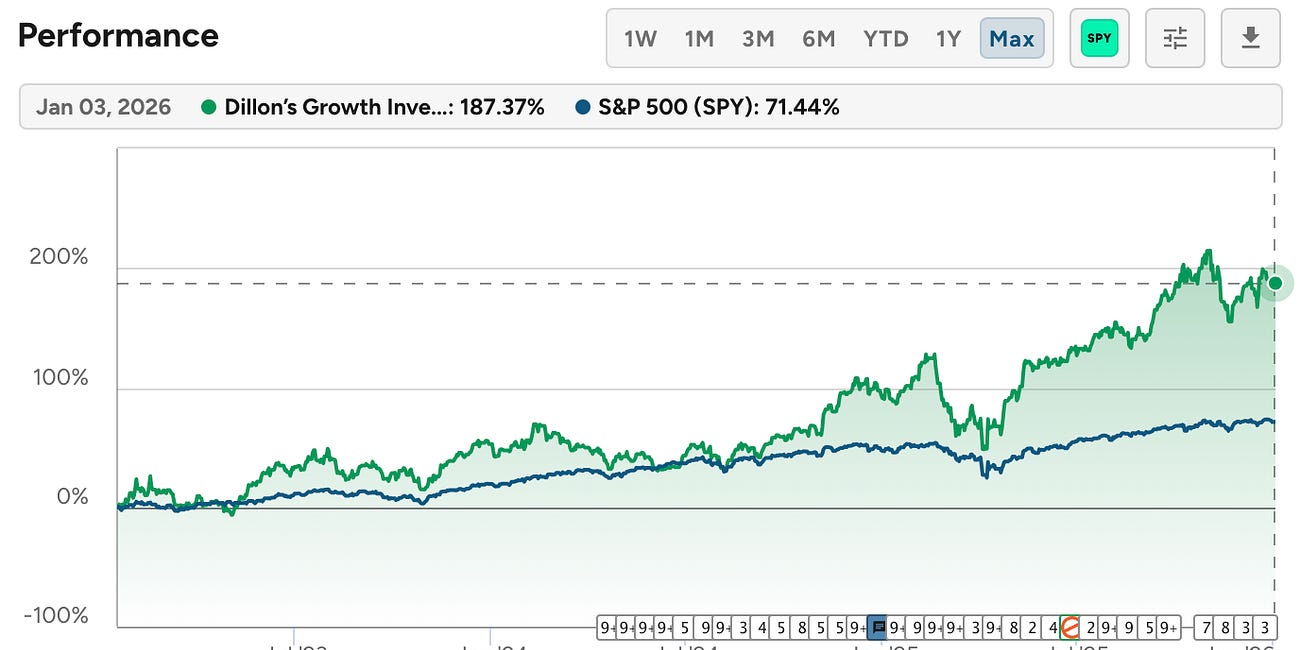
It has been 3 years since I have seriously produced content. The dogma and narratives that circulate retailed investor focused social media doesn’t necessarily lead to honest, trustworthy results that people can trust to either learn from, or simply find entertainment from. What usually happens is that people will get hindsight posts where someone will …
In the journey of finding stocks that I can hold for years, I go through a mental check list in my head. My first thought is, “what does the company do?”, the next thought is, “do they make money (cash flow) and if not when will they start to make money?” and, the most important part to this is, “can I see them beat analyst expectations over the coming years based on what I know about their business model and the macro trends?”
For years, I thought it was “good enough” to hold companies that were growing at 20%+ for years into the future (to out perform markets). In many cases, this principle is true but to really gain alpha over the financial markets, you have to understand what the “Efficient Market Hypothesis” is.
As defined by Grok: “The Efficient Market Hypothesis is a foundational theory in financial economics that posits financial markets are “informationally efficient,” meaning that asset prices fully reflect all available information at any given time. Developed primarily by economist Eugene Fama in the 1960s and 1970s, it suggests that it’s impossible to consistently achieve higher returns than the overall market (i.e., “beat the market”) through stock picking, market timing, or other strategies, because any new information is quickly incorporated into prices.”
Although I believe you can out perform the markets, contradicting economist Eugene Fama. I do agree (and know) that all present information is reflected into the future of the stock price. Wall Street heavily models stock prices approximately 6-9 months out, or 2-3 quarters out. This comes from a defensive posture on Wall Street where they need to model conservative estimates into the stock price to ensure that the business is not deteriorating.
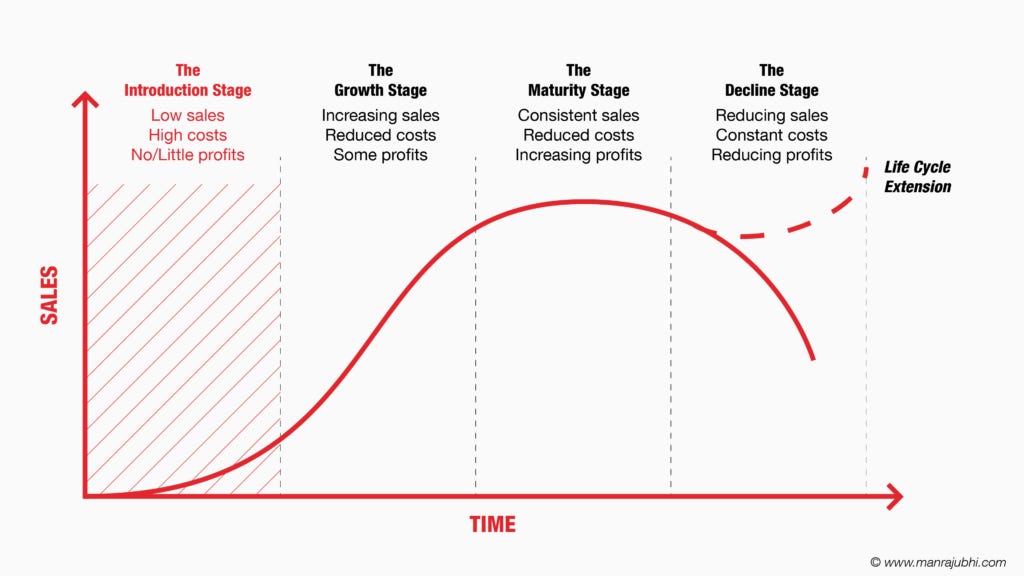
All companies work through a life cycle. Once the company matures, they eventually begin to decline. Once a company hits the maturity phase, and they don’t find ways to return to growth, eventually their stock price will be stagnant for years as the business slowly/gradually deteriorates over time. At this point, the business is either sold/acquired, delisted or it just goes out of business.
Wall Street models companies so heavily because management teams lie, numbers don’t, and approximately 50% of all publicly traded companies are delisted within 10 years of initial IPO.
It has become my understanding that it is best to find companies who are at the bottom of an S curve. A companies S curve is very hard for Wall Street to model and this is the inflection point where individual investors can gain the life changing returns that come with participating in financial markets. For example:
Tesla during the Model 3 and Model Y ramp
Nvidia after the ChatGPT launch and demand inflection for their GPU’s
Palantir’s inflection and bet on the Ontology working out
Those are just a few examples that have happened over the past few years. Within my portfolio today, there are multiple companies that I have (usually in the spec position of my portfolio, more on that in article 2) that I believe are at the very bottom of massive S curves.
Everything I do, all the work I put into managing my own portfolio, always stems down to the principle that I am attempting to compound my portfolio at 20%+ for the next 30 years. In order to accomplish this, I find the right stocks, manage risk/volatility, follow the story of the stock/business, and hold onto positions while a company’s story develops.
As mentioned above, if you enjoyed today’s article introducing you (the reader) to my strategy, stay tuned for my next where I will be talking about position sizing and how I construct a portfolio.
In articles 3 and 4, I will further break down how I navigate risk and define various forms of risk as well as share my exact stock selection process.
No posts
Comments
Nothing yet. Say the first thing.
Sign in to join the conversation.