
Stop me if you’ve heard this before.
Following the controversial resignation of a civic leader, an opposition candidate rises up and builds a healthy lead over their rivals in the lead-up to election day. They consistently outpace in a wide variety of polls, both in terms of companies and methodologies - meanwhile the supposed successor struggles to overcome a frustrating vote split and low morale. The outcome seems so clear that pundits are way past digging the grave of the losing candidate, and have moved on to parsing out exactly who will be in charge of what in the new regime.
Election day comes and… woops! Big error! The successor wins and does so handily, leaving pollsters and pundits alike stunned for weeks.
What am I talking about - Alberta in 2012, BC in 2013, or to a lesser extent Winnipeg 2022?
Or - am I giving a preview of what’s to come June 26 in Toronto?
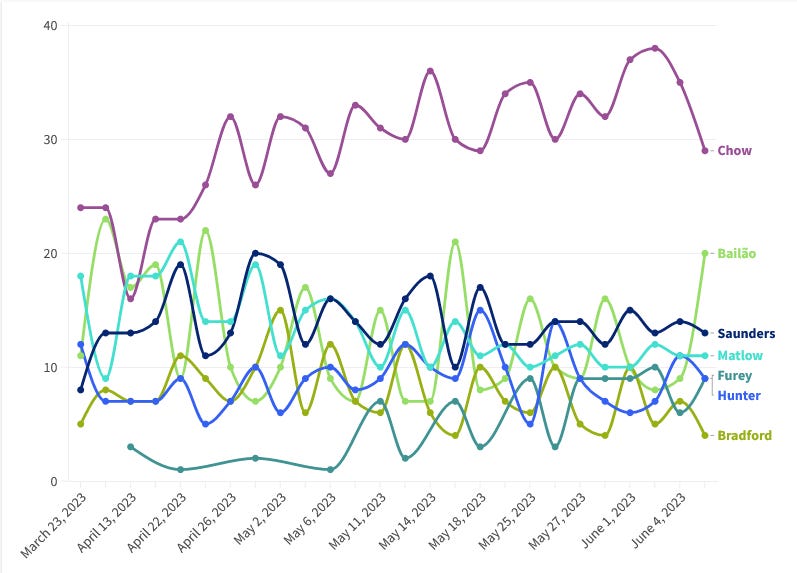
Former NDP MP (and 2014 third-place finisher) Olivia Chow’s lead in the Toronto mayoral by-election has been consistent since nearly the start. In fact, she has trailed only once since signifying her interest in the race, in a mid-April Mainstreet Research poll where she was statistically tied with former city councillor and Deputy Mayor Ana Bailão and current councillor Josh Matlow. Since the start of May, Chow hasn’t seen anyone approach her within the margin of error (MoE) of any poll.
With a clear lead and no rivals consolidating behind one another (save for in Mainstreet’s polling, which we’ll get to), Chow’s campaign can probably count on squeaking by even if a traditionally severe polling error occurs between now and election day - dropping 10 percentage points would put Chow 5-10-points ahead of her rivals on average, instead of the 15-20 she is now.
In some ways Olivia Chow is in a blessed situation similar to Denis Coderre’s in 2013, where a multiplicity of serious-but-not-consolidating challengers allowed him to win despite a 9-point difference between the final poll (conducted just over two weeks prior to election day) and his actual results - 41% vs 32%.
(Of course when facing against a singular challenge in 2017 and 2021 Coderre lost handily - but let’s not worry about that for the moment.)
On the other hand - Vancouver’s 2018 mayoral election is instructive about what happens when a rival does emerge and has some eerily similar vibes.
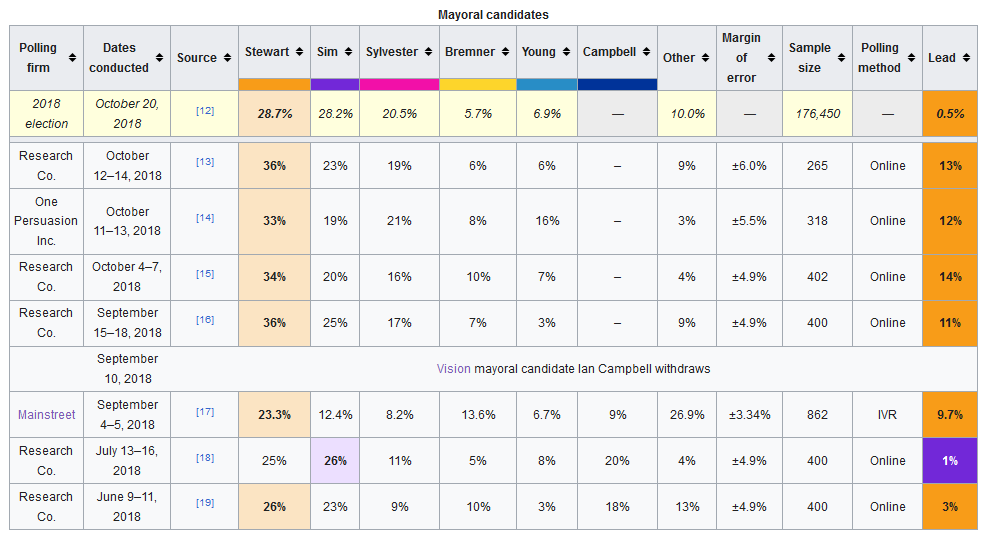
Kennedy Stewart, a former NDP MP, ran to replace the outgoing mayor, entering the race with strong name recognition - enough to easily consolidate when the previously expected progressive candidate withdrew. The average margin leading up to the late October election had Stewart ahead by well over 10 percentage points…
On election day, Stewart barely won with a margin of 0.5% against conservative rival (and 2022 winner) Ken Sim. His polling average dropped from 35% to 29%, while Sim’s went from 22% to 28%.
In a similar situation in Winnipeg just last year, former mayor and Ontario MPP Glen Murray entered the race with incredible advantage in name recognition. He led in what few polls there were, and his most consistent rival - Scott Gillingham - was fighting for space with a number of other organized campaigns.
In the final Léger poll two weeks out before election day, Murray led 28% to 19%.
On election day, Gillingham won 27.5% to 25%.
And finally, while Québec City’s 2021 mayoral election was less of a polling miss and more of a surprise on election night, the winning candidate, Bruno Marchand of Québec forte et fière, came from a distant third to first, squeaking by with a tight 0.4% of the vote against the successor candidate to the previous long-serving mayor.
Olivia Chow has name recognition, high level organizing, and historical precedent boosting her campaign. She is a fierce advocate and speaker and, frankly, if I was a Toronto resident I’d have a tough time not backing her, even though a candidate like Chloe Brown shares more of my political outlook.
Critically though - a lot of Torontonians are not like you and I. Engagement in this race is spotty at best. Undecideds, where we get them in publicly released polls, remain as high as 20%. When asked if they would vote for the resigned-in-disgrace John Tory over the current field, Torontonians would pick him two-to-one over Olivia Chow. Turnout, already at a record low in 2022 at 29%, could be even worse - it being summer and a by-election to replace someone most voters don’t even seem to have wanted gone does not bode well for civic engagement. We’ll know more when advanced voting figures are released this week.
It’s unclear whether low turnout is a benefit or drawback for Chow. High name recognition can mean she is the default choice for those who show up to vote - in the same vein it can mean when pollsters contact voters and give her name, she is their default choice, but half of those respondents may not make their way to the ballot box.
What the race will come down to is organization - who can drag more voters out to vote. On that count Chow can rely on the local New Democratic machine - somewhat shaky these days but still significant - and Progress Toronto, which backed several successful council candidates in 2022, most of whom have also backed Chow. She also has the support of a number of public sector unions, such as EFTO, CUPE, and OPSEU, and some private unions.
And helpfully it appears in 2022 there were clear geographic differences in turnout, with the Old City of Toronto areas - where progressive and liberal-aligned candidates typically do better - having higher turnout compared to the suburbs.
Her rivals do have some institutional support however. Ana Bailão in particular has picked up a number of endorsements from prominent Liberal-aligned politicians and strategists, such as Zubair Patel, and including 9 of 23 Toronto MPs (two others are backing Matlow). Bailão also has the support of prominent Ford-aligned private construction union LiUNA! and pollster Nick Kouvalis. She also has the support of Noah Zatzman who I do not like, but that’s neither here nor there.
(There is also a rumour of Tory potentially endorsing Bailão - but if it didn’t come before advanced polls then it likely won’t come at all.)
Similarly Josh Matlow has the endorsement of a few weighty Liberal names, though most of them were relevant in prior decades - such as John Sewell and David Soknacki.
Interestingly despite some earlier positive noises from Ford, former TPS Chief Mark Saunders’ primary endorsement is from Councillor Holyday.
Which hilariously leaves Toronto Sun columnist Anthony Furey, currently running on an ‘anti-woke’ campaign who has the backing of a number of conservative cranks and Harper-era has-beens, ranging from Jordan Peterson (seriously), Conrad Black, Joe Oliver, Roman Baber, and Sue-Ann Levy. Also he has the support of former Toronto Liberal MPs from the Chrétien-era (??) Sarmite Bulte and Dennis Mills. Your guess is as good as mine, but never underestimate the potential turnout power of fascists.
All this to say - name recognition will not get Chow across the line any more than it did Murray.
We need to talk about Mainstreet (disclosure: I worked for them as an independent contractor during the Québec election).
It is very obvious when looking at the mayoral by-election polling that Mainstreet Research tends to really boost Bailão. Incredibly obvious, in fact - to the point where many political watchers have asked what is going on.
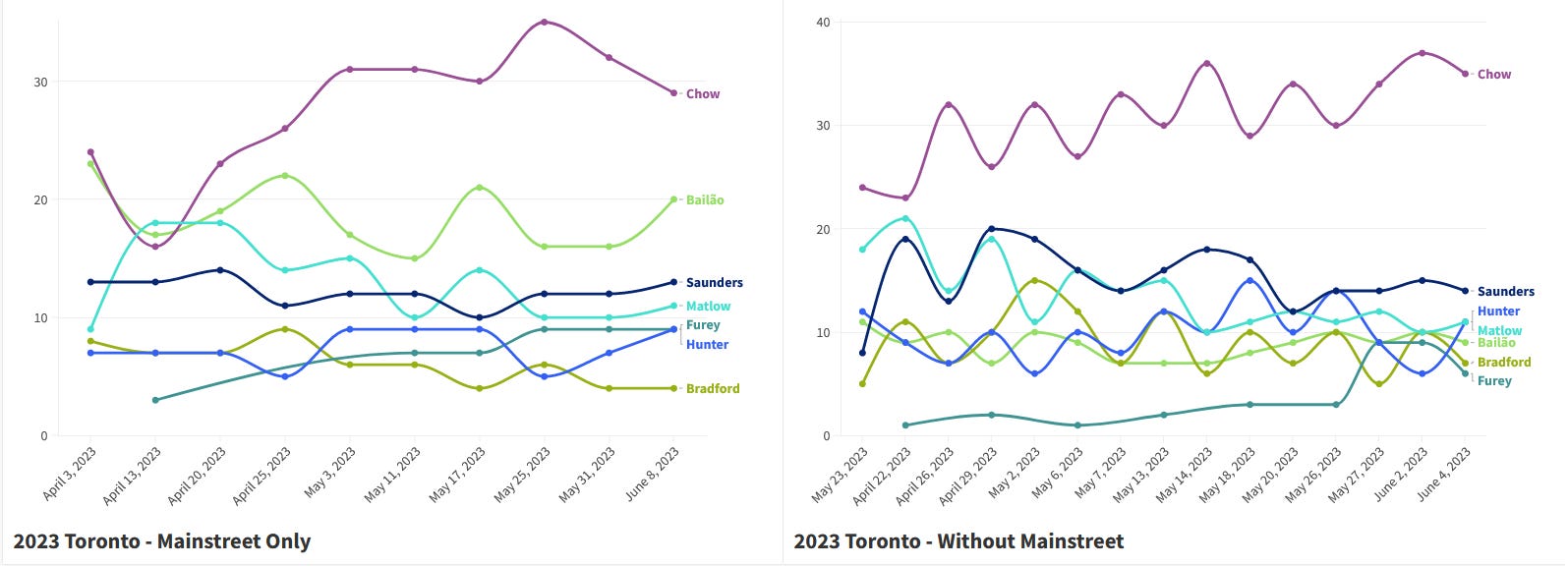
MSR’s Robert Martin - who, another disclosure, is my friend and I talk with regularly - has said he believes the primary difference comes down to the company’s demographic weighting to account for the over-representation of university-educated respondents.
This is a valid point, though I will note the difference isn’t between 6 and 12, but 20 and below 10. And while some of the other regular pollsters in this race, such as Liaison Strategies and Viewpoints Research are less well known and could understandably make this mistake, Forum Research has been around for a long time - there is no reasonable way to assume they wouldn’t know to counteract the issue. Forum’s record can be spotty but they performed better in Alberta than MSR did.
That all being said - Bailão does seem the most competent and serious competitor to Chow, who MSR also says is leading by a statistically significant number and has done so steadily since May.
Hypothetically too, I would consider Bailão most similar to the Scott Gillinghams and Ken Sims of other recent mayoral races. A business-friendly candidate with the backing of establishment centrist/centre-right orgs who focuses on budgets, housing, and to a lesser extent, crime. And while she goes around saying she’ll demand Doug Ford pay for highways (which, lol gl) and poo-poo’s the new strong-mayor powers, she will obviously be far more amenable to working with the Conservative government than Chow.
In an election where most of the talk revolves around Toronto’s budget shortfalls, housing costs, and concerns about crime, I’d typically bet on the more conservative side pulling off a win. Luckily most of the clowns running on the right are poorly organized - leaving Bailão as the imperfect but stronger standard-bearer.
That, or we should start watching out for Furey over the next two weeks.
If you’re a Chow-derhead in support of Olivia-mentum, maybe consider getting out there today. Take nothing for granted.
Want more Toronto polling? Check out my experimental 2023 Toronto Mayor Ward Model and Model Polling Average on Flourish!
No posts
Comments
Nothing yet. Say the first thing.
Sign in to join the conversation.