
The art of getting rich in a strong state with property rights and a solid justice system is quite a different art to getting rich in a weak state without strong property rights or justice system. As is ensuring the continuation of your wealth down the generations of your family. Admittedly, the wealthy in developed countries have been less interested in this latter goal in recent decades.
How can business be profitably conducted when basic protections against fraud are not enforced? What unique opportunities does this lack of enforcement bring and how can one succeed in this environment so different to the current West? As Western governments grow ever more incompetent and corrupt, it is likely the West will see some of these ‘emerging’ or even ‘frontier market’ conditions in the future. So it’s a good idea to broaden your bourgeois knowledge-set to navigate, succeed and build inter-generational wealth in such an environment.
The marginalised overseas Chinese have prospered and founded everything from multi-national commercial empires, all the way down to small but lucrative businesses under hostile Third World conditions in South-East Asia. It is primarily from their experience in the 20th century that I draw these lessons and principles.
“Trust in Chinese systems of social relations contributed to the development of practices enabling Chinese businesses to operate with less reliance on Western-style financial institutions or formal political-legal institutions. Because of these practices, [Chinese] ‘business groups have been able to escape (or limit) subordination to political power holders’ (McVey 1991:15)” (Ethnic Business, Jomo K.S. & Brian C. Folk, 2003)
In a developed economy the business contract and its enforcement is used at every important level of business. Creditors are given certainty on both the availability and value of the borrower’s collateral, or at least enough verified information to cheaply price the risk. Instances of an investor’s capital being embezzled are deterred by anti-fraud enforcement. Due to these institutional triumphs, among others, there has been a wide availability of capital to businesses in Western countries at low interest rates.
In frontier and emerging markets contract enforcement is less rigorous. Consequently, investment is lower and small to medium enterprise loans are priced at astronomical 20% to 30% APRs (Annual Percentage Rates) or more, if they are even available. As financial institutions are inaccessible or impractical, the budding entrepreneur must turn to his network for credit and capital. Trust replaces contracts and credit score.
The reliance on family and friends for credit and capital significantly changes the business landscape as well as the company structure and culture. Lifelong mutually beneficial relationships must be cultivated. Critically, one must keep their word within their family and network and return any favours. Failure to do this (or at least making up for it vigorously) will lead to exclusion from the social network. This has similar consequences to being excluding from the formal banking system for the modern atomised Western entrepreneur. That being severe constraints on business growth, scope and scale, operations and great sensitivity to downturns.
In 1970s Malaysia, the ethnic Chinese faced affirmative action legislation that was introduced to discriminate against them in favour of the politically dominant but poorer ethnic Malay majority. The government provided loans and capital to Malay entrepreneurs as well as eased university admission and offered scholarships to Malay students, excluding the Chinese. Ethnic Chinese also had greatly reduced access government positions.

Yet despite being excluded from government, facing hostile regulations, the Chinese have prevailed economically. The Chinese still founded businesses, some of which grew extraordinarily large. Chinese were and still are wealthier than the Malays 60 years later.
This is not only due to the thrift and work ethnic of individual Chinese entrepreneurs but that the Chinese built businesses through their parallel networks, instead of relying on institutions that are hostile to them. Indeed, the case can be made that by excluding the Chinese from government the Malays inadvertently redirected Chinese talent away from the bureaucracy and towards business, further enriching the Chinese.
These same lessons from the Malaysian Chinese can be applied to the United States, if white Americans were to face similar hostile treatment or otherwise dysfunctional state and institutions. However, it requires that white Americans abandon the ‘pull yourself up by your bootstraps’ post-war mutation in their culture.
Parents, aunts and uncles must lend to and support their children and nieces and nephews. Children, nieces and nephews must be induced to working at below market wages at their senior family members’ businesses for a time, or otherwise repay their seniors. But indefinite naked exploitation must be reserved for those outside the network, where it may be profitable.
Low-trust ‘only lend what you can afford to lose’ Anglo practices when dealing with family also must be abandoned. However, families must be prepared to chastise and exclude family members that don’t pay their debts or favours, rather than siding with the debtor family member as is unfortunately often the case in Anglo families.
An exception applies when the creditor family member is predatory. This binds the family closer together, and allows individuals to feel comfortable giving substantial and costly support each other, which is critical without institutional support. To the degree to which institutions are hostile and/or dysfunctional, an individuals’ success at achieving anything will be limited. It takes a family and a network.
A more concrete method if you need it. Chinese immigrants have on different occasions from Papua New Guinea to Australia created most interesting backyard bond markets that served them when there were no financial institutions available, but also caught in circumstances where familial capital was not satisfactory. It comes in two main forms, Lunhui and Biaohui. They differ by the method they which allocate the capital.
The basic run down of both is that a typically small community of 20-60, on average 40, each member will deposit a set amount of money weekly, which is managed by a trusted member of the community such as a successful business owner and/or elder. Each week one member will receive the entirety of all the members’ deposits that week, which may be equivalent to 2 years average wage or more.
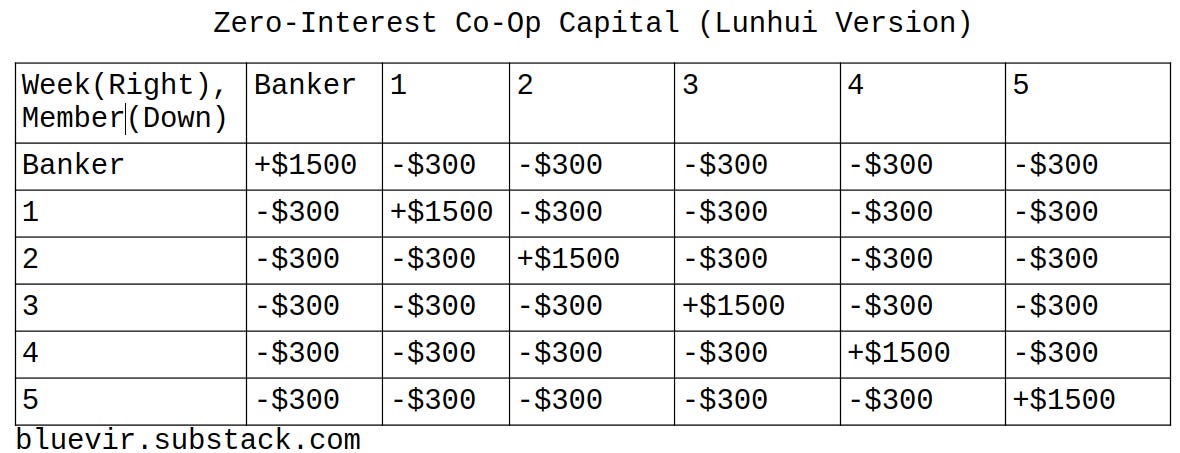
This can meet to the start-up capital requirements at low to no interest for most boring but reliable small businesses, such as delivery services, laundromats or grocers. Considering that it is a consistent cycle of capital it also facilitates the expansion of these businesses as well. Failure to repay this debt means expulsion from the group and rejection by the whole community.
In the Lunhui form the recipient of the capital is on a pre-determined cycle and the loan is interest-free. Biaohui form the recipient of the capital is determined by an auction of the loan, whoever is willing to pay the most interest secures the loan. However, once an auction has been won that person cannot get another loan until everyone else in the group has received a loan. This ensures that one member isn’t hogging all of the credit and that the group will never face the situation of a single person defaulting bringing the whole system down.
In the Biaohui that I have read about, the bidders’ bids are anonymous – delivered to the manager in an envelope. The interest rates on these loans seem to be consistently far below market rate. I imagine that the anonymous bidding is partly responsible for this – which is highly advantageous in a high-interest rate environment where other competing businesses don’t have access to cheap credit.

In emerging and frontier markets, state policy and positions are vehicles to enrich in-the-know elites. A major way this is done is through leveraging the fundamental information asymmetry between policy makers and the public. Insider trading (say, purchasing a construction company’s shares before assigning it an infrastructure project) for example is scarcely prosecuted, and to the extent which it is prosecuted as a crime is for use as blackmail to ensure compliance of elites serving the ruling class. A profitable case “I scratch your back, I scratch yours”, but where failure to stay on an influential state official’s good side leads to prosecution for corruption.
It has been quite the show watching the second Trump administration moving in this direction. Don’t take this as my criticism of Trump, I am apathetic to any of his supposed corruption. But it is hard to deny that the immense donations from crypto barons to Trump presidential campaign and inauguration were reciprocated after Trump’s victory with pardons of crypto affiliated individuals and organisations and the release of Trump Coin ($TRUMP) and Melania Coin ($MELANIA). With Trump Coin reaching a peak market cap of 55 billion USD in a few days it has made a few insiders a tidy fortune.
There being confirmed reports of crypto traders (read: Trump adjacent) purchasing 2 million USD worth of $MELANIA before it was publicly announced on Truth Social, then dumping for just under 100 million USD. In these conditions it pays handsomely to not just focus on maximising your own business’ efficiency, but also on building connections and inserting allies (often family members) into government positions where they can direct resources and relay valuable information. The Gupta family of South Africa applied this principle to its maximum.
Shopkeepers back in India, they arrived in South Africa in the early 1990s just after Apartheid had set. Their first venture was a shoe store, which failed. The Guptas then began a computer import company named Sahara Computers. The Guptas eagerly employed black officials or their family members. The black faces and their party connections helping the Guptas land their first highly lucrative contracts for supplying overpriced computers to public schools beginning in 1996.
The Guptas initially prioritised regional government capture, rather than immediately aiming for the national level. They collaborated with the regional governor Ace Magashule and so Sahara Computers gave contracts to ANC (African National Congress, the dominant party of South Africa) connected sub-contractors in the region.
As their wealth grew into the mid 2000s the Guptas expanded their patronage network. When Jacob Zuma was nominated as leader of the ANC (but not yet president) in 2007, Sahara Computers gave one of Jacob Zuma’s sons a role in the board of directors of the now sizeable company. This would pay off massively when in 2009 Jacob Zuma became president.

The Guptas rapidly expanded into mining and media, founding the now defunct pro-ANC newspaper ‘New Age’. They worked within the ANC to remove anti-Gupta ANC members from key positions, sponsoring politicians who replaced them. Subsequently, the Gupta family’s companies were awarded with mining contracts and government advertisement spending was directed towards their newspaper, among other lucrative sources of revenue. In one case the state-owned airline of South Africa bought millions copies of New Age. Additionally, the Guptas’ new coal mines were given contracts by the state-owned electricity company Eskom to supply the country’s coal-fired power stations.
To cut the story short, one of the largest corruption scandals in modern history brought them down. But not before the Guptas managed to escape to Dubai with 3.5 billion US dollars in 2017. They have as of the time of writing not been extradited. A solid 20 year run for failed shoe salesmen.
Doubtlessly if they toned down their ambition they could’ve remained without prosecution in South Africa. Also doubtlessly there are many other families laying low and keeping their cards to their chest doing exactly that in South Africa and all across the Second and Third World. Perhaps soon this will come to a neighbourhood near you.
Wealth creation in weak and hostile states requires relative self-reliance within the family and network for capital and credit. The creation of these parallel structures is essential, as ‘going at it alone’ is hard, and should only be done for time, if necessary. Weak states present unique opportunities that are incredibly lucrative to those who can exploit them by inserting family members, surplus sons, friends or perhaps themselves into these positions. As the West faces growing institutional dysfunction, adopting these principles of parallel institutions and insider leverage will become essential for building and sustaining inter-generational wealth.
I was going to add a section on ensuring inter-generational wealth in weak and hostile states, discussing inheritance practices, family offices and the like but decided against it as I did not have enough information or knowledge on the topic. Perhaps later if I feel confident I’ll write a subsequent article it. As always, discussion in the comments is highly encouraged.
Support my work by donating to my Ko-Fi: https://ko-fi.com/bluevir
No posts
Comments
Nothing yet. Say the first thing.
Sign in to join the conversation.