
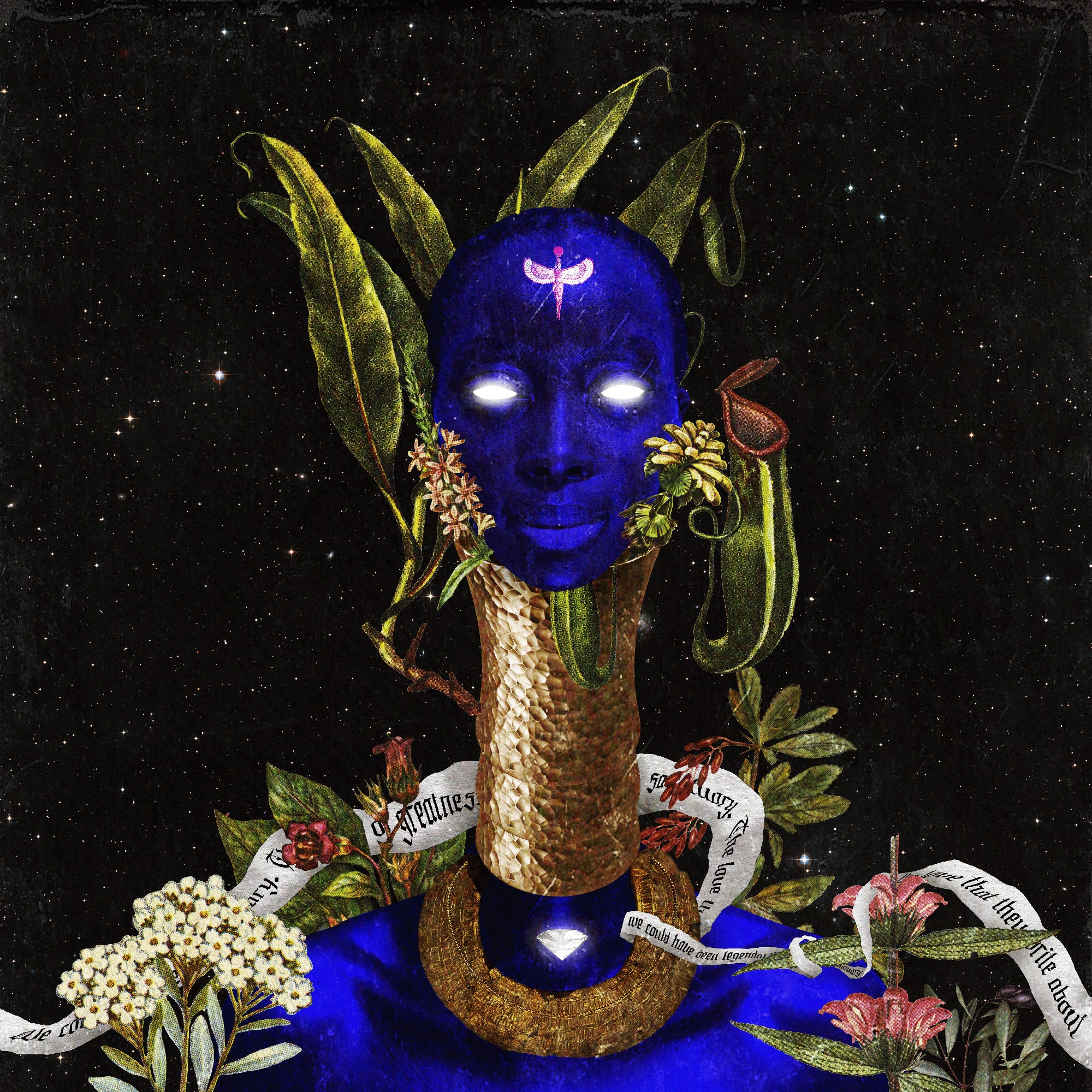
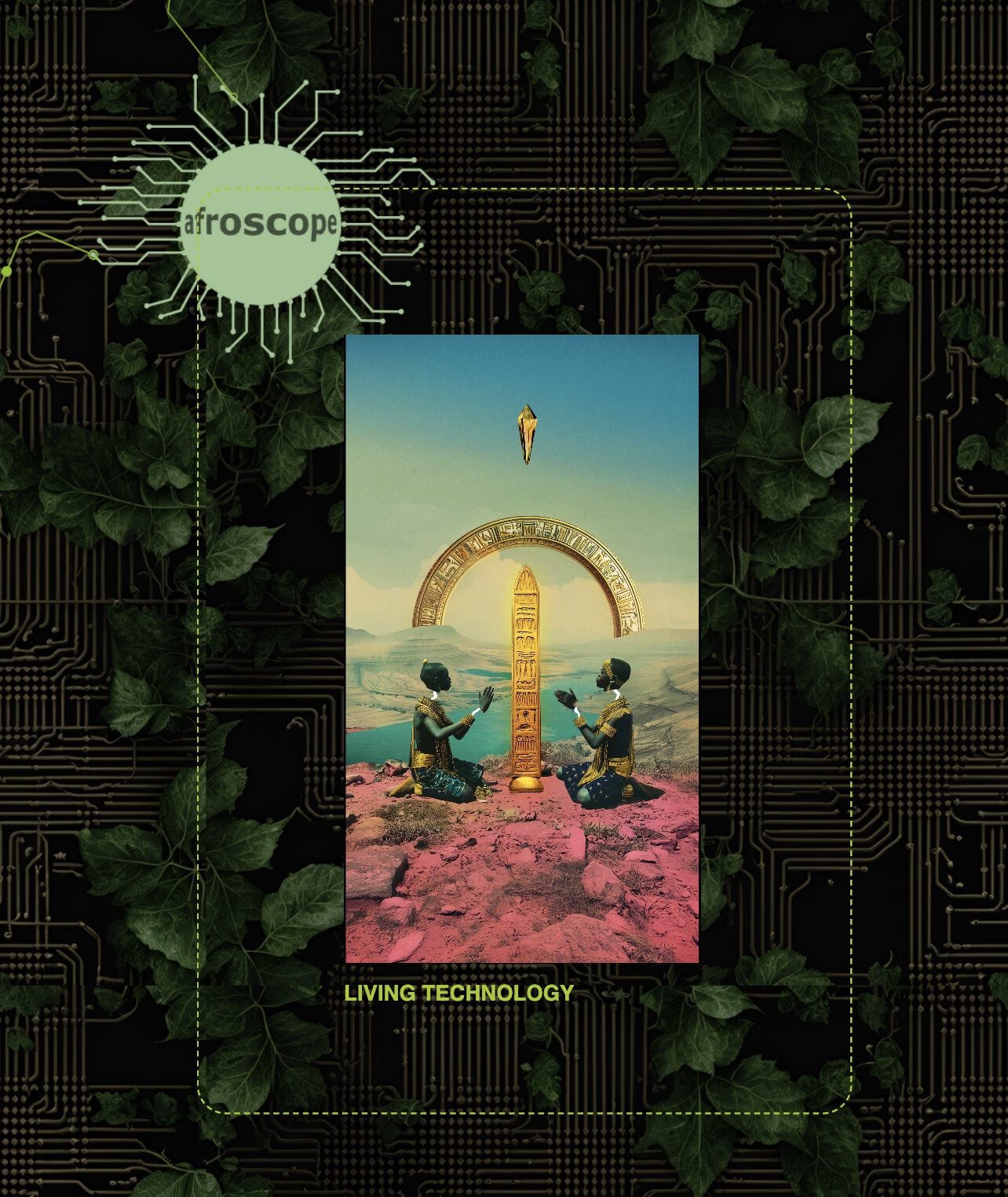
Isaac Nana Akwasi Opoku a.k.a. AFROSCOPE’s work in the exhibition Down the Silicon Meadow, offers a quiet proposition: what if the most advanced technology we’ve ever known is the human being itself? In the digital illustration Living Technology, the artist invites us to see the mystical, imaginative, and spiritual capacities of the human body not as metaphor, but as living infrastructure.
Presented as part of the group exhibition Down the Silicon Meadow, co-curated by Office Impart and Blueshift, AFROSCOPE’s contribution reconfigures technology through the lens of ancestral knowledge systems, post-colonial resistance, and spiritual memory. Their multidisciplinary practice spans digital art, textiles, poetry, and identity design, grounded in the ongoing work of reclaiming what has been erased.
This interview was conducted on the occasion of the exhibition, which is accessible online via Common Garden.
Diane Drubay: Your artistic practice is deeply rooted in ancestral indigenous beliefs and customs. How did it all begin?
AFROSCOPE: A lot of what I do now connects back to my disillusionment with colonially-programmed norms. Growing up in Ghana, I found myself constantly having to participate in things we were just supposed to do because they were “right,” even when they didn’t make sense.
We were supposed to go to church and not question whether we found meaning in what was being preached. We were supposed to take certain subjects seriously and aspire toward certain careers and professions, even if they didn’t feel aligned with who we felt we were.
We were supposed to read certain books and not others, to toe a certain line. For me, at a very young age, it all felt odd. I had so many questions, even though at the time I may not have had the vocabulary, the confidence, or adequate experience of “something else” to know how to really vocalize what felt off in my pursuit of being a “good” member of society who did what was expected of them.
DD: When did things begin to shift for you?
AFROSCOPE: As I grew up and my curiosity led me to discover more about the history of where I’m from and the people who came before me, I started to notice just how much had been systematically erased from contemporary knowledge.
I saw the extent to which we have been made, in many ways, to look down on ourselves as Ghanaians, as Africans—and how it was all just a big hoax.
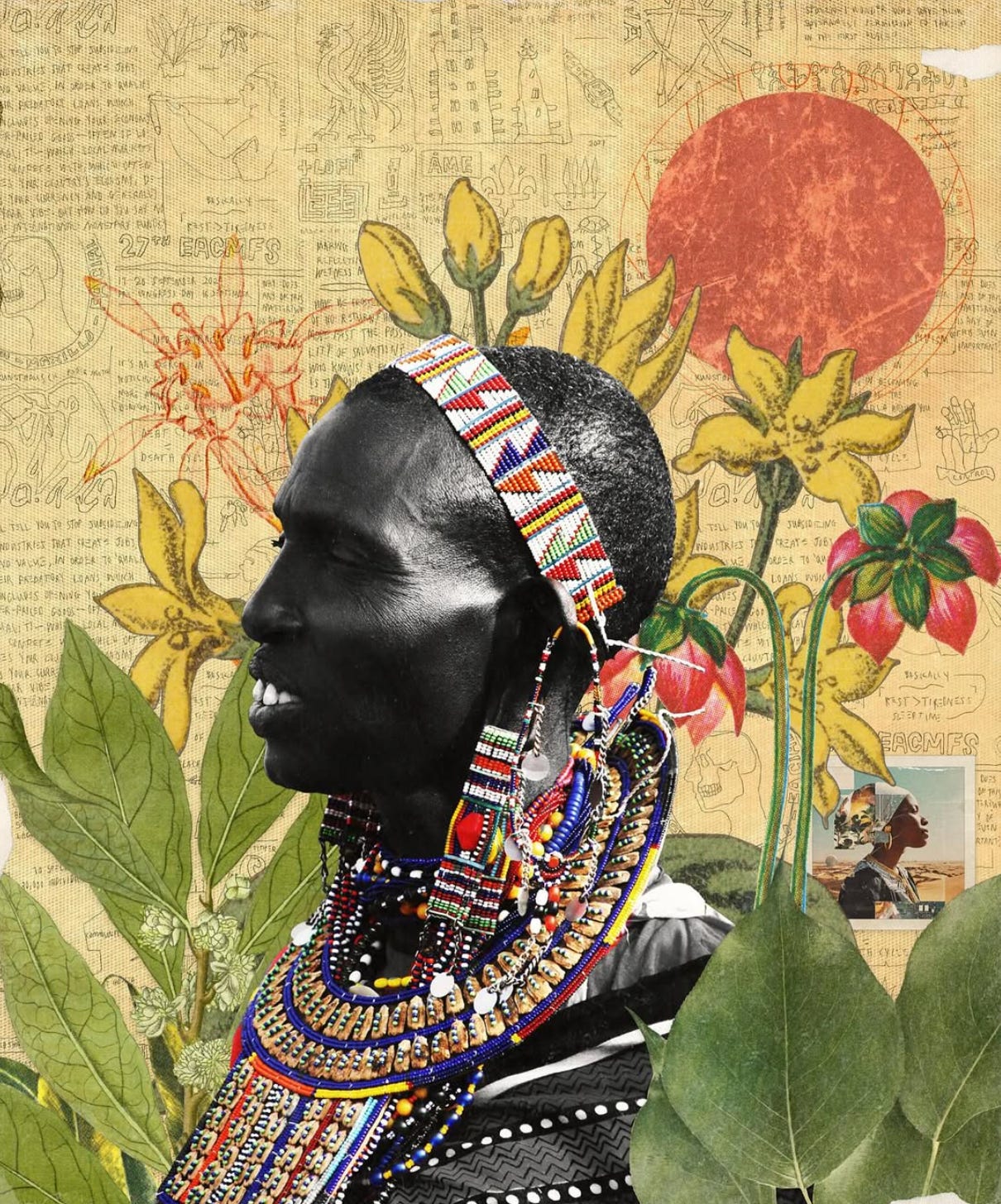
Even though I may not have known exactly where this curiosity would lead, it felt right to lean more into it and to use my creative inclinations—my desire to make—as a way to process, synthesize, and shed more light on these things I was discovering and why they were important. To write a counter-narrative through poetry, through design, through art.
DD: How do you see this counter-narrative taking shape in your work today?
AFROSCOPE: Fast forward to now, where I have simulated several iterations of this discover-and-then-create process, it has become a thing where almost all aspects of what I do are reflections of this resistance to what is colonially programmed, what is expected of me to be “good” in this system.
And so almost all my interests and how I express them—be it through my work with artisans or with studio assistants working on pieces, in researching textile histories, my own work creating art digitally or doing identity design, and even my interest in diving into books, which I love so much—have all become intertwined with this feeling that my role is to unearth what has been hidden from us and to share it with those who need to know it most.
DD: Let’s talk about Living Technology, the artwork you presented in Down the Silicon Meadow. What was your starting point for this piece?
AFROSCOPE: In the artwork Living Technology, I was dancing with this notion that we as human beings are some of the most advanced pieces of technology in the universe—not just in the cold, mechanistic and crude sense of an object that can perform a certain profit-driven function, but as expressions of that which makes us in awe of nature and of existence.
In us, I see—or should I say I have learned to see—something that is often beyond words, something so mystical in its beauty and radical in how varied, dynamic, and diverse life can be.
DD: What aspects of human experience were you hoping to explore?
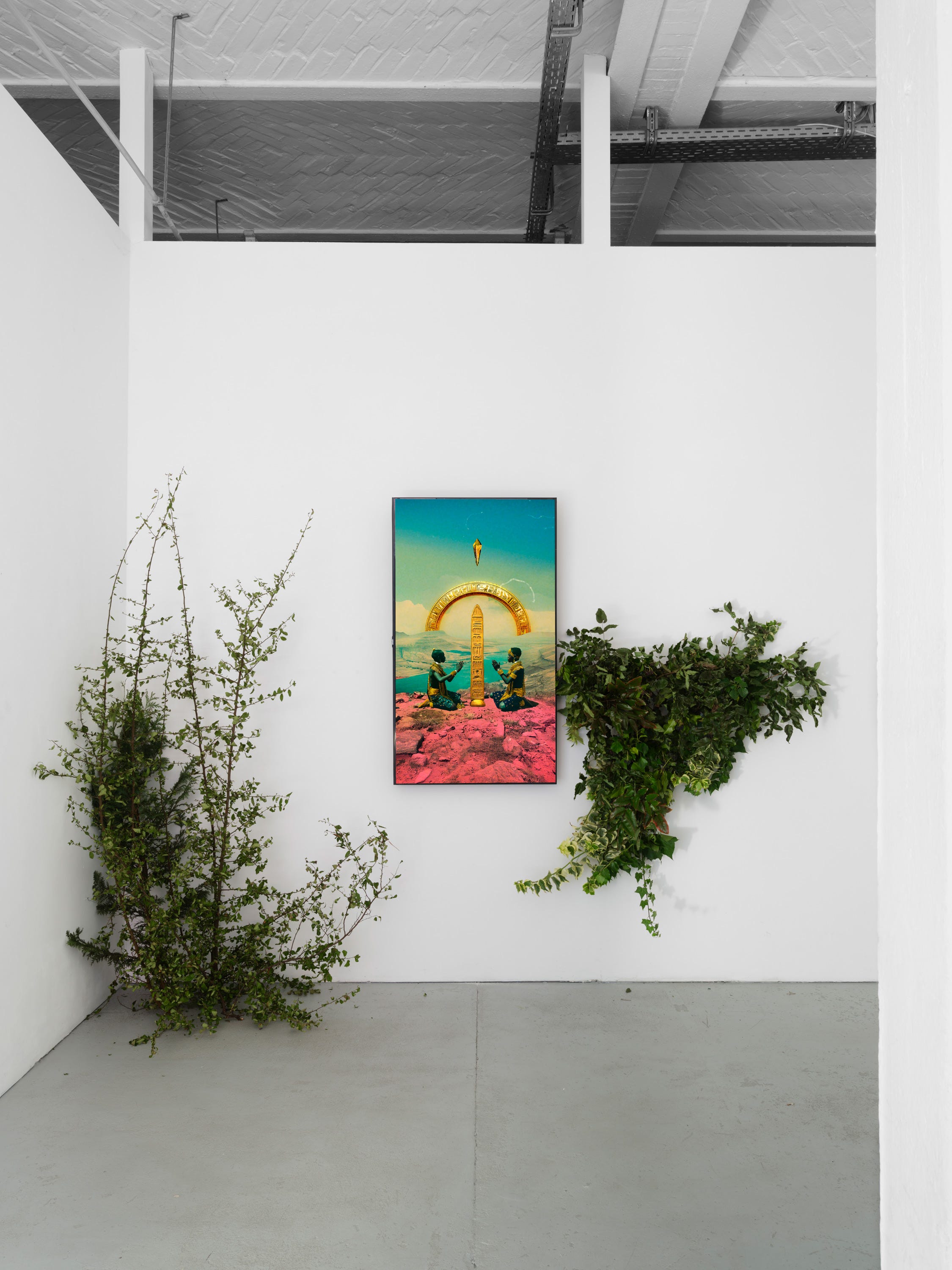
AFROSCOPE: In this work, I wanted to speak to that ethereal quality of being human and how enchanting it can be to witness how so many people who have come before me have expressed their humanity in unimaginably dynamic and diverse ways.
Our ancestors were very much in touch with this spiritual dimension, and we can see that in how different indigenous groups from different parts of the world honored life and nature, using their bodies as vessels for this reverence.
They created traditions and cultures that live on to this day, which have influenced millennia, created eras, and shifted our understanding of life and the cosmos.
DD: In that context, imagination becomes a kind of technology in itself. Would you agree?
AFROSCOPE: They honored this magic of imagination, which I see as the ultimate technology—this possibility to dream into existence that which had never before existed and to take others on journeys into realms they might never have encountered in their wildest visions.
So for me, the human—the one through which continents have been reshaped, the planet has been escaped, the wildest beasts have been tamed, AI has been birthed, and diseases have been eradicated—is peak technology: alive, dynamic, unpredictable, and evolving. These are some of the ideas I was looking to explore while creating this work.
DD: Were there specific traditions or spiritual references that guided you in making the piece?
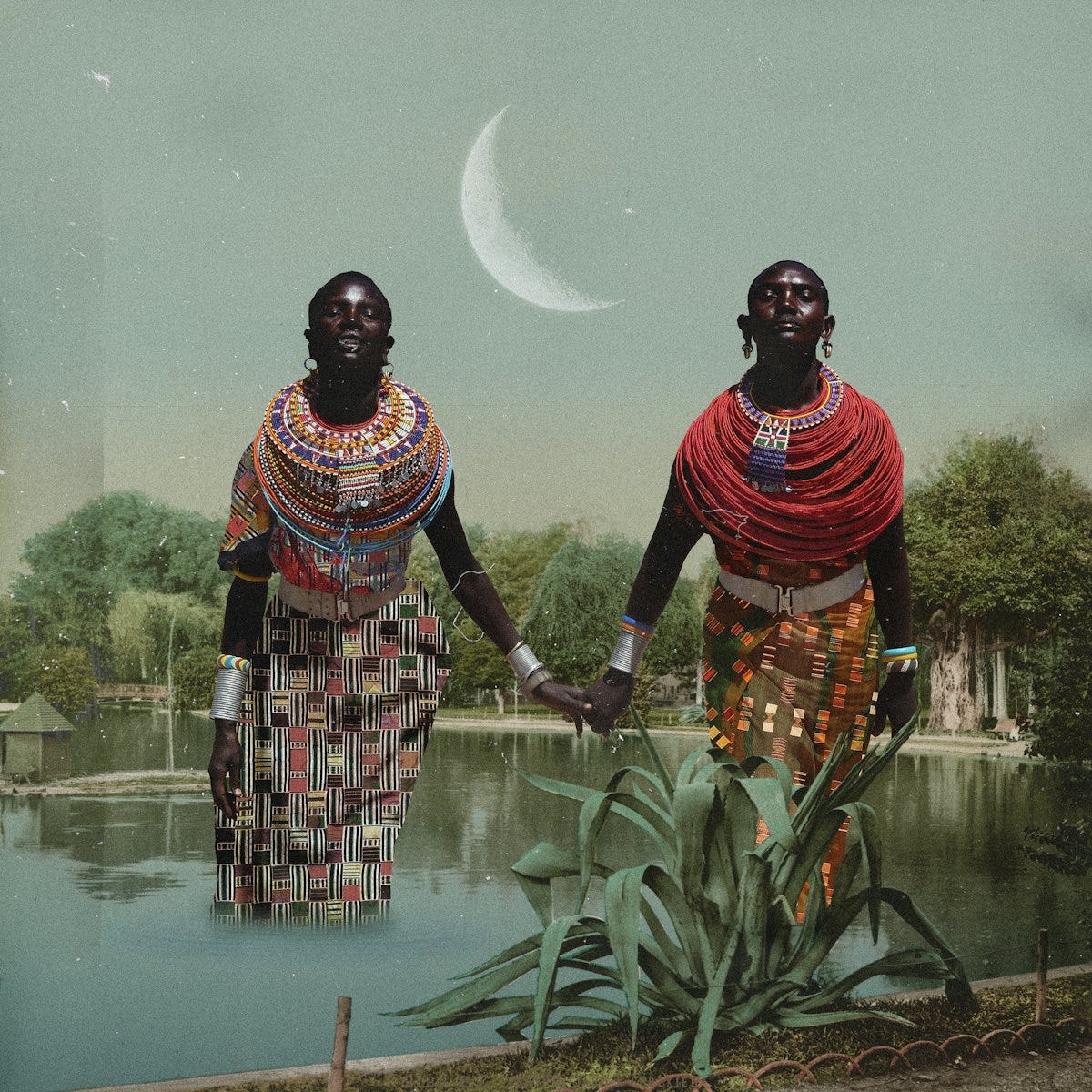
AFROSCOPE: It’s hard to attribute what I sought to explore to any one specific cultural or spiritual influence, because the work speaks to the magic of almost all the various cultures I have encountered, learned from, and learned about.
It reflects the impression they made on me, specifically regarding the beautiful elusiveness of how they even came to be in the first place, which is what I’m often drawn to—that blurry line between when the thing was not, and when it came to be.
DD: In general, what is your opinion on technology as a cultural infrastructure?
AFROSCOPE: For me, technology and culture go hand in hand because culture shapes technology as technology in turn reshapes culture. And so on the question of cultural infrastructure, I think it becomes a matter of being mindful of the kind of systems, traditions, and rituals we want to live with and perpetuate into the future.
DD: How do we navigate this relationship today, especially in a time of ecological and technological crises?
AFROSCOPE: In engaging or entertaining this question of what kind of society or future we want to create, we have to be mindful of the kind of tools and technology that we invest time into producing, how we want those things to be used, and how we want them to shape us as human beings.
It becomes a conversation about value and what we as a collective society valorize and deem as priority in this age where we are faced with multiple crises and have to contend with the possibility of having created technology—AI—which is arguably smarter than us.
DD: What role do you think artists can play in shaping how we move forward?
AFROSCOPE: When I look at these challenges we’re faced with and also consider the idea that artists shape culture and thus influence how technology shapes this cultural infrastructure, it feels incumbent on us to demonstrate through our work the qualities of humanity that we want modern technology to reflect.
We must ensure that unpalatable and distasteful acts such as the extractivism of capitalism, the erasure of colonialism, and the genocidal architecture of imperialism are limited and not repeated, so that they don’t define the general human culture of the future.
AFROSCOPE, Living Technology, 2024. Presented in the exhibition Down the Silicon Meadow, curated by Office Impart and Blueshift. Explore the full show online on: Common Garden. Collect an edition of the artwork on OBJKT.
Stay tuned for our next SHIFTED interview.
Comments
Nothing yet. Say the first thing.
Sign in to join the conversation.