
Two weeks ago, during Art Basel, I was organizing a 4-day conference series on digital art for ArtMeta, as one of the highlights of The Digital Art Mile. There were wonderful discoveries, new and old encounters, debates about who writes the history of digital art, a return to slowness but also to icons, walks along the Rhine, and above all a transformative moment at Julian Charrière's Midnight Zone exhibition (I'll come back to that soon). But in between all that, there was a request for an article for ARTnews: what is your favorite digital work? Spending time thinking between panels and exhibitions, hesitating, starting to write, and then writing again. In the end, it was a paragraph on Claudia Hart's “Short Season” that was published in George Nelson's article, but it was also a desire to know what the artist herself thinks of her work.
So, I asked 2 questions to Claudia Hart:
Diane Drubay: When you first created The Seasons in 2007, the world was quite different. The pandemic had not started, generative AI was not widespread, and climate change was not as severe at that time. What were you originally responding to, and how has your connection to this work transformed since its initial creation?
Claudia Hart: 3D-simulation making made me realize that virtual art was actually everything that tangible art was NOT. I love the virtual world because it is otherworldly. In virtuality, I can ignore the worldly constrictions of time and space. Time can run in many directions, all at once. And most wonderfully, if I want to, I can turn the gravity off. Or make it drip sporadically.
I started expanding on these ideas in 2004, with a piece called Timegarden. I’m still inside of that same practice! By the time I made the first Seasons, in 2007, I’d brought my insights from the garden to the human body. My idea was that virtuality was fluid. It was unstable, impossible, metaphysical, and ontological. I think of virtuality as a visualization of ontology, the branch of metaphysics that dissects the nature of being.
To produce my work I use a kind of simulation software also made to produce interactive games and Pixar animated films. Its interface design is actually a complex map of the natural world. With it, I can make computer worlds that run parallel to the tangible world, because my software imitates the processes of nature to move things around. It has graphical menus that deploy the language of Newtonian physics, material and optical sciences, and both human and plant biology. I imagine myself as harnessing natural forces to make events unfold in my experimental animations.
Today, I still hold the same idea of fluidity close to my heart; it is a metaphor for the cycles of nature and also of history—both of these representing related ideas about the cycling of time. Ashes to ashes. We return to the dust from whence we came. I think of the Short Season and the longer The Seasons as a pair. One is painfully slow and the other is too fast to grasp. That’s the point! Time is relative.
DD: If Short Season were a seed, what kind of future would you want it to grow into? Under which environmental conditions would Short Season reach its complete development?
CH: I would love to see a future NOT governed by the creed that progress and innovation are necessarily good. Short Season is a seed: yes, brilliant! But the seed of a slow future in which we humans see ourselves as a small part of a larger global world—one that is much, much bigger than whatever it is that is the next new thing.
And here is what I wrote about “Short Season” by Claudia Hart:
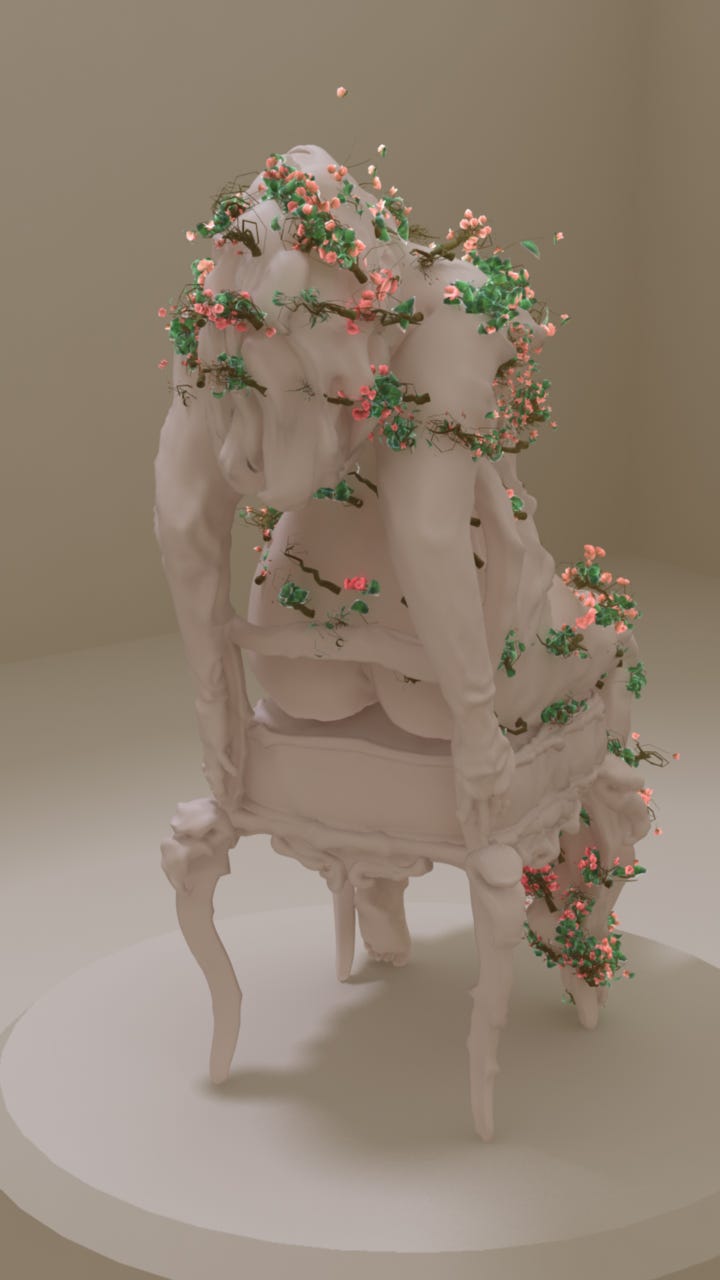
“The first time I saw Short Season by Claudia Hart was in the exhibition “A Beating Heart,” curated by Anika Meier. I couldn’t take my eyes off it. I was under a spell—fascinated by its feminine power, call for regeneration, and ecological entanglement. I left with one of its editions.
Short Season (2023) is a condensed version of Hart’s earlier 2007 work, The Seasons, and offers a two-minute meditation on life’s ephemerality and infinite cycles. It shows a woman slowly spinning on a pedestal, surrounded by blooming and decaying roses. It is slow, still, but not static. Like breath, or the constant movement of matter.
The more I look at it, the more I’m reminded of Ludwig Sussmann-Hellborn’s Dornröschen (1878), which I first encountered as a teenager in Berlin, during a visit to the Alte Nationalgalerie. But in Short Season, Sleeping Beauty falls asleep later in life—she is not waiting to become a woman; she already knows the scheme of adulthood. She is waiting for her next transformation. She is fertile, not decomposing, but giving life.
There’s something profoundly ecological here, where our bodies are seen as hosts for more-than-human life. Short Season is regenerative. Here, Sleeping Beauty is not the maiden waiting for others to direct her life—she is the witch who nurtures it. Claudia Hart’s work is not a fairy tale; it is a feminist invocation of a multispecies future.”
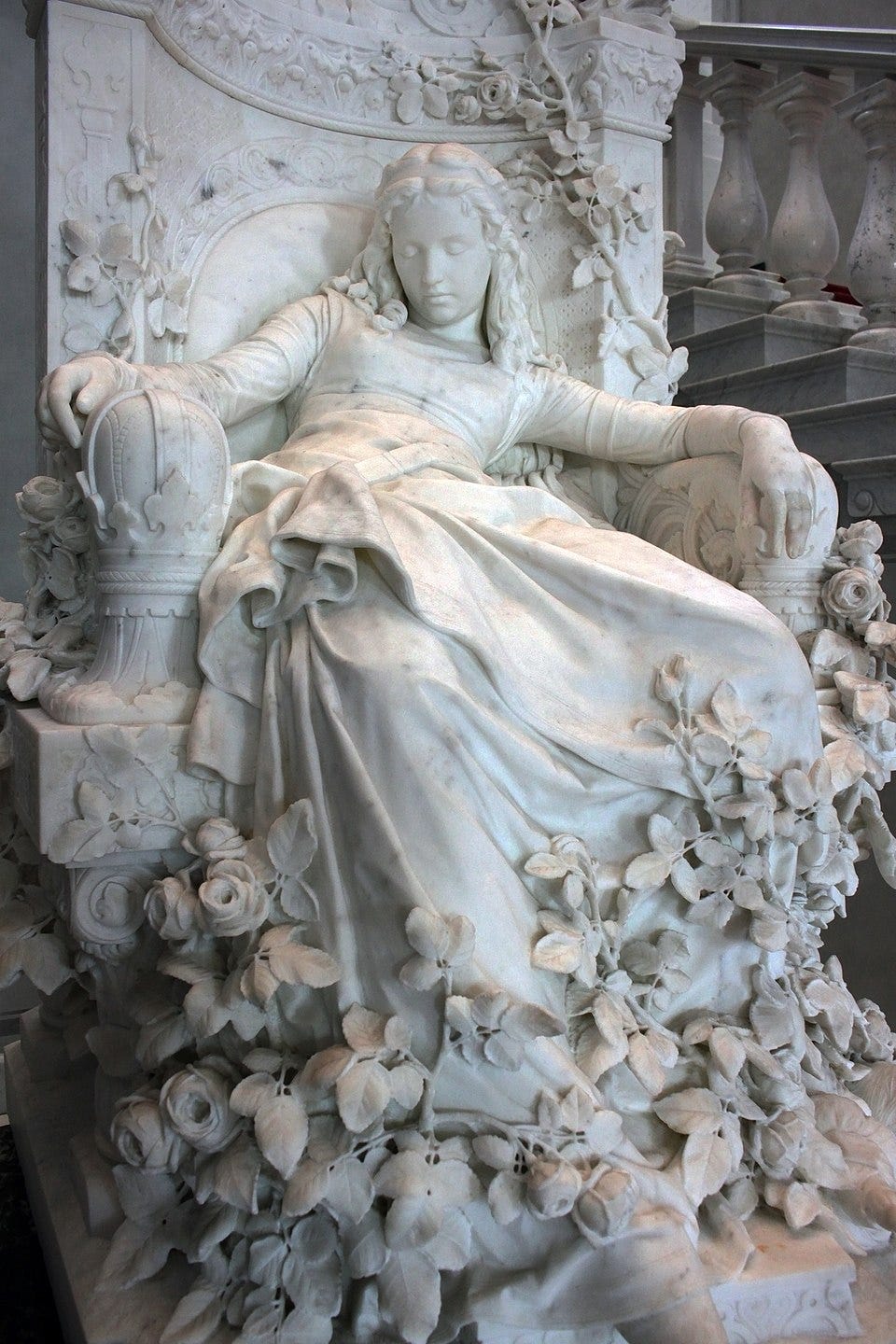
Two perspectives on the same artwork.
Until next time.
This is the first episode of a new signature series for SHIFTED that deepens the conversation around digital art, ecological futures, and the artists shaping this space.
Comments
Nothing yet. Say the first thing.
Sign in to join the conversation.