
The long, cumbersome process of handing over Camp Bucca prison to the Iraqis training as detention officers culminated with cadet graduation one late April day. Erin and I had graciously accepted the invitation from the Army National Guard instructors of the academy, who had quietly helped us identify sources within the student body. The Department of Defense had to activate the Army National Guard from Rhode Island, among other states, to help fill persistent personnel gaps in Iraq after nearly exhausting Air Force resources.
These guardsmen were among the most professional operators at the camp. I often marveled at the patience they exhibited when training young Iraqi men who had few relatable skills and little interest in doing the work. They also proved to be some of the most flexible. I suspected the private sector jobs they held back home had conditioned them to get work done rather than wait to act only when a rule authorized it, like many full-time militaries. Different incentives lead to different behavior, I guessed.
As we made our way to the ceremony across base, I mulled over how a majority Shia security force would soon oversee an internment facility full of incarcerated Sunnis. The American government had every intention of transferring authority to the Iraqi government as soon as possible, regardless of the impending confrontation between the rival Muslim sects.
No doubt the change in responsibility would come as a welcome relief to U.S. forces having to manage the sensitive location and deal with its unyielding political drama, particularly the patently false accusations of abused prisoners routinely provided to human rights observers, themselves all too interested in that information, which would disparage America’s reputation. In one sense, this pending handover already felt like a pyrrhic victory. But greater consequences awaited if the United States did not address the obvious problems inherent giving Shia management of the prison. Little did we know then those soon-to-be ISIS leaders began shaping an organization inside the prison walls and planned to unleash their terror on world after the handover.
That familiar bitterness welled up inside me right then.
I hated how Bucca made me feel like effort didn’t matter; how it seemed like leadership in the wars refused to solve the problems we all saw. What’s the point, I asked quietly, before chastising myself for being so weak. A fatalist mindset, a defeatist attitude, has no place in war. I repeated back in a soft voice, “God grant me the serenity to accept the things I cannot change, the courage to change the things I can, and the wisdom to know the difference.”
We arrived to see five or six rows of gleaming white folding chairs lined neatly along one side of a dusty parade ground. Designers had draped ribbons along the backs of the open seats and sprinkled colorful décor atop tables arranged under military tents alongside vehicles parked orderly with graduation regalia on the hood. I was impressed with the effort American forces went to so that the graduation had the trappings of any official military occasion, despite the woeful lack of material.
The gaggle of base leadership took the front row as we found vacant seats toward the rear. The ceremony began soon after, and on time, undoubtedly due to American management. Iraqis were notorious for treating appointed times as mere suggestions.
The Iraqi guards launched into what was supposed to be a formal military parade. Instead, it resembled a sort of organized chaos, complete with a steady stream of unsynchronized steps, awkward cadences, and incomplete movements. Some enthusiastic students marched with more vigor than necessary while others hardly attempted the performance, acting supremely uninterested in the whole process. Still others looked confused, uncertain what to do. For their part, the Iraqi instructors of the camp looked professional and polished. The whole thing lasted about ten minutes and ended with a hearty clap from the onlookers.
The Iraqi guards gathered to one side of the parade ground, as the commander took center stage to offer a few words of gratitude and encouragement. The soon-to-be graduates stood with a collective nervous energy. The commander concluded his brief speech with the official announcement. “Congratulations. You have successfully completed your training as detention officers. Please welcome our newest graduates.”
The trainees burst forth with emotion, jumping and shouting with excitement. The previously uncoordinated and uninterested guards now joined together to form half-circles and, with arms draped across each other’s shoulders, began rotating in unison, singing and kicking their legs back and forth. The famous Dabke dance of the Arab World had broken out. “They have coordination after all,” I said to Erin.
The thrill seemed genuine and was encouraging to watch.
After a few minutes of coordinated jubilation, the circle collapsed on itself as men ran into the center, jumping and chanting in Arabic. Their enthusiasm made me feel, if only for the moment, that the handover might succeed. Their joy gave me hope that Iraq could survive. While I remained lost in thought, Abdul leaned in and shouted over the noise. “That chant they are yelling…” I nodded without making eye contact. He leaned in closer and said, more softly, “They are chanting for Muqtada al-Sadr.” I turned my head and yanked my glasses down from over my eyes. “Are you serious?” I said angrily. He nodded, sheepishly, as if upset with himself for ruining the moment.
I couldn’t believe it. I turned back to the crowd of graduates. The newly minted prison guards cheered the infamous Shia militia leader who had fought against American forces and aligned closely with Iranian saboteurs. They had celebrated an anti-American radical after completing an expensive training paid for by the United States. Those cultural loyalties told me then that the nefarious Shia leadership and their Iranian proxies already had a foothold.
This hyper-Shia atmosphere partly explained the Sunni discontent that ISIS would thrive on years later.
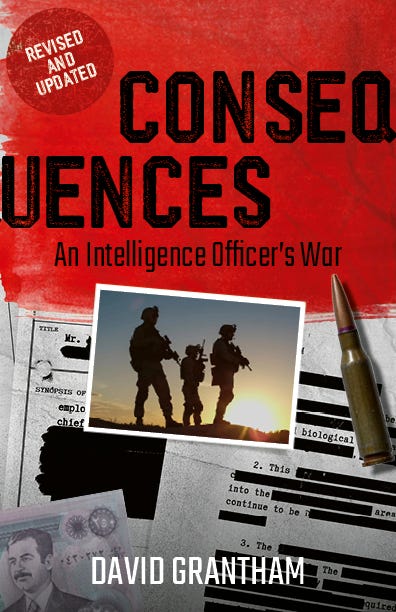
David Grantham’s book Consequences: An Intelligence Officer’s War will be republished in a revised and updated edition by Blue Ear Books in November 2026.
No posts
Comments
Nothing yet. Say the first thing.
Sign in to join the conversation.