
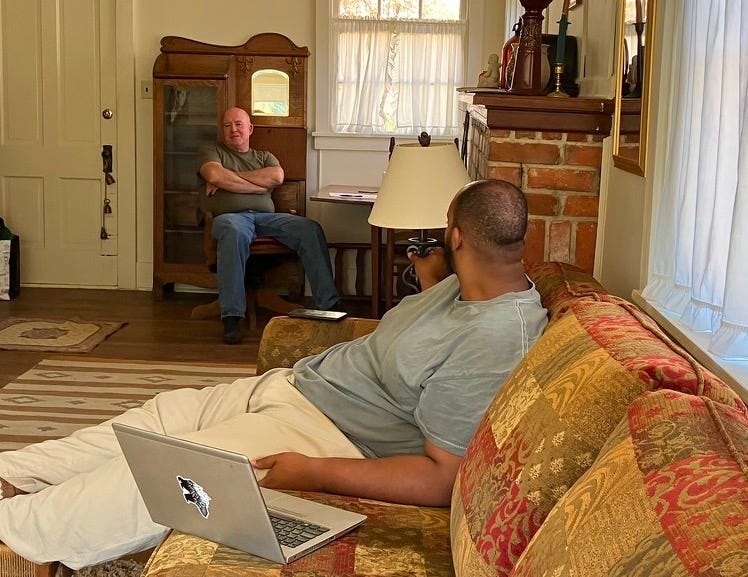
Hello everyone, I’m John Singleton, recently appointed consulting editor at Blue Ear Books and longtime close colleague and friend of publisher Ethan Casey. Over the years I’ve known Ethan, Blue Ear Books has grown from a conversation to a concept to a reality, and finally to the place we occupy now, en route to even bigger and better things. With a robust and growing geography of stories that are not easily classified, we take pride in this diversity of experience and thought, and in working with many of you reading this message. To our current and aspiring authors, as well as our friends, welcome. We are excited that the vision of Blue Ear Books is gradually and gratifyingly being realized.
If you know Ethan Casey, you may very well know the story of Clyde Edwin Pettit. If not, it briefly serves to note that the republicaton of Pettit’s classic and unusual Vietnam War history The Experts represents not only the conclusion of a series of seminal conversations with Pettit while Ethan was working as a journalist in Southeast Asia in the 1990s, but also an early step towards a Blue Ear Books goal: creating (or recreating) literary work in spaces that large legacy publishing houses have abandoned.
You are likely familiar with Elie Wiesel’s admonishment, in his Nobel Peace Prize acceptance speech, that “We must always take sides. Neutrality helps the oppressor, never the victim.” (In the same speech, Wiesel also said: “When human lives are endangered, when human dignity is in jeopardy, national borders and sensitivities become irrelevant.”) This problem is not unique to publishing. From what you eat to what you study to what you see and all points in between, the decisions on what folks have access to is based on the saleability of the idea. Author, documentarist and thought leader Michele Mitchell tells a story about trying to find producers for what became The Uncondemned, her powerful 2015 documentary film about the use of rape and terror in the Rwandan genocide. One potential producer backed out, commenting that “Rape is not an effective brand.” More recently a “very, very high-profile streaming executive” told another filmmaker, Joe Wright, that his platform would not distribute Wright’s series Mussolini: Son of the Century, claiming it was “too controversial.” Wright’s response: “Since when did antifascism become controversial?”
So we’re not alone. We have friends trying to tackle the same problems in other spaces. With the growth and political clout of enormous tech and digital media companies, our small town and neighborhood bookstores and libraries – not to mention small publishers – are increasingly under pressure. I am not excited about which books our children will have permission to read, and which ideas will be approved for them to consider, if those were to go away. What was a conspiracy theory in 2010 is no longer amusing or outlandish.
And while branding and selling books is required for a publishing house, Blue Ear Books recognizes that community is more than publishing. The “writing life” can be solitary—with good reason—and Blue Ear Books believes that sharing experience can be more than cathartic. No two authors tackle the work of writing in the same way. How each of us handles creativity, research, and production, while participating (or not) in the spaces we inhabit, can inform and motivate others.
The history of authoring books is at least one day older than the history of repressing them. The work of good storytelling, of authoring and producing books with integrity, and of promoting with our work the kind of world we wish to share, has many points of entry. It is honorable and noble and quietly patriotic. And we’re happy that you’re a part of that.
With this in mind, Blue Ear Books is launching a program of informal community Zoom meetings, to be held roughly every six weeks. The first will be held Monday, March 2 at 7:00 p.m. US Eastern Time/ 4:00 p.m. US Pacific Time. All are welcome, and all you need to do to attend is to visit the Contact page of the Blue Ear Books website and join via the standing link you’ll find there, or use this direct link.
Each session will begin with a 10-15-minute talk by an author about a specific topic related to the work of writing and publishing books. No requirements, no expectations, no spam—just an hour or so, every six weeks, getting to know one another and focusing on the work of producing good writing. After the talk, the floor will open for discussion. Ethan Casey will kick off the inaugural gathering by discussing how Blue Ear Books got here and your role in where we’re going.
Blue Ear Books is a reader-supported publication. To receive new posts and support our work, consider becoming a free or paid subscriber.
Comments
Nothing yet. Say the first thing.
Sign in to join the conversation.