
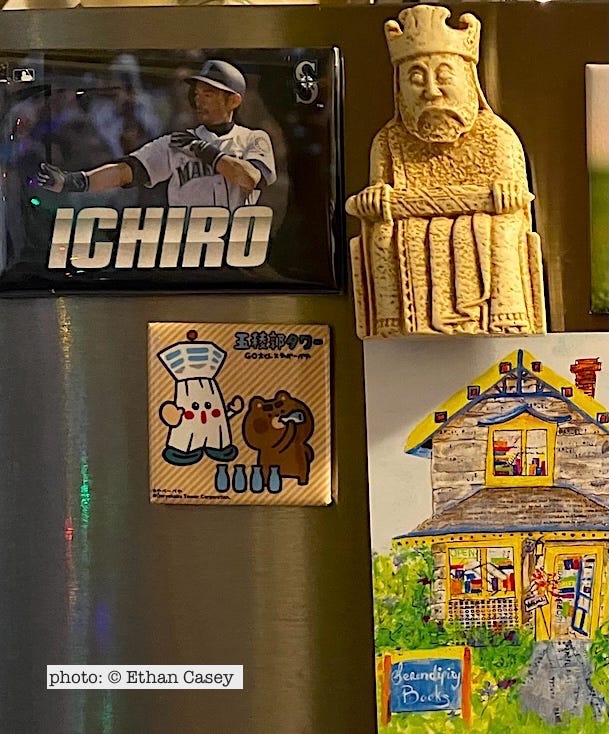
We are all collectors, of thoughts or objects, books or toy soldiers (“military miniatures”), and my friend Ethan, founder/publisher of Blue Ear Books, collects fridge magnets. He recently sent me a photo of the cartoon bear magnet I had bought him in Hokkaido, Japan. In the array surrounding it, I noticed a 3D magnet of a Lewis chess king. This was unmistakeable to me because I use a bookmark with a picture of a related walrus ivory medieval monarch.
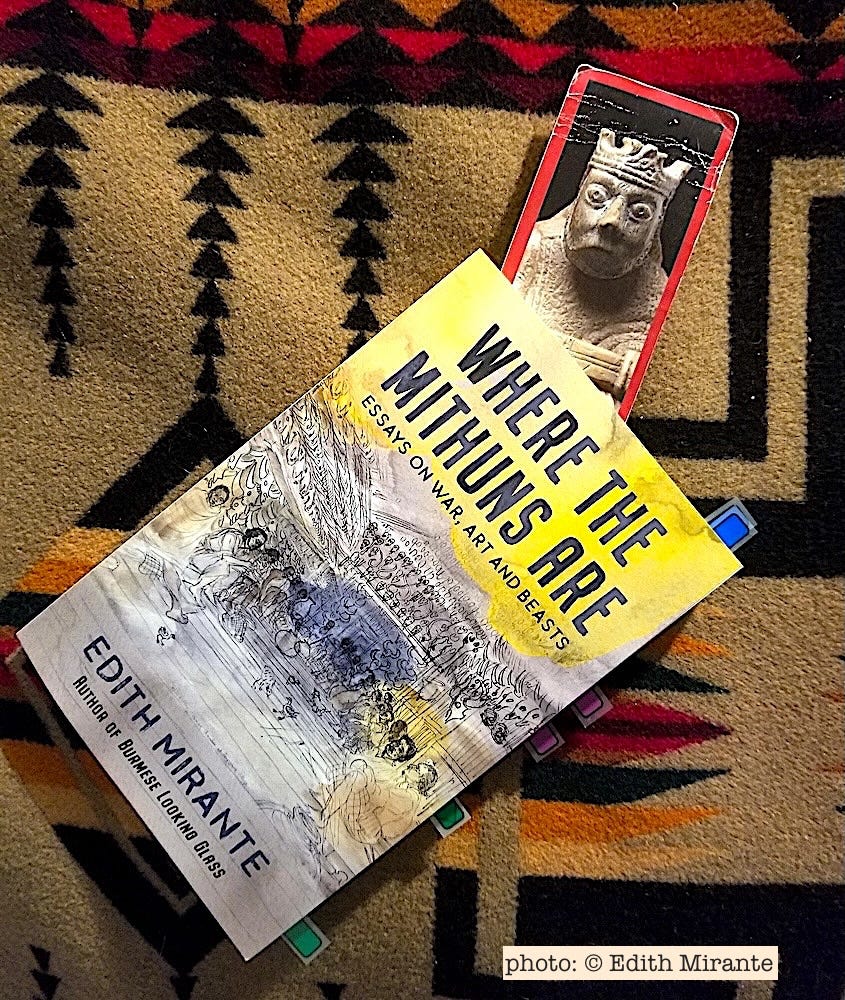
About four sets’ worth of walrus ivory chess pieces (plus a few whale’s tooth ones) were discovered in the early 19th century on Scotland’s Isle of Lewis, likely near the Bay of Uig. The pugnacious little figures had probably been carved in 12th-13th century Norway. Their postures and facial expressions still delight us. Are they amused, astonished, appalled? “Berserker” knights gnash the tops of their shields as if maniacally eager to slay mirror-image opponents across some checkered field. The walrus ivory, durable fangs of those great slouching pinnipeds, traveled from Greenland’s rough coast to Norway under sail on looting or trading vessels. Perhaps a ship carrying the Lewis chess pieces had wrecked at stormy Uig, in the then-Scandinavian Hebrides.
The coincidence of our chess kings echoes the way my new book, Where the Mithuns Are: Essays on War, Art and Beasts, came to Blue Ear Books. I had met Ethan years ago, at a talk I gave in connection with one of my Burma books. As I wrote in Where the Mithuns Are, a couple of years ago, “At the very moment when my essays were lengthening and coalescing into what I’d realized must be a book, Ethan emailed, proposing ‘publishing some of your essays in book form under the Blue Ear Books banner.’”
The medieval walrus ivory trade among north Atlantic islands relates to the Greenland trade routes of “An Ark of Horn: Ruminations on the Muskox,” my final essay in Where the Mithuns Are, about a charismatic arctic beast, its survival, captivity, commodification and hunting. Now the Lewis chess king bookmark is inserted in my new book, along with some color-coded stickers for passages to read out loud at events. In 2025, it feels so good to have produced a physical object that needs physical bookmarks.
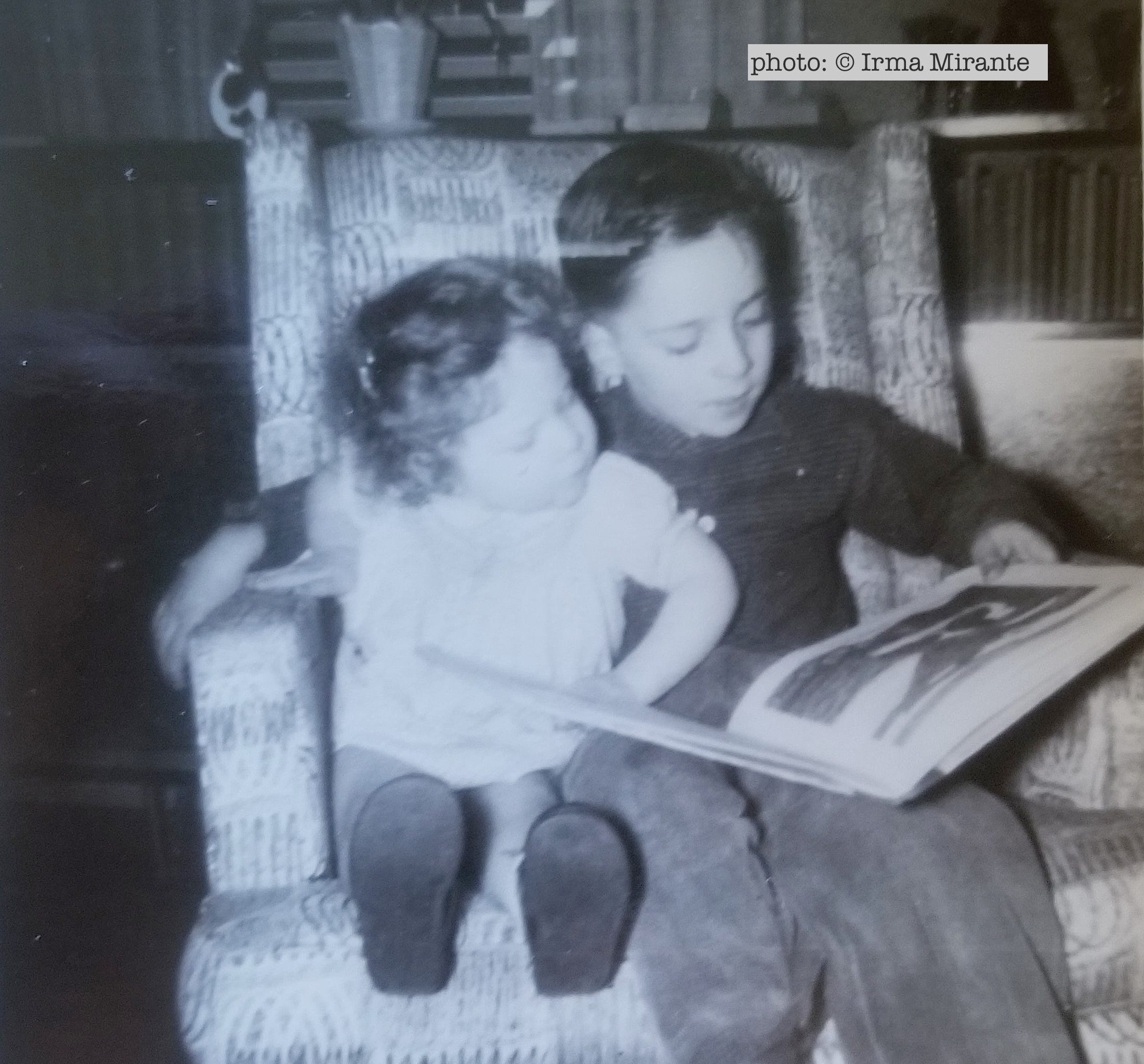
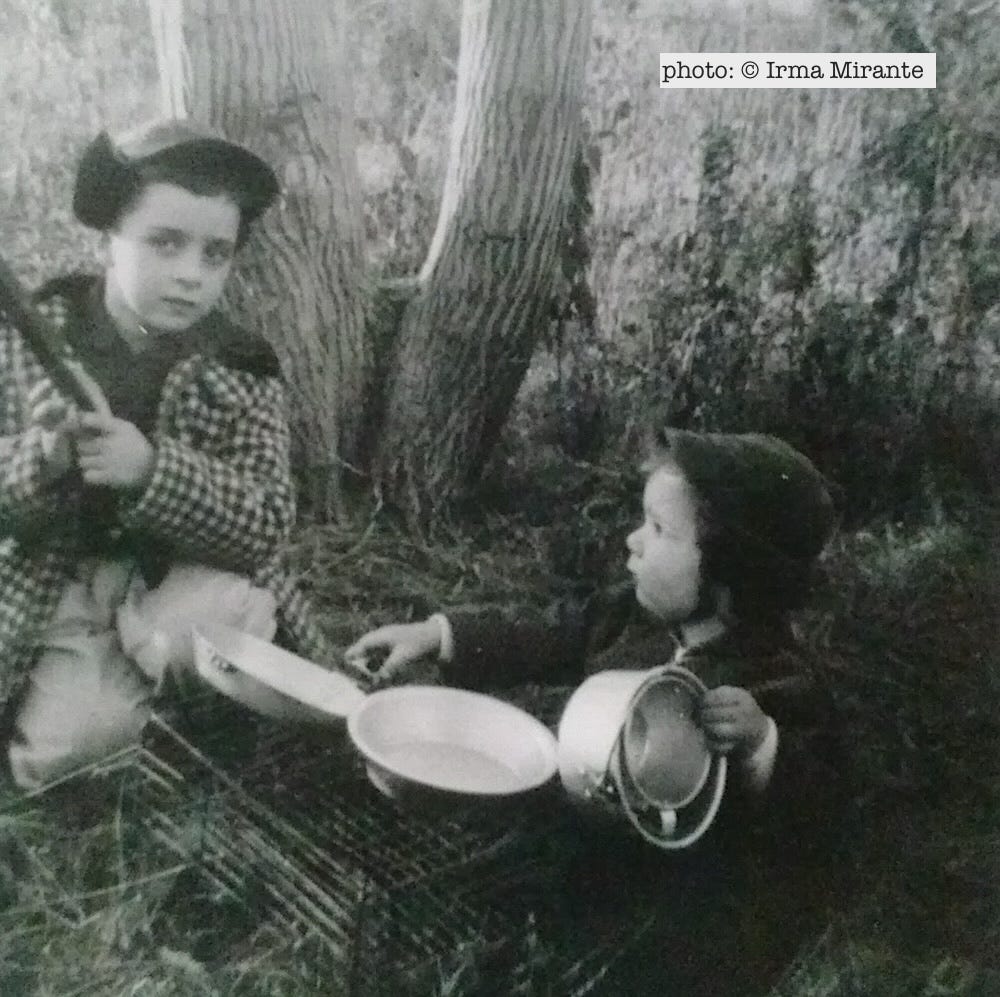
But a physical book wouldn’t do for my brother Rand, who was diagnosed with ALS three years ago. Grip slackened and arms weakened by the disease, he could no longer hold books and turn their pages. Instead he relied on an iPad e-reader and an array of history podcasts to fill his diminishing waking hours. Rand and I grew up on nature walks and historic battlefield visits and endless shelves of books. He would teach a seminar about treason, at Princeton, and collect miniature Napoleonic troops, and write about the great villain Joseph Fouché. I would venture to and write about the war zones of Burma and rainforests of Malaysia. Rand has influenced everything I’ve ever done since childhood.
I sent Rand a “bootleg” pdf version of my muskox essay last week. But suddenly he was gone, his lungs failing, a peaceful demise without the worst of ALS and still a wrenching, awful loss. Rand, also, knew about the walrus ivory chess sets found on a remote beach, because he knew about everything. It would take a whole extra lifetime to absorb every book, article and podcast he’d recommended. How all the words connect up and events of history intersect or reflect. He knew how none of this dies with us.
Edith Mirante is the author of Where the Mithuns Are: Essays on War, Art and Beasts, just published by Blue Ear Books, and of the classic travel book Burmese Looking Glass and two other books. She is the founder of Project Maje.
Blue Ear Books is a reader-supported publication. To receive new posts and support our work, consider becoming a free or paid subscriber.
Comments
Nothing yet. Say the first thing.
Sign in to join the conversation.