
Its been a couple weeks since I posted; we welcomed a new family member - Cora Jane - into the world, and I took some time to be with the family. Back to our usual cadence now with some cool tools in the knowledge (code) graph space…
As an aside, network graphs - the nodes, and relationships between them - are, currently, the most accurate digital representation we have of the physical world; the ontologies that can be represented with these data structures are simply more “complete”; I’ll write more about what this means in the world of solution architecture, and how we can build more (and more complete) simulations to make a better world, in a future post.
Most repos are read once and forgotten. The next engineer onboards by grepping, asking Slack, and rebuilding context from scratch. Two OSS projects this week try to fix that by turning code and agent memory into knowledge graphs you can host yourself and query like a database.
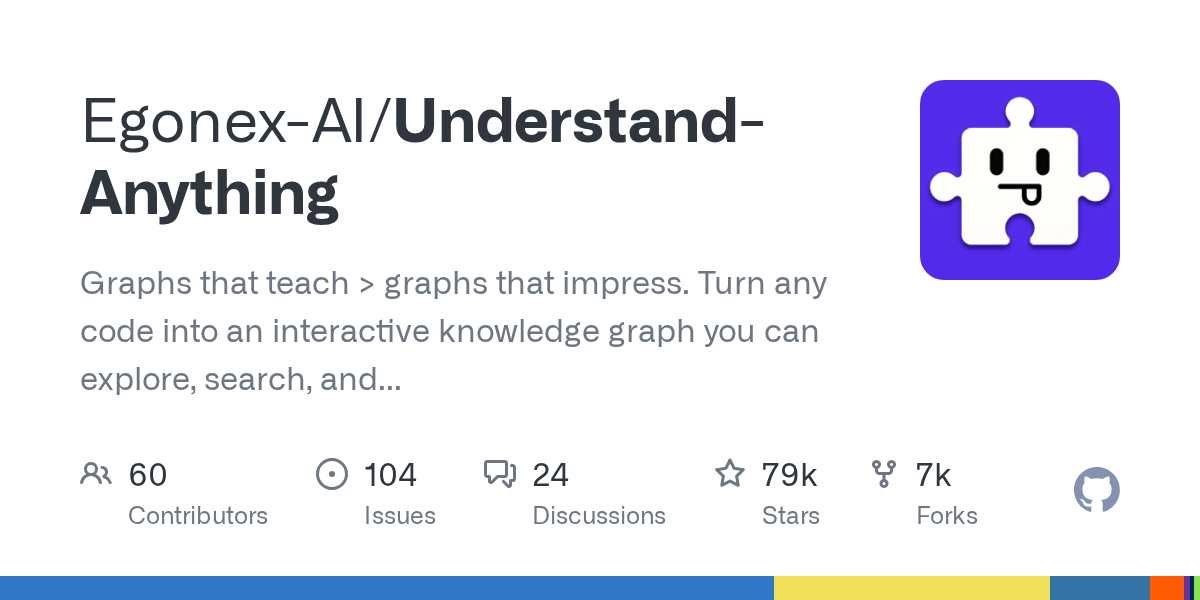
Summary. Understand-Anything converts a codebase, knowledge base, or docs tree into an interactive knowledge graph you can explore, search, and ask questions against.
Open-source project from Egonex, with commits led by Lum1104, thejesh23, and ZebangCheng.
Designed to interoperate with Claude Code, Codex, Cursor, Copilot, and Gemini CLI — the graph becomes the shared map those agents read from.
Nodes represent code structure and business logic; the README frames it as "graphs that teach > graphs that impress," with AI-generated summaries attached to each node.
Self-hosted and language-localized (English, Chinese, Japanese, Korean, Spanish, Turkish, Russian).
Use case. Aimed at the engineer who inherits a 400k-line monorepo and needs to find the seams.
Imagine a platform team trying to deprecate a billing module that touches twelve services. With Understand-Anything, you could load the repo, ask the graph which call paths terminate at the deprecated functions, and produce the migration list without manually walking imports.
For FinOps: imagine a cost-attribution exercise where finance asks "which services write to this expensive Postgres cluster?" The graph answers that as a query, not a week of code review.
For agent workflows: instead of pasting files into Cursor and praying for context, the agent walks a graph that already knows what depends on what. Token spend per task drops because the agent stops re-reading the same files.
The honest caveat: graph quality is a function of how the indexer chunks your code. On a polyglot repo or one heavy in generated code, expect to tune.
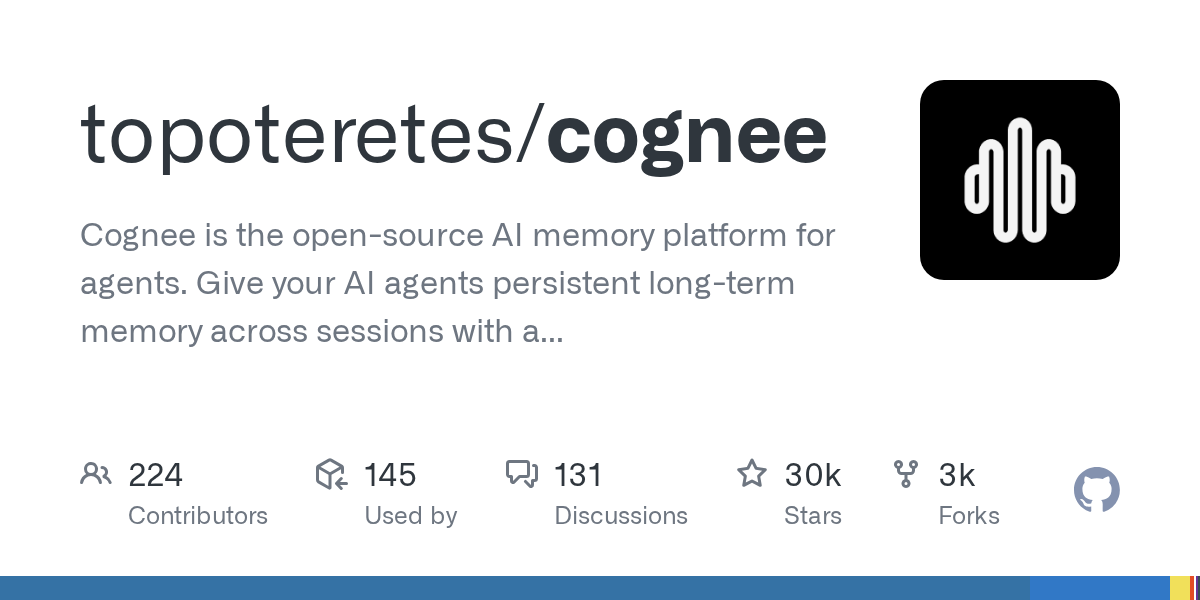
Summary. Cognee is an open-source AI memory platform that gives agents persistent long-term memory across sessions via a self-hosted knowledge graph engine.
Maintained by topoteretes, with a Discord and r/AIMemory community around it.
Ingests data in any format, builds a graph, and combines vector embeddings with graph reasoning so agents can recall, connect, and act with context.
Self-hosted by design — your memory layer doesn't leave your infra.
Plugin/add-on ecosystem listed in the repo for extending ingestion and retrieval.
Use case. Aimed at teams running agents in production who keep paying to re-feed the same context every session.
Imagine an internal support agent that handles AWS billing tickets. Without persistent memory, every session re-ingests the account structure, the tagging policy, and the past month of anomalies — that is tokens you pay for on every invocation. With Cognee, that context lives in a graph the agent queries on demand.
Imagine a multi-agent FinOps pipeline: one agent detects a cost spike, another writes a Jira ticket, a third proposes a rightsizing PR. Shared memory in Cognee means the third agent already knows the spike's root cause without re-deriving it from CloudWatch.
The cost lens: long-context prompts are how LLM bills balloon. A graph-backed memory layer is a way to push retrieval into cheap infra (Postgres, a vector store, a graph DB) and out of per-token model spend.
Self-hosting matters here. Sending agent memory — which often contains account IDs, internal architecture, and customer data — to a third-party memory SaaS is a procurement headache most platform teams would rather skip.
These two projects solve adjacent problems and compose well:
Understand-Anything builds a graph of your code, for humans and coding agents.
Cognee builds a graph of your agent's experience, for the agents themselves.
A reasonable architecture: index the repo once with Understand-Anything, expose it as a queryable source, and let Cognee-backed agents reference it as one node-set inside a larger memory graph that also includes tickets, runbooks, and past incidents.
This week's decision: pick one repo you actually maintain, point Understand-Anything at it, and see whether the generated graph matches your mental model — that gap is the onboarding tax you've been paying. If the project saves your team a sprint of archaeology, sponsor the maintainers.
This one was free. Paid gets you the prompts and data. Annual gets you the code.
Every tool I ship. all my knowledge, every method, every data source; current: crm_helper, agent swarm manager, bluearch cli & tagging manager PRO, EDP & PPA surplus-line repot, government contract data miner, EDP/PPA miner, and whatever ships next is included.
InfraGPT: your personal, enterprise-grade, self-hosted finops agent
Source code: all the data, code, and methods used to create the tools.
Share CloudCast and get a week of a paid sub free.
License key hits your email.
→ Go annual — $4,799/yr · Start at $50/mo (most readers start here)
No posts
Comments
Nothing yet. Say the first thing.
Sign in to join the conversation.