
Something that’s been driving me absolutely insane lately? Every time I open Facebook, I get hit with AI farming content. Usually, it’s pictures of large-breasted women, clothes totally spotless, their manicured fingers holding up a bouquet of produce from unrelated seasons, also somehow magically free of dirt. The fields behind this suggestively smiling farmer are perfect rows of plants, each one copied and pasted in its perfection.
Then, of course, there’s the AI gardening reels: a cute woman (again featuring a well-endowed bosom) daintily picks up a 5-gallon bucket full of rocks, seemingly weightless, and pours it onto the ground, and strangely, the rocks continue to pour indefinitely onto the ground, before she piles hay bales on top, plants some potato plants into it, and harvests some tomatoes after the plants magically grow before your eyes!
Barf. (Do people still use that word anymore? I haven’t heard it in years. But I digress.)
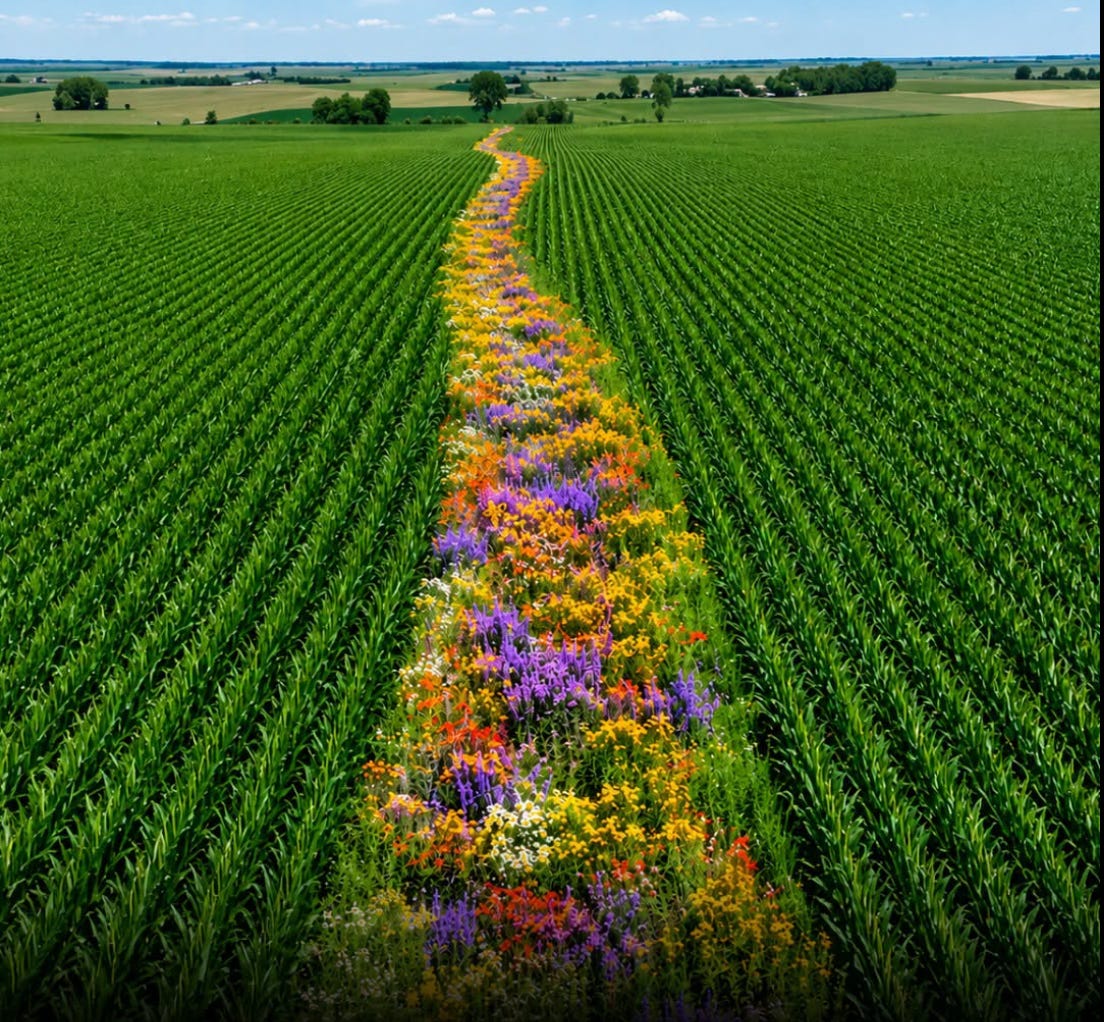
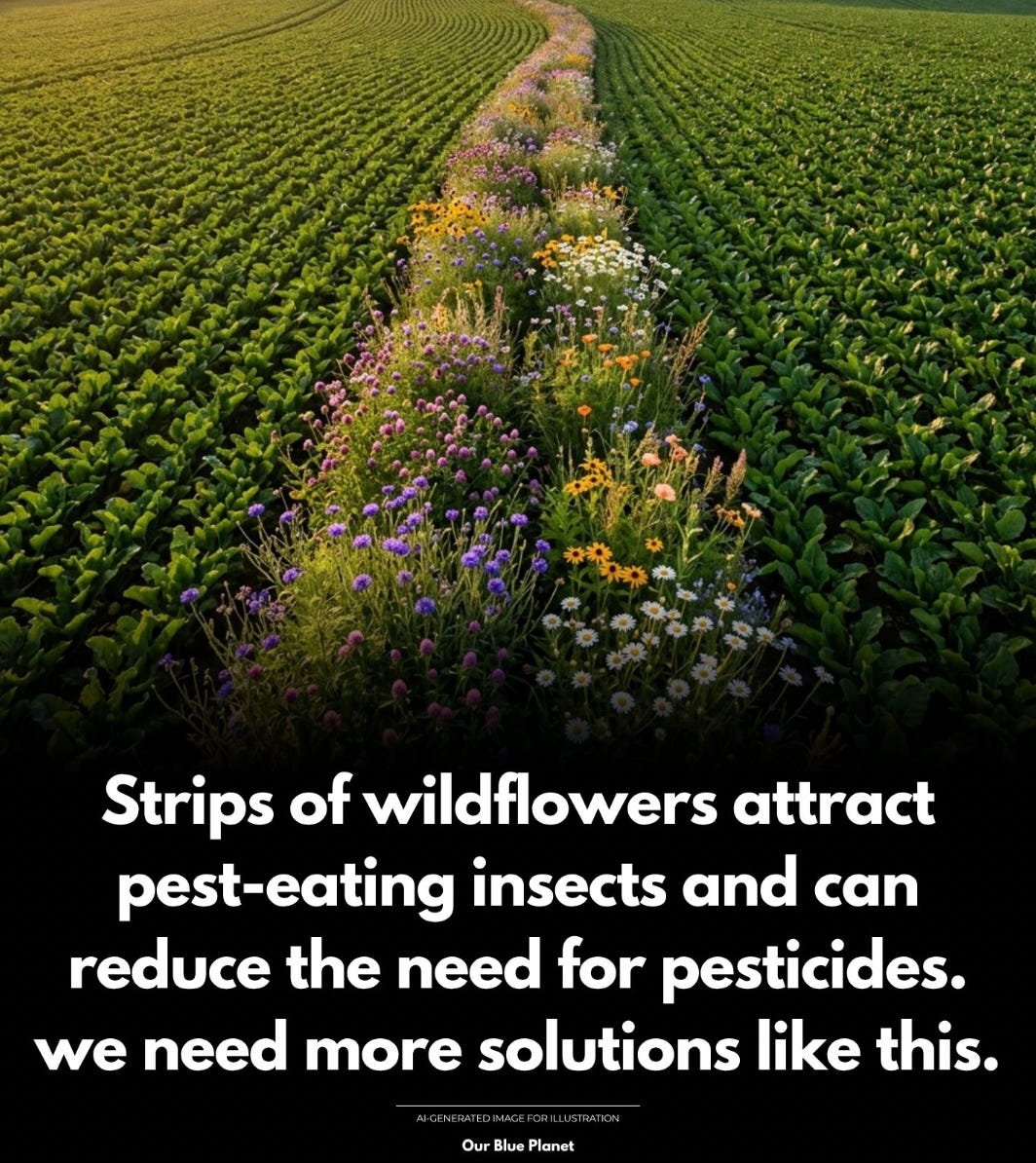
All those are annoying enough. But lately I’ve been getting more agricultural AI—one that keeps circling is a generative AI image of a field of corn, with a strip of flowers down the middle. The caption of the photo details how “farmers use strips of wildflowers instead of pesticides to reduce insect damage in fields.” It always strikes me as interesting that accounts use energy and water-intensive AI to promote ecological ideas, but that aside… let’s talk about the practice in and of itself. Two questions that pop up from photos like this in my mind would be: 1) does this work, and 2) are farmers actually doing this?
In my last article we talked about interplanting considerations and how I actually apply them on my 2-acre, smaller market farm, and how the perennial native planting perimeters and multitudes of blooming flowers help to reduce pest damage and eliminate the need for any pesticides. But what about on our 200 acres? Is it actually feasible for farmers to scale these practices up?
First of all, something I’ve learned as I started attempting scaling of these practices up is that I didn’t fully understand farming. I understood growing practices, soil health, plant health—those kinds of things. But what I didn’t understand was the actual intricacies of the business of farming. Until I started farming myself, I didn’t realize what a game of literal cents on the acre farming can be.
Weeds take over a field? You’ve lost money. Didn’t get enough rain at germination? You lost money. Cover crop grew too much and kept your main crop from growing as well? You lost money. On a commodity row crop farm that grows grains, oats, wheat, corn, soybeans… you don’t set your own prices. The market sets the price based on global purchases, and so many things can affect that price—tariffs, oil prices, wars, weather, and more. A bunch of politicians decide to act like children and enact pointless tariffs on each other, leading to increases in input prices like fertilizer? Yup, that impacts the farmer. In the meantime, they’re rapidly losing increasing control over input prices (all these things we’ll go more into later, of course)— monopoly seed companies keep increasing the prices for their patented seeds. Chemical companies keep increasing prices for herbicides and fungicides. And those bailouts they get from the government? Pretty much run straight through the pockets of farmers and back to those seed and chemical companies and to pay equipment loans.
Lose money a few years in a row? Congratulations, you’re now the first person in your family to lose the farm that’s been in it for five generations!
Once you understand the pressure farmers are under and how truly unprofitable farming in and of itself is, you understand why they are less likely to take the risks that are easy to promote from outside the combine.
Comments
Nothing yet. Say the first thing.
Sign in to join the conversation.