
1.
“We were both ridiculous and brave,” writes Stacey D’Erasmo in her book The Long Run: A Creative Inquiry, a collection of essay-interviews investigating what keeps the most innovative, exciting artists going, decade after decade. Among others, she interviews Samuel R. Delany, Blair Brown, and Steve Earle, and writes about the influences of Colette, Michael Cunningham, Elizabeth Bowen and many others on her work and life. The book doubles as a partial memoir of D’Erasmo’s own “long run” as a journalist, novelist, educator, cultural omnivore, and shape-shifting human on the planet. The ridiculous and brave “we” refers to radical rebellious lesbians at Barnard College in the 80s—D’Erasmo’s “tribe”—who were “ready to remake the world and rewrite history.”

It is familiar to associate that flavor of ridiculous courage (and courageous ridiculousness) with youth. When we’re young, what we don’t know is our very superpower. We either don’t realize we are ridiculous, or we do and wear it as a badge of aliveness because we have no muscle memory of ridicule as damage.
And yet, curiously, these two words in tandem—ridiculous and brave—resonate with me now, as I morph into my own next shifted shape, professionally and actuarially, in my 50s.
Confession: Last week I recorded my first Substack video, here at Bloom. I will resist saying I am “late” to that game, since the raison d’etre of our community here has always been—since we launched in 2011—to counter establishment pronouncements on what is early, late, or right on time when it comes to creative pursuits. In any case, my confession isn’t actually that I was a video virgin; but rather that I felt ridiculous doing it. The combination of speaking to a computer screen as if (with hopes that) a human is on the receiving end, while hawking one’s own wares (my re-released debut novel as the first selection for Bloom’s new Book Club), felt like putting on an elephant costume and attempting to sing the blues.
There was a little bit of tailwind there, however, which is why I mustered the courage to do it: I wasn’t just hawking my own wares. I was inviting Bloom readers to lean in a little; to step out of the shadows of anonymous following/reading and into the Zoom room of interacting and engaging (via the Book Club and also new monthly meetups for paid subscribers).
There’s something a little ridiculous about operating the way we have—impersonally—for all these years, and now saying, Hey, let’s hang! But that’s exactly what we’re doing. We’re putting ourselves out there, uncertain if anyone cares or will respond. Because why not? You’re all here, and so are we. Yes, for introverts who are more comfortable at keyboards and screens, both inviting and accepting invitations takes some bravery. But let’s step off a tiny ledge here: What might be fun and fruitful for us to do together? What’s going on in your creative and literary lives? What are you reading, what are you writing, what are you worried about, what are you excited about? Anything ridiculous you’d like to share or talk about? Let’s hang!
At Bloom we’re also being more transparent about the challenges of keeping Bloom operational, let alone blooming, without financial support: It’s a miracle of good will and excellent folks that it’s kept on and barely missed a beat for 14 years. (Please see our About page for the list of excellent folks of whom I speak.) But at some point, it is both right and good to ask for help, and we’re betting on this being right on time. So once again, ICYMI, we are inviting anyone out there who has received nourishment and/or inspiration from Bloom over the years—or is inclined to lean in, going forward—to consider investing in us with a paid subscription.
2.
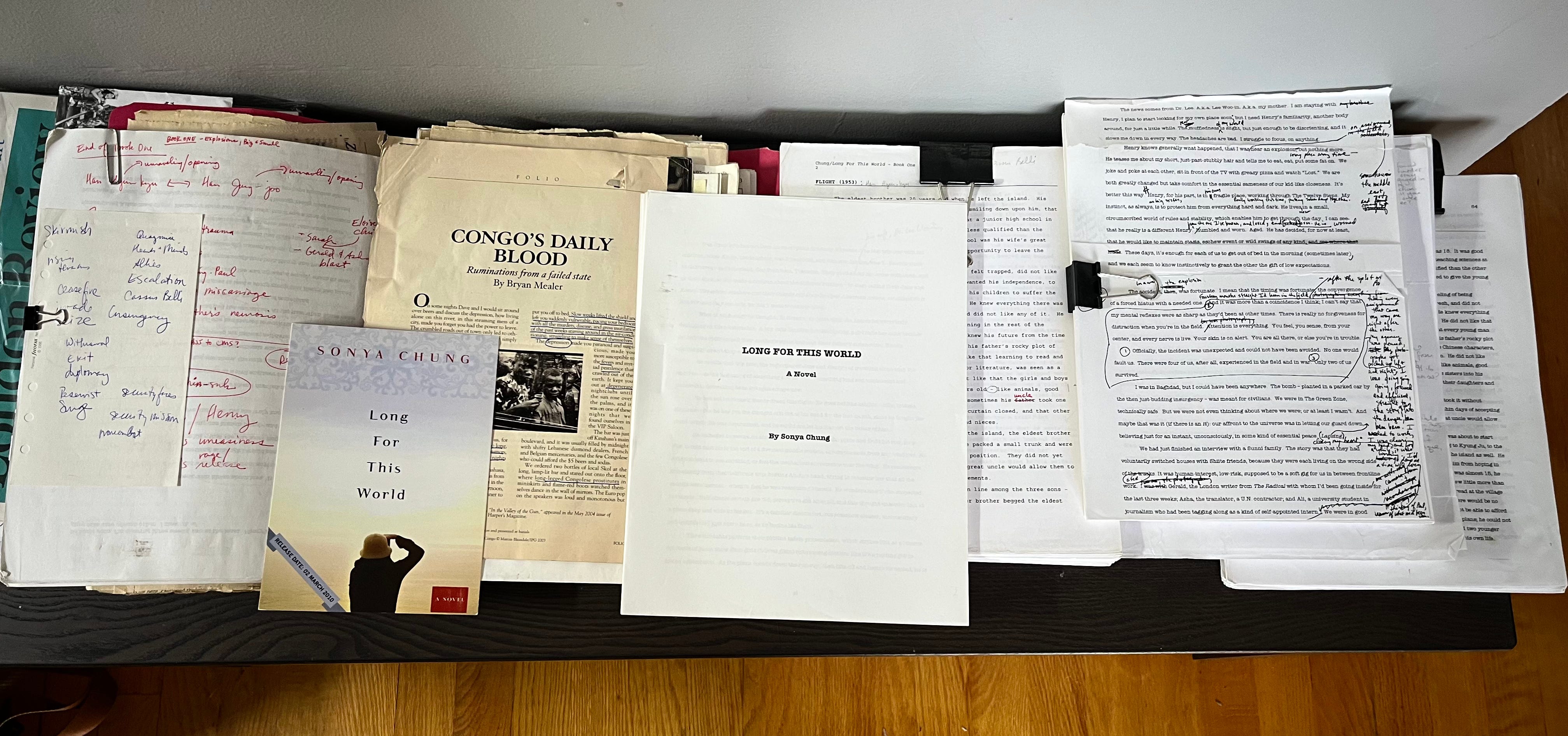
Last but not least (or maybe least? I’m okay with that), my wares. I wrote a book, many years ago, my first novel. I was young(er) and did a ridiculous thing: I quit a good job and went off into the woods to write it. It took a long time; it was the hardest thing I’d ever tried to do; I revised it many times; it was rejected by many agents, all while I was under-employed and accruing debt. I despaired, alone in the woods, increasingly out of sync with my peers, who were getting promoted and married and buying houses.
But I tried to be brave, as ridiculous as it seemed. I kept trying. Somehow I revised the book significantly one last time and wrote to one last agent—actually, I went back to an agent who had rejected me—and she took me on, and the book was published by a Big Six publisher. Not a lot of people read it, because I was an unknown author, and as was their custom in these cases, the big publisher did scant marketing. Sadly, they did not even print a paperback. Still, those who did read it—trade reviewers and serious literary people, you could say—thought it was a good book.
Most writers would look back and say, I’m lucky it was published at all. And I am indeed grateful for that. It changed my life, no question. But…
…it became clear recently that if I left the book under the ownership of the big publisher (who is now owned by an even bigger corporation), it would go out of print/out of circulation—essentially erased from existence. And it has become increasingly clear that gigantic corporations are dominating and manipulating our lives in every way, and that my tolerance level for passive acceptance of this is waning. So: I did another ridiculous thing—brave? maybe—and bought back the rights, redesigned and printed the paperback myself, and put it up for purchase on my website only. Not on Amazon, which I quit out of protest about a year ago.
I want to make clear: Re-releasing my 16 year-old debut novel isn’t a sour grapes or wounded ego thing. I hadn’t been stewing about it or plotting my revenge or thinking This book MUST be more widely read! I am, however, proud of Long For This World. While it is flawed and not for everyone, it is also well-wrought and honest and should be available in the world. Taking back the rights and putting the book back into print in this simple, straightforward way was to my mind the sensible and sound response to a confluence of factors. These factors pressed the question: Why as an artist would I allow capitalist values and power to dictate the fate and worth of my creative life and work, if I could do something about it?
Late-stage capitalism owns everything else and ruins so much of what matters. Mostly we accept this. But amidst an imperfect economic and social reality, isn’t our art, after all, meant to be our one sacred realm?
Other scary questions have inevitably followed that I am ready to entertain: Why, for example, do writers still covet and celebrate the approval of corporate media like The New York Times or The Washington Post? The wisdom of years truly does change your perspective… on what is actually ridiculous. D’Erasmo affirms this:
“[W]hile power can determine access and market worth, it can’t tell anyone that they’re not an artist… this is the one power that power doesn’t actually possess, no matter how loudly it barks that it does. If I were to offer any warnings…I would tell [artists starting out] not to fall for power’s costume.”1
3.
The artists that D’Erasmo interviews for The Long Run are diverse in every way, as are their journeys. Unsurprisingly, there is no singular formula or answer to the question, “What makes for a long run?” in the creative life. But here is one piece of it, from the book’s epilogue:
[W]ill is certainly a factor. We push. However, of equal if not greater importance is willingness. Forces arise, within and without, and it’s that willingness to turn in their direction, to yield, that seems to foster resilience… in the world, surrender is often what leads the artist where they find they must go.”2
I love this crucial distinction between two related words—will and willingness. Will is clamping down, digging in, white knuckling yourself into forward linear motion. Willingness is openness; unclenching your fists and all those core muscles they keep telling you to tighten; welcoming uncertainty so you can invite adventure and transformation. In D’Erasmo’s words: turning, yielding, surrendering.
More often than not, the call you allow yourself to answer is a little ridiculous, which is why it takes courage to lean in. It’s ridiculous to talk to your screen with the hopes of building community. It’s ridiculous to leave corporate predictability and attempt to create your own human-scaled marketplace. It’s kind of ridiculous to write a poem or a story or a book at all, especially a good one that will require hours and years of your best energy and may land like a tree falling in the woods with no one to hear it.
If you are still reading, you too are ridiculous and brave. Are you willing? Who’s with me? Shall we remake the world?
Join us as a paid subscriber, which includes Bloom Book Club and Bloom Monthly Meetups. Be ridiculous & brave with us.

The Long Run: A Creative Inquiry, by Stacey D’Erasmo, Graywolf Press (2024), p.307.
Ibid., p.306.
Comments
Nothing yet. Say the first thing.
Sign in to join the conversation.