
Leah De Forest: First, congratulations on Names Have Been Changed, which is out today from Penguin Random House (Tiny Reparations Books). Can you tell us a bit about how this book came about?
Yu-Mei Balasingamchow: I’d been in a creative slump for something like half a year, and I was trying to revive the writing impulse by playing around with new ideas, very low-stakes. One day, a thought came to me: How would a person live if she committed a crime and fled her home country of Singapore? What would she do to survive and not get caught?
A voice erupted in my mind: urgent, prickly, demanding to be taken seriously. I started writing, and the character behind the voice, who called herself Ophir, emerged. I realized the story would be about shifting identities, concealing one’s true self, and, for Ophir, an eventual reckoning about who she really is.
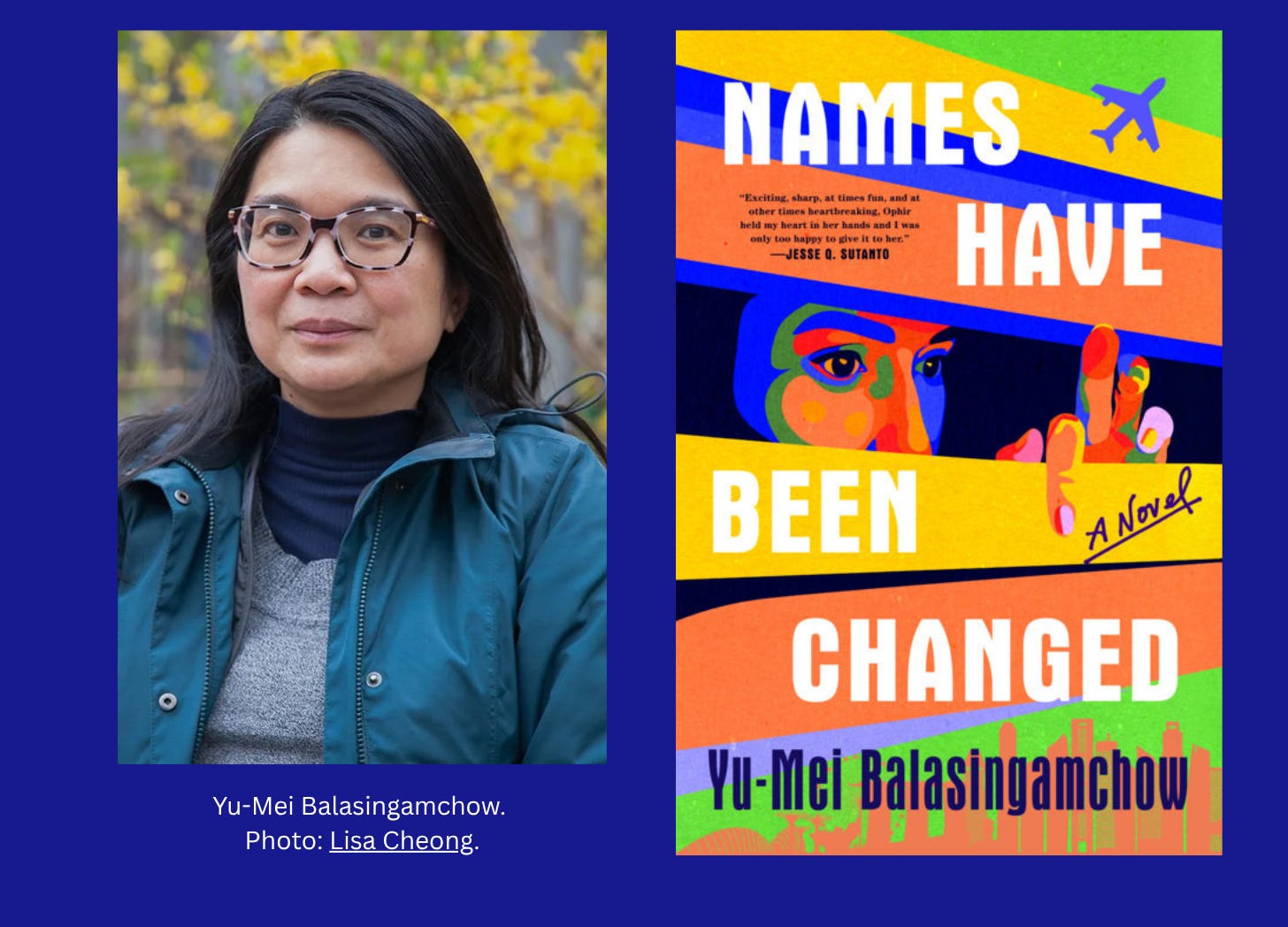
The core idea hasn’t changed from day one. Ophir bounces from country to country and gets entangled in romance and subterfuge with diasporic characters, a number of whom are also from Singapore. With my previous attempts to write two other novels, I had made detailed outlines and then felt straitjacketed by them, and I never finished those manuscripts. I didn’t want to risk that with Names Have Been Changed, so I wrote as fast as I could without much of a plan, following the impulses of Ophir’s voice.
Leah: I was so curious about the form of this novel—it’s told in a series of podcast episodes, which the narrator, Ophir (not her real name) is broadcasting from an undisclosed location. How did that evolve?
Yu-Mei: Ophir’s voice was a very insistent and propulsive presence in my mind. I couldn’t stop thinking about her, and she had a lot to say! Before she gets mixed up in crime, she has a pretty good life. She’s the youngest in a big family, she has lots of friends, she likes going out and being the center of attention. Then her best friend pulls her into a criminal scheme, and one day, the police catch up with them. Everything changes overnight. Ophir flees Singapore without thinking and becomes an accidental fugitive.
By the time we meet her at the start of the novel, she’s been on the run for ten years. A lot of internal emotional pressure’s been building up. Ophir misses home terribly, and she doesn’t trust anyone. She finds out her father has died, just before the world goes into lockdown in 2020. Now she’s even more isolated and also grieving, and she needs a way to let it out. She decides she’s got to “speak [her] mind and live with it,” and if she does it on a podcast, no one will know where she is.
This becomes a weekly routine that allows her to speak with her real voice. She doesn’t have to hide her Singaporean accent or the details of what she’s done. This triggers an emotional transformation that unfolds over the course of the novel.
As the author, I was interested in the intimacy of thought and voice and how saying something out loud changes the speaker. Oral storytelling is an ancient tradition, but what does it mean to confess one’s own story aloud to an unseen audience? What is an authentic voice, if there is such a thing? I also enjoyed pushing the idea of what a novel could be. Names Have Been Changed is narrated entirely by Ophir. She builds a very direct relationship with the reader—ostensibly, a listener—with her words. I kept thinking about how she would tell her story, what details she would skirt around or evade, or other moments when she would go off on a tangent or have a TMI moment. I also had fun thinking about how words sound and about how to integrate other languages, including Singlish, the creole language of Singapore, into Ophir’s telling.
Leah: Like all great novels, this book is about many things: it’s a personal reckoning, a road trip story (of sorts), an adventure, a family narrative, and—to my mind, at least—a love letter to Ophir’s home country, Singapore. Can you talk a bit about how those various elements unfolded?
Yu-Mei: Names Have Been Changed is an episodic novel and also a picaresque. Ophir tells us about encountering people from Singapore on her wanderings abroad. They are what she calls “[t]he highlights of my fugitive life.” In Tokyo, it’s a university student leading a secret double life. In London, a political exile. In Colorado, a doting mother who reminds her of her grandmother.
These characters have left Singapore for different reasons (spoiler: no one else is a criminal). Many of them also have a fraught relationship with Singapore. All of them, including Ophir, face the question: How far am I willing to go to live this life, away from Singapore? Ophir comes to realize there are many different ways of existing outside one’s homeland and building a fresh, complex identity. She’s also pushed to take a hard look at her own choices to run away and stay away from home.
All this came together in the novel with elements of romance, adventure, mystery, suspense, and family estrangement. As I was writing, I didn’t want the novel to keep hitting the same dramatic or emotional notes. It was more fun to mix it up!
Leah: Like Ophir, you were born in Singapore. How did your own experience of moving to the United States inform the way you understood, and rendered, her character on the page?
Yu-Mei: Ophir and I don’t have a lot in common, but one thing we do share is that we’re familiar with feeling like an outsider. When I was growing up in Singapore, it was relatively unusual for someone to be mixed-race like me (and Ophir) or to have a conjoined last name like I do. Moreover, the school system and mainstream discourse relied on a purist, monolithic idea of what it meant to be Chinese, Eurasian, Indian, or Malay (the primary racial groups in Singapore). As Ophir says, “If you’re mixed, people ask what you are,” because they’re trying to put you into one of the racial boxes. That made me feel like an outsider, as someone who’s mixed-race, even though I often passed as Chinese (which is the most dominant group, numerically, economically, and culturally).
Living in the US now, I feel like an outsider in a different way, although I’ve found a niche in my career and in the community where I live. I moved here alone in middle age, for one thing, and there are cultural references I don’t get or social expectations that are different from how people behave in Singapore. You know what that’s like! I think every migrant feels it. It isn’t necessarily hostile, but the differences are there, and I can’t help but notice them, while to my American friends they’re just part of the water they’ve always swum in.
Some of this carried into Names Have Been Changed. For example, when Ophir describes how she’s perceived in Singapore by her peers. She’s also keenly aware of different accents and Englishes around the world, or habits like whether people eat with their hands or with a fork and a spoon (as many Southeast Asians do). (Sidenote: I still cannot get over the fact that some people eat rice with a fork!)
The novel provided a large canvas for exploring outsiderness. Ophir is, literally, an international criminal fugitive and therefore, by definition, a social outcast everywhere she goes. She yearns to belong somewhere, but she can’t reveal who she really is. One way this manifests in her body is through language. She says that every time she speaks in her natural voice, in Singlish, “it’s like going home.” She say it’s something that “makes sense only to us, our precious music.” I feel that very strongly.
Leah: Can we talk a bit about Milo? (Big Milo fan here).
Yu-Mei: I love it so much! Especially (God forgive me) the formula with palm oil that I grew up with, which is made in Singapore and Malaysia. It’s not the same as the milkier Australian version I think you’re familiar with? Milo’s still very popular in Singapore and Malaysia today. I also remember bonding with a friend from Jamaica over our enthusiasm for it, which is why in the novel, it’s an emotional touchpoint for a character who’s from Jamaica as well. And then an early reader of the novel, a friend from Trinidad, told me the Milo references resonated with her too!
It’s incredible how something that was created in Australia has made its way around the world on its own migratory journey. I think of this global shared affection as an inadvertent cultural legacy of the British empire, a colonial connection that’s right there in plain sight, even today.
Leah: And Singapore noodles?
Yu-Mei: Are you ready for a deep dive? There’s a food writer and researcher in Singapore, Sheere Ng, who’s done a massive amount of research about this. Singapore noodles are typically a kind of fried noodle dish that involves curry powder, and it most likely originated in Hong Kong but was named after Singapore, possibly to make it sound more exotic. It then migrated with people who moved from Hong Kong to the UK, the US, and Australia, where they started restaurants. It’s now a menu staple in diasporic Cantonese-style restaurants. In Singapore, however, it’s typically made without curry powder.
I’m not a fan of Singapore noodles, but it was perfect to slide into the novel to bring up questions about identity and cultural authenticity. At the Chinese restaurant in London where Ophir is working, a character keeps coming back to order it, and she’s in fact a Singaporean who has fallen in love with what she calls “a fake Singaporean dish.”
Leah: What do you think Ophir learns about herself over the course of the novel?
Yu-Mei: I mentioned earlier that the central question of the novel for many of the characters is: How far am I willing to go to live this life, away from my homeland? Some of them really push that to the limit. For Ophir, in pursuing one kind of freedom—staying out of jail—she sacrifices another: the freedom to claim her name, to speak in her real voice, and to be with the people she cares about. The thing about freedom is that we often don’t realize how much we appreciate it until we lose it. At the end of the novel, she has to decide, which kind of freedom and life do I want?
Leah: What do you hope readers will take away from reading Names Have Been Changed?
Yu-Mei: A fun read, first and foremost! The novel is a fast-paced adventure, and I hope readers will connect with Ophir, who’s prickly but also funny and vulnerable. At a deeper level, I hope readers will recognize that place, culture, and identity are quite complex and can mean different things to different characters—and that’s a good thing! In the current climate, the word immigrant or migrant gets cast with a very narrow definition. I hope Names Have Been Changed will offer an alternative view. People leave home for many different reasons, sometimes against their will, sometimes out of pure love, and leaving one’s birthplace doesn’t mean severing all connections with what you’ve left behind.
Leah: What has been the best thing about publishing your debut novel?
Yu-Mei: I’ll answer this more broadly. The best thing about the whole process was learning that I could finish a full novel manuscript, even if it was just a first draft—that was the first time I’d done that. And then learning that I could revise it and make each draft better, making it become more and more of itself. And then the satisfaction of having my agent, Lucy Carson, and then my editor, Emi Ikkanda, reflect their excitement and understanding of the manuscript back to me during the querying and submission stages, respectively. Their responses were such a wholehearted affirmation of what I was trying to do with this story, the fact that they recognized and appreciated the subterranean emotional throughlines—I can’t even tell you how incredible that felt.
Leah: What has been the most surprising?
Yu-Mei: How easy it is to lose sight of the novel in the midst of pre-publication marketing and publicity work. All that is important work, but it’s a lot of writing and talking about and around the novel. A couple of months ago, I sat down and read my novel from cover to cover in one day, because I needed to sink back into the words and remind myself what it really was. I’m thinking about doing that again before it’s published. I want to feel that closeness, that intimacy. I’ll never be as close to it as when I was revising it and examining every word choice, every dramatic beat, every punctuation mark. But I want to get as close again as I can and remember why I wrote it.
Leah: What’s next for you?
Yu-Mei: I’m writing another novel, also about displacement and exile. No runaway criminals, though! I had the idea for it last fall, right around the time we finished copy editing Names Have Been Changed, and I’ve been writing for a couple of hours almost every day. It’s giving me life, as the kids say! I’m nervous—and hopeful—about how Names will be received, but I’m also thrilled to have new characters and ideas emerging on the page.
Yu-Mei Balasingamchow’s short fiction has received a Pushcart Prize Special Mention, won the Mississippi Review Fiction Prize, and been shortlisted for the Commonwealth Short Story Prize.
Yu-Mei is also the co-author of Singapore: A Biography, editor of How We Live Now: Stories of Daily Living, and co-editor of In Transit: An Anthology from Singapore on Airports and Air Travel. She has an MFA in Creative Writing from Boston University. Her writing has been supported by the Ucross Foundation, Massachusetts Cultural Council, Elizabeth George Foundation, Sewanee Writers Conference, Ragdale Foundation and Vermont Studio Center, and in Singapore by the National Arts Council and Nanyang Technological University.
Originally from Singapore, Yu-Mei now lives in Boston. She is editor at Gaudy Boy, an independent press that brings literary works by authors of Asian heritage to an American audience, and teaches at GrubStreet.
Leah De Forest was born in Geelong, Australia, and lives in Boston. Her debut novel, Any Kind of Known Tomorrow, is out from Betty on 9/15/26. Her fiction, essays and criticism have appeared in Griffith Review, CRAFT Literary, Fiction Writers Review, and Kill Your Darlings, among other venues. Leah is a senior editor at Bloom.
Comments
Nothing yet. Say the first thing.
Sign in to join the conversation.