
Leah De Forest: First, congratulations on In Bloom! Can you tell us how this book came about?
Liz Allan: Thank you so much! I started writing In Bloom during the first Covid outbreak in 2020. It was a period of great uncertainty and out of all that chaos the collective voice of the girls came to me one morning after a phone call with my mother. Although the plot is fictional, the characters are very much based on me and my friends’ shared experience of growing up in Victor Harbor, South Australia in the 90s. I had a very close group of girlfriends and most of them were also in single mother, low-income households and we shared a lot of formative experiences which had a huge impact on my life. The first page of the novel is essentially unchanged from that very first draft in 2020. I used the first page as a model for the style of the rest of the book and I kept coming back to it as a kind of touchstone until it was completed.
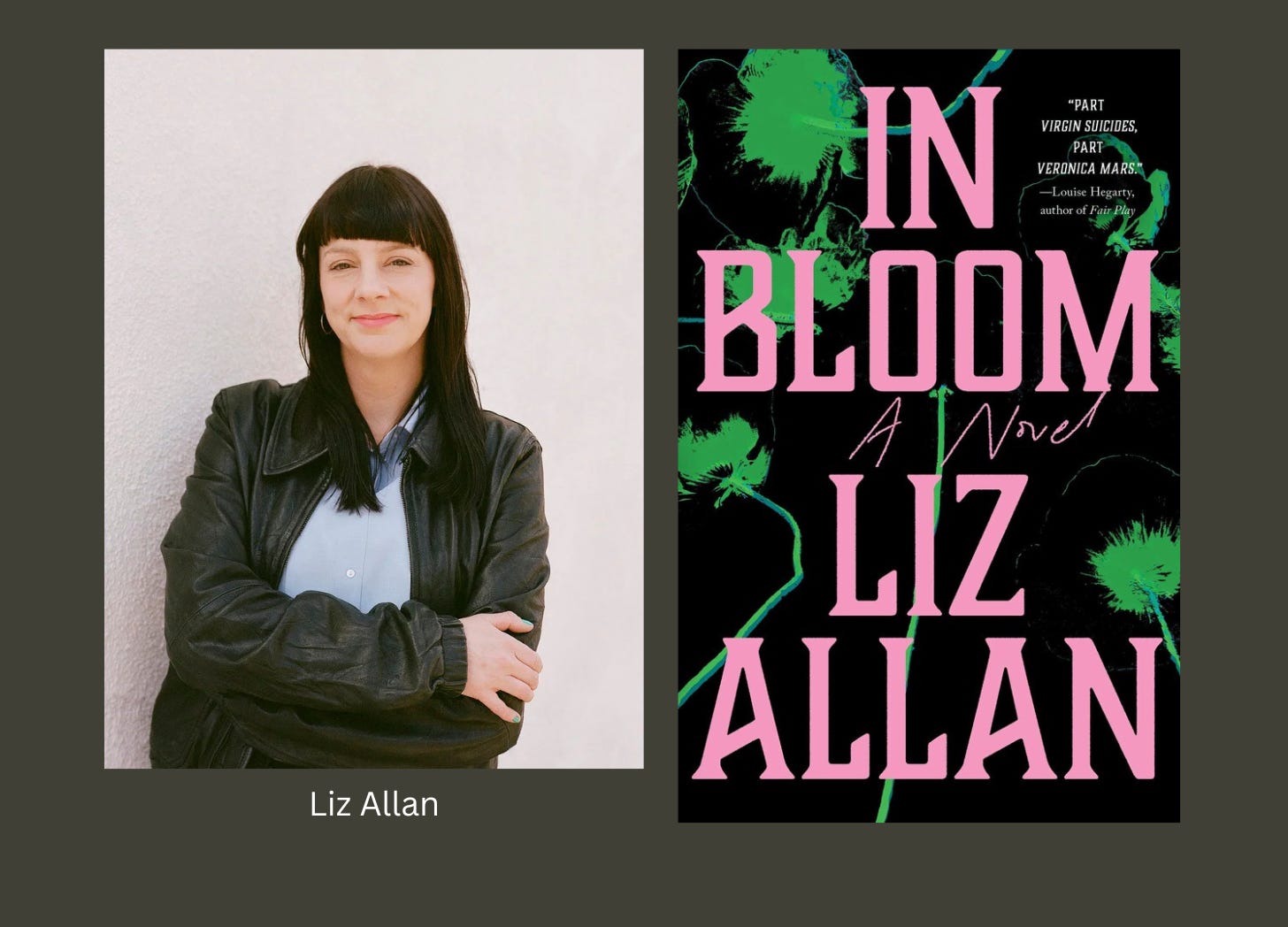
Leah: To me, one of the striking—and successful—aspects of this novel is the point of view. It’s told in the first person plural, as in ‘we’. Can you tell us a bit about who ‘we’ are?
Liz: The ‘we’ are three teenage girls named Amy, Violet and Jade, who live in a small coastal town in South Australia in 1994. They play in a grunge band called The Bastards and dream of escaping their provincial, suffocating town. The girls are all first born daughters in single mother, low income, multi-sibling households and they are tightly bonded through shared experience and circumstance. There was a fourth member of their band: Lily, and the recent loss of her friendship has created a terrible discord amongst the girls.
Leah: There’s a sense, isn’t there, at least from the people around The Bastards that they’re interchangeable.
Liz: There is definitely a sense that other people view The Bastards as being interchangeable. I wanted to show the feelings of invisibility that come with growing up in disadvantaged circumstances, and the way neglected children feel like they are on the periphery of society, and not quite active parts of it. At the same time, the girls rebel against this: they call themselves The Bastards to take ownership of their identities, and to prevent anyone from ridiculing them. They are active and brave, and they refuse to let other people define them, which I greatly admire.
Leah: It’s clear, by the end of the novel, why this point of view is the right fit for the story (readers will have to check out the book to learn more!). I’d love to know how you landed on this approach. Was the novel always told in the ‘we’?
Liz: The ‘we’ voice was something I tried out experimentally and as soon as I wrote the first page I knew it was going to work. Although the characters and the plot are fictional, writing from a collective voice enabled me to be honest about what it felt like growing up in underprivileged circumstances in the 90s. My adolescence was defined by close female friendship, and these women have remained my family and inspiration to this day. I can’t imagine what kind of person I would be without them, and I wanted to portray the power, and also the danger, of girlhood friendships and the lasting impact they can have on the formation of our identities. When you are a teenager your peers become your entire world, and this obsessiveness can be a negative thing, or a positive, depending on the people you befriend.
Leah: What were some of the challenges in telling the story this way?
Liz: I found the first-person plural voice to be freeing, rather than limiting. Removing pronouns enabled me to write a narrative that focused on the present, and the physical actions of the girls and the sensory experience of the town. I think the Oulipo approach to creativity, whereby constraints are applied to writing in order to enable the writer to approach their work in a new way, can be very effective. As a teacher, the worst thing I can say to my students is: write a story. Without boundaries and constraints, it can be challenging to create something original. The first person plural voice was a joy to write, and I actually found it more challenging to break it, and switch to first person singular towards the end of the story.
Leah: This book is set in a seaside town in Australia in the mid 1990s—a landscape that’s somewhat familiar to me (though I’m from the next state over). What was it like for you, writing a story set in that time and place?
Liz: It definitely brought back a lot of memories, good and bad! What I hoped to achieve by describing my hometown is the way that a person’s upbringing and home life influence their experience of place. When you grow up in a small town the responsibility lies heavily on the family unit to provide you with activities and company and enjoyment. And if you are in a family where the carer does not have the time or money to provide that for you, the small town can become a hostile place. I think people would look at where I grew up and find it idyllic: but a lot of kids growing up there had a lonely time, and unhappy teenagers will inevitably get themselves into potentially risky situations.
Leah: “The Bastards” are driven, in much of the novel, by wanting (really, really wanting) to get to a “Battle of the Bands” competition in Geelong (which happens to be my hometown). Can you talk a bit about what this competition means to them?
Liz: The Battle of the Bands is EVERYTHING to the girls. They are fixated on this goal to the point of obsession, and they are incapable of letting go of it when it becomes difficult for them to attend. The fact that they were accepted into the finals was the best thing that has ever happened to them, so they put their hearts and souls into winning the competition. They love the band Nirvana and they want to be just like them, to the point of obsession. The girls view music as the only possible avenue for them to improve their circumstances and they’ll stop at nothing to win it.
Leah: What do you think it meant, in that time and place, to want to escape?
Liz: I think the town itself was symbolic for the girls of the ways they felt imprisoned: by their lack of income and connections and their lack of access to opportunities. The girls don’t believe that they are smart enough to go to university, or skilled enough to get a good job. Grunge music is the one thing that gives them hope and inspiration. I think the grunge movement was very accessible for small town kids, and disadvantaged kids, because it was anti-capitalist, and a champion for the weirdos and outcasts of the world. Grunge music wasn’t about money or fame or power, it was about uniting people and giving them an avenue to express their disenchantment with the world.
Leah: I’ve thought a lot, since finishing the book, about what characters see, and what they choose not to see. Was this on your mind when you were writing it?
Liz: When I started writing the novel I was focused on the ways that adults in their lives let the girls down in various ways: through not recognizing their struggles and not asking the right questions. But as I wrote the story it became apparent to me that the girls were in massive denial about things as well. I think being a teenager is a uniquely painful experience, because you experience a deep yearning for love and acceptance, but you are also simultaneously defensive and insecure. These girls were not protected, and it’s very difficult for them to admit how badly they were hurt by someone they trusted. I think we all have a responsibility to notice when a vulnerable person is not safe.
Leah: It was such a pleasure for me to read a book that uses words and phrases like “lay-by” and “scratchies” and “dob him in”; they’re authentic, of course, to the narrators’ voices. I wonder if you encountered any confusion from UK or US readers? (Maybe we should offer translations!)
Liz: There were a number of words that needed clarification! The cleaner we call Jiffy in Australia, for instance is called Cif here. Chicken Crimpies were a source of confusion, as were Spotlight memberships cards. When I moved to the UK two years ago, I scandalized my students by saying sneakers instead of trainers and lollies instead of sweets. They greatly enjoyed mocking my ignorance, but I am learning to correct myself and I have moments of pride when I ask for paracetamol instead of Panadol or crisps instead of chips.
Leah: Charles Baxter, in an essay on writing, describes books as portals that can take us “into a place that is wiser … about the world than the world itself is.” My question is twofold: what did you learn in writing this book? And if we agree that this book takes readers somewhere they might otherwise might not have gone, where do you think that is?
Liz: I learned from writing this book how healing female friendship can be. Writing about The Bastards made me reflect deeply on the friends I have had since childhood, and how grateful I am to have them in my life. I’m learning to be more vocal about how much I value and appreciate people instead of just assuming they know how I feel. As for the place this book will take readers, I think it is a dark place at times because of the male violence the girls are exposed to. But I think out of this darkness emerges a bright light, which is the love the girls have for one another, and the tenacious belief they have in each other’s specialness. Female friendship is incredibly powerful.
Leah: What’s next for you?
Liz: I’m currently writing my second novel which is set in London on the Thames. For now I’m describing it as a combination of Oliver Twist and The Little Mermaid.
Dr. Liz Allan is an Australian writer and teacher living and working in the United Kingdom. Her debut novel, In Bloom, was chosen as one of the Observer’s Best Debut Novels of 2026. Liz has a PhD in Creative Writing and a Masters in Teaching from The University of Adelaide. She will be the Elisabeth Maynard Writer in Residence at Frensham School, NSW Australia, April-June 2026.
Leah De Forest was born in Geelong, Australia, and lives in Boston. Her debut novel, Any Kind of Known Tomorrow, is out from Betty on 9/15/26. Her fiction, essays and criticism have appeared in Griffith Review, CRAFT Literary, Fiction Writers Review, and Kill Your Darlings, among other venues. Leah is a senior editor at Bloom
Comments
Nothing yet. Say the first thing.
Sign in to join the conversation.