
Liz Ross spoke with Ellen Birkett Morris about her award-winning debut novel.
Liz Ross: First, congratulations on Beware the Tall Grass. Your novel centers around the Sloans, a family grappling with their young son’s troubling memories of a past life as a soldier in Vietnam. You weave their story with one that unfolded decades earlier, when Thomas Boone, a young man caught up in the drama of mid-sixties America, was sent to war. I was intrigued by the idea that there are children who experience past life memories. What inspired you to explore this?
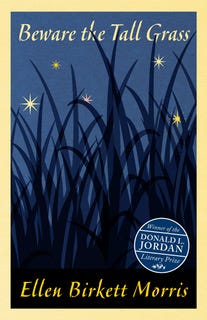
Ellen Birkett Morris: In 2014, I was on a road trip with my husband and heard an NPR story on the University of Virginia Medical Center program that attempted to corroborate the past life stories of young children with the experiences they describe. These children talk about being in war, the Holocaust, and being present during terrorism. The researchers would hear the stories and look at news accounts and records to see if they matched the details of the story the children told. A surprising number of times they did match.
I’ve had this sense about growing up, that the life we expect often isn’t the life we get. Certainly this is the case for the children who have these memories, and for their parents. Parents think of children as a blank slate they’ll be able to fill with happiness. So it appealed to me on that level, imagining a kid carrying around these heavy memories, and parents trying to navigate them. It’s an example of the inevitable challenges we face, things we don’t expect that change our lives.
LR: Would you talk a bit about the title of your novel?
EBM: The phrase came to me, Beware the tall grass, nothing good ever happens there as I was writing a scene where Thomas has to make a difficult choice. Tall grass shows up several times in the book. It represents those dangerous areas where we can’t see what is coming next.
LR: Can you talk a bit about your character Thomas, and his decision to enlist during Vietnam?
EBM: He’d lost his horse, Beau, who was his best friend. He was depressed and couldn’t imagine his life on the ranch without Beau. I also think he was sold a bill of goods. He was looking for connection and the Army recruiter said he’d be with a band of brothers. He imagined this was the answer to his problems with no real sense of what it would mean to be sent to a war zone. In my research I came to understand that these young men were taken out of factories and farms with no real sense of what they were getting into. Their only reference point for war was WWII, which was a completely different sort of conflict.
LR: Thomas is a gentle person. Can you tell us a bit about what it was like for him, being in a war zone?
EBM: In many ways he was a complete innocent, but he was also a kid who had a deep sense of integrity. I wanted him to be a gentle, animal-loving soul in an unexpected situation. The more I’ve written, the more I’ve realized that the craft of coming up with a story is largely about establishing a character and then creating situations that push back on their core qualities and beliefs. So I’m going to take this kind, animal loving kid and put him in this situation where he is asked to do horrific things. I was reminded of advice I received in a workshop, to start where the pain is, so that is what I did.
LR: Decades after the Vietnam War, Thomas’ memories surface in the Sloan’s young son, Charlie, who is traumatized by them. Can you tell us a bit about this?
EBM: Charlie’s memories were a great way to push back on Eve Sloan’s desire to give Charlie a perfect childhood. Since I’ve written the book people come up to me with all kinds of stories about their children, their siblings, or themselves. I’m largely a skeptic, but this is definitely a phenomenon that affects some folks and I’m not sure we can fully understand where it comes from.
LR: This November marked the 60th anniversary of the Vietnam War. What would you like people to be thinking about as we mark this milestone?
EBM: So many people were touched by the war. I would love for us to remember, with some degree of appreciation, the sacrifices and challenges faced by the people who served. While the war was a real hot button issue, and there was protest and opposition, I would like us to look back with compassion and understanding at the complexity of the conflict, for those whose lives were changed by it, both here at home and in Vietnam.

Ellen Birkett Morris is the author of Beware the Tall Grass, winner of the Donald L. Jordan Award for Literary Excellence, judged by Lan Samantha Chang, published by CSU Press. She is also the author of Lost Girls: Short Stories, winner of the Pencraft Award and finalist for the Clara Johnson, IAN and Best Book awards. Her fiction has appeared in Shenandoah, Antioch Review, Saturday Evening Post, and South Carolina Review, among other journals. Morris is a recipient of an Al Smith Fellowship for her fiction from the Kentucky Arts Council.
Liz Ross has an MFA from the Program for Writers at Warren Wilson College, several publications in LEON Literary Review, and lives in Southern California where she is at work on a novel.
Comments
Nothing yet. Say the first thing.
Sign in to join the conversation.