
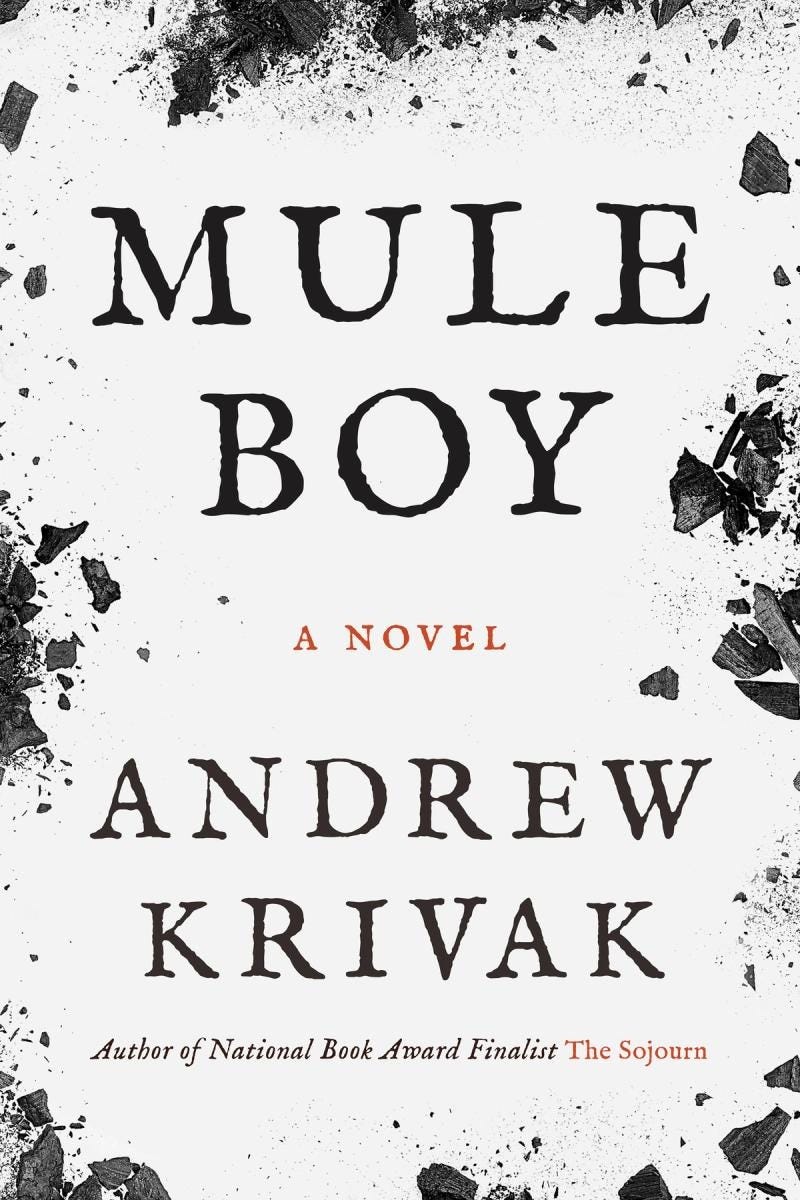
We are pleased to publish the following advanced excerpt from Andrew Krivak’s 5th novel Mule Boy, which will be released on February 24th by Bellevue Literary Press and has received starred reviews at both Kirkus and Publishers Weekly. Krivak’s debut novel The Sojourn — the first in a trilogy — was published when he was 47 years old and was a National Book Award Finalist and Dayton Literary Peace Prize winner.
In the New York Times Book Review, author Roxana Robinson described Krivak as “An extraordinarily elegant writer, with a deep awareness of the natural world.” Author Laura van den Berg writes of Mule Boy:
Andrew Krivak is one of contemporary fiction’s finest architects of the line, and I am utterly swept away by his lyric, daring, and kinetic music. Mule Boy is a riveting exploration of the ghosts we carry coiled within us—and what is unleashed when they leap out into the present. This book is as brilliant and sure as a bolt of lightning.
In Krivak’s own words about this semi-autobiographical novel:
I am…fascinated by the way in which oral storytelling has always defied the conventions of the written word, not consciously so much as naturally, and I wanted to experiment with a different style of storytelling to capture the rhythms and the spirit of how stories move. Hence, Mule Boy is written not with a traditional—or rather “conventional”—sentence structure but in an oral paratactic style. Every clause is a thought and every comma is a breath because it is not through sentences that stories move, but through the layers of time and memory that have worked to shape those stories.
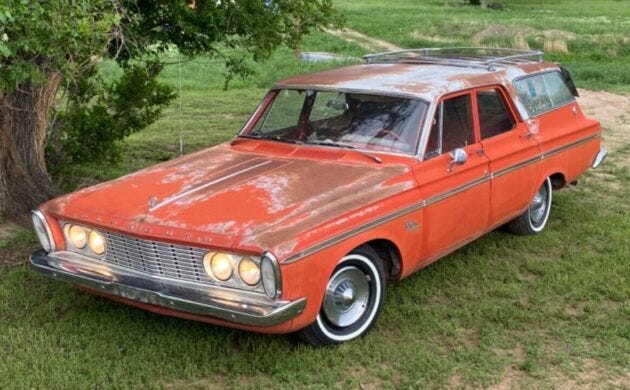
and although I had told all of this to Jacobson in prison, the first of the children came to the mountain to find me many years later, on my last day with the Forestry and Recreation Commission, my last day in the guard shack at the entrance to the trail up the saddleback of the mountain, an afternoon in late August when I knew there would be one of those summer storms so big the clouds rise up in the western sky like an erupting volcano, the air becomes thick with ozone, and the forest ticks with the sound of wildlife skittering for shelter, and they drove up in an old and hard-worn Plymouth station wagon about to boil over, drove up with the windows down, it was so hot, an older man, a younger man at the wheel, and a boy in the backseat looking like his father in that way the firstborn always does, and I recognized all three of them, recognized them right away, and before the younger man could even say anything I told him his radiator needed water and he stared down the hood of the car from inside and nodded, and I took a pail I kept by the steps of the booth and walked with it down to the creek that ran from the top of the mountain and into one of the ponds that lay to the east of the mountain, and I hoped he knew what I was doing, because it took me some time to walk down to the creek with the pail, cicadas whirring in one last chorus of heat before the rains began, and I wondered where I would start when he asked the question I knew he was going to ask, and I filled the pail at the creek side and walked a little slower back up the road with the cold water splashing over the sides and onto my hands and boots, and I don’t know if they wondered where I was or where I had gone, but all three of them were still there in that Plymouth when I returned and they seemed neither bothered nor worried by how long it took me to walk down to the creek with a pail and return with it full of water, maybe the older man was trying to figure out how or where he would begin to ask what I knew he was going to ask, and I told the younger man at the wheel to pop the hood and he got out and undid the latch and lifted the hood and it was hot under there, so hot I had to unscrew the radiator cap with my hand holding on to my loose shirttail, and I could see the water was down more than half and the radiator was going to boil over if he drove that car more than a few more miles, and I poured the creek water sputtering and boiling right to the top of the radiator, and when it cooled I put the cap back on and closed the hood and told him that ought to do it for a while, and he said he was much obliged and was quiet for a minute, so I just waited
I’m looking for Ondro Prach, he said
and I nodded and told him he didn’t have to look any further and I stood there and listened to him explain not why but from where they had come, the state of Pennsylvania, the town of Hazelton, the mining patch not far from where his grandmother had lived during the early years of her life, a place he had never known and hadn’t even visited because it was nothing more than a ruin in the midst of slag heaps and culm banks and a big hulking breaker that rose up in the near distance like the husk of some long-dead monster, and when he was done, or sounded like he was done, I went over to the guard booth and closed the door and locked it and told him I was about to knock off for the day and in fact this was my last day at work and he and his son and his grandson ought to come on over to my place, we could talk there, and I began to walk down the hill along the dirt road
You know who I am, he said
and I stopped there in the road with my back to them, not because I realized it must have seemed strange that I was walking away after I had just invited them to my house but because it never occurred to me to get in a car and drive the mile distance home, and I turned around and walked back to their car
I know who you are, could tell the minute you drove up, could tell it by looking at all three of you, I said
and he said he was going to ask me how I knew the boy was his son but didn’t have to now, and I said again that we could talk at my place, or rather, his father could ask his questions and I would try to answer them, or tell him what I think he wanted to hear, or maybe what he didn’t want to hear
I can drive us over if it’s far, he said,
and I told him it wasn’t far, but maybe we should drive after all, otherwise he and his son and his father would have to walk back here to the guard booth to get his car, but I was just so used to closing up and walking home to my house, down the mountain and across the road to the pond, that I guess that’s why I started out on foot, and he looked over at his son in the backseat and motioned with his head and his son moved over and opened the door and I got in and pulled the door shut and the man got in behind the wheel and turned the engine over and checked the heat gauge, and I looked over at the boy and asked him what his name was
Emil, he said
and I told him that was a fine name and he smiled, and I turned back to face the road and told the man to pull out, then take the first left he came to and drive about a mile, and he eased the clutch and pulled that Plymouth out onto the road and used his indicator there in the woods to make the left turn when we got to my road, and we drove along past the wetlands that had dried up some in the summer heat and the fields of long grass almost ready for mowing, both wetlands and grass no doubt looking forward to the rain coming, and I pointed to a space between a beech tree and a giant hemlock and told him to turn in there and we drove up the one-lane path to the house where I lived on the pond, and they stayed in the car when I got out and walked to the door, so I turned to see why they weren’t following me and walked back over and leaned into the rolled-down window of the passenger side, where the older man was sitting
I’ve got iced tea and lemonade in the house and it’s nicer than sitting here, I said
and they seemed to be talking to each other, father and son
That sounds like just the thing on a day like today, the younger man said
and all three of them got out and walked with me up to the front door and we went into the house that isn’t very big, just a living room and a kitchen with a table and a couple of bedrooms down the hall, and they stood there, already looking like they wished they were back on the road headed home, and I got lemonade for the boy, whose name was Emil, and was about to pour a glass for his father
You got something stronger than that for me, beer maybe, it sure has been a long drive, he said
and I told him I didn’t, that I hadn’t had a drop to drink since I got arrested for not going to the war and becoming a conscientious objector, and besides, I had had my fill of beer working at the brewery in Wilkes-Barre, and plenty of whiskey when I wasn’t working there and was trying to run away from the people and things I wanted to run away from, so no, I told him I was sorry but I didn’t have any beer, but I could walk over to the hotel if he wanted some that badly and find some beer there, or whiskey even, if it was strong he wanted, but it would take some time and I’d come back wet as a muskrat with this storm coming, or he could drive, I told him almost as an afterthought, because I had already forgotten that we had driven in his car, and he laughed and said iced tea was fine if that was what I was pouring, and so I poured him one, and I poured his father one, who hadn’t said anything this whole time, and I poured another one for myself, and we took our drinks and I led them through a side door out onto a porch I had built that faced the mountain under an old and towering white pine that had somehow escaped the clear-cutting from over a hundred years ago, and I stood facing the mountain as the storm clouds grew, and they didn’t know what it was I was going to do, what it was I would tell them about the butty Emil, one’s father, the other’s grandfather, the boy’s great-grandfather, until lightning flashed from out of those clouds, then a clap of thunder so loud the boy whimpered almost and moved close to his father’s side and the man hugged his son as though he feared the thunder more, and the rain came down like Heaven itself had breached the sky and we stood watching from under the porch roof and the white pine
That’s what it sounded like underground that day, the collapse of the room from the breach to the gangway, I said
You still remember, the older man said
Excerpt from Mule Boy. Copyright © 2026 by Andrew Krivak. Published by Bellevue Literary Press: www.blpress.org. Used by permission of the publisher. All rights reserved.
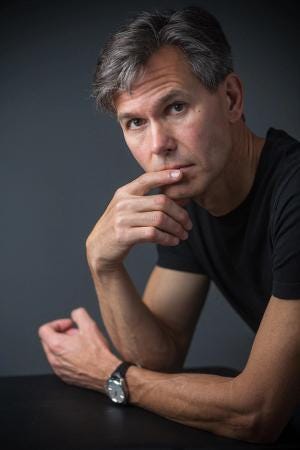
Andrew Krivak is the award-winning author of Mule Boy, The Bear and the freestanding novels of the Dardan Trilogy: The Sojourn, The Signal Flame, and Like the Appearance of Horses. He is a discussion facilitator with the Family Connections Center, New Hampshire Department of Corrections, and visiting lecturer on English at Harvard University. He lives in Somerville, Massachusetts, and Jaffrey, New Hampshire. For more information, visit www.andrewkrivak.com.
Comments
Nothing yet. Say the first thing.
Sign in to join the conversation.