
David Haynes: Let’s talk about the journey of creating this collection. It’s been a long time coming. How does it feel to finally have it out here in the world?
Nancy J. Allen: It feels like it’s been a long time coming and, also, unbelievable that it has come!
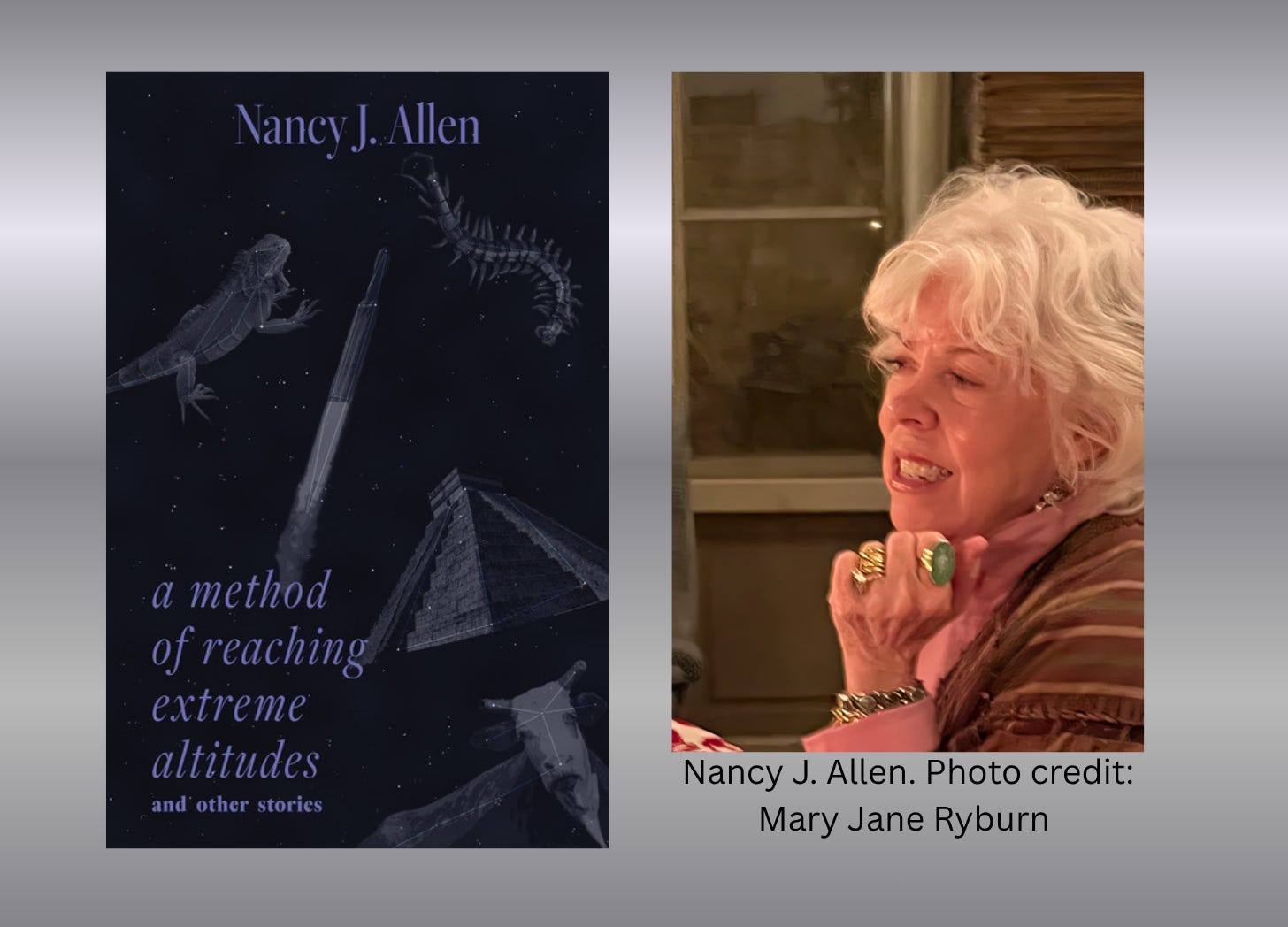
David: I remember you telling us when you came to the MFA Program for Writers at Warren Wilson College that this degree was your retirement gift, but I know you’ve always loved literature and writing. Talk about those years before the MFA and how fiction was a part of it.
Nancy: How much time do you have? It’s a long story. TV reception didn’t come to Roswell until I was twelve years old so I had many years of reading, and I wrote little stories and plays that the neighborhood children put on—always casting myself as the lead, of course. In high school and college I continued to write all the skits and I wrote many papers for my English Lit. classes, but I didn’t consider myself a writer. Writers wrote novels. I was just noodling. Then I had a baby.
Lacy wasn’t a year old when I strapped her into a contraption I put on my back and stood in line in a gym to register for Creative Writing 101 at Southern Methodist University. The professor, when I reached him, said he was sorry but there was no room, the class was already filled. Instantly I started crying, which made Lacy cry too: a telling beginning for my writing career. That baby is now 54 years old, and I am publishing my first book. Enough said.
When my girls were in elementary school, I wrote a novel in a little glassed-in cubicle on the second floor of the SMU Science Library. (The librarians let me keep my electric typewriter on the floor behind the front desk.) Somehow my novel caught the interest of an editor in New York who asked me to please revise, i.e., cut, and resubmit. I bought a Wang Word Processor (a huge investment!) and worked day and night in our garage/guesthouse. I was on fire. This was my ticket! After a couple of months of extreme work, I put my revised pages into a Wang function called Global Pagination, where you put a whole manuscript into memory and the machine formats it into pages. I was alone in the garage, it was after midnight. I was going to be a famous novelist! The next morning I discovered that though the Wang had made no outward sign of malfunction, the manuscript within it had silently exploded. I had made a backup copy on a floppy disk, but the machine had copied the damage. Everything was mishmash! I had nothing! Roger would see me sitting, crying, on the floor in various corners around the house and literally wring his hands. Wang sent out a representative but there was nothing he could do.
David: Ouch! I remember a few close calls of my own with one of those early computers, in my case borrowed from the elementary school where I taught. The power went off during a nasty thunderstorm in St. Paul, and I lost a day’s worth of edits on my first novel. To this day, I’m convinced that some of my best writing ever disappeared into the ether. Did anything from that novel reemerge in another form in other stories?
Nancy: I’ve never used anything from that novel. I don’t even know where it is—in the house somewhere. I did manage to cobble it back together and go to New York to meet “my” editor. He was very kind to me but said he couldn’t publish my book: its form was not consistent with its content. The Golden Notebook, he said, shocking me (I had copied Lessing’s structure, but never thought anyone would notice) was about serious issues: communism, colonialism, women’s rights. My book was about drugs and sex and football. His disdain was obvious. But you’re a good writer, he said. Bring me your next book.
There was no next book.
David: There is now! And let’s get into it: There’s so many things to love and admire about these stories. Let’s talk about place. Clearly, the Southwest is deeply embedded in your soul. It’s vibrant across these pages!
Nancy: Thank you. I think growing up in a barren landscape engenders a certain kind of sensitivity. I remember clearly the first time I saw a cardinal—a red bird!—it seemed like a miracle, which, of course, it is, but I wouldn’t have had that frisson of wonder had I ever seen anything other than brown sparrows. And when we drive to Taos now, I still feel that wonder: climbing up off the Llano Estacado onto the Caprock, my heart lifts—literally lifts up. Our lives aren’t unfolding against a backdrop. Our destiny is always entwined with the landscape. “If we are lucky, we find a place special to us.” I don’t know who said this but I wrote it down years ago in a notebook. I was lucky.
David: I know what you mean about those places of geological transformation. Seared into my memory is the moment I drove out of the forests of the Cascade in Washington state and into the rain shadow desert east of the mountains.
Let’s get into the stories: In your fiction, you are a great observer of the body; textures and frailties and beauty. Can you talk about how the physicality of your characters informed the creation of these stories?
Nancy: Once again, I believe this happened by chance. At Warren Wilson, I was writing in order to make the required “packet” length every three weeks. Writing, really, without thinking too much about what I was doing. No one had ever mentioned a “thesis.” When I finally heard about this graduation requirement, I was forced to look at what I’d produced as a whole. Surprise, surprise. Without knowing it—no rational mind here!—most of my stories were about older women with physical ailments. Who knew? I was only 67 when I graduated from Warren Wilson, and the real decline hadn’t yet started for me, but, clearly, my unconscious was preparing. My stories have scoliosis, lung cancer, endometriosis. I also have 200 pages of a novel about an older woman—what else?—who suffers two retinal detachments and is forced to retire after 30 years of teaching high school geometry. It’s an adventure story!
David: You render all of that with rich, sensory detail. It’s also true that while certainly shaping the journeys of these characters, the stories aren’t necessary about having a failing body. You’re telling us so much in your work about families and families in communities.
Nancy: I grew up in a time of parental “benign neglect.” Having fought WWII, our parents got on with their adult lives and left the children free to do whatever it was we did, which was both less and more than now. For example, in elementary school I could get on my bike Saturday morning and be gone all day by myself, who-knows-where, collecting bugs or rocks. But I never spent the night away from home—which meant I didn’t see how other families lived, and since Roswell had no TV, I had nothing against which to measure my life.
Parents weren’t enmeshed in their children’s lives as they are now, and I don’t think children, left to themselves, are naturally judgmental. They don’t think someone is Other unless they’ve been taught to think that. When I workshopped a version of “Running” at Aspen Summer Words, a woman told the class she had Googled Mark Howell Elementary (where several scenes in that story are set), and it actually existed. It was an ugly concrete building set on dirt. She looked at me and in front of everyone said, “How did you stand it?”
But, of course, it was my world: I loved it! I have never Googled Mark Howell because it’s as vivid to me now as it was then. I was never conscious of any social hierarchy among the girls in my Brownie troop—although of course there were.
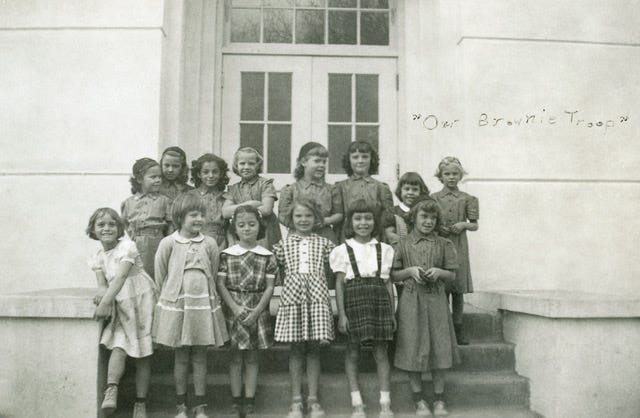
The social pressure to fit in grew as I grew. Confinement grew: outwardly, with body-deforming apparatuses, waist cinchers and girdles; inwardly, with the emphasis on “acceptable behavior.” There were no sports for girls then and no birth control. Sex was a mystery. “The wildest colts make the best horses.” Plutarch said this, but, of course, his metaphor referred to men, not women.
David: In these stories, you’re writing both about lost worlds, but also about people from those worlds who, almost seemingly by magic, wake up one day and find themselves in new and different times. Even if they aren’t trailing all the physical detritus of those lives, they can’t escape the memories, and it’s hard to leave behind all those ways of being.
Nancy: Do we ever leave behind our “ways of being?” I don’t know. I do know that stories begin with trouble. What else? They’re never about “happiness.” They’re about moments of change and often hinge on hidden things, secrets—and everyone has those in family life! I was blessed and cursed to have a life that changed completely—landscape and social standing—so I’ve always felt like an outsider, and it’s the never-quite-fitting-in that enables storytelling, I think. You know this.
David: I sure do. A significant part of my own journey has been about navigating my own many changes in place and circumstance. Certainly, one of the most compelling engines for storytelling is placing characters who have learned to operate in one world into a totally different one. That Cinderella sure was a trooper. In “real” life, though, it’s what one does with these ironies and juxtapositions that keep us reading. Your stories do a wondrous job illustrating this.
Nancy: Thank you. The world as we’ve known it is becoming more unreliable. I think reading stories about, as you say, “ironies and juxtapositions” might be one of the best ways to strengthen our hearts for the future that’s coming toward us.
David: What’s next? What about that novel?
Nancy: I think that first novel was destined for the drawer. My motivation—to escape my life—was flawed, unworthy of art-making. But I do have 200 pages of another novel, also in a drawer, that I spoke about earlier. I quit working on this novel five years ago because I wrote a scene that I literally did not know what to do with. It scared me. Faulkner said, A writer must teach himself that the basest of all things is to be afraid. I am gathering my courage and plan to start back nose-to-grindstone.
David: Courage! Your fans will be waiting.
Nancy J. Allen grew up in New Mexico and moved to Texas when she was thirteen. She is a graduate of Vanderbilt University and the Warren Wilson College Program for Writers. Her fiction has won awards in journals such as Southwest Review, StoryQuarterly, bosque, and Short Story America. A research fellow of the School of Spiritual Psychology in Santa Fe, she lives with her husband in Dallas and Taos. Find her online at www.nancyjallen.com
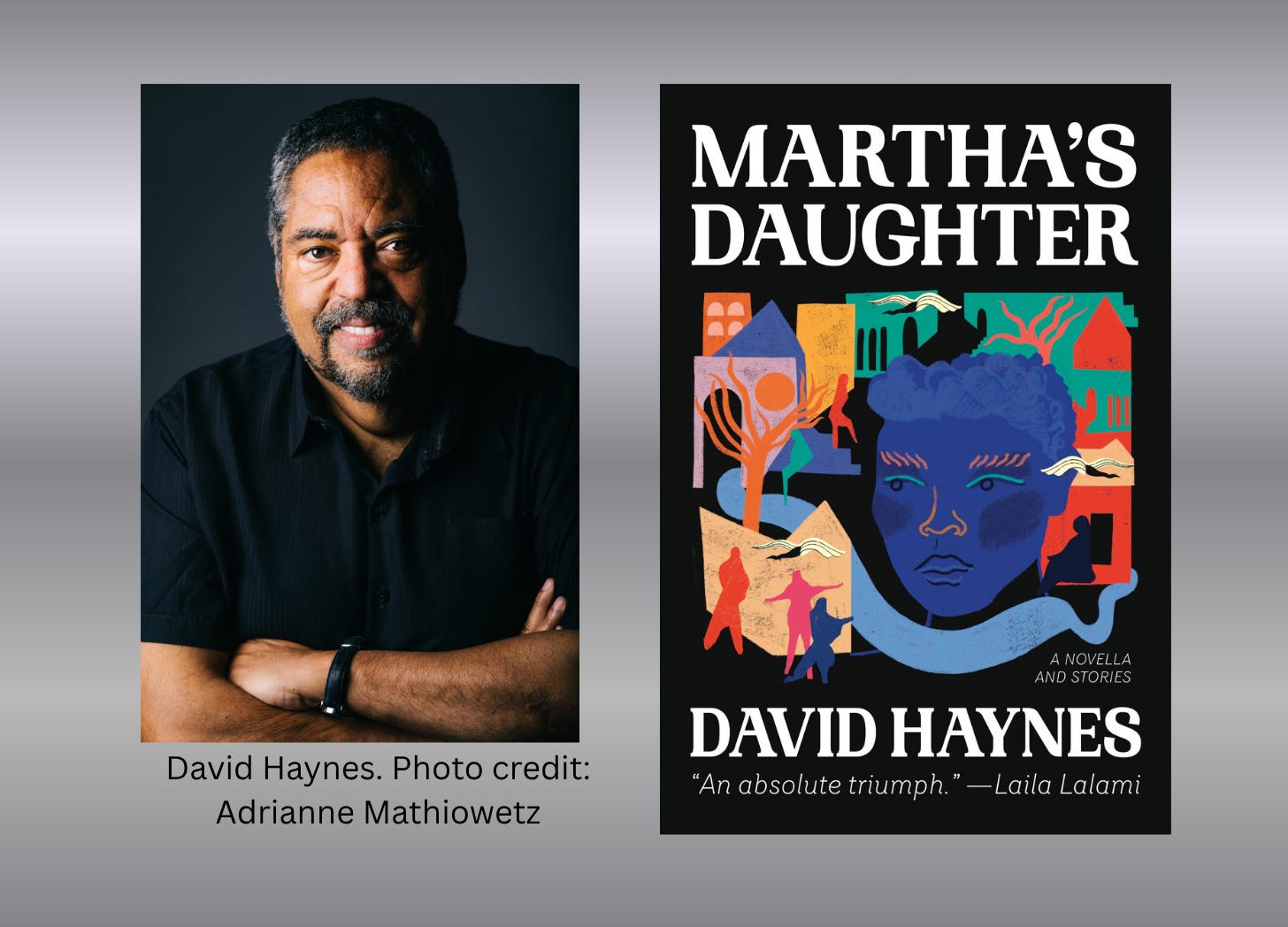
David Haynes is the author, most recently, of Martha’s Daughter: A Novella and Stories, which was named one of the top books of 2025 by Kirkus, Publishers Weekly, and Washington Independent Review of Books. He is also the author of seven novels for adults and five books for younger readers. David is an emeritus professor of English at Southern Methodist University, where he directed the creative writing program for ten years. Between 1996 and 2024, he taught regularly in the MFA Program for Writers at Warren Wilson College.
Comments
Nothing yet. Say the first thing.
Sign in to join the conversation.