
So much is happening in October! On October 20th, we celebrated our five-year anniversary! We want to take this opportunity to thank all of the amazing volunteers who make this organization such a success!
We also released our new interactive catalogue, where you can search for individual plants, or for plants with specific characteristics (height, salt tolerant, etc.) You can also find information on how to harvest these plants and our labels. Please reach out to catalogue@wildflowerseedlibrary.ca if you have any questions or find any issues with the catalogue. We really appreciate your feedback!
Over the past couple of months, we’ve hosted four seed packing events and had 159 volunteers show up to help! What an incredible turnout, we are so thankful for your support! We also gave away seeds to 152 people at our first seed giveaway event of the season, held last Saturday at Springhurst Park. We’ve got a seed giveaway event happening every Saturday from now until December 13 (listed below) - we’d love to see you at one of these events!
Finally, we hosted our Fall Virtual Doors Open on October 29th, where we provided an overview of what to expect at this fall’s giveaway events, got an intro to the sensational new native plant catalogue, and of course, were inspired to integrate more sedges! Thank you to all who participated and made this event a success!
The OWSL has several seed giveaway events coming up in November and December. Don’t miss out on this opportunity to collect native plant seeds and meet members of our community!
When: Saturday, November 1, 2025 from 1:00-3:00pm
Where: Tom Brown Arena, 141 Bayview Rd.
When: Saturday, November 8, 2025 from 1:00-3:00pm
Where: Trinity United Church, 1099 Maitland Ave.
When: Saturday, November 15, 2025 from 1:00-3:00pm
Where: Jim Durrell Rec. Centre, 1265 Walkley Rd.
When: Saturday, November 22, 2025 from 1:00-3:00pm
Where: St. Columba Anglican Church, 24 Sandridge Rd.
When: Saturday, November 29, 2025 from 1:00-3:00pm
Where: Centre communautaire, 12 rue de Picardie, Gatineau
When: Saturday, December 6, 2025 from 1:00-3:00pm
Where: Ray Friel Rec. Complex, 1585 Tenth Line Rd.
When: Saturday, December 13, 2025 from 1:00-3:00pm
Where: Tony Graham Recreation Complex, Hall A, 100 Charlie Rogers Pl.
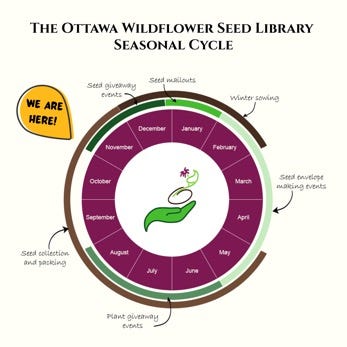
Full Moon Date: November 5, 2025
As we move into November, the air gets cooler, the leaves continue to fall, and the days get shorter and shorter as we approach the winter solstice. Starting at the beginning of this month we also see the end of Daylight Saving Time on November 2, 2025.
Daylight Saving Time, first introduced to Canada in 1918, was a way to maintain sunlight further into the evenings during the spring and summer months. In March we “spring forward” by setting our clocks ahead by one hour and in November we “fall back” by setting our clocks back an hour. So this month, don’t forget to change your clocks and enjoy an extra hour in your day!
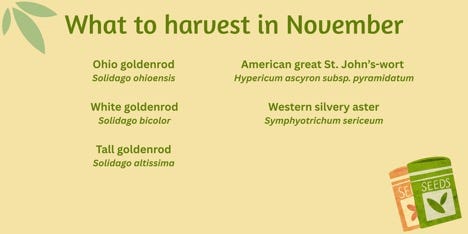
Contact us at info@wildflowerseedlibrary.ca to drop your seeds off at one of our locations in Alta Vista, Barrhaven, Nepean, Kanata and Orléans.
Spotted Jewelweed (impatiens capensis)
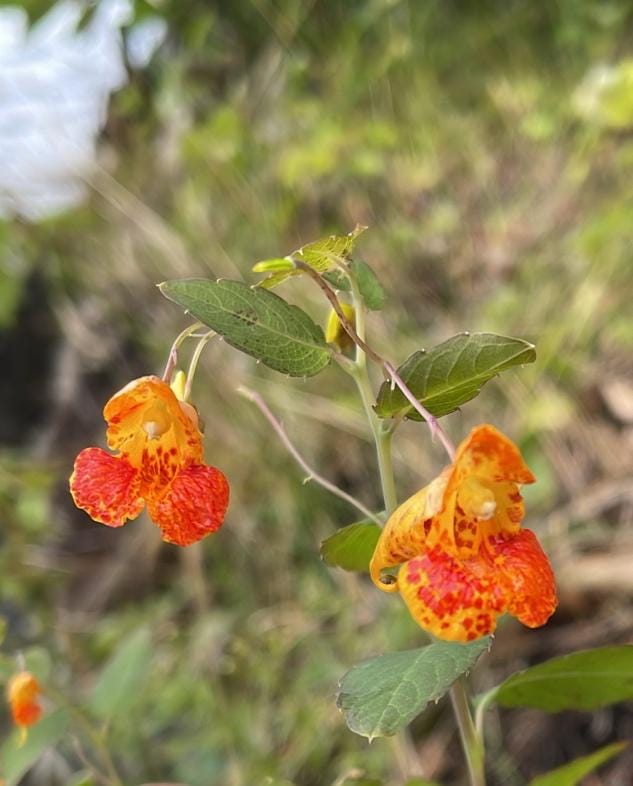
Spotted Jewelweed, also known as Spotted Touch-me-not, Orange Jewelweed and Wild Balsam, is a long blooming native plant whose vivid orange blooms add a pop of colour to the garden from as early as June all the way to the first frost. The plant has smooth, toothed, oval leaves and small flowers that appear in clusters of one to three. The flower has a tubular shape and is a bright orange with deep red-orange spots. These spots can range from sparse to densely arranged on the flower’s petals. While the sunset hues of the flowers are a lovely sight, one of the most interesting characteristics of Spotted Jewelweed are its seedpods.
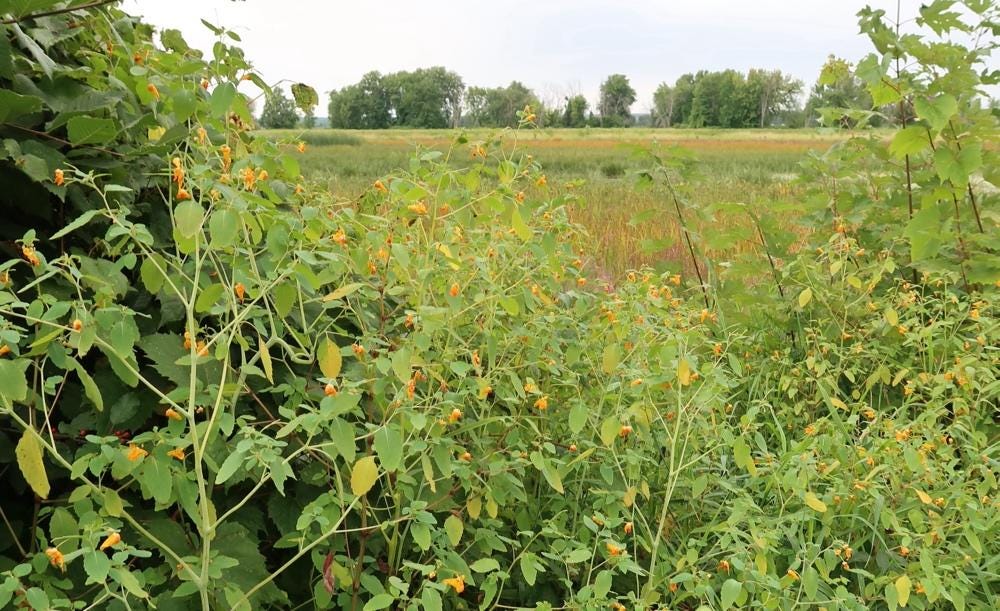
Like many plants, Spotted Jewelweed endeavors to disperse many seeds over a wide area to help ensure its seedlings have adequate room to grow. In order to achieve this, the seedpods are designed to open explosively, sending seeds out like tiny projectiles! A ripe seedpod will open at the slightest touch, which is why it is also known as “touch-me-not”. In order to successfully harvest seeds from Spotted Jewelweed (before they are flung far away!), it is recommended to place a ziplock bag over the seedpod prior to seed collection. The seeds do not take well to drying and should be sown shortly after harvest. Cold-moist stratification is often needed to ensure germination.
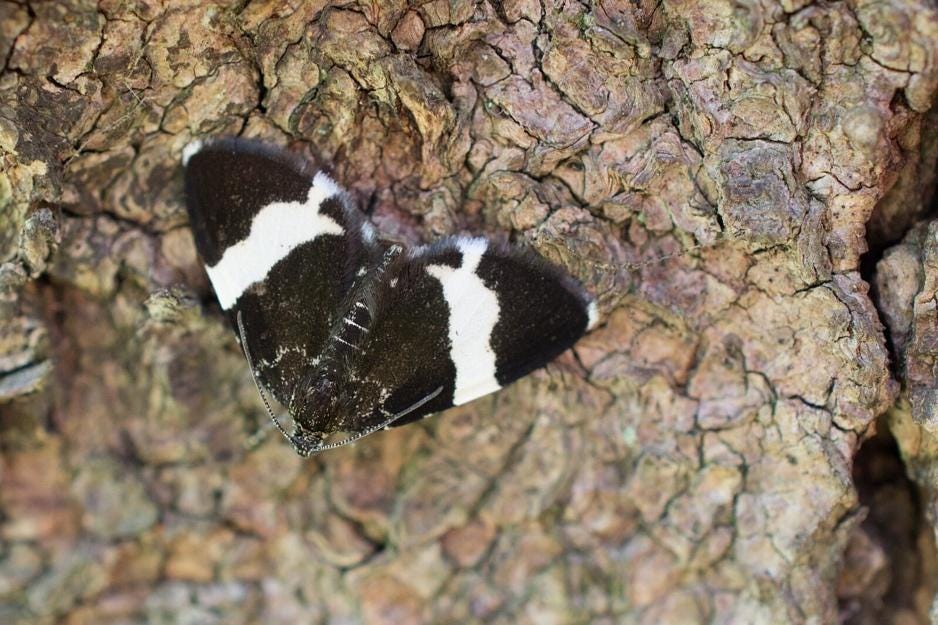
Spotted Jewelweed is attractive to a variety of pollinators, such as bees, butterflies and hummingbirds. The seeds are also a food source for birds, mice and shrews. It also acts as a host plant to moths, such as the Obtuse Euchlaena (Euchlaena obtusaria), Pink-Legged Tiger Moth (Spilosoma latipennis) and the White-Striped Black (Trichodezia albovittata).
In our last issue we looked at the importance of leaving the leaves for the pollinators and beneficial insects that overwinter in the leaf litter. This time, we’ll look at another important location within our gardens – stems! Plant stems are an important habitat for a variety of stem-nesting bees who use hollow or pithy plant stems, as well as branches, to lay their eggs. There are also several bees that hibernate within the hollow stems, using them as a cozy home over the cold winter months.
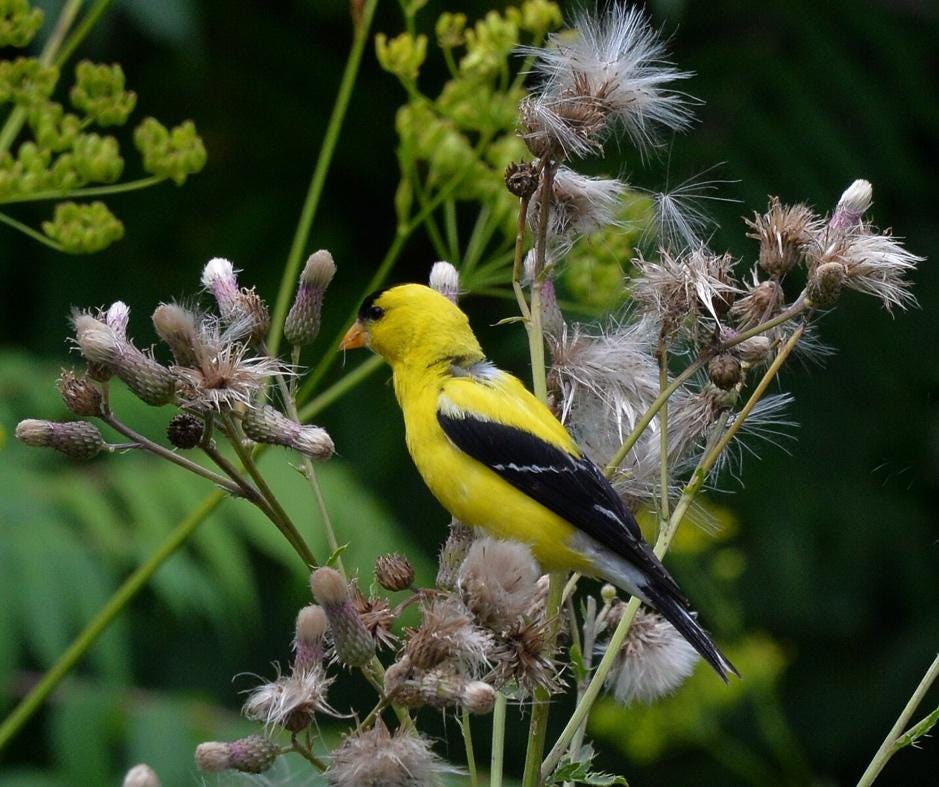
In addition to providing habitat for stem-nesting bees, plant stems and their attached seed heads are an important food source for birds throughout the fall and winter. Plants such as black eyed susans, aster, and blazing star provide nutrition to our feathered friends when other food sources may be scarce.
Lastly, an added bonus of leaving the stems of spent flowers is that they help trap fallen leaves around the base of the plant, which will act as a mulch for the plant as they decompose over the winter and spring. So while it can often be tempting to “clean up” our gardens in the fall, your local wildlife will thank you for putting the garden shears away and leaving plant stems intact over the winter season.
This month’s volunteer spotlight highlights the work of Connie Schultz:
Connie has always been a gardener. She grew up with a dad who tended to the outdoor plants and a mom who cared for those that stayed indoors. Therefore, it was no surprised that, following her retirement in 2022, Connie’s plan was to redo her sadly neglected gardens. After joining a local gardening group, she learned about the OWSL. As she began to discover the world of native plants, Connie felt like Alice falling down the rabbit hole and into Wonderland!
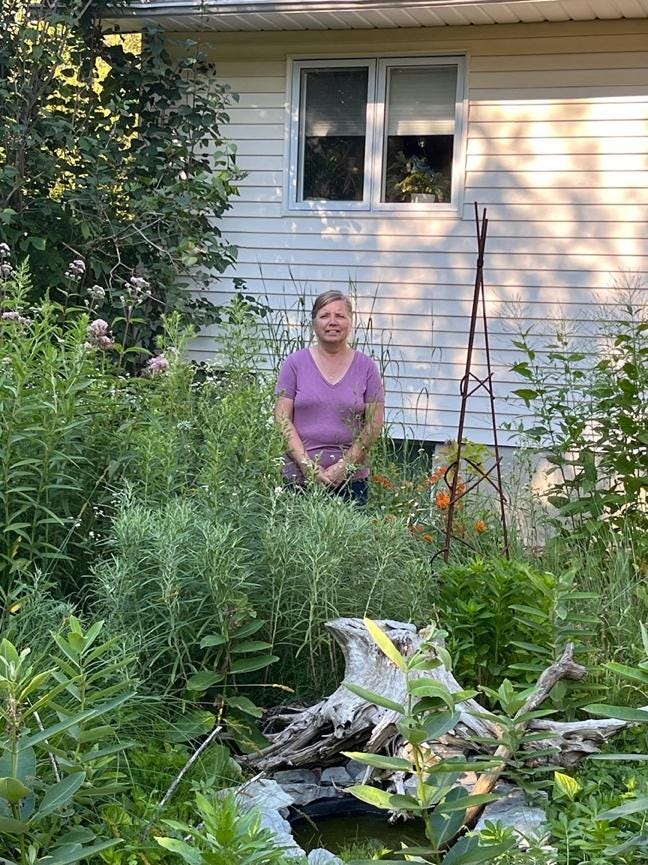
After ordering seeds from the Library in January 2023, she joined the Facebook group and shortly thereafter became a volunteer. Her volunteer work started with helping out at seed giveaways, envelope folding events, and admin. She has also helped with research for the seed harvest catalogue and giveaway events. Connie enjoys volunteering with like-minded people and learning from their knowledge and experiences. She finds the OWSL to be a supportive, positive group that works towards making a difference in the world, one seed at a time.
When asked what her favourite native plant was, Connie noted that it was difficult to choose just a single plant, but she liked challenges and unusual plants. She highlighted her recent work creating a bog garden so she could grow a show lady’s slipper orchid, as well as her recent planting of white and red baneberry. While she can’t choose a single favourite, she does try to grow plants that are more local to eastern Ontario.
Sources:
Rick Gray and Shaun Booth, The Gardener’s Guide to Native Plants of the Southern Great Lakes Region (Ontario: Firefly Books, 2024)
Mori, Angelique. “Spotted Jewelweed”, The Blazing Star: A Publication of the North American Native Plant Society. (Summer 2016, Volume 17, Issue 3), 2016. https://nanps.org/wp-content/uploads/Blazing_Star_2016Summer.pdf
University Canada West, “The History of Daylight Saving Time”, 2021. https://www.ucanwest.ca/blog/media-communication/the-history-of-daylight-saving-time
Xerces Society, “Nesting & Overwintering Habitat: For Pollinators & Other Beneficial Insects”, 2020. https://xerces.org/sites/default/files/publications/18-014.pdf
No posts
Comments
Nothing yet. Say the first thing.
Sign in to join the conversation.