
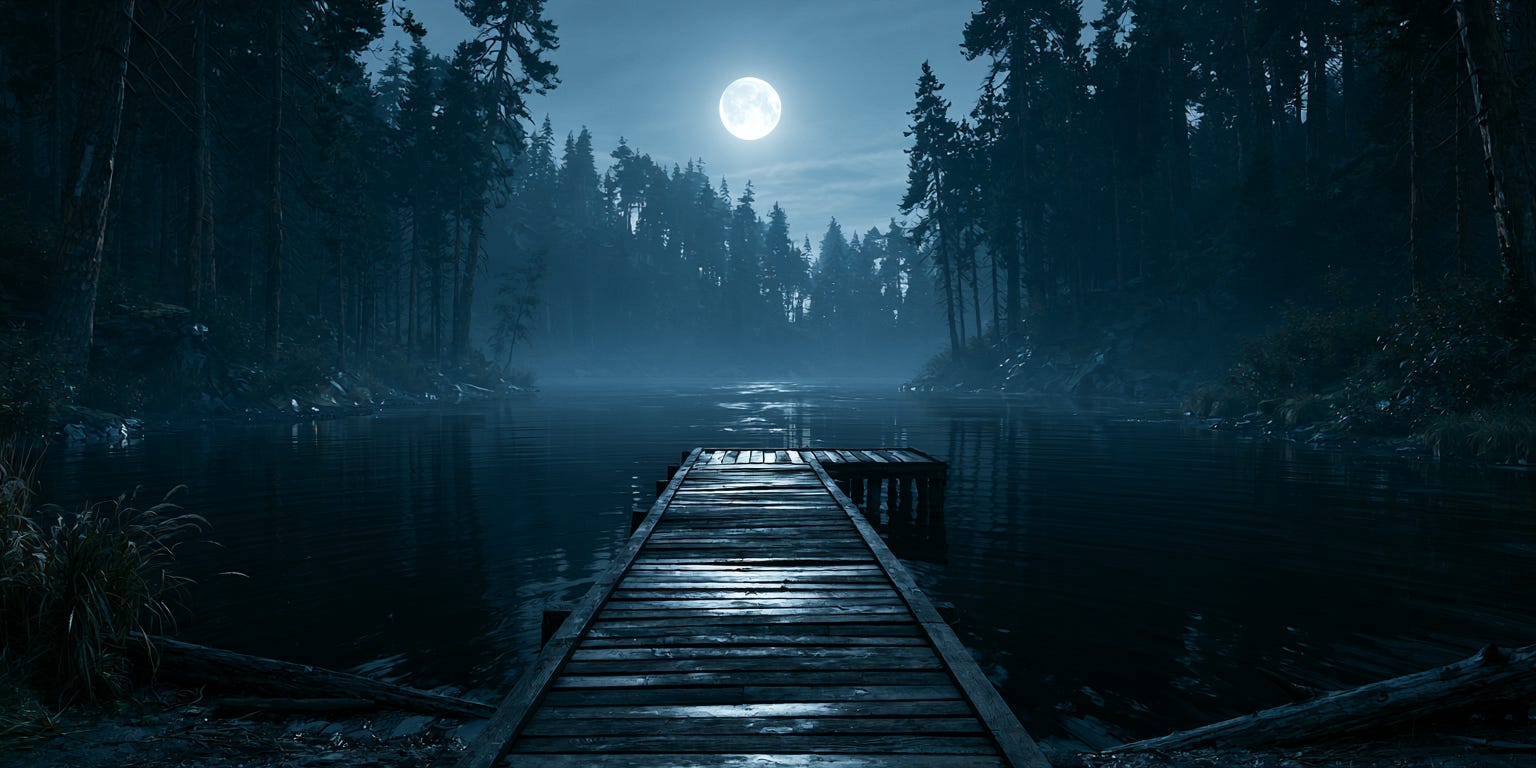
I haven’t been to Lake Withermere in thirty years, not since I was my son’s age. And after what happened there recently, I won’t be going back.
My family owns a cabin just off the lake, which makes us sound like we have more money than we actually do. In reality it’s a tiny, dilapidated shack on two acres of overgrown land no one wants. My grandfather built it sometime in the sixties, when the land cost less than five hundred bucks and the wood was practically free.
According to my father, who has since passed, my grandfather built it to get away from my grandmother. They loved each other very much but fought constantly, and back then a man’s options were either to take up a hobby or risk being poisoned by their wife. And so my grandfather found fishing, and eventually a lake to fish in. He went every weekend, and his coffee remained free of rat poison.
When my father reached ten years of age, his father, deciding it was high time his son learned how to fish, packed him in the car and took him along on his weekly trip. The drive was quiet and boring—for some reason my grandfather didn’t believe in listening to the radio in the car—but he’d fallen in love with the cabin the moment he set eyes on it. Back then it was fairly well-kept, with a soft if not moth-eaten couch, and a working fireplace bordered by two giant stacks of firewood.
The impression the cabin made on him, however, was nothing compared to the sight of Lake Withermere as he and my grandfather walked to it, rod and tackle box in hand.
The lake was hidden from any nearby neighbors or roads, and small enough to paddle cross in twenty minutes or so. Its water was dark, not black exactly but a deep grayish-green that didn’t reflect much sunlight, especially in the soft glow of early morning. Its shoreline was choked with hemlock, and bordered on all sides by a crowd of pine trees so thick, you couldn’t see more than twenty feet into the treeline. The outermost pines leaned sharply toward the water as if trying to hear its whispers.
That weekend, on a boat at the center of the lake, affected my father so deeply that thirty years later he brought me there to see it for myself.
To see it, and to fish it.
It was just a few weeks after my tenth birthday. By then the cabin was in a sad state, with warped floorboards and a sagging roof. The fireplace had long since stopped working, the chimney blocked by years of dead branches and leaves. My father never bothered to perform any upkeep in all the time it was his, even though he stayed there to fish at least once a month.
After he died, and the cabin passed to me, I did what I could to fix up the place. I replaced the roof and half the floorboards, then spent two miserable days clearing out the chimney. The cabin was more than fifty years old by that time, and the woods had a way of wearing a place down. So much wind and rain. So many prying, nesting animals. The renovations I made helped make sure the cabin wouldn’t collapse, but it was a far cry from the way it had looked when my father first saw it. Still, it had a rustic charm, a kind of old-fashioned appeal that I couldn’t wait to one day show Henry, my son.
The weekend of our fishing trip was grayer than I’d hoped, with an overcast sky that brought brief if not frequent periods of drizzle. I kissed my wife Marie goodbye, promising her I wouldn’t keep Henry out on the lake for too long at a time, and then we hopped on the highway nice and early and were soon heading north. Unlike my grandfather, I’m very much a fan of listening to music in the car, so Henry and I enjoyed my driving playlist on the drive up.
“What’s mom doing?” Henry asked just as one song ended. He’d caught me mid-thought, and it took me a second to process the question.
“What do you mean?”
“While we’re gone,” he said. “She’s by herself.”
I smiled at his concern for his mother. He’d always been a thoughtful kid, empathetic to a fault. “Are you worried about her?” I asked, and he shook his head.
“But won’t she be bored?”
“Oh, I don’t think so. Your mom loves spending time in the garden. I bet she’s at the store right now, pushing around a cart full of plants. Trust me, she’ll be fine. We need to talk about something much more serious.”
“What?” he asked, looking worried.
“Have you asked any girls out for a date yet?”
He rolled his eyes, and I laughed. The truth was, I’d been so focused on planning the fishing trip and spending some time with Henry, I hadn’t even considered what Marie would get up to all weekend with the house to herself. We’d gotten into the habit of not asking each other too many of those kinds of small questions, and it had worked out just fine until then.
By ten o’clock we reached the turnoff for the lake, though it was unmarked and I almost missed it, turning the wheel at the last second to skid onto the unpaved road. Henry turned down the music and we drove up the narrow, path, the trees on both sides so close that their needles scratched at the car doors, the road winding through the forest, neither of us saying a word. I could feel Henry’s anticipation at seeing the lake, and his excitement became my own.
Several bumpy minutes later, the road spit us out onto open ground, a wide stretch of grass and shrubbery half a mile wide. The image of the cabin in the distance never failed to stir up the old feelings of nostalgia in me, silhouetted against the pines, birds circling above, looking as secluded as one of those mountaintop monasteries you only ever see pictures of.
“There it is,” I said, smiling over at Henry. He was so excited he could barely get a word out.
I pulled the car up to the side of the cabin in front of the rowboat and trailer. The two of us jumped out and grabbed our bags and gear from the back, bringing it all inside. I was happy to find the door shut, the lock still locked, and all the windows unbroken. There hadn’t been any break-ins yet, not that I was aware of, but you hear about these things.
As I set the bags down against the far wall, I heard the telltale squeak of couch springs and spun around, finding Henry sitting on the couch facing the fireplace, taking everything in.
“Careful there,” I blurted, just a touch too loud. Henry jumped up and turned with a scared look on his face. “It might be dirty,” I explained. “Sometimes animals get in.”
“Like bears?”
I chuckled. “Much smaller. Like mice.”
Once we’d gotten settled and had a little something to eat, we grabbed the fishing gear and headed outside to check on the rowboat. It was still in good shape, waiting patiently on its dolly trailer up against the side of the cabin. We threw the gear in, then hitched the trailer to the back of the car and hopped in.
Withermere Lake. There was something special about it, a feeling you got standing on its banks and looking out across its dark waters, not a single other soul in sight. That it was so unknown, so ignored or avoided by the locals made it that much more of a hidden jewel. The surface prickled with raindrops that could just as easily been fish coming up to suck down the tiny bugs gliding across.
Henry and I stood on the boat launch next to the dock, a simple dirt grade that descended into the water, the boat unloaded from its trailer and bobbing in the water next to the dock.
Henry looked up at me, all teeth. “C’mon,” I said, returning the smile.
The dock was twenty feet of gray wood that had gone soft at the edges. The wooden railings were missing from one side, long since broken and drifted away. It had a single mooring post, metal, rusted. When the lake was still, you could see the posts well below the dock pilings, covered in swaying green and black algae.
We climbed into the rowboat and pushed off.
Once we’d found a decent spot—my favorite was a deeper spot near several fallen trees—I showed Henry everything I knew about fishing; how to bait a hook; how to hold the rod; the correct flick of the wrist to get some proper distance without tangling the line; how to read the water. I wasn’t as skilled as my father or grandfather had been, but I’d caught a few in my time, and I reveled in the chance to share what knowledge I had with my son.
The most important lesson I’d brought him to the lake to learn, however, was patience. Patience was the thing I’d taken most from fishing. I’ve always had a restlessness about me, a resistance to standing in one place for too long. The longer I stayed still, accepted what I had, the harder it became for me to remain satisfied with my lot. It was a quality I’d inherited from my father, and he from his. So I taught Henry. I taught him about not casting constantly. About letting the water calm between casts. About reeling in steady, using consistent rhythm, keeping tension on the line so it didn’t go slack.
Time passed like this, the two of us in the rowboat, hovering on a plane of glass as the sun dipped in and out of hiding, with the breeze nudging us along. I must have dozed off, because suddenly I was opening my eyes feeling like I was bathing in syrup, and the sun wasn’t where I’d left it. A brief moment of fear passed through me as I realized I’d dropped my guard and taken my eyes off my ten-year-old boy in the middle of a lake, where he could have easily fallen in, the disapproving face of my wife passing through me. I sat up quickly, turning to check on Henry and make sure he was safe. But the image I found was a confusing one.
Henry was leaned over the side of the boat, his small head craned, staring intently down into the lake. His scrawny body perfectly still.
“What’s going on, bud?” I asked, hoping he was just deeply engaged in the activity, scanning the lake for fish to catch.
“There’s something down there,” he replied, with the curious certainty of a child.
“Oh, wow. You see a fish?”
He shook his head, never taking his eyes from the waters below, and said, “It’s looking at me.”
Henry had always had an active imagination, building elaborate stories for his action figures when he was very small, later drawing his own miniature comic books, featuring characters he’d himself created. But he’d never, as far as I could tell, used his imagination to lie to either me or his mother. If he told us something it was because it was true, or at least he very much believed it to be.
So when Henry said he saw something under the boat, something that was looking at him, a part of me went cold. A place like a memory, buried deep.
“Get to the middle,” I said, using my serious voice on him. It worked, breaking the trance he seemed to be in. He shifted to the center, glancing at me with a kind of guilty look, like he’d been caught breaking the rules. Then I carefully moved to other side of the rowboat, making sure not to rock it or tip it in any way.
I’m not sure what I expected to see when I peeked over the side. I think the rational side of me thought it would be nothing more than a fish with unusual markings, the way carp or koi can appear to have human faces when seen from afar. The less rational side, the side steeped in old fear, might have thought someone, a local perhaps, had seen our boat drifting out on the lake and decided to screw with us. Swam out under the boat and made just enough movement beneath the surface to attract our attention. But with each second that passed, the chances of someone being able to hold their breath long enough to pull off a move like that became less and less likely.
I was ready in some way to find either of these sights in the lake, beneath the surface. Not truly prepared, not in any real sense, but at least they would mean that Henry wasn’t lying to me or allowing his imagination, his fear, to see things that weren’t there. So it was with an unusual feeling of disappointment that I found nothing in the water beneath our little rowboat. Just a few ripples on the surface, and beneath them, the slightest hint of disturbed dirt from the lakebed.
Henry stared at me like he was in trouble and awaiting his punishment. “I don’t think they’re biting today,” I said. “What do you say we head back?”
Later, after we’d tied the boat up at the dock and driven back to the cabin, I built a fire in the fireplace and heated up two cans of beef stew. As night fell, we sat on two chairs outside and ate our stew. I told Henry stories about his grandfather, a man he’d never met but heard so many legends surrounding, and my thoughts flashed back to my father and I, sitting in that same spot, as he told me of the things my grandfather had done. A man I’d never met, yet felt a connection to, the same way I hoped Henry felt for his grandfather.
Soon, Henry grew tired, his face growing longer, eyes heavy, so I rolled out his sleeping bag behind the couch, a safe distance from the crackling fire, and he crawled in. Before I could say goodnight to him, he was out. I smiled down at him, feeling good about our day on the lake, despite the fact that we hadn’t caught anything, and the bit of strangeness with Henry seeing something under the water that obviously hadn’t been there.
I eyed the couch, deciding whether or not I wanted to risk laying down on the old thing, and chose instead to go for a walk outside. It was still early yet, and the night was calling to me. Henry has always been a strong sleeper, and once he was down he rarely woke up again, even in unfamiliar surroundings.
The temperature outside had dropped since our dinner on the porch. The crickets were screaming, the owls asking their usual questions. Back home I could count the number of stars on two hands, but out in the woods, away from people and their busy machines, it would take a thing with far more hands to tally all the blinking points of light overhead. The sight was intoxicating, as was the feel of dirt and grass underfoot, and before I realized which direction I’d been walking instinctively, like muscle memory, I found myself by the side of Lake Withermere, its waters gently lapping against the shore.
I walked onto the dock, passing by our boat which was still safely moored to its metal post, until I reached the far end. The lake was deathly still before me. I felt drawn in by it, by its calm, black surface, like a sheet of volcanic glass stretching out further than I could see, even under the yellow light of a massive moon. And as I stared out into the darkness, beneath the sound of the breeze moving across the open space, I heard the sudden rippling of water, as if something had disturbed the surface of the lake.
It sounded large, and close, and yet the darkness around me, combined with the sound of the wind and the crickets and all the other living things that came out in the night, made the location of the noise hard to pin down. I strained to listen. To hear the telltale sloshing; the rapid displacement of water that meant something was surfacing.
The water noises came again, and this time I understood why it had sounded so close the first time—it was coming from directly under the dock.
Right beneath my feet.
Moving nothing but my head, I glanced down through the spaces between the wooden planks to see if I could catch sight of whatever it was moving through the water below. But there was nothing there, nothing but the shadow of the dock playing across the surface.
Then, I spotted it: something large and slow, moving just under the still surface. Floating through the water like a dark spot in the vision, then stopping directly below my feet. It held there, hovering in place face up. I can’t tell you how I knew it was facing me, other than to say I could feel it looking at me with every cell in my body, every fiber of my being. There were no eyes, and yet I felt them on me all the same, staring not just at me but into me, as if I were left open; a book laid bare, that it could read at a glance and understand every aspect of me, even the parts I kept hidden and told no one. Even if I could move, I wouldn’t have.
A noise came from behind me, the hard, sharp impact of something landing on the dock. I jumped, broken from the trance, and spun around to see. A dark object sat on the dock a few feet from me. It was round and small, only a few inches wide. I looked toward the shore, to see if anyone had thrown it at me, but found the same empty stretch of land I’d stepped from minutes earlier.
Not forgetting the shadowy shape beneath the dock, I turned back to make sure it hadn’t come any closer, or begun to climb the wooden structure, my mind filling in the thousand tiny details from creatures I’d seen in movies since I was Henry’s age, so many watery monsters trudging up from the depths to find their screaming prey.
But it was gone. The shadows below belonged only to the dock I stood on. The waters were calm, leaving me to wonder if I’d seen anything in the first place, or had simply been the victim of my own imagination, spurred on by Henry’s odd behavior earlier in the day. Either way, the empty water underfoot sent a shiver through me, and I decided not to stick around any longer.
Before I left, I bent down and took a closer look at the object that had fallen onto the dock. It was a rock, round and smooth. With hesitation I reached out and touched it, finding it to be solid. So I picked it up. It was cold, colder than it should have been, a chill that moved into the meat of my palm. I checked for writing, markings, anything that would discern it from a regular stone, but found nothing. For reasons I didn’t understand, I slipped the rock into my pocket. I told myself it was to get a better look at it in the light and safety of the cabin, but that wasn’t quite it. It was more of a possessive feeling. My burden to hold.
I felt the weight of it hit the bottom of my pocket and come to rest against my leg, the cold seeping into my skin, into the muscle, and then, as I turned back toward the cabin to start the short walk back, a sharp light stabbed at my eyes. I lurched back, as if I’d been punched in the face, and felt resistance on the back of my head, and on my legs and back. My hands came up to shield my face and I noticed for the first time that I was somehow horizontal, lying down.
I was on my back, lying on the couch back in the cabin. A beam of sunlight piercing the window. I looked around, thinking I must have been drugged or otherwise tricked, but my head was clear, the cabin’s door closed and locked.
Nothing made sense. My walk to the lake, the rock I’d found—had it been a dream? I didn’t remember coming back to the cabin, and I certainly didn’t remember lying on the couch and going to sleep. And yet, clearly, I had. There was a missing gap in my memory of at least fifteen minutes, something I’d have to take up with my doctor, maybe ask for a referral to a neurologist. In the meantime there was no point in dwelling on it, and nothing that would change the past. If Henry and I got dressed and ate a quick breakfast, we would have time for one last outing on the lake before we had to pack up and head home. But when I stood up, my stomach knotted at the sight in front of me.
On the floor, behind the couch, was an empty sleeping bag.
After checking the bathroom and finding it empty, I ripped the front door open and ran outside, scanning the field for signs of him. It was still early, the sun just peeking through the trees, birds starting to wake up and sing their mocking songs, making fun of me for dropping my guard and losing my boy. I could only pray Henry hadn’t wandered into the woods. The cabin was surrounded by miles of unbroken wilderness on all sides. A fair amount of hikers had gone missing in the area, with not all of them being found—at least not in time.
I squinted, looking across the field toward Lake Withermere. The horrible image of Henry floating face-down in the water stamped itself into my mind. Eyes unfocused. Mouth open for tiny fish to explore. But then I spotted a shape; a small figure, standing on the far end of the dock.
“Henry!” I called out as I ran across the field, moving as fast as I could over uneven ground, shoes whipping through the long grass, tripping over small mounds and divots. I continued to shout my son’s name but either he didn’t hear me or he was ignoring me. It felt like it took forever to cross the expanse between the cabin and the lake, but finally I reached the dock, barely slowing my pace as I ran onto the dock and down the length of it, stopping myself short of plowing into Henry and knocking him into the water.
When I reached him, he was standing not far from the spot I’d stood in my dream, staring down into the lake. “Hey,” I said, shaking his shoulder. He blinked, then slowly looked up at me. “What are you doing out here?”
He said nothing, just shrugged. I wanted to press him further, make him tell me what had possessed him to leave the cabin without asking and walk all the way over there. But as usual, I could see he was telling the truth. Henry didn’t lie. Not to me. If he said he didn’t know, he meant it.
“Come on,” I said, leading him by the arm. “Let’s go home.”
It didn’t take long for us to pack our things. Henry was quiet but otherwise acting like himself, and even helped me to make sure the fireplace was fully extinguished as to not burn the place down. I moved quickly, not even bothering to go back to the lake and pull the rowboat out of the water. I resolved to return the next weekend and properly put it back into storage, at least until I’d worked up the nerve to go out on the lake again following the strange events of our trip.
I had no way of knowing that the strangest was yet to come.
I put the cabin in the rearview mirror and drove the unpaved path leading back toward civilization. All the excitement of the drive up had been drained from us, leaving me with the desire to get the boy to his mother and myself to a tall glass of whiskey. Even the high, green wall of trees surrounding the path felt different this time. Dark monoliths, standing guard.
Eventually we exited the dirt path and I turned onto the main road, heading south. The air became immediately lighter, as if a boot had been pressed down onto our chests and was finally lifted. Henry and I exchanged a glance as if to acknowledge the feeling.
“Can we listen to music?” he asked. It was the first thing he’d said of note all morning, aside from the simple yes-or-no reply to a question. I smiled, happy to see his spirits hadn’t been dampened.
“Whatever you want, bud.” He turned on our driving playlist, heavy on the classic rock I’d grown up hearing all the time, at home, in my father’s car. Henry enjoyed it as well, possibly more than I did, which once again reminded me of all the ways he reminded me of dad.
I settled into the drive, more than happy to put the somewhat failed fishing trip behind us. It was a negative way of looking at things. I’d spent time with my boy, floating on a quiet lake, teaching him how to fish, telling him stories, eating our dinner on the porch among the sounds of nature. We’d made a few memories, the kind he would one day relate to his own son when he was asked what I was like.
Some time into the drive, Henry’s small head slumped forward. He’d fallen fast asleep. I reached over and gently pushed his head back so it could rest in the crook of his seat, then got back to driving, prepared to do finish the rest of the drive without any conversation to keep me entertained.
As my mind replayed the events of the previous day, as well as that morning—though they felt like one long day to me—some of the details felt oddly familiar, as if I’d lived some version of them before. Memories of my father, my father’s memories of his father, or maybe just the stories he’d told me, feeling as real as if I’d lived them, words becoming solid, thoughts concrete. Suddenly I felt trapped, the sense of great gears turning all around me, their teeth so large I was in danger of being crushed between them.
I flinched at the blare of a semi-truck roaring past my window, the sound jolting me out of a daydream. The steering wheel slipped from my hands and I grabbed it, the car zigzagging, heart pounding like thunder. A nervous laugh escaped me once I got the car under control. What a ridiculous way it would be to go.
Aside from scaring me, the moment with the truck had managed to shake me back into my body, and I became aware of a sound inside the car and under the music. It was a strange voice, low and deep, and it took me a few seconds to locate the source.
Henry was talking in his sleep. This on its own would have been inconsequential, nothing more than a story to tell his mother, maybe lightly tease him about. But this was no ordinary sleep talk. He was speaking in a voice that wasn’t his, that was nowhere near his usual vocal register, in a manner of speaking that wasn’t like anything I’d ever heard from him or anyone else. A peculiar flow of words like a faucet left running. I turned down the radio so I could hear what he was saying.
“…Will be like he, as he was like other. You put all worth on mate and offspring but body will betray you as you seek worth of flesh.”
The most unnerving thing about it was the way his whole face didn’t move as he spoke, only the lips. There was no motion in his cheeks, his nose, his eyes. No sign that his mouth was moving other than the mouth itself.
“Father did. Father of father did. You will do. Lake keeps. Lake remembers flesh. Flesh brings flesh. You bring boy like them. Three of you now, three before, three before that. Stone knows. Stone counts, counts like your son. Your son’s eyes see what you cannot see. Soon he will do as you do. As your father did. As his father did before him. Lake is patient and lake is old. Lake remembers when there was only forest, and will remember when there is only lake.”
I checked my mirrors and pulled the car over to the shoulder. Then I undid my seatbelt and leaned over.
“Hey. Wake up,” I said, shaking Henry by the shoulder. “You’re having a bad dream.”
“Not dreaming. Seeing. Your son sees you. Sees your lies. How you seek worth of flesh from others, like father did, like father of father did, secret carnival of flesh and-”
“Stop it!” I shouted. I shook him harder, wanting to slap him but stopping myself.
“Men are brief and forgetting, bred hollow without worth with need to lie to themselves and other, pretending they choose paths when paths choose them, to believe desires are own when desire is only hunger wearing man’s skin.” Louder and louder the voice spoke through him, deeper and deeper, until the words were deafening inside the car. “You will lie to Henry as your father lied to you and his father lied to him, each of you pretending cabin is just wood and stone, a way to pass time, and all along it is a mouth and you are food, man after man, father and son and son’s son, three men drowning, different years but same water, same dark water that knows your names before you are born and will know them long after you are dust, as you seek ”
He wouldn’t stop. I didn’t know what to do, how to help him, if I should call for help or do something more drastic to snap him out of the delirious state he’d entered into and which was only escalating by the minute. I’d never hit my boy. Not really. But in my desperation, I might have shaken him a bit roughly, applied just a little too much pressure to his arm. All I wanted was my sweet son back, not this lying creature in front of me, accusing me of actions I’d never done, things everyone thinks about even if they don’t admit they do.
“Men deceive. Men return to cabin. Men delight in strange flesh and deceive again, but lake keeps memory.”
In the middle of all this, a thought came to me, like lightning to a tree. As he continued to spout terrible things, lies about himself and me and my father and my grandfather, I pulled him forward in his seat and searched his pockets, first his left, then, when that was empty, leaned over and searched the right.
My fingers brushed against something cold. I stopped breathing, pulling the small object out to see for myself.
It was the rock, the one from my dream, if it had ever been a dream. Henry must have found it on the dock that morning and picked it up, must have hidden it from me. It was probably why he’d gone out to the lake in the first place, hearing its call and answering it, letting it poison his innocent mind. Now, without it pressing into hi leg, Henry had fallen quiet, looking to be sleeping peacefully in the passenger seat.
Without thinking about it, I rolled down my window and threw the rock as far as I could into the field next to the road, watching it disappear into the long, unkempt grass. Once I was sure it was gone, I turned my attention back to Henry, giving him a soft shake until his eyelids began to flutter, then open.
“What happened?” he asked, his voice his own again.
“You fell asleep.” He looked around, confused, probably wondering why I’d stopped by the side of the road just to wake him up. “You were having a bad dream,” I explained.
He nodded, looking like he could almost recollect it, like it was a sentence on the tip of his tongue, and all he needed to do was remember the first word for the rest to come rushing back.
The rest of the drive home was quiet. As soon as we walked in the door, Marie asked about the bruises on Henry’s arm, and one on his face that I couldn’t explain. I told her about his bad dream, a night terror, and how difficult it had been to wake Henry from it. She didn’t believe me, can you imagine that? But no matter how much she questioned Henry, demanded he tell her the truth, all the boy could remember was something about being underwater, and the next moment sitting in the passenger seat of the car with me yelling and shaking him. Eventually she dropped the subject, but I can’t say she’s looked at me the same way since.
I said before that I wouldn’t be going back to Lake Withermere, and I wish that was true. I wish I could say I hadn’t driven back the very next weekend, telling myself it was to put the boat in storage but stopping by the side of the road where I’d pulled to the side a week earlier, kicking through weeds, getting down on my knees to search the tall grass, desperate hours spent in the hot sun until my fingers brushed against something cold. Grabbing it up, holding it tight with both hands to feel the cold, to hear the voice speaking about my father, and my father’s father, about what they had done in the cabin and what I was going to do. Driving the rest of the way to the lake with it weighing down my pocket. Walking out onto the dock and throwing it out, out into the water where it belonged, where it could listen and see and remember in all the ways I wouldn’t, the same as Henry, who would come back to the cabin one day and tell his son how much fun it had once been, while he planned returns of his own.
Away from the questions.
Away from the eyes.
Telegrams from Bloodstream City is a reader-supported publication. To receive new posts and support my work, consider becoming a free or paid subscriber.
Comments
Nothing yet. Say the first thing.
Sign in to join the conversation.