
Barry Maher has lived the kind of life most writers would have to make up. Before becoming a horror novelist, he spent his misspent youth churning out articles for dozens, maybe hundreds of publications, working an equally dizzying number of odd jobs, and at one point literally living on the beach. Not in a house by the beach—on the sand, with the seagulls.
Eventually, he traded the surf for suits, working for a Fortune 100 company before launching a long career as a professional speaker. His storytelling took him across the globe and onto shows like The Today Show, NBC Nightly News, CNN, and CBS, not to mention a nationally syndicated newspaper column titled Slightly Off-Kilter.
Then came the plot twist. After surviving a baseball-sized brain tumor that nearly killed him—and stole his sense of time—Maher woke up with a new story to tell. The result was The Great Dick: And the Dysfunctional Demon, a darkly funny, supernatural thriller set in 1982 California that’s been praised as “witty, literate, scary, sexy,” and “wholly original.”
Here he is, answering my Five W’s.
Who is an artist you look up to?
If we’re talking about an artist like a painter or sculptor, my answer would be Van Gogh. If we’re using “artist” in a broader sense, covering any type of art, then my answer would be Van Gogh. The Great Dick: And the Dysfunctional Demon may be the only one of my books that doesn’t mention him.
Currently, Van Gogh’s reputation suffers from the “nobody likes him, he’s too popular” syndrome. If the man or woman in the street loves Van Gogh almost as much as they love Thomas Kinkade, some self-appointed experts think they have to disagree. But that print of Starry Night hanging over the mantel beside a velveteen painting of dogs playing poker simply says that Van Gogh is so great that everyone can appreciate him. Like Ice cream. Or the Beatles. Or sex. Almost anyone. There’s nothing that everyone likes. Not even sex.
Van Gogh’s determination was even more astonishing than his talent. Nothing could stop him from painting. Not poverty or isolation or ridicule. Not a virtually complete lack of acceptance. Not even mental illness. He kept painting, always trying to improve. Creating works of astonishing genius that the world around him considered trash. Right up until his brain finally betrayed him—long after most of us would have given up and gone into real estate.

What is your day like?
I’m not as obsessive—or dedicated—as Van Gogh. Still, my average day is writing. I wake up, have breakfast, then I sit my butt down in my easy chair and open my laptop. I write looking out over Santa Barbara and the beach that was once the only bedroom I could afford. (I’ve been very lucky.) I write until lunch. After lunch I write until dinner. After dinner I enjoy what other people have written.
Where are you headed next?
Not Barcelona. I turned down a speaking gig this morning on a cruise from Miami to Barcelona. I hated to do it. But I’m tied up right now trying to get the word out on The Great Dick: And the Dysfunctional Demon. That means podcasts, radio & TV, lots of internet and anything else I can do to get people to notice the book. Nowadays promotion is part of being a writer.
I try not to be too obnoxious about it. Did I mention the title is The Great Dick: And the Dysfunctional Demon? I certainly wouldn’t claim that it’s the greatest book ever written. But if someone said it was “one of the greatest books ever written” who am I to argue? Now if I could just get someone to say that.
When did you start on this path?
This particular path started in Asia. I was speaking on a cruise when I realized I could no longer figure out what the hands of the clock meant. The next day, during a session, I introduced the ship’s captain. Twenty minutes later I picked him out of the audience and asked him what he did for a living. (The uniform did look a tad familiar.) That same day, I gave up trying to understand foreign currency. Even American money was getting tricky. In Viet Nam, I handed a vendor two hundreds and a ten for a $7.00 baseball cap. It was a very nice cap.
Back home, the first thing my doctor did was have me draw a clock face at ten minutes to three. The second thing he did was take away my driver’s license. Then he sent me for an immediate MRI. The nurse there wouldn’t comment on the results, but when I asked where the restroom was, she said, “I can’t let you go in there alone.”
I explained that bathroom visitation was a particular expertise of mine.
“Like telling time?” she asked. “You need to talk to your neurosurgeon.”
“I have a neurosurgeon?” Just what I always wanted.
I also had a brain tumor—the size of a basketball. Or maybe the neurosurgeon said “baseball.” I wasn’t tracking too well at that point. Still, I quickly grasped he was planning on carving open my skull with a power saw.
“I don’t really need to tell time,” I said. “Or I can just buy a digital watch.”
Everyone said my neurosurgeon—or, as I thought of him, “Chainsaw Charlie”—was brilliant. My problem was that I’ve spent my life around intelligent people, and I’ve always believed human intelligence was overrated. To me, on a scale of everything there is to know in the universe, the main difference between Einstein and Koko the Wonder Chimp was that Einstein couldn’t pick up bananas with his feet. (As far as I know.)
Still, I went under the knife—or in this case, the power saw. Maybe I had a seizure. The doctors weren’t sure. That might explain what happened. Because I came out of the surgery with Lady Gaga singing in a loop in my head and an unforgettably vivid story, like a memory of something that I’d just witnessed.
Reacting to the power saw inversion, I suppose my brain could have given me a dream or a story, maybe even Citizen Kane or a nice rom/com or a few episodes of Seinfeld. Instead I got open crypts, bizarre spells, sudden death and the Ralph Lauren version of the Manson Family.
“How did my operation go? Well, I’m doing okay, but the people in my head—or wherever they were—they went through Hell.”
Lady Gaga went away after a day or so. But the story stayed with me. And when I was able, I spent a couple of years writing it all down, working it out, trying to get it just right. And that became The Great Dick: And the Dysfunctional Demon.
And with the cancer in remission, I’ve even lived to see the book published.
Why do you keep going?
I love what I do. When I first started trying to write for a living, it was extremely difficult. I set myself a goal of writing four hours a day. And I’d keep track of every minute I spent writing. Thirty-seven minutes or four or thirteen, until it added up to four hours. It was grueling. Plus, I was working on an electric typewriter. I used bottle after bottle of White-Out, so I wouldn’t have to completely re-type the page every time I made changes. Half the time I was groggy from the fumes.
According to Google, who knows everything, inhaling White-Out fumes “is extremely dangerous . . . Even a single, concentrated inhalation can be fatal, a phenomenon known as ‘sudden sniffing death.’”.
Fortunately, I didn’t die. Though come to think of it, years later I did come up with a giant brain tumor.
And, fortunately, sometime over the years, everything changed. Maybe it was getting to write on a computer, so I could revise and rewrite with no threat of sudden sniffing death. But nowadays I keep going because there’s nothing I would rather do than write: Whether I’m working on one of my syndicated Slightly Off-Kilter columns or the follow up to The Great Dick: And the Dysfunctional Demon I write far more than four hours a day and the hours fly by. It’s my job and my hobby and I love it. I doubt poor Van Gogh was ever this lucky.
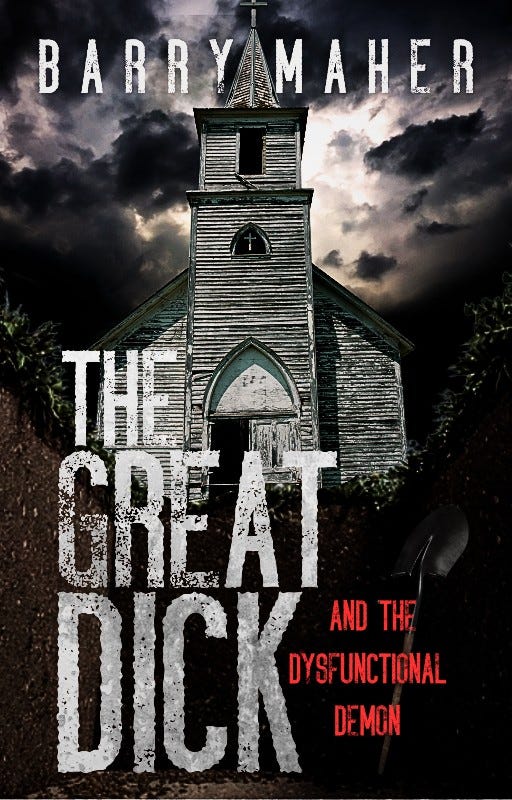
The Great Dick: And the Dysfunctional Demon
“What a page turner! Witty, literate, scary, sexy, and powerfully evocative.”—Gayle Lynds, New York Times bestselling author
It’s 1982. Steve Witowski, a failed songwriter on the run from the law, finds himself caught in a supernatural thriller after an apparently innocent act of heroism—saving a woman from a vicious assault by a seemingly unstoppable wino. The woman, Victoria, is just part of a mystery Steve can’t unravel. Even as he’s looting the decomposing dead for the secrets of a self-proclaimed sorcerer. Even as he plummets into a nightmare of fire and blood and murder. Even then, Steve remains certain the sorcerer’s spells, the occult rituals—the supposed demons and supernatural horror—are simply delusion and fantasy. Steve is wrong.
Victoria, who has just bought a dilapidated church with a haunting past, entangles Steve in a deadly game of dark magic and rituals. As,unknown to him, the demon grows desperate, Steve plunges deeper into a world of crypts, grave robbing, and long-forgotten secrets, all while trying to escape his own haunted past. But when the face of the man Steve killed appears on his arm, the line between reality and nightmare begins to blur.
This supernatural novel will leave you on the edge of your seat, with wickedly funny dark humor and, ultimately, pulse-pounding suspense, as Steve and Victoria navigate a twisted adventure full of occult horror, supernatural suspense, and shocking revelations.
Available now on Amazon
Telegrams from Bloodstream City is a reader-supported publication. To receive new posts and support my work, consider becoming a free or paid subscriber.
Comments
Nothing yet. Say the first thing.
Sign in to join the conversation.