
The price of crude and Brent oil surged above $100 a barrel as tensions in the Middle East escalated further. A small price to pay, according to the President of the United States.
I suspect, however, that Trump is looking through far too narrow a lens to grasp the true cost of this latest military intervention, if he is considering that cost at all.
What is the objective?
At times, I think I can detect a strategy in Trump’s actions. Whether that strategy is particularly clever is another matter. But when it comes to Iran, it is hard not to ask the obvious question: what exactly is the overarching objective here?
No doubt, it will be framed as the need to neutralise Iran as a future nuclear power. Under the new national security doctrine, it does not take much for the United States to classify something as a threat.
Still, the earlier rhetoric, about giving Iranians the chance to reclaim their own country, has largely disappeared. Not surprisingly. Those same Iranians have now spent well over two weeks hoping no missile lands in their street. It is difficult to rise up and fight for your freedom when drones are circling overhead day and night.
A high price
This is not a question of whether the war is justified. My focus here is on Trump’s suggestion that a higher oil price is a small price to pay, which is deeply short-sighted.
For Americans, that may appear true at first glance, though they will feel it at the pump, which tends to matter when elections come around. But for the rest of the world, the picture looks very different. There, the price is anything but small.
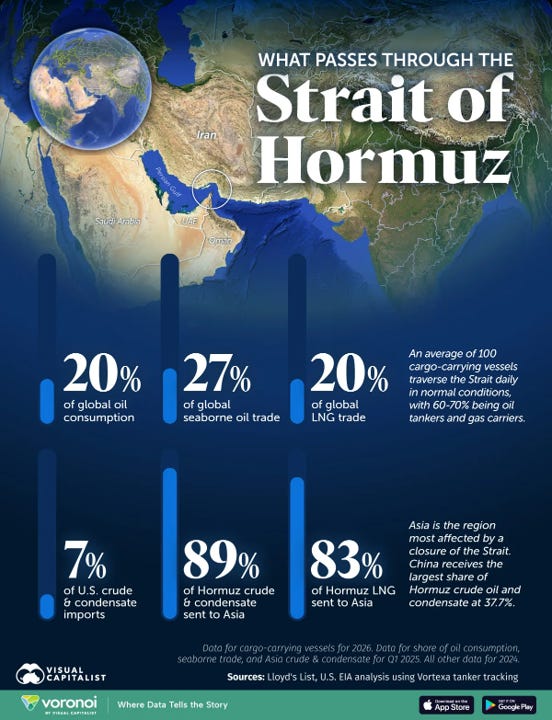
To understand why, it helps to step back and look at what all that energy flowing through the Strait of Hormuz is actually used for. One crucial example receives far too little attention: nitrogen-based fertilisers, which require enormous amounts of natural gas. In fact, natural gas can account for up to 90% of total fertilizer production costs.
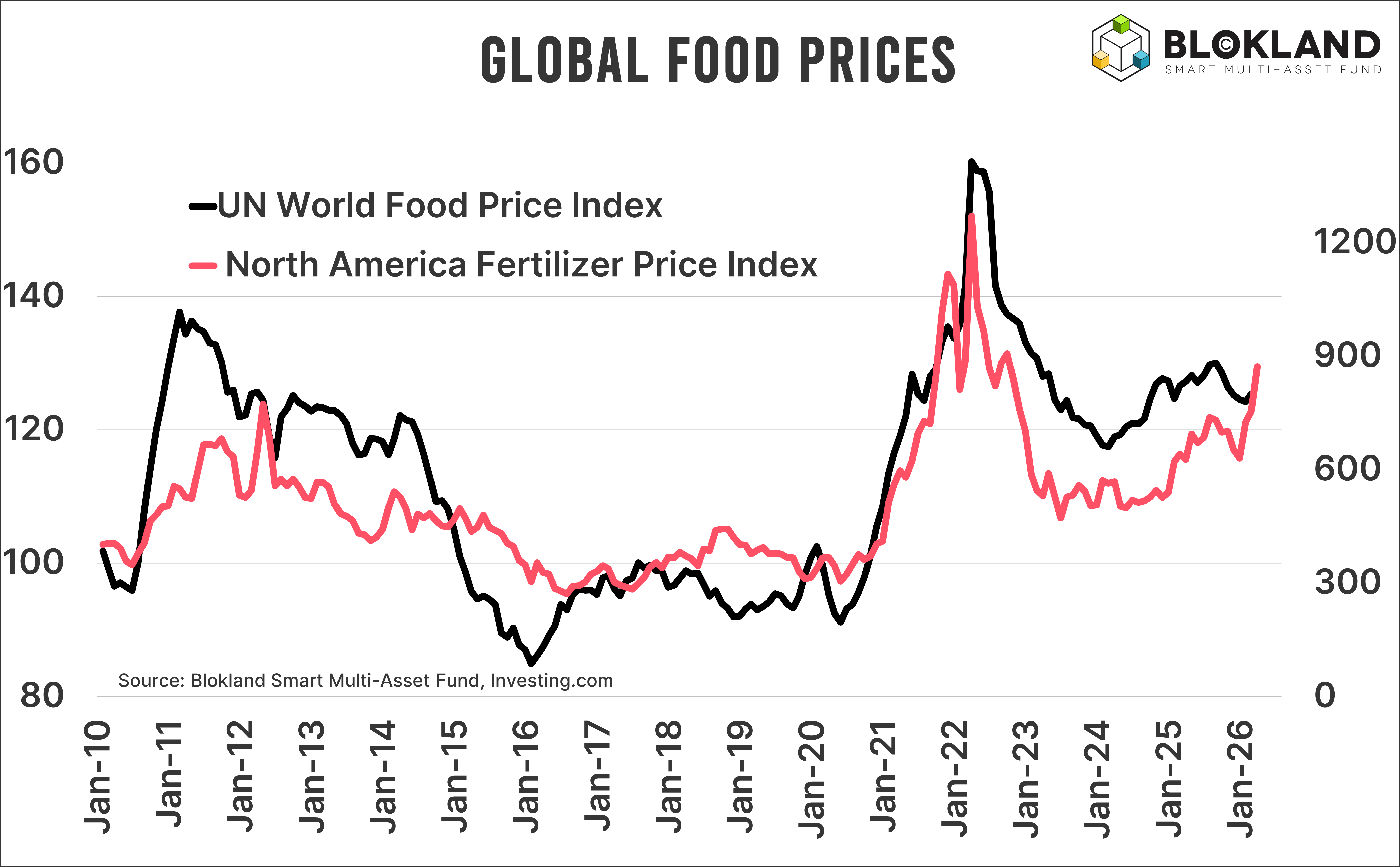
You can see where this leads. The longer the Strait of Hormuz remains partially or fully disrupted, the greater the upward pressure on fertiliser prices. And higher fertiliser prices eventually feed into higher food prices, as is shown in the chart above. That is precisely what the world does not need. History is full of examples of social unrest, political instability and even war being accelerated by rising food prices.
If oil rises by 30% (we are actually above that increase), food prices typically follow with a lag and can increase by around 4% to 5%. If oil were to move back above $110 and remain there during a prolonged conflict, food inflation could eventually approach 10%.
And that matters most for the most vulnerable parts of the global population, the people least able to absorb it. From both a humanitarian and a geopolitical perspective, this is exactly the kind of outcome Trump should want to avoid.
No easy way out
The United States, and Trump in particular, now seem trapped in an awkward, and perhaps partly self-created, dilemma. Israel is using the moment to eliminate as many hostile targets as possible, while the US president is facing growing pressure at home to bring this war to an end quickly.
That becomes far easier if you can claim that the current regime has definitively fallen and that Iran can begin rebuilding under new political leadership.
So yes, I have my doubts. And I hope that, despite everything, Trump brings this conflict to an end sooner rather than later. The cost of this war is far less manageable than he suggests.
Paradoxically, it may end up becoming the fuel for future conflicts.
Blokland Smart Multi-Asset Fund
Inflation is always and everywhere a threat. It affects the costs of the food on your table, the purchasing power of your savings, and the real value of your investments. We offer a solution for the threat of inflation from an investment perspective.
Would you like to learn more about the Blokland Smart Multi-Asset Fund and how we invest in a combination of quality equities, physical gold, fully allocated in the name of the fund and securely stored in a Swiss vault, and bitcoin, a programmed form of scarcity that enables digital value storage?
Feel free to contact me at jeroen@bloklandfund.com. You are, of course, also welcome to give us a call. You can find all contact details and further information on our website.
Kind regards,
Jeroen Blokland

Comments
Nothing yet. Say the first thing.
Sign in to join the conversation.