
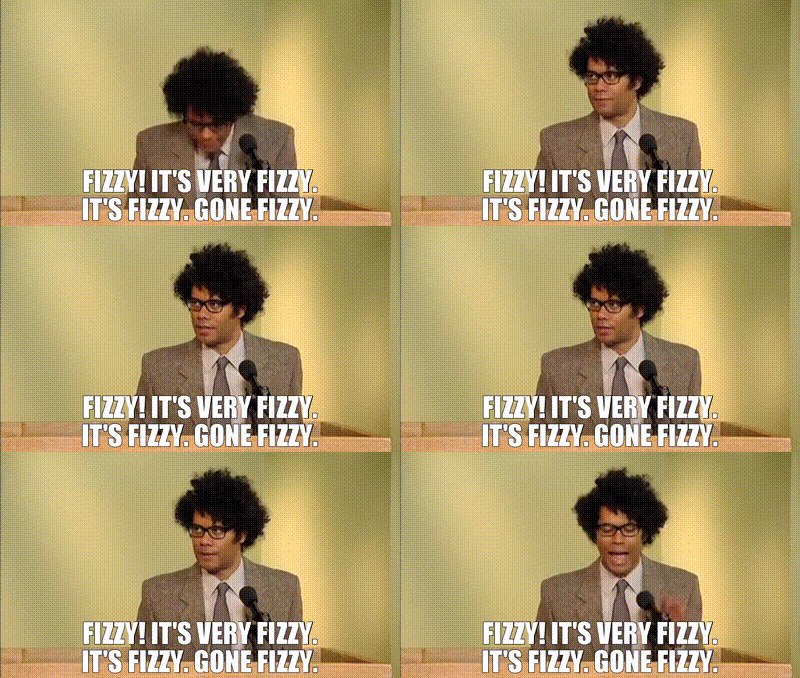
I read a lot of Substack. I have my favourites, whose every newsletter I open excitedly, but I also love discovering new writers. I read their opinions on culture, neurodiversity (neuroadversity?), trends, book reviews, the online hellscape with gusto and, dare I say, even a bit of envy—because I wish I could write like that. Because many of my favourites write very fizzy.
Just last week I subscribed to Postcards by Elle, Midwesthetic and Default Blog, and randomly read posts from a dozen others, along with my regular subs. My reading in general is pretty promiscuous and spread across different media and devices—I just finished Fervour and am now reading Yellow Face in paperback (late to the party, I know) and the odd indie blog about traveling by train from Vienna to North Korea. Maybe I should do a recommendations list?
But back to fizzy writing. There’s a particular tone of voice I love reading. It’s casual and conversational, but also excitable, expansive, sometimes uncapitalised but never incoherent, savvy in a way that shows they’re in on the joke. It feels like you’re on the phone with a friend or walking and talking a mile a minute, coffee in hand, a self-deprecating joke here and there that rings funny but not tragic. It’s exciting, like being in on the gossip, at the centre of it even, but the gossip is actually an insightful and well-researched analysis of one of your special interest topics.
There’s an idiosyncrasy to the language, an ease with mixing metaphors, abstract and concrete adjectives, sensory descriptions, playing with sentence length. It’s a kind of writing that, to me, feels fizzy. Effervescent. Like a cold Fanta (or Mirinda, IYKYK) in a glass bottle, the bubbles giddily hitting the back of your throat, your nose. You want to burp, then laugh at your own insouciance.
Fizzy writing has a certain disregard for convention that makes it feel, at the same time, relatable and off-the-cuff. “Oh, this 1500-word essay on third spaces? Just banged it out between lunch and happy hour, no biggie.”
It uses all caps for emphasis and short, staccato sentences for a clipped, excited, and exciting rhythm. It reads like natural conversation. It might resemble stream of consciousness or even a social media caption, but it has substance. It contains the necessary information and usually not much more. The fizzy writer knows how to edit for meaning and concision, but also for fun.
I’ve often seen this style in articles and essays written by late millennial/early Zoomer writers, especially women, who make the old adage “write like you talk” look effortless in the same way a professional ice-skater’s movements are effortless.
And that’s why fizzy writing, for all its breezy simplicity (is it the no-makeup makeup of writing? comment your opinion), is actually hard. Most people get really weird when they sit down to write. They can write just fine when texting friends or captioning social media posts, but something short-circuits in us when it comes to “serious” writing. Suddenly, we start using high-school-English-essay language and sentence structures our favourite writers wouldn’t be caught dead with.

For one, “write like you talk” is not entirely true. Oftentimes, our mouths move faster than our brains can edit. Day-to-day speech is full of uhm and er, hedging or imprecise language, skipped and implied words, and jumping around in the sentence to add bits of information. If you were to transcribe that, you’d end up with a language puzzle only your best friend could make sense of.
Literally writing as you speak doesn’t make for a very fun read. But do you know what does? Writing free from (most of) the constraints of grammar. Free from the judgemental gaze of your high school English teacher.
Of course, this doesn’t mean you should ignore the things that actually make a text easy to read and understand: grammatical accord, punctuation, structure, coherence. That would probably make your editor cry. But it does mean ditching the Thesaurus—think descriptive grammar over prescriptive.
Share if you’re also a descriptivist. Or prescriptivist. I won’t judge.
But don’t take my word for it—this is ancient advice from any writing workshop worth its salt.
But fizzy writing is more than that. Sure, it’s free from the shackles and conventions of prescriptivism. It’s freer than that pair of sunglasses you shoplifted at the seaside when you were 17. But it’s also ever so slightly unhinged. A bit loud. Hypomanic. And just personal enough to get readers engaged in the conversation. That, in my opinion, is what makes for really good fizzy writing.
No posts
Comments
Nothing yet. Say the first thing.
Sign in to join the conversation.