
Blogging Guide is a reader-supported publication. To receive new posts and support my work, consider becoming a free or paid subscriber.
Something changed around mid-2023, and if you have been publishing content for any length of time, you felt it. Traffic that once flowed from informational queries started drying up. Not because your content got worse, but because Google got better at keeping people on Google.
AI Overviews now sit at the top of results for thousands of queries. Featured snippets answer questions in three sentences. People get what they came for without ever clicking a link. Welcome to the zero-click era.
For a comprehensive primer on how SEO works for bloggers, Blogging Guide’s SEO for Bloggers guide is an excellent starting reference.
The bloggers who will thrive are not the ones fighting AI Overviews. They are the ones who make AI Overviews irrelevant to their strategy.
This guide is a tactical playbook for exactly that. Not theory, but specific decisions you can make today about which queries to target, how to format your content, what kind of experience to document, and how to build an audience that does not depend on search at all.
1. Stop Competing for Zero-Click Queries
The first move is not a content tactic. It is a targeting decision. Not all queries are equal in a zero-click world, and the first thing you need to do is stop writing content for queries that Google will always answer better than you.
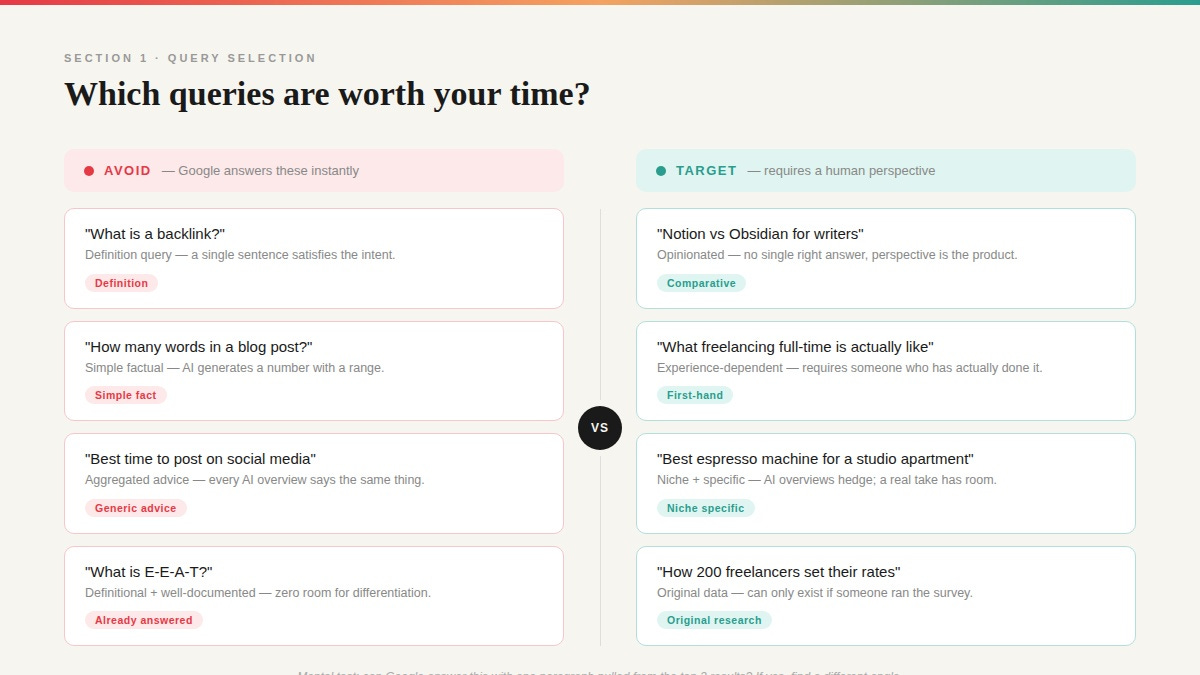
Zero-click magnets include definition queries, simple how-to questions, conversion queries, and anything Google can answer with a box, a graph, or a calculation.
The queries worth chasing tend to be:
Comparative and opinionated: “Notion vs Obsidian for writers” does not have a clean answer. Google cannot summarize a perspective it has not formed.
Experience-dependent: “What it is actually like to freelance full-time” requires someone who has done it. AI Overviews pull from existing content; they cannot manufacture lived experience.
Niche and specific: “Best espresso machine for a one-bedroom apartment” is narrow enough that an AI overview will hedge and generalize. Your specific take has room.
Research-heavy: When someone needs primary sources, case studies, or original data, they need to click somewhere. Be that somewhere.
A useful mental filter: ask yourself whether Google can confidently answer this query with a paragraph pulled from the top three results. If yes, find a different angle.
2. Build the Information Gap Google Cannot Close
Even when you are targeting a good query, the content itself needs to offer something that an AI overview structurally cannot. This is where most bloggers leave clicks on the table; they write content that is technically good but does not contain anything irreproducible.
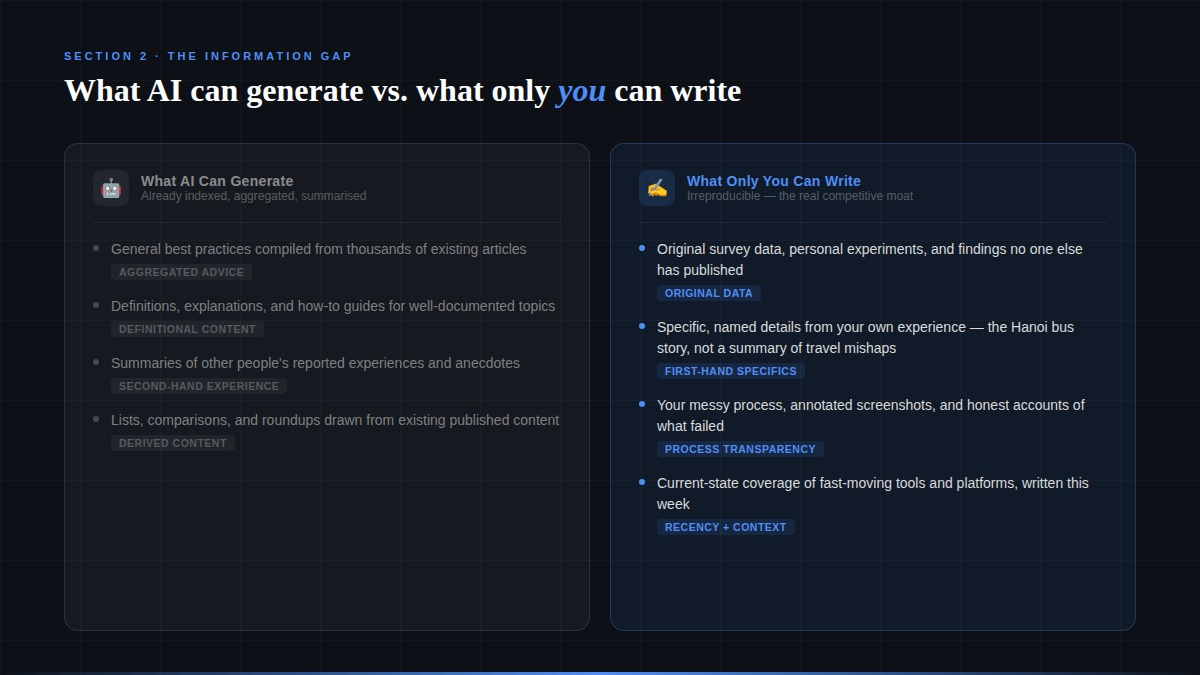
Here is what creates genuine information gaps:
Original data and research. Run a survey. Analyze a dataset. Compile publicly available numbers into a coherent finding. “I surveyed 200 freelance designers about their rates” is a hook that no AI can replicate because the data does not exist anywhere else yet.
Documented first-hand experience. Google’s AI can summarize other people’s accounts of backpacking Southeast Asia. It cannot replicate your account of missing a bus in Hanoi and what that actually cost you, logistically and emotionally. Specificity is the gap.
Process transparency. Do not just tell readers what to do; show them your messy, annotated version of doing it. Screenshots, mistakes, the thing you tried that did not work. The messiness is the value.
Recency with context. AI Overviews lag. If you are writing about a tool, platform, or industry that moves fast, being the most recent and most specific account of the current state of things is a real competitive advantage.
If you can imagine an AI writing your post from memory, rewrite it until you cannot.
3. Format for Clicks, Not Just Snippets
There is a persistent piece of SEO advice that says you should format your content to win featured snippets: clear definitions, concise answers, structured headers. That advice made sense when snippets were the prize. Now, the snippet often just feeds the AI overview, and you never see a click.
The formatting question has shifted. You now want to be clear enough to rank, but interesting enough that ranking is not enough for the reader. You want to create micro-curiosity.
Blogging Guide covers this well in their breakdown of how to structure the perfect blog post, including how formatting decisions affect both readability and rankings.
Tactics that work:
Open loops in your intro. Pose a question that the overview answers, then immediately pivot to a harder question it does not. Give readers a reason to keep going.
Promise specifics you deliver deep in the piece. Mention in your intro that you will share the exact template, the specific number, the actual name of the tool. Readers who want the specific thing have to come get it.
Use formatting that implies depth. Long-form table of contents, numbered frameworks, multi-part series; these signal that there is more here than a paragraph can hold.
End sections with a bridge to the next. Good long-form writing pulls readers forward. Each section should create mild anticipation for what comes next.
4. Invest Heavily in First-Hand Experience Content
Google has been pushing E-E-A-T (Experience, Expertise, Authoritativeness, Trust) for years, but the emphasis on Experience is newer, and it is not a coincidence that it arrived as AI-generated content exploded. Experience is the one thing AI cannot fake, and Google knows it.
What this means practically: content that documents your personal engagement with a topic carries a structural advantage. Not because Google can definitively verify it, but because genuine first-hand accounts read differently. They contain details that aggregated information does not. They are specific in ways that feel earned rather than assembled.
Ways to systematically build experience content:
Run experiments and publish the results. Try five productivity systems for 30 days each and report what actually happened. Buy and test the products. Use the software long enough to find its edge cases.
Document your failures. The posts that consistently over-perform in terms of time-on-page are the ones where writers are honest about what went wrong. Failure content is rare because it requires ego exposure, which is exactly why it is valuable.
Create a recurring format around your ongoing experience. A monthly check-in on your freelance income, a quarterly review of your content strategy, a weekly roundup of what you are reading and why; these build authority through accumulated honesty.
5. Make Your Audience the Asset, Not the Traffic
Here is the structural problem with a search-dependent content strategy: you are building on rented land. Google’s algorithm changes and your traffic changes with it. AI Overviews expand and your clicks shrink. You have no relationship with the people reading your content, just numbers in a dashboard.
The bloggers who are weathering the zero-click era best are the ones who converted search traffic into direct audiences before the traffic dried up. They built email lists. They created communities. They built things readers came back to by choice, not by query.
If you have not started treating email as your primary metric, start now. Not as a vanity project, but as infrastructure. Every piece of content you publish should have a natural offer to subscribe: a related resource, a deeper dive, a template, a weekly roundup. The reader who found you via search and joined your list is no longer dependent on search to come back.
If you are not sure where to begin, Blogging Guide has a practical walkthrough on how to build an email list for your blog that covers tooling, strategy, and subscriber incentives.
Social is a secondary distribution channel, not a substitute. Platforms come and go. An email list is yours.
Search traffic is a visitor. An email subscriber is a relationship. Build for the relationship.
6. Write Content That Journalists and Researchers Want to Cite
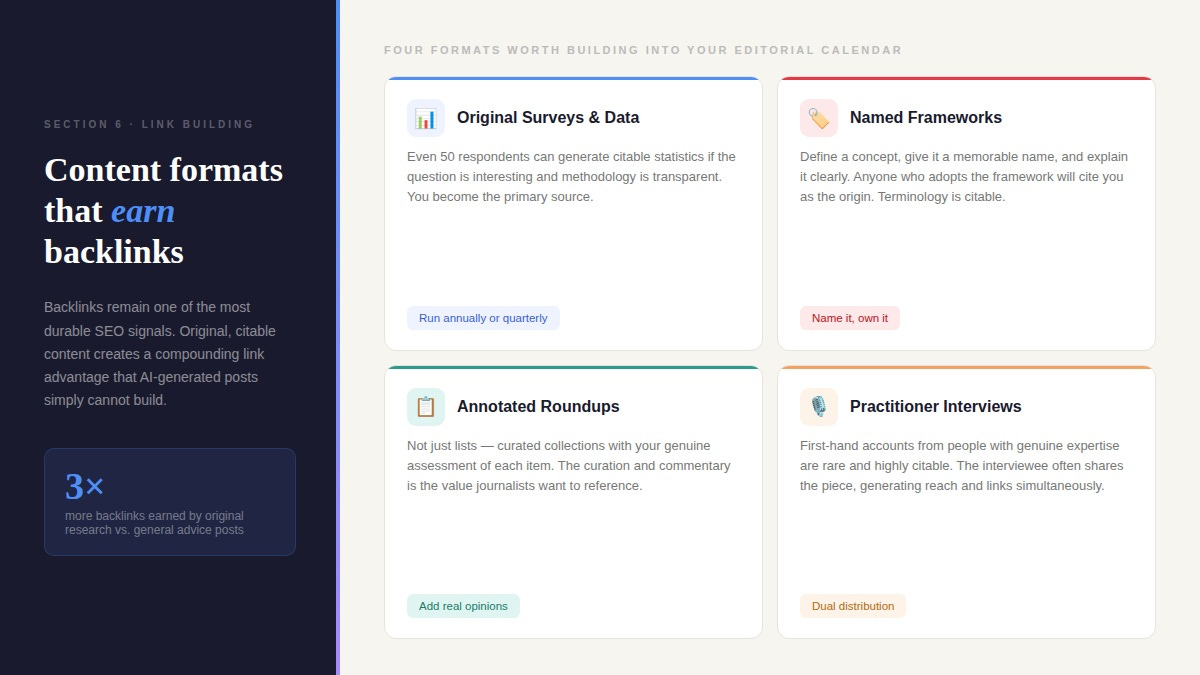
Backlinks remain one of the most durable SEO signals, and in a world where AI can generate generic informational content at scale, original research and data-driven posts have become proportionally more valuable as link targets.
Think about what gets cited: statistics, frameworks with clear names, studies, original surveys, expert roundups with attributed quotes. If you produce these things, you become a node in the web of content that AI draws from, and you get traffic when people want to verify or explore the original source.
Blogging Guide’s guide on how to get quality backlinks for your blog goes deeper on the mechanics of earning links and building domain authority over time.
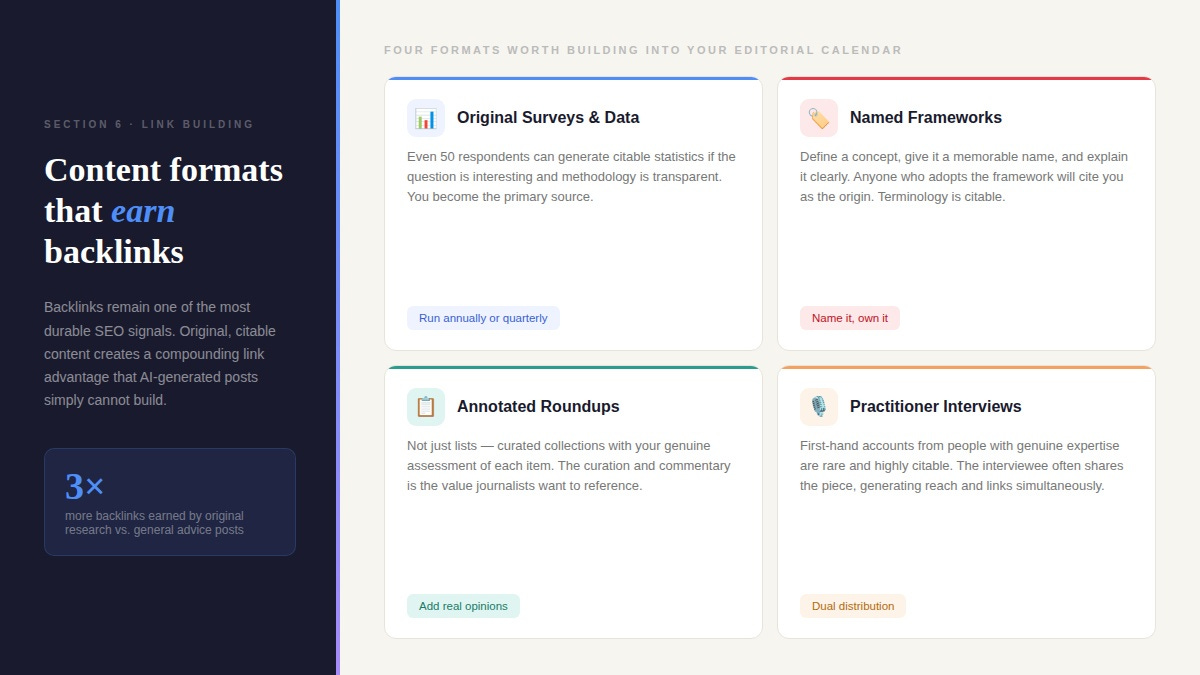
A few link-worthy content formats worth building into your editorial calendar:
Annual or quarterly surveys in your niche. Even 50 respondents can generate citable data if the question is interesting and the methodology is transparent.
Original frameworks with memorable names. If you name a concept and explain it clearly, people who adopt the concept will cite you.
Comprehensive resource roundups. Not just lists, but annotated collections with your actual assessment of each item.
Interviews with practitioners. First-hand accounts from people with genuine expertise are rare and citable.
The Honest Bottom Line
Zero-click SEO is not a tweak to your existing strategy. It is a reorientation of what you are optimizing for. If you are optimizing for pageviews from search, the math is getting harder every quarter. If you are optimizing for a direct relationship with a specific audience, search is still one useful path among several.
The practical playbook comes down to a few commitments: target queries that require a human perspective, create information that AI cannot generate from existing content, format to create curiosity not just rank, document your real experience relentlessly, and convert every reader you can into someone who will come back without needing Google to bring them.
Google is going to keep getting better at answering questions. The question is whether your content is answering questions, or doing something more interesting than that.
Comments
Nothing yet. Say the first thing.
Sign in to join the conversation.