Scientists have discovered a new type of matter. Inside a cooled crystal, structures spontaneously arranged themselves into a three dimensional weave, and they did it at around room temperature. The researchers can even rewrite parts of the pattern with a laser. News like this doesn't come every day. Let's take a look.
Could our universe have been born inside a collapsing star? That idea recently made headlines, and I got a lot of questions about it. The paper behind them describes a new solution to Einstein's equations in which a collapsing star expands on the inside and never forms a black hole. Let's take a look.
A group of astronomers say they've spotted more than twenty giant unidentified objects racing around the Moon, some of them forty kilometres across, and that the Moon serves as a base for them. The daily mail loved it. My bullshit meter did not survive it. But underneath all this nonsense there's a serious question that almost nobody is looking into. Let's take a look.
You've probably heard that quantum mechanics is spooky, that measuring one particle instantly affects another across any distance. A physicist now says there's a reason: the universe doesn't have one dimension of time, but two. It sounds absurd, but he's got the maths and even a way to test it. Genius or nonsense? Let's take a look.
The origin of life is one of the biggest mysteries left in science. Now a group of researchers says there wasn't just one originsttr, there were two. And I want to explain why, despite how impossibly long ago it all happened, I'm actually optimistic that we'll one day work out how life began. Let's take a look.
How special is Earth? It's one of those questions that runs through all of science, and here's a version of it most people have never thought about: why does our planet even have continents? A group of geologists now says the answer lies somewhere unexpected, in the shape of the Milky Way itself. Let's take a look.
The war on artificial intelligence is no longer just online arguments and complaints about data centers. Something has shifted, and law enforcement has noticed. Where did this new anti-technology movement come from, who's behind it, and where is it heading next? Let's take a look.
Neuroscientists have long assumed that when a brain region becomes more active, more blood flows to it. That assumption is the entire basis of functional magnetic resonance imaging. A new paper now says it's wrong for about 40% of the signals, and it isn't the only recent study to find that a lot of what we thought we knew about the brain rests on bad measurements. Let's take a look.
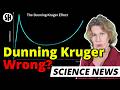
The dumber you are, the more certain you are that you aren't. That's the Dunning-Kruger effect, and it's been used to explain everything from bad politicians to the state of social media. Now psychologists have gone back to the biggest dataset we have and come out with the opposite conclusion. But there's a reason both sides can look at the same dots and see the opposite thing. Let's take a look.
A worker at a US government lab got bitten by a monkey carrying a deadly virus, and it turned out nobody knew what to do about it. Around the same time, someone from the same lab tried to smuggle outbreak samples into the country. All of this while everyone's worried about AI making bioweapons. Let's take a look.