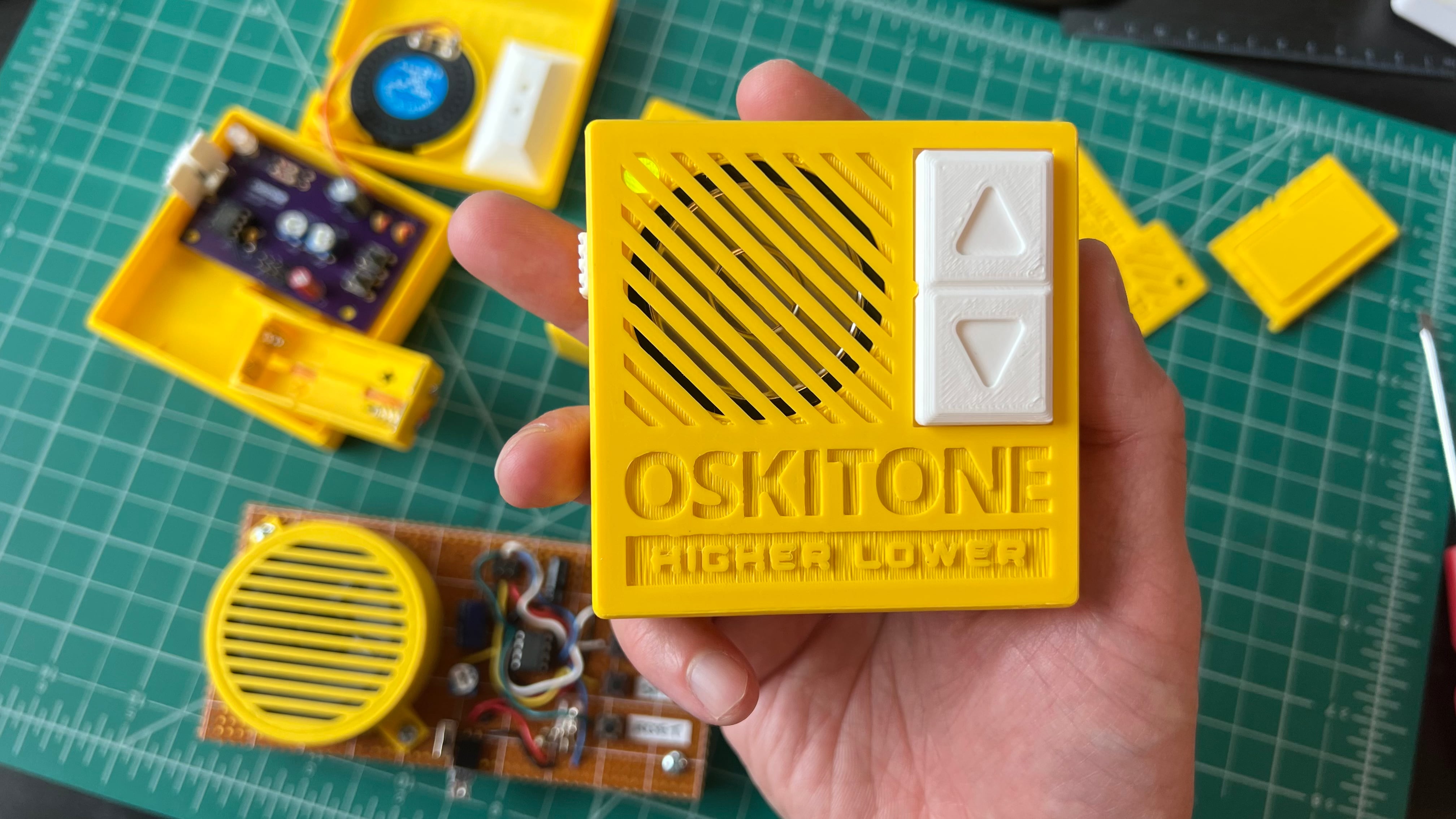
The latest Oskitone kit is an electronic handheld game I made called "Higher Lower," where you have to guess if a tone is higher or lower than the previous one, and the more you get right the harder it gets to tell. It was fun to make and is fun to play! Prompt The impetus for this project was Hackaday's "Tiny Games Challenge" : Sometimes the tightest constraints inspire the highest creativity.…
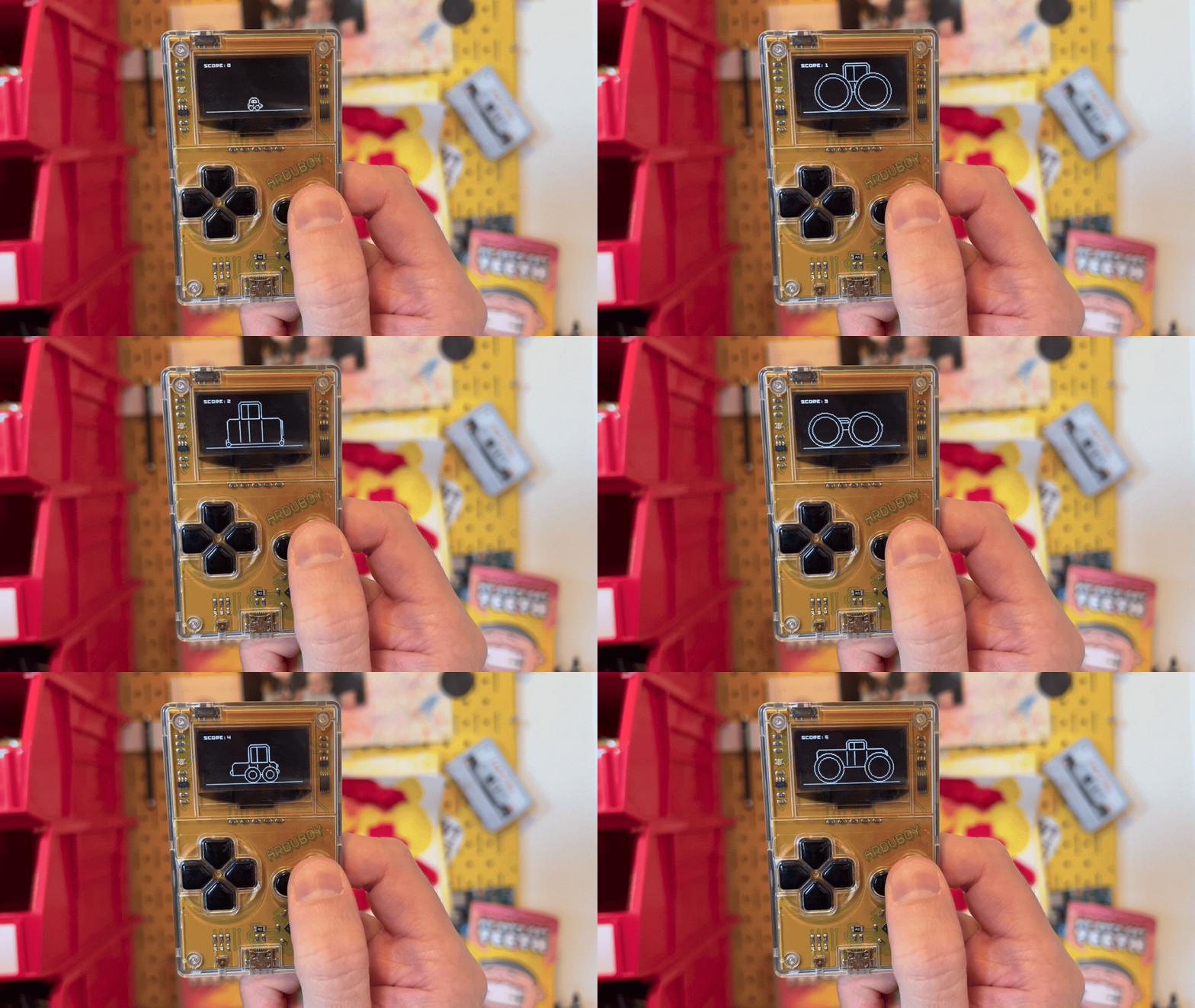
I've been having a lot of fun with this open-source game console, the Arduboy . It's effectively an Arduino Leonardo in the guise of a minimalist GameBoy: 1.3" OLED display, D-pad+A/B buttons, and battery in a credit-card sized enclosure. Plug a cable into the USB port at the bottom there to swap the game or upload your own. I think its limited specs are a blessing in disguise. The small screen…
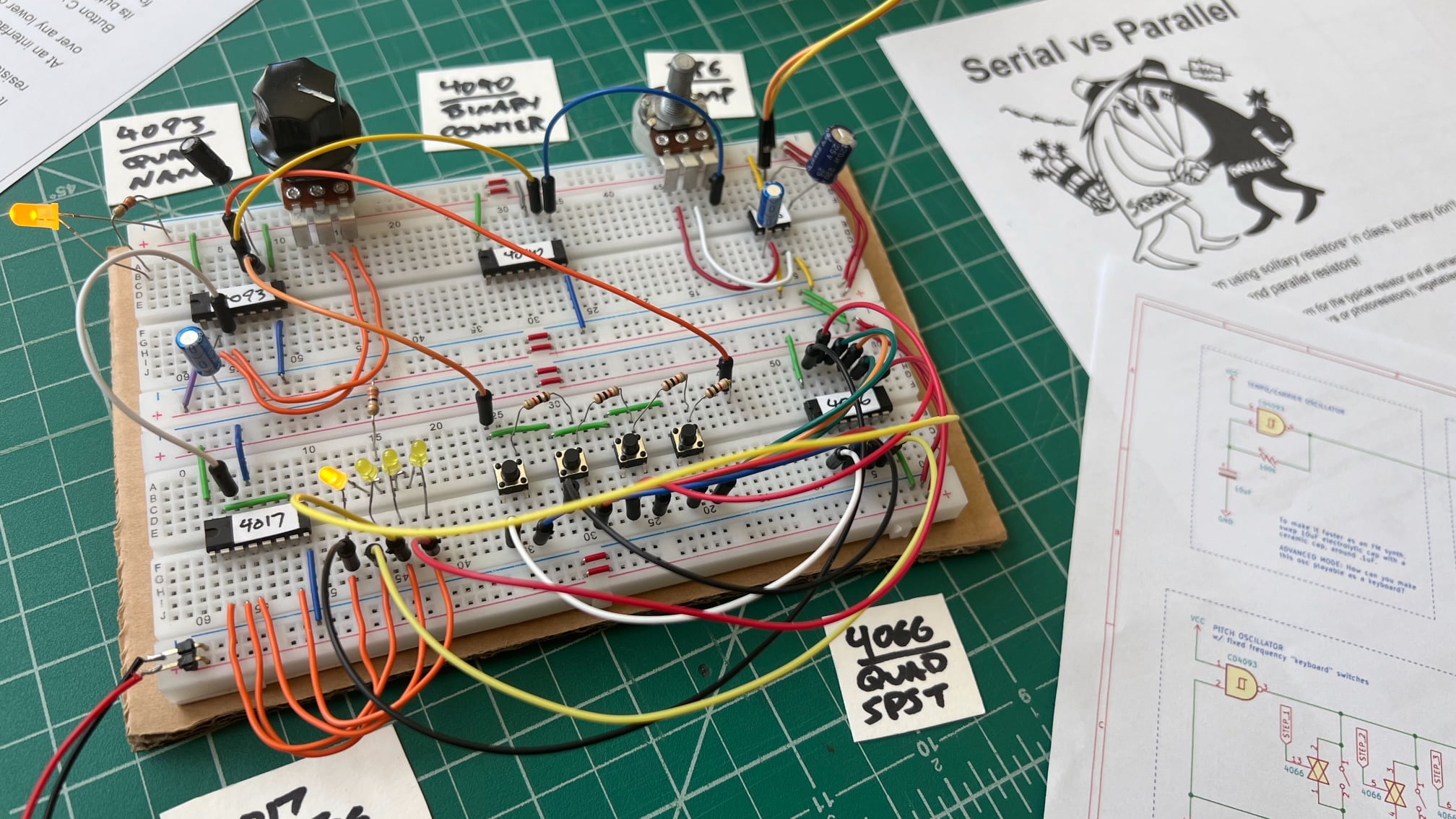
I sometimes get the honor to be an instructor for "DIY Synths for the Electronically Unacquainted" , a virtual workshop put on by the fine folks at Dogbotic . For two hours a week over nine weeks, we meet on Zoom and trick antiquated logic gates into performing audio synthesis on breadboards. It is great fun. And I'm open-sourcing the documents I make (and the code that makes them) for my workshop…
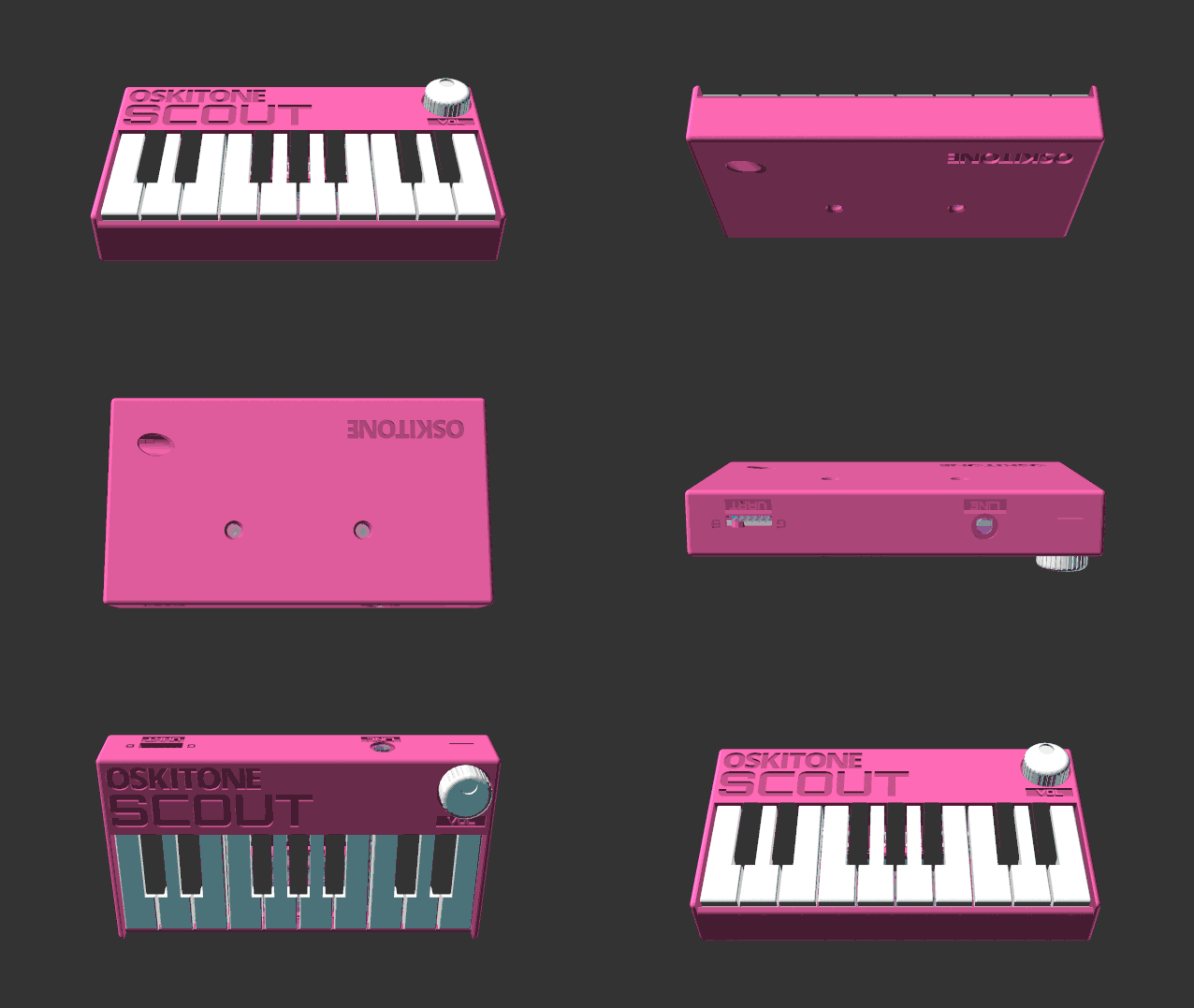
It's time for a new Oskitone synth... the Scout! It's called the "Scout" because it's the first Oskitone synth to use a microcontroller, specifically the ATmega328 -- just like the Arduino Uno. From the readme: scout ( /skout/ ): One sent to obtain information Jean Louise “Scout” Finch, of Atticus Finch The first synth from Oskitone to venture into the big ol' world of microcontrollers The Scout…
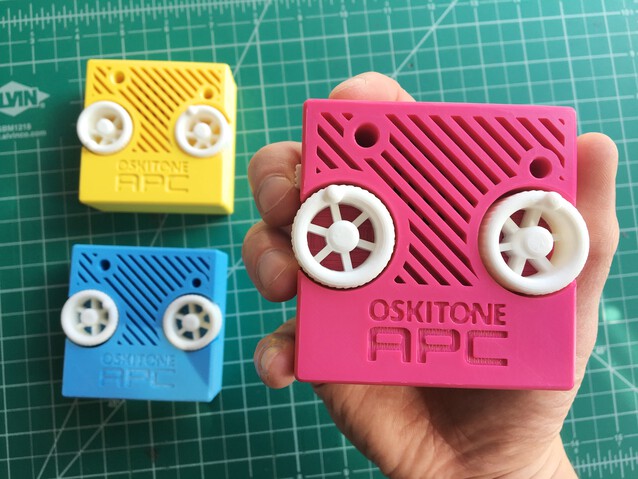
A decapitated robot head? An extraterrestrial communicator? A specter summoner? Nope (and yep!), it's an APC! Just like the other Oskitone projects, it's a 3D-printed electronic musical ~instrument, designed in Kicad and and OpenSCAD, Open-Source , and just plain ol' annoying fun. Here it is in action: As usual, this blog post details all the nooks and crannies that can't fit on the store's…
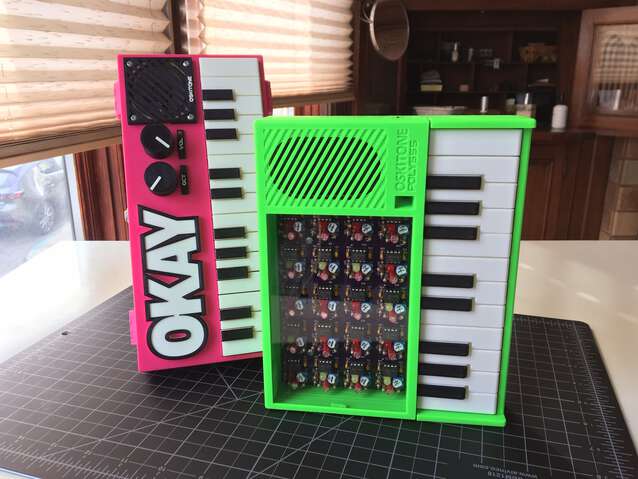
I made a new Oskitone synth: the POLY555! It's an analog, 20 note poly phonic , square wave synthesizer based on the 555 timer chip . The enclosure and keys are 3D-printed, its models were programmed in OpenSCAD, and its PCB was designed in Kicad. A little history The monophonic (one note at a time) OKAY synths I made a couple years ago also used the 555 timer as their oscillator, as a sort of…
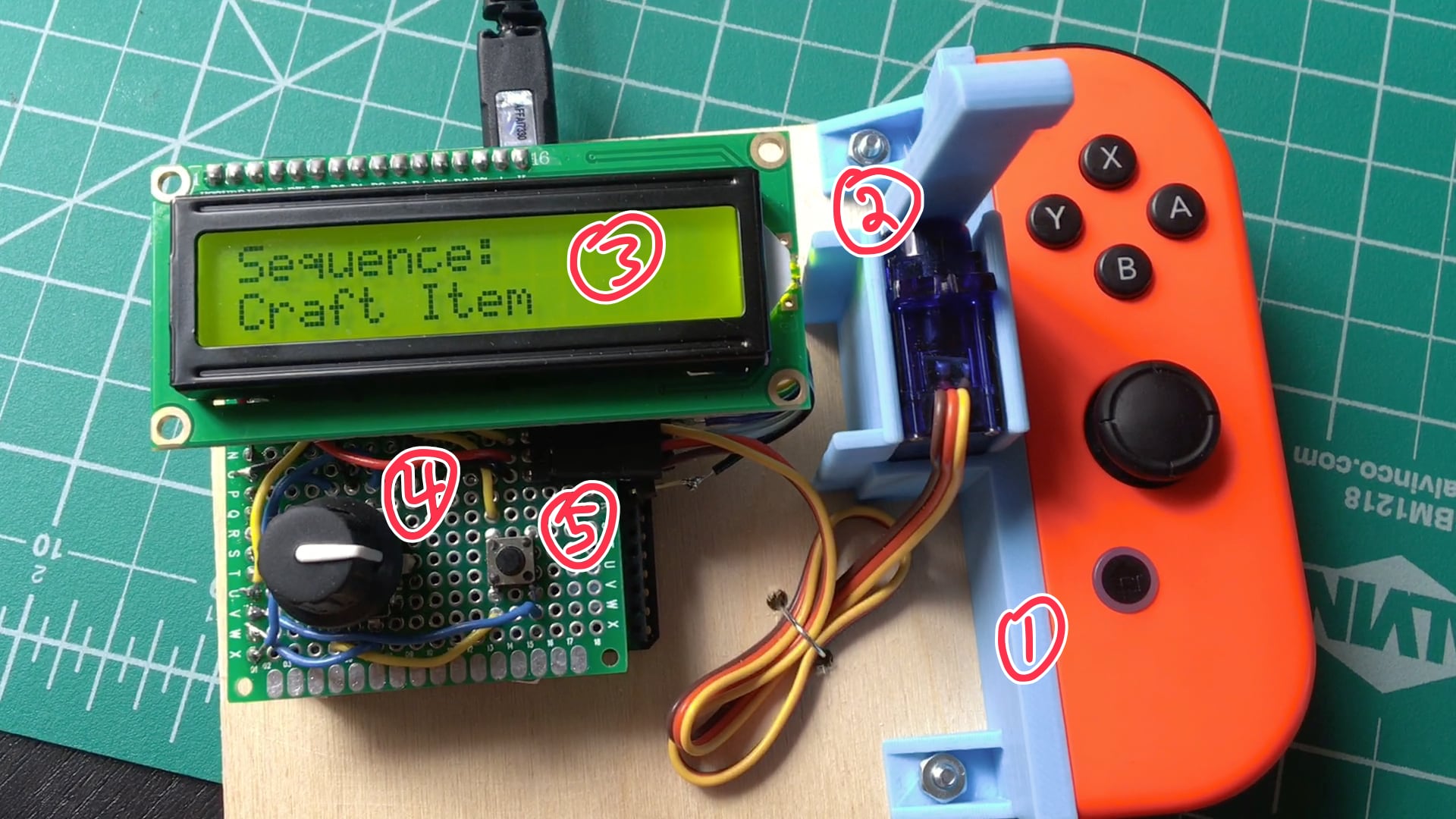
I made a machine to automate some of the boring parts of Animal Crossing, and it is very satisfying to me. Like my other projects, "buttonpusher" was designed in OpenSCAD and 3D-printed. The code controlling it is CircuitPython , running on an Adafruit Metro M0 Express . Code, circuit, and 3D models to make your own: https://github.com/rocktronica/buttonpusher How it works, briefly The Nintendo…
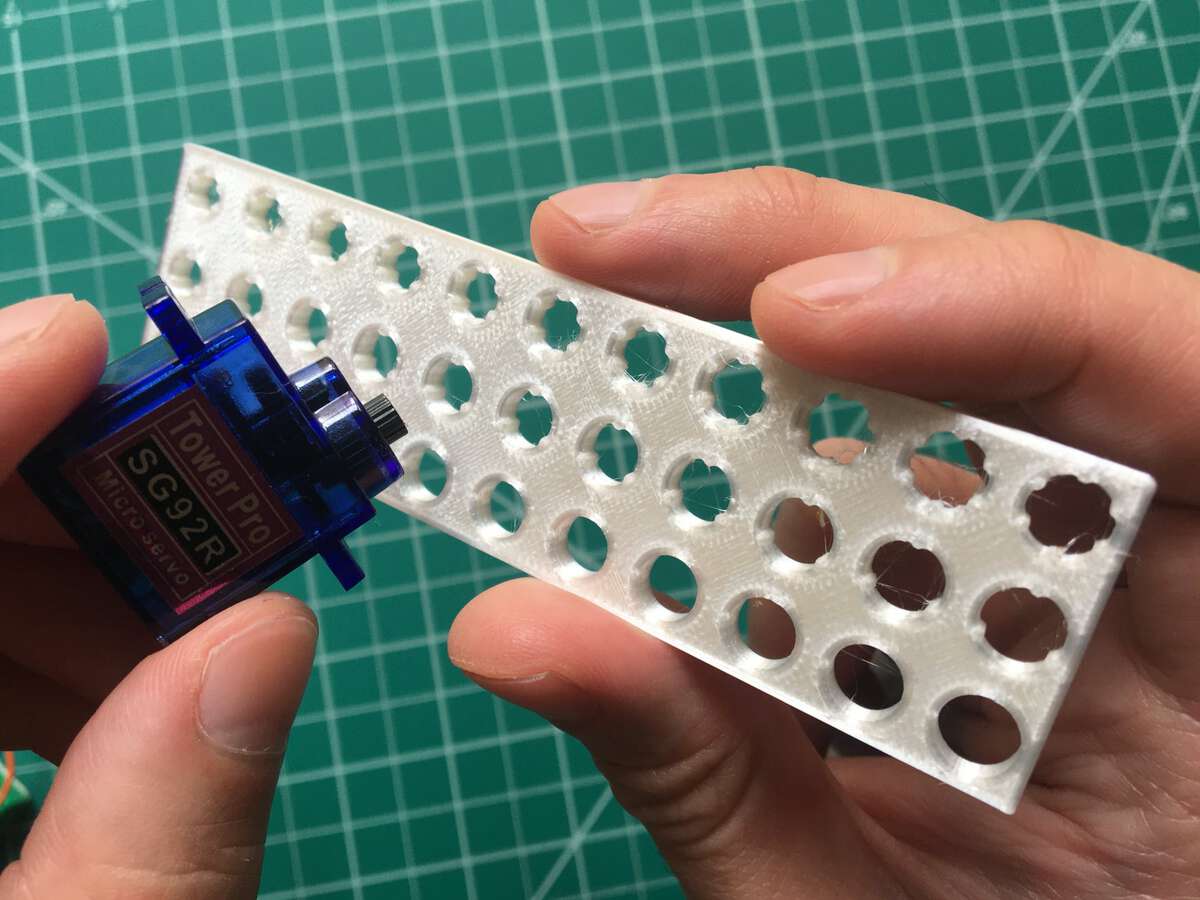
Designing 3D-printed parts that need to perfectly match the dimensions of something else can be arduous, because it'll often mean meticulously designing-then-printing-then-trying each individual iteration, ad infinitum. A trick I like (and I'm sure this is old news to many folks) is to combine an array of those tests into one big combo test. Then, just like Goldilocks, all you have to do is move…
I wrote a script called Unfocus to prevent me from wasting too much time reading the news and Twitter. I wish that weren't necessary, but wataryagonnado, huh? Example: ~/.unfocus.sh 15 Which lets me bum around for 15 minutes. After that, I'm greeted by: Nice! 😅 How's it work A popular trick to prevent visiting a website is to convince your computer that its domain resolves to localhost. This can…
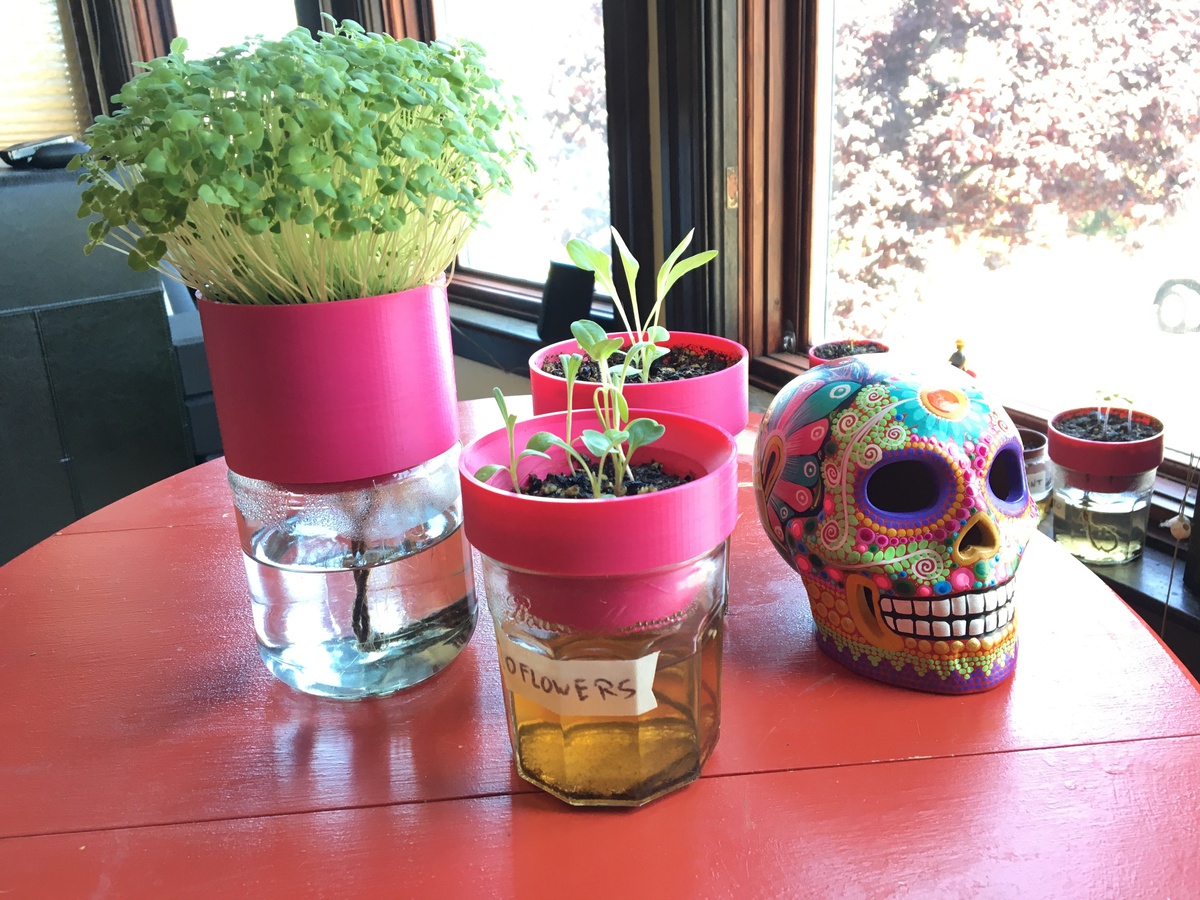
Well folks, I never could have guessed it, but I (apparently!) have opinions about plant planters and made a variation of a self-watering planter that fits into household glass jars. Keep reading to learn how I made it or to make your own! Whyyyyy I’m not much of a green thumb, but I like plants. They make me feel good. When the world is scary and unknown, growing a cute little plant in a cute…
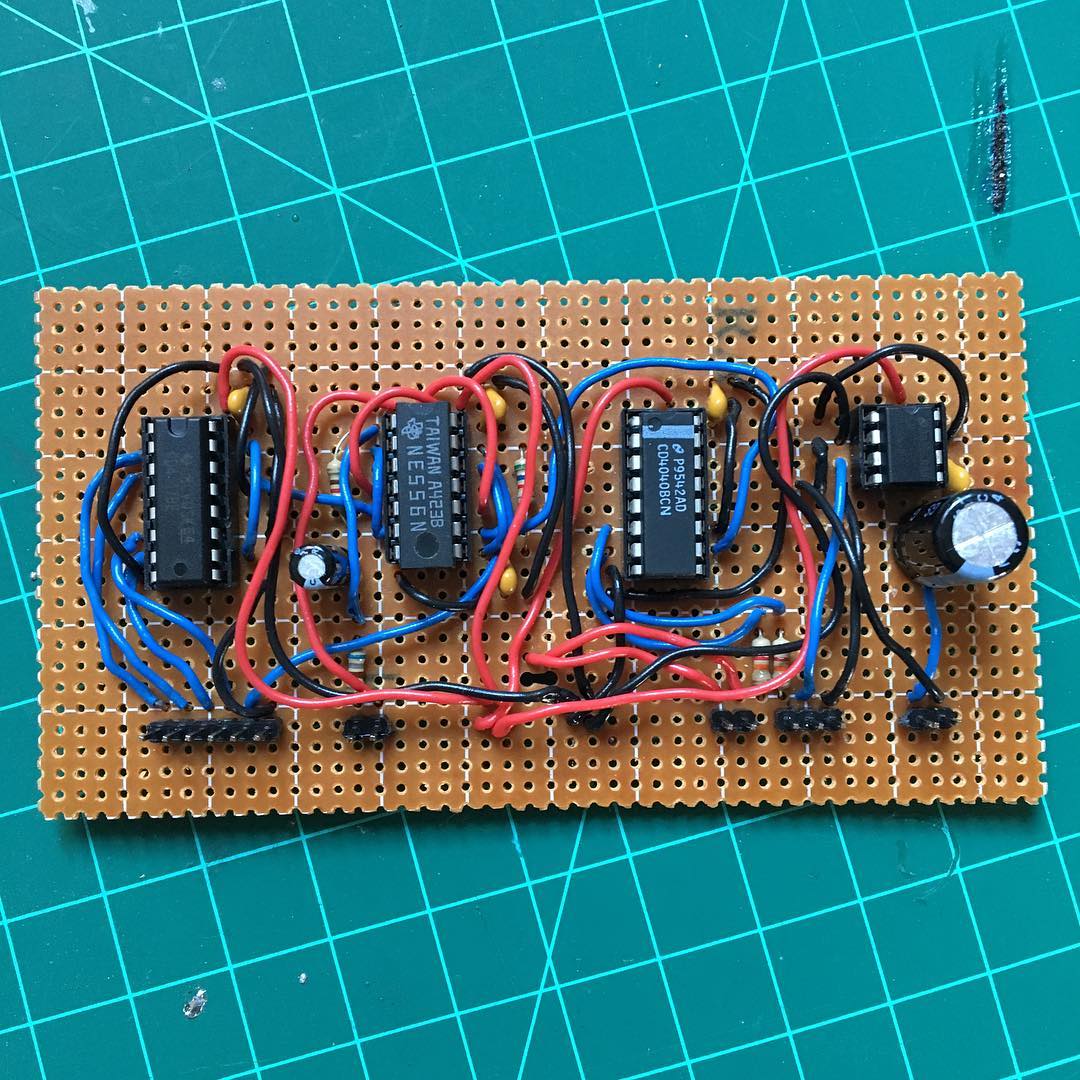
Four-Step Octaved Sequencer from oskitone on Vimeo Background The first version of this sequencer idea was a collaboration with an artist named Rasterstache . It displayed at Maker Faire and eventually made its way to the popular Chicago band OK Go: pic.twitter.com/NmKWoNfnOg — OK Go (@okgo) November 4, 2017 A look inside Inside that robot figure is a really pretty, one-off, hand-wired circuit I…
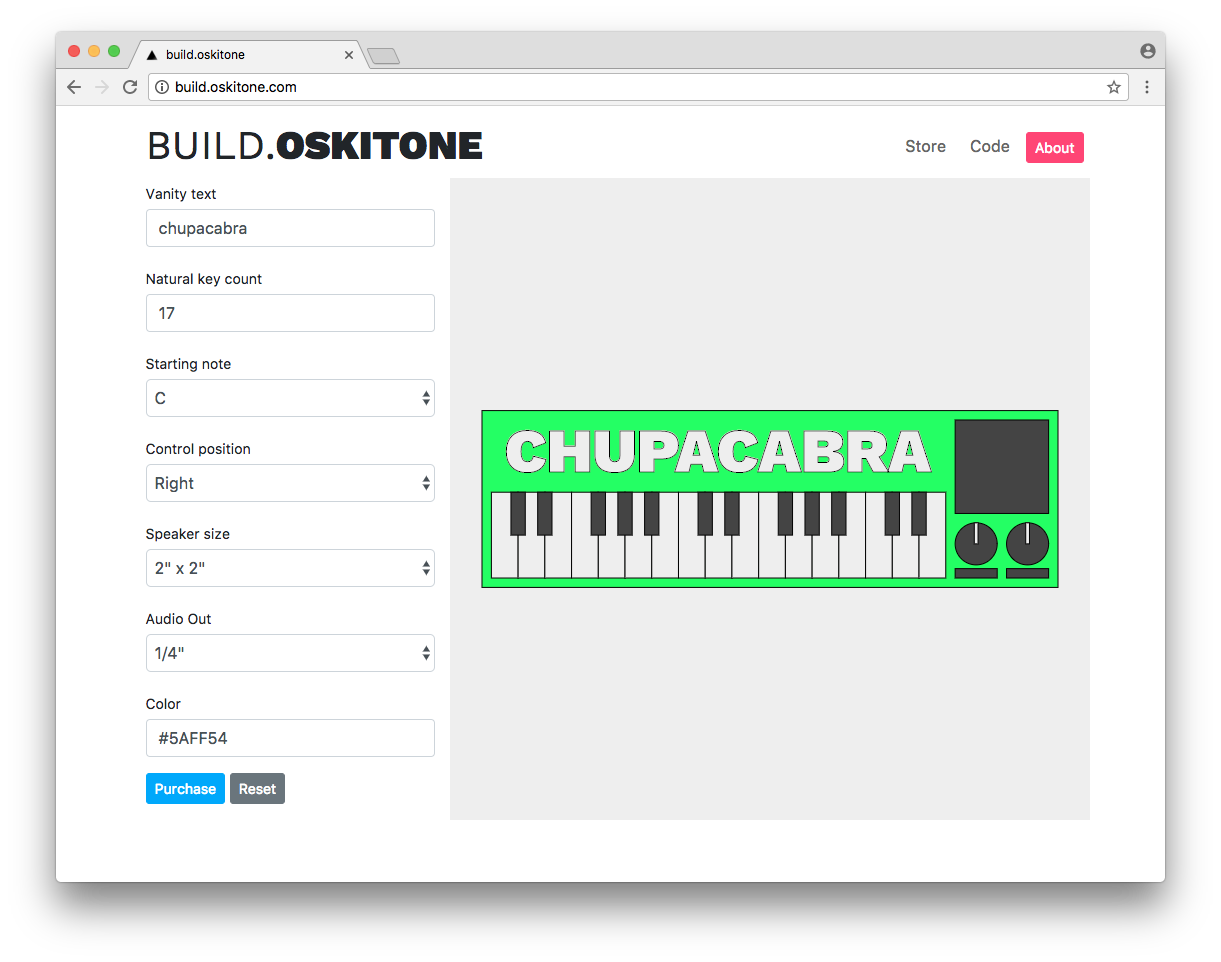
Here’s a web app I’ve been fiddling with recently to help visualize (and, ahem, sell!) custom synthesizer based on the OKAY Synth and the OKAY 2 . It’s built in React with Next.js , uses Bootstrap styling via Reactstrap , and renders its preview onto canvas with Konva . It’s also the first time I’ve used any of that stack, so I expect to be thoroughly embarrassed by my code if/when I revisit it in…
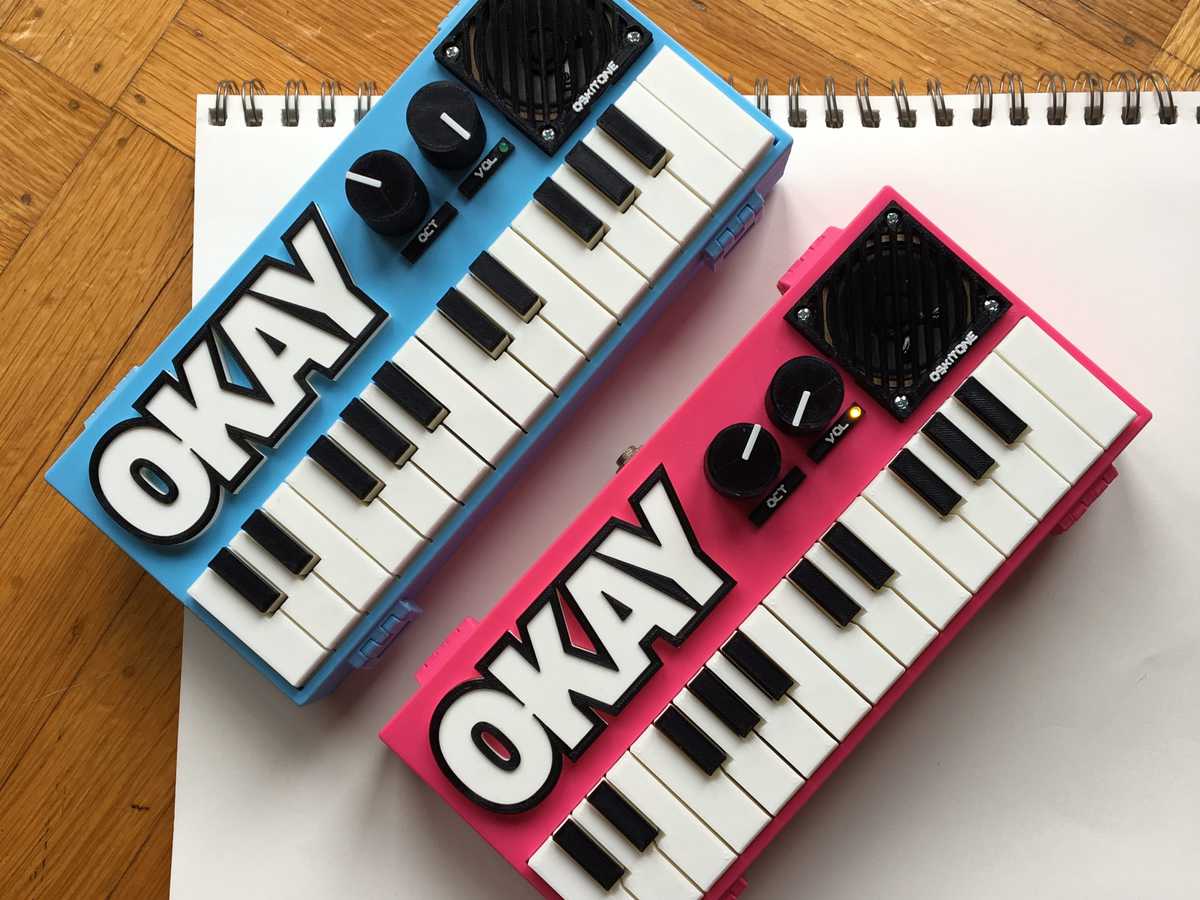
The long awaited Oskitone OKAY 2 Synth is finally done and ready to share! It looks like this: And it sounds like this: Oskitone OKAY 2 from oskitone on Vimeo Just like the first OKAY Synth , the OKAY 2 is an analog, monophonic, square wave synthesizer. It uses the very same modular PCBs, octave and volume controls, and speaker as the OKAY 1, and all of it was designed by me in OpenSCAD and EAGLE…
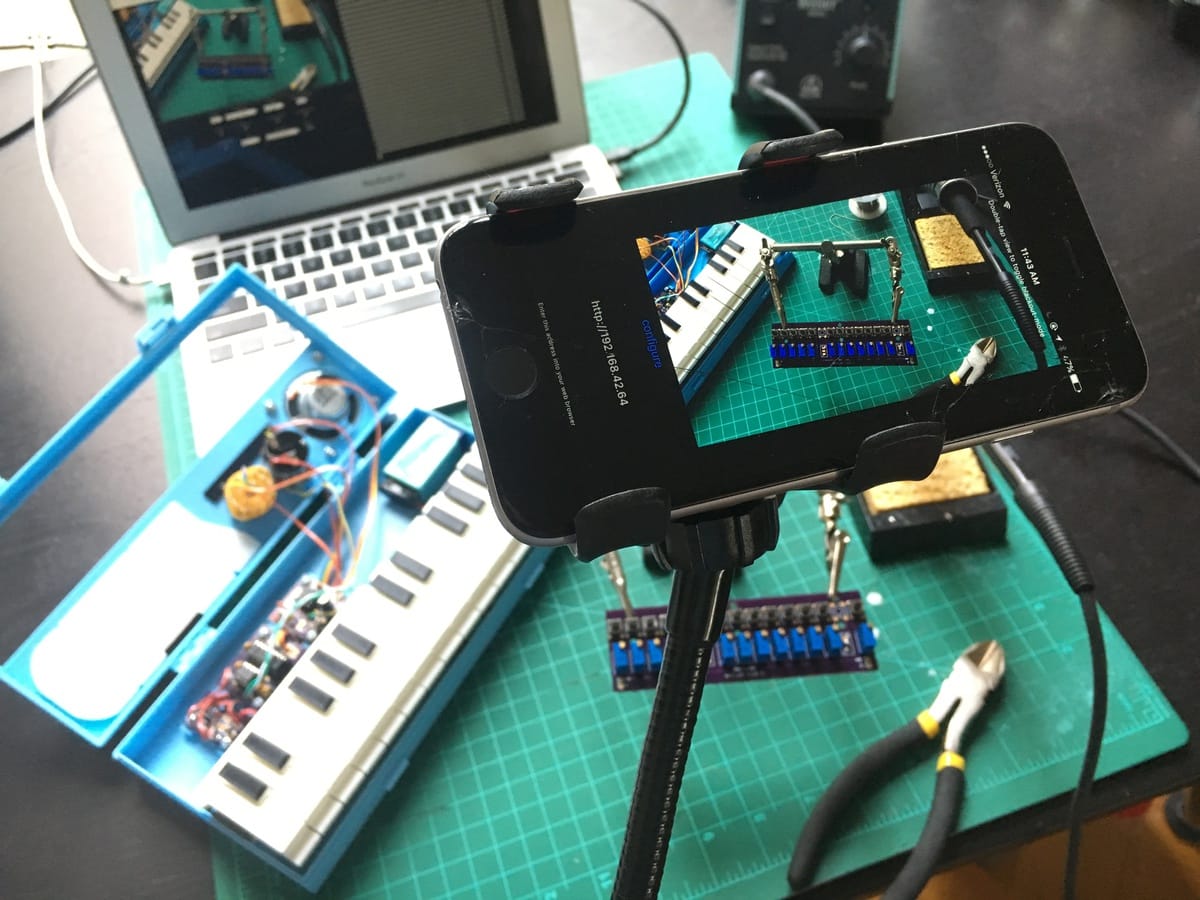
Here’s how I make the time-lapse videos for my Oskitone projects. It’s certainly not for everybody, but if your phone is the best camera you own and you’re not shy of the command line, maybe it could work for you! Code: https://github.com/rocktronica/timelapse How it works IPCamera app turns iPhone into a webcam, accessible on local network. capture.sh script repeatedly downloads its image. (It’s…
Hey! Check this out Oskitone OKAY from oskitone on Vimeo . It's a monophonic, analog, square-wave synthesizer, and I'm calling it... OKAY! Monophonic: Only one note at a time can be played. This is opposed to “polyphonic,” where multiple simultaneous notes can be played. Analog: There are no computers, microcontrollers, sound samplers, or anything digital involved. The sound you hear is the sound…
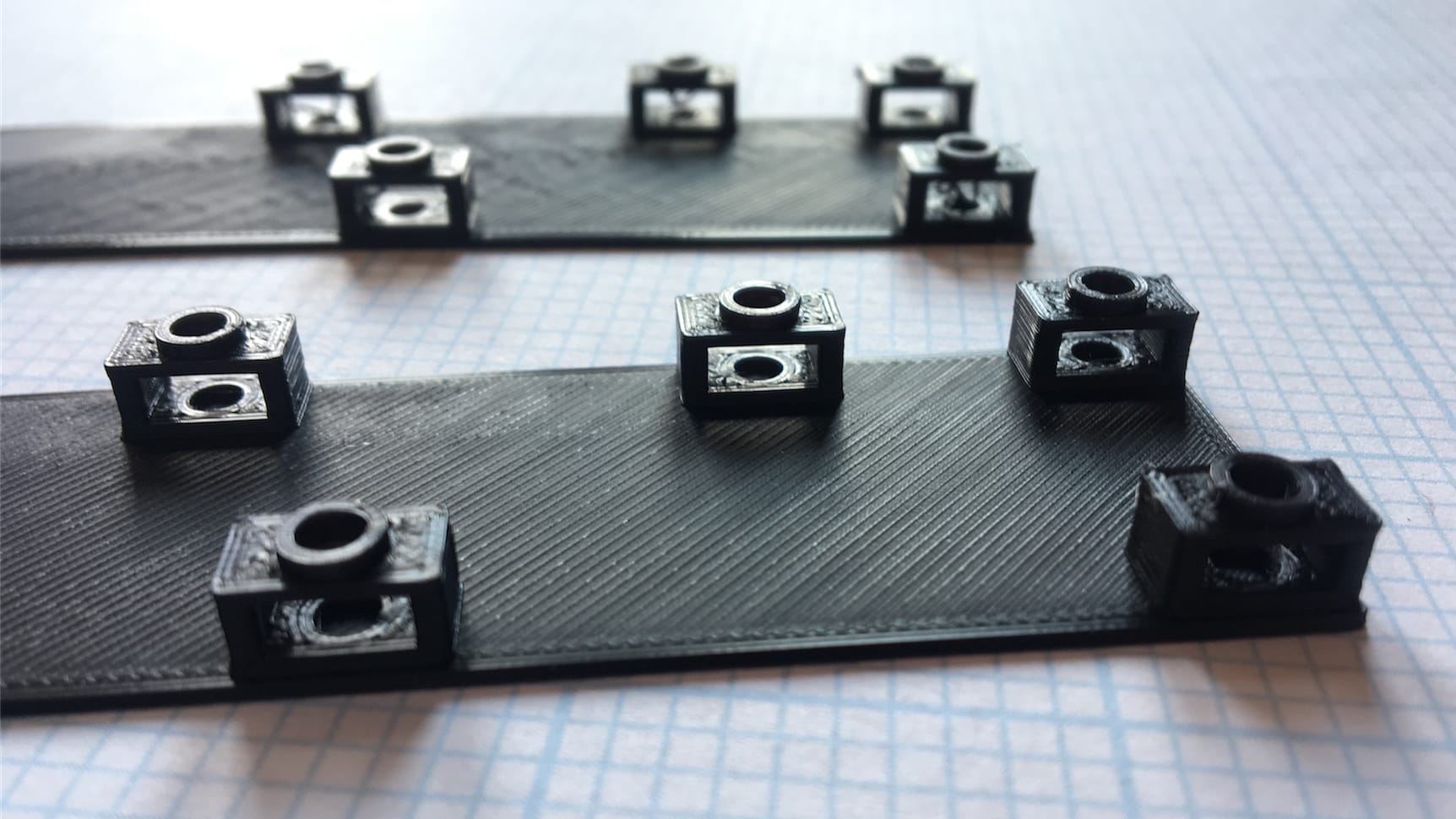
A lot of my designs have bridges with holes in them, like this post with a locking cavity for a hex nut: If printed without supports, the material at the top of the cavity has nothing to sit on and falls inward if it does anything but go straight across. Not the end of the world, but really not ideal, especially for a part that needs to be perfectly calibrated. And printing with supports can be…
Changing filament in the middle of a print is an easy way to get multi-color effects without a multi-extruder 3D printer. One way to do it is to sit by your machine and, when the moment is right, pause and change the spool. Another way is programmatic. The process varies across printers and slicing software, but for my Prusa, I use their ColorPrint web app. With Slic3r's layers panel open as a…
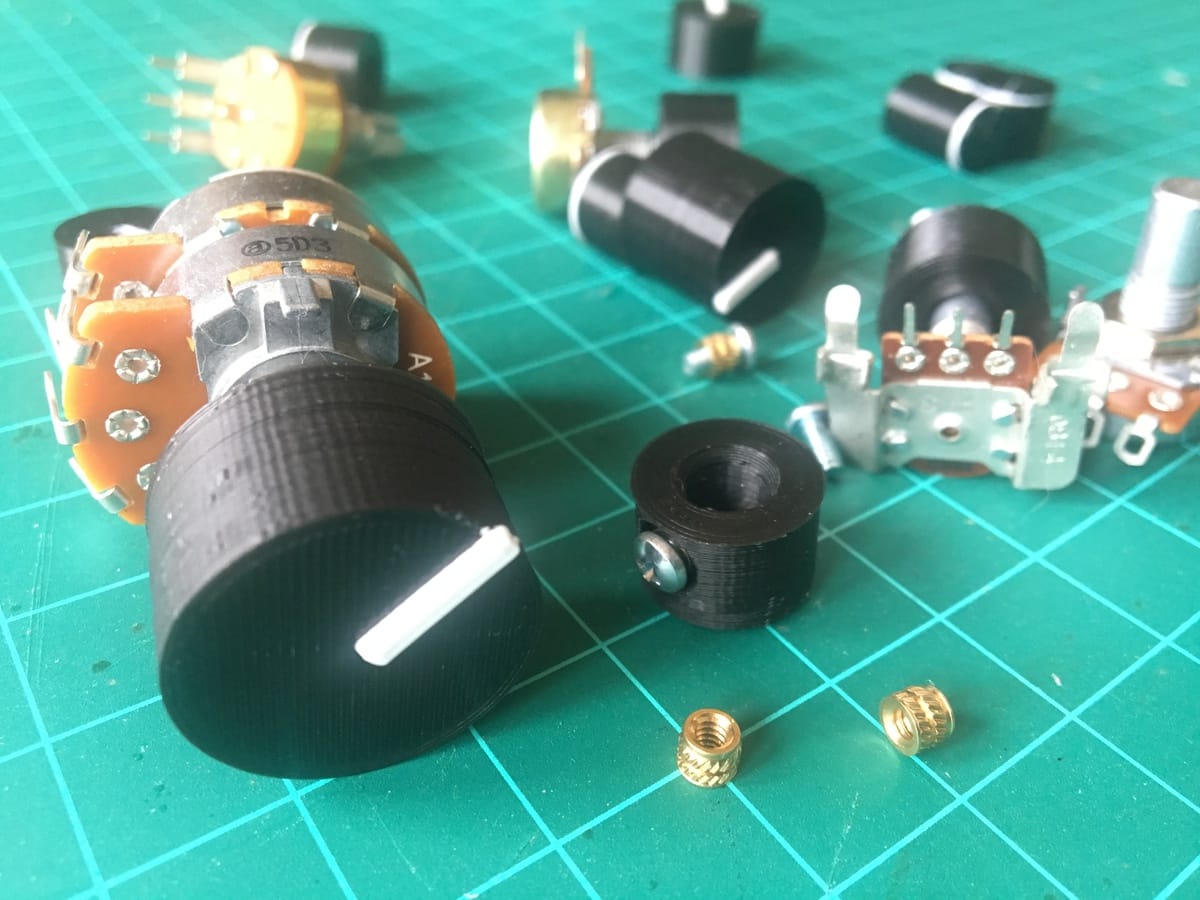
Who needs to buy new potentiometer knobs when you can make your own? Armed with patience, calipers, and a 3D printer, this is quite doable. (Note: this advice will also apply to rotary switches and encoders!) Different knobs for different potentiometer shafts A well-fit knob matches a potentiometer (affectionately referred to as “pot”) and its shaft. Thankfully, there are only a handful of types:…
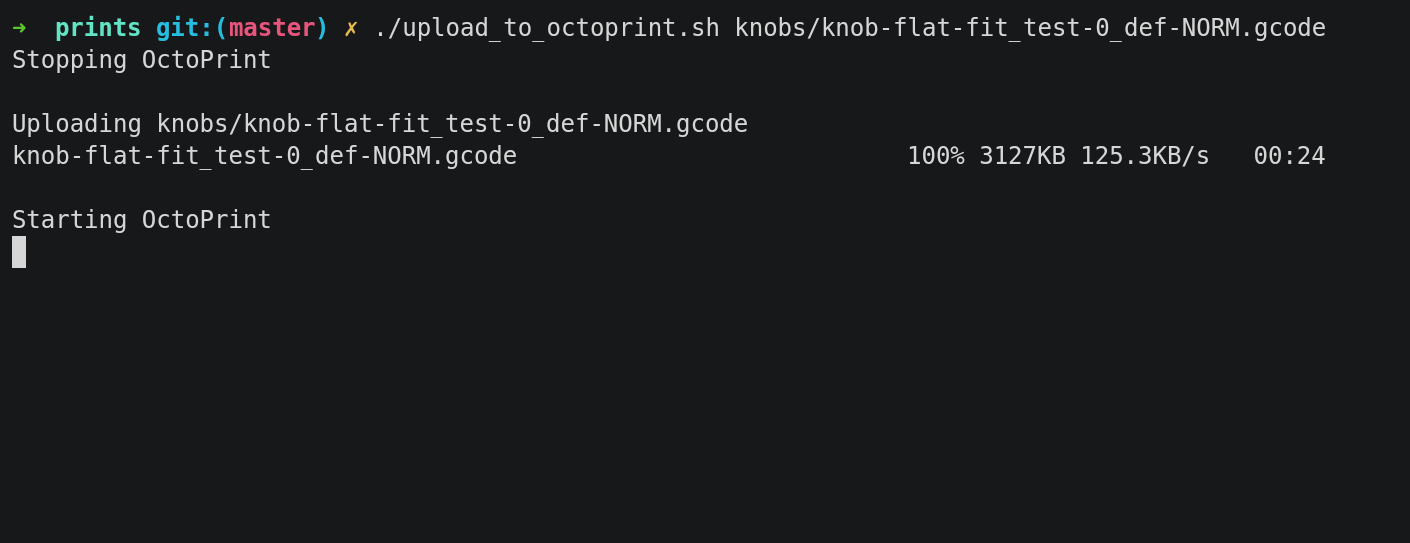
OctoPrint is a web interface for 3D printers, letting you manage prints and monitor progress without a constant USB connection between the printer and your computer. It is a lovely piece of software and I happily support it on Patreon . But, for reasons I don’t entirely understand and despite conversation to the contrary , uploading large files (1mb+) through the normal drag-and-drop interface…
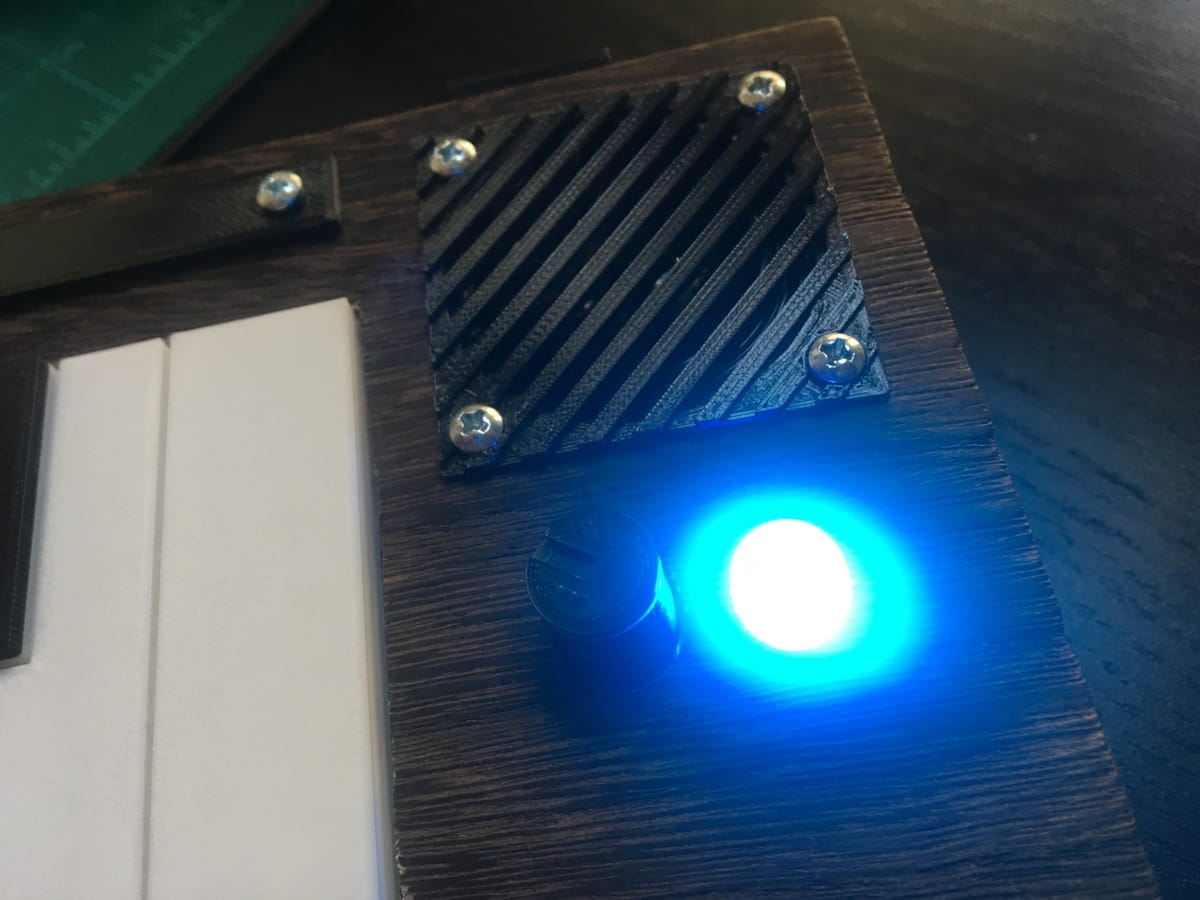
One of the problems with my F0 synth was its power indicator LED. It was so bright, you basically couldn’t look at it straight on without being blinded! (Ow, my eyes!) There are a couple solutions to an overly bright LED, the obvious being to limit its supplied voltage, but another idea is to use a light pipe: a component that redirects light from one place to another. Additionally and…
Inspired by a chord organ I had in high school, my 'chord synth' is a lo-fi analog interpretation with twelve oscillators, sixteen chords, and a wild jungle of routing jumper wires. Organization The internals try to follow the principle of single responsibility . Counter-clockwise from top-left in the photo: An oscillator board for the notes A buttons board for user input A router for connecting…
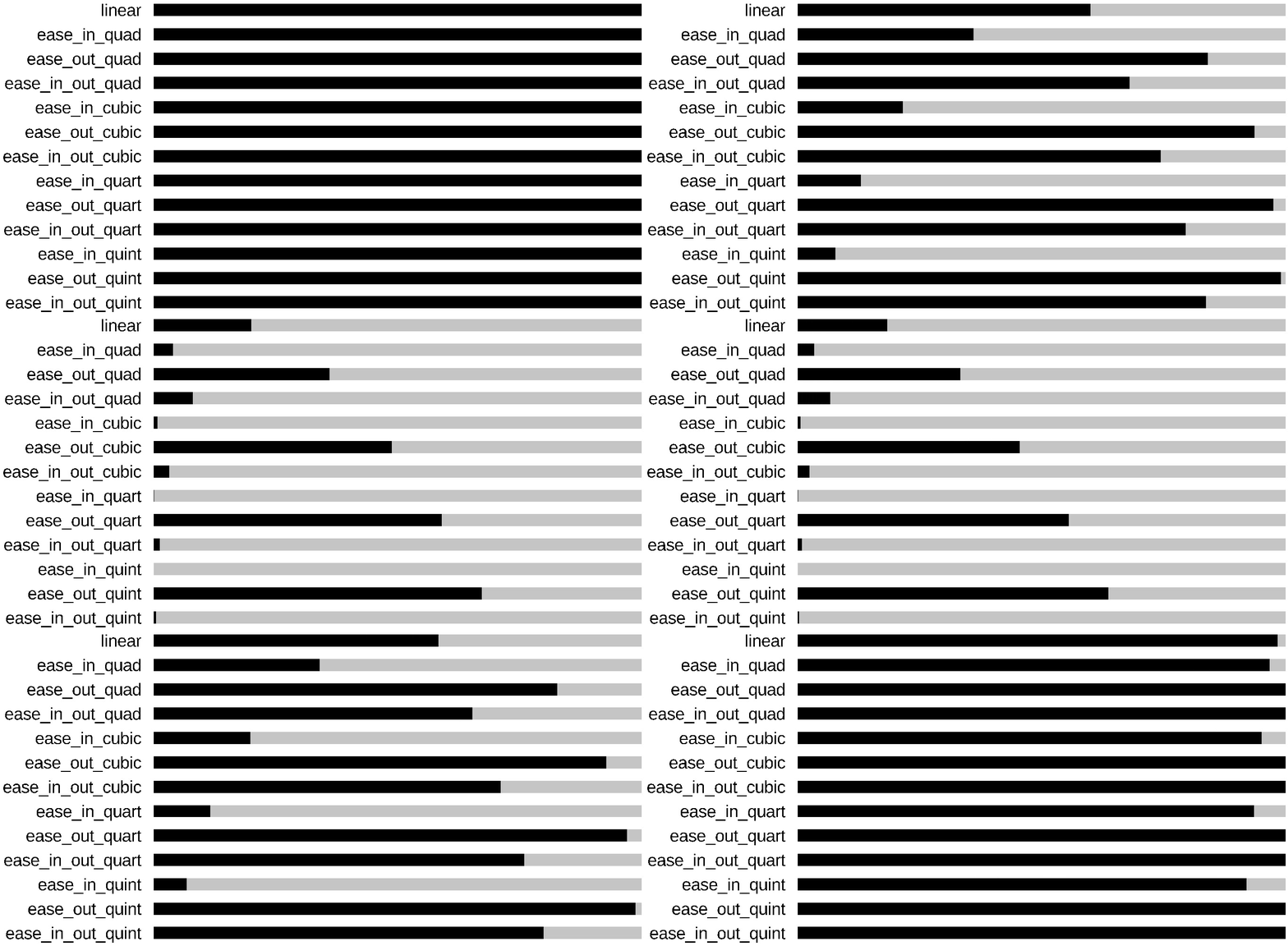
OpenSCAD provides a $t variable as a representation of the animation’s progress. It starts at 0, increases to 1, and immediately loops back to 0. The movement is called linear because each step is equal across the timeline. Things in real life, however, hardly ever move exactly linearly. Consider a bouncing ball or a felled tree or your swaying arms as you walk. Gravity accelerates each,…
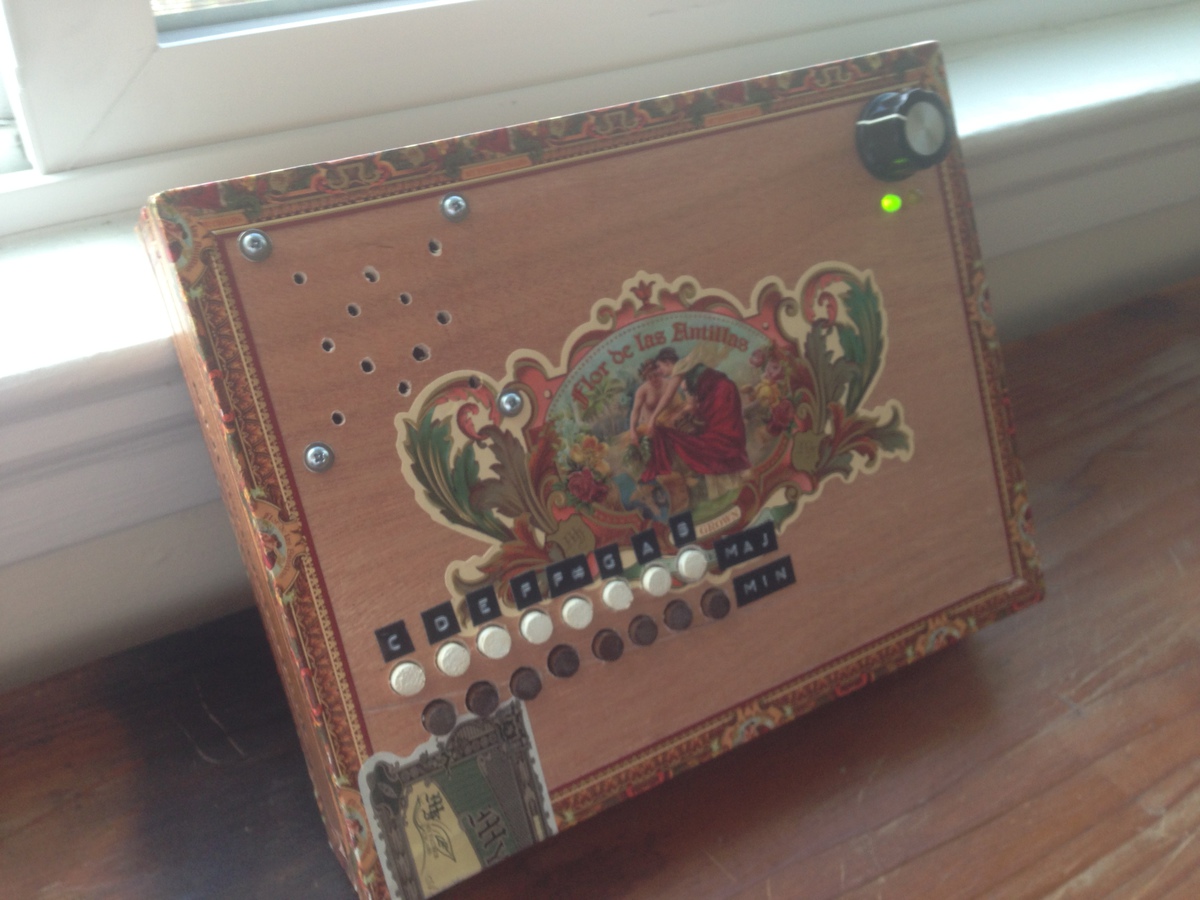
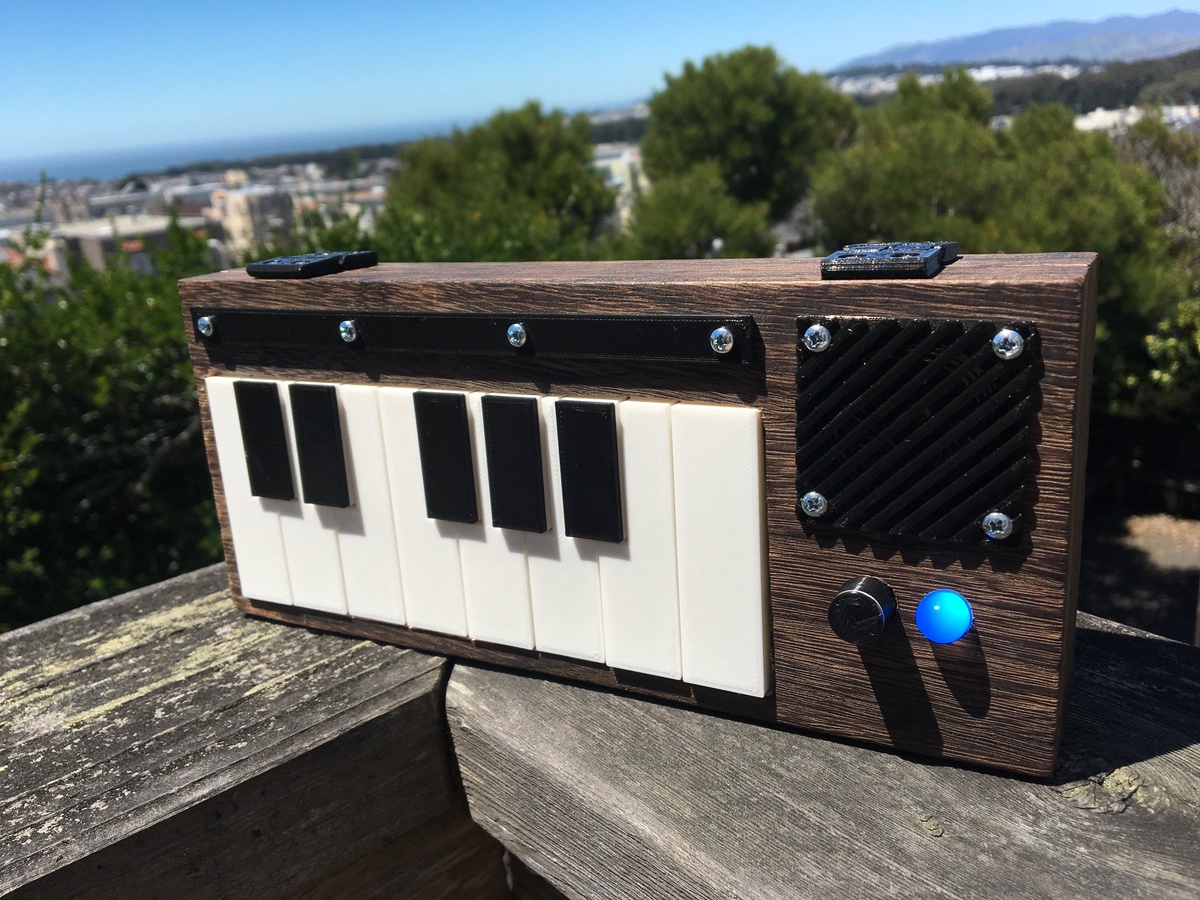
Say hello to the F0! The F0 is a minimalist, analog, square wave synthesizer with chunky 3D-printed piano key overlays, 9V battery power, and a “Feathergrain” (from which we get the F in F0) box enclosure. Because space inside the enclosure was tight and I wanted mostly just to validate a new button layout design, it is admittedly a very spartan Minimum Viable Product (MVP), but it sets a nice…