
Sometimes the best trades aren’t clever at all. From 2021 through early 2022, one of the highest-returning strategies in crypto was stupidly simple: market-make on stablecoin pairs like BUSD/USDT with as much leverage as you could get. The unleveraged return was around 29% a year. Add 5-10x leverage, and you were looking at 200%+ annual returns for what amounted to quoting at the best bid and ask on a pair that barely moved.
This strategy has since decayed — returns today are closer to 10% unleveraged, which barely covers leverage costs. But the case study is fascinating because it reveals how market microstructure creates pockets of outsized returns that persist far longer than they should, and why understanding why a strategy works matters more than the strategy itself.
Quote at the best bid and ask on a stablecoin-to-stablecoin pair (BUSD/USDT, USDT/USDC, etc.). When you get filled on one side, immediately place the acquired inventory on the other side of the book. Repeat endlessly.
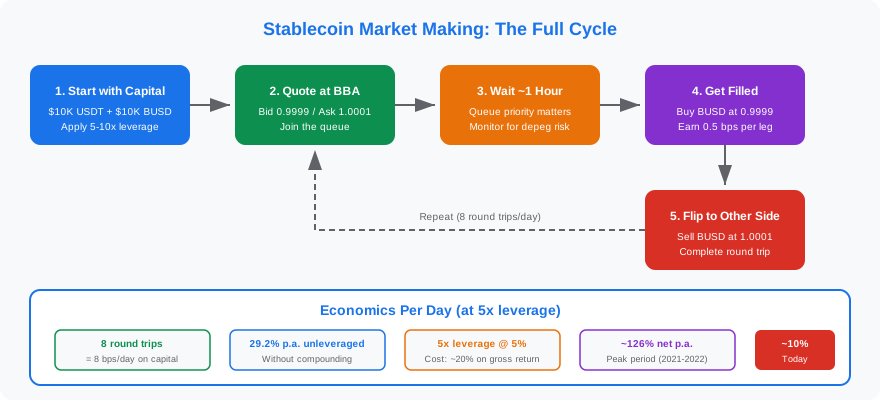
That’s it. The spread on these pairs is typically one tick wide — 0.0001 on BUSD/USDT — so each round trip (buy at 0.9999, sell at 1.0001) earns 1 basis point. Most major exchanges charge zero maker fees on stablecoin pairs regardless of fee tier, so there’s no fee drag to overcome. The entire edge comes from earning the spread multiplied by volume, amplified by leverage.
The natural question is: if it’s this simple, why didn’t competition compress returns to zero? The answer lies in how stablecoin orderbooks work — and specifically, why the competitive mechanism is fundamentally different from normal markets.
In typical markets, market makers compete on two dimensions: skill (predicting where the price is going) and price (tightening the spread to attract more flow). In stablecoin markets, neither dimension applies. The price barely moves, so there’s minimal skill edge to exploit. And the spread is artificially wide because of minimum tick size constraints — the equilibrium spread is tighter than the exchange allows, so you can’t compete by offering a better price.
Instead, market makers compete on queue time. When the spread is fixed and the price is stable, the only way to get filled is to wait in line. If returns are attractive, more capital joins the queue at the best bid and ask, the line gets longer, and the time between fills increases — which mechanically reduces annualized returns until an equilibrium is reached.
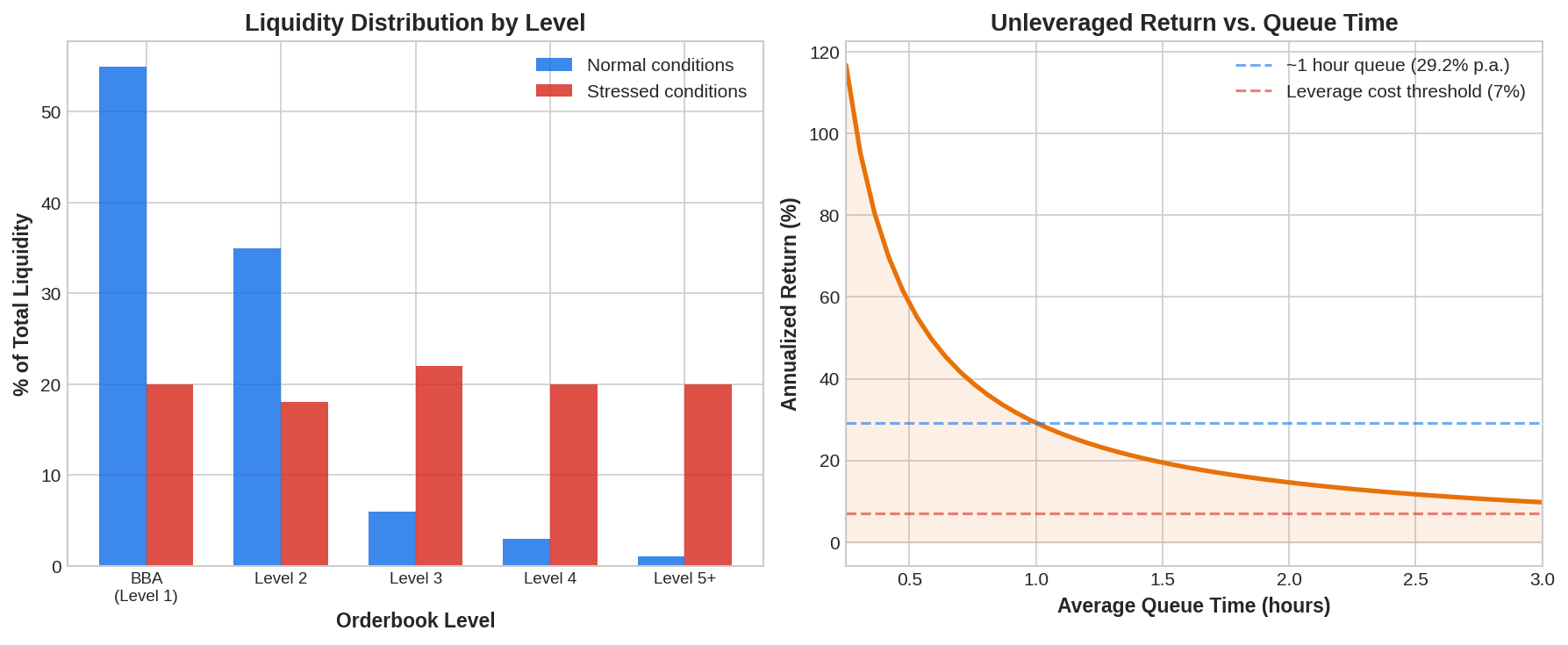
The math works out to roughly one fill per hour during the strategy’s peak. With about 16 effective trading hours per day (accounting for time lost when quotes need to be moved), that’s 8 round trips daily, earning 8 basis points. Annualized without compounding: 29.2%. The simplicity is almost offensive.
The raw 29% is decent but not extraordinary. What made this strategy print was leverage — and the unique property that stablecoin leverage is far less risky than leverage on volatile assets.
Comments
Nothing yet. Say the first thing.
Sign in to join the conversation.