
Somewhere in the last decade, Gnosticism stopped calling itself Gnosticism.
It didn’t disappear. It shed the name and slipped its way into movements that would be offended to hear the label attached to them. You’ll find it if you scroll long enough through spiritual content online, or sit through enough sermons that never mention the word…probably from a pastor who has no idea that he’s teaching an ancient heresy. Someone explaining that your “true self” is trapped inside a body it was never meant to inhabit sounds pretty close to the idea of the flesh as sinful, but the inner creation is sanctified. A podcast guest arguing that the God of the Old Testament is too angry, too tribal, too violent to be the real Father of Jesus, so there must be some greater truth hidden from us. A deconstruction account insisting that the real Christianity got buried by a power-hungry institution centuries ago, and the right book or the right teacher can finally hand you back what was taken from you.
Most of those people have never heard the name Valentinus or Marcion. Almost none of them would accept the label Gnostic if you confronted them with it. But almost everything I just described is second-century Gnostic theology wearing twenty-first-century clothes, and part of what let it slip back into Christian sermons and online content undetected is that it stopped using the word that would have given it away. Before we can talk about why the early church fought this system as hard as it did, we have to answer a more basic question.
Where did Gnosticism actually come from, and how did it end up inside the church in the first place?
Let’s start with the term itself. Gnosis is Greek for knowledge, but a specific kind of knowledge. You wouldn’t use gnosis for arithmetic or history. It’s closer to how you’d talk about knowing a person, an intuitive, experiential kind of knowing. The Gnostics claimed that a select few had access to a hidden, saving knowledge about who they really were, where they came from before this world, and how to find their way back.
That’s an important distinction, because Gnosticism was never mainly a checklist of doctrines you could argue down with proof texts. It was a posture toward reality. The material world is a trap and the god who made it is either incompetent or malicious. Salvation comes by remembering a truth about yourself that this world has worked hard to make you forget.
If you can see it as a posture rather than a system, you start noticing it in places that never call themselves Gnostic. That’s why it’s so difficult to root out of the Body and exactly why I’m writing this series with a friend. (He’s writing part 2.)
For a long time the assumption ran something like this. Gnosticism grew up inside the church, borrowed its vocabulary, and twisted it into something the apostles never intended. Irenaeus and Tertullian wrote as though this were true, since the teachers they were refuting spoke the church’s own language and claimed apostolic pedigree of their own.
There’s some truth in that part of the story. By the time we reach Valentinus in the second century, we’re clearly dealing with a movement operating inside Christian circles, using Christian vocabulary. But the further back you trace the actual ideas, the harder it becomes to believe Gnosticism started there. The basic ideas were already embedded across Judaism and the Greco-Roman world well before Jesus was born in Judea and raised in Galilee.
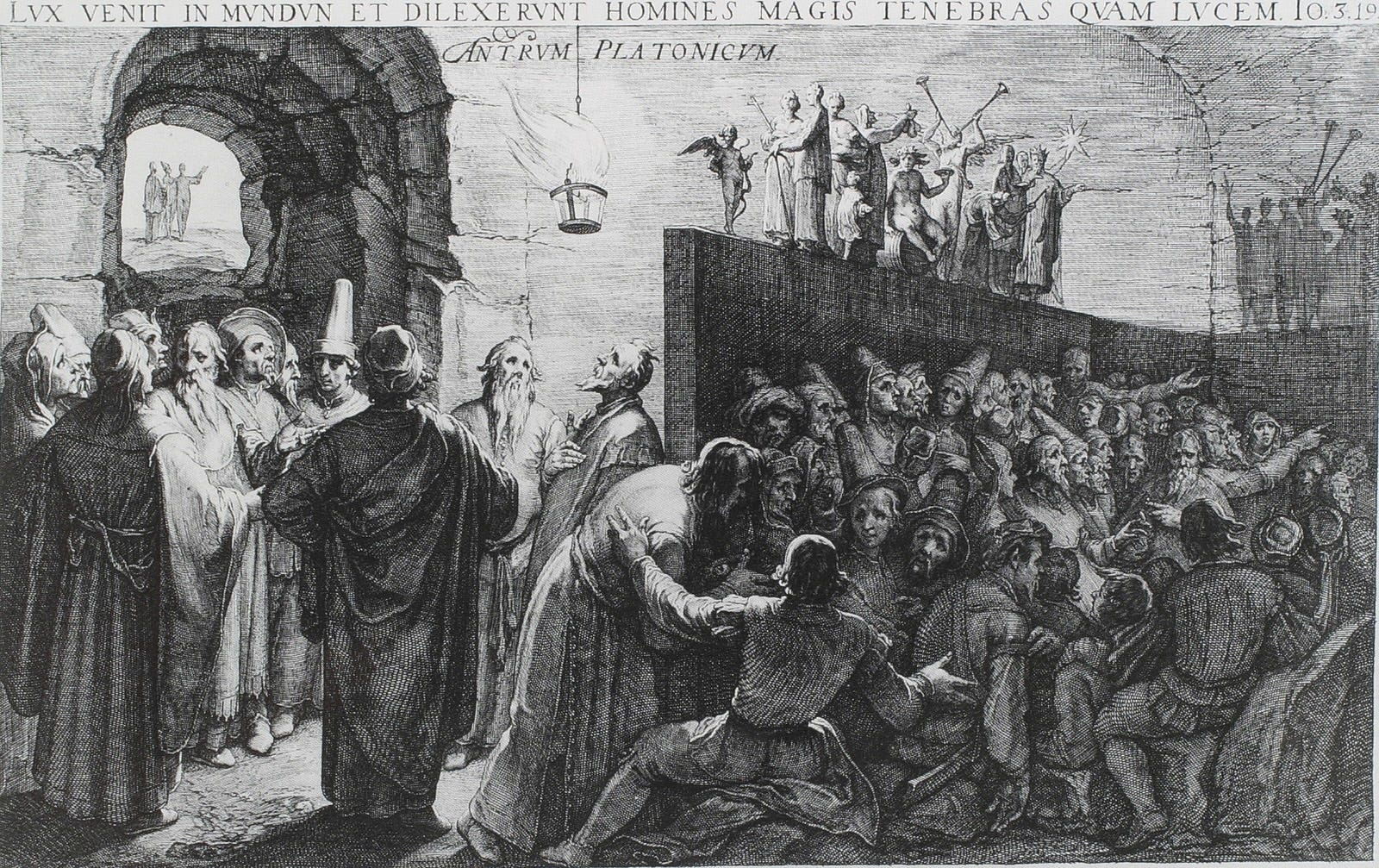
Here’s a fact most people don’t know about Gnosticism: Plato planted the seed first. Centuries before any Gnostic teacher started formalizing and advocating for something with shape to it, Plato was already describing the soul as something diminished and imprisoned by the body. In the Phaedo, his account of Socrates’s death is framed almost as a release, the soul finally shedding the flesh that had clouded its perception of true reality. The Cave allegory makes the same point from another angle. What most people see and touch is shadow. The real, unchanging world of Forms sits behind it, and only the mind trained to look past appearances can glimpse it. Strip out the philosophical vocabulary and you already have the outline of the Gnostic story: a base and unreal material world, and a truer reality hidden behind it, available only to those who know how to look for it. That’s the underlying posture of Gnosticism.
Middle Platonism made that idea more palatable as it moved into the first century. Plato’s ideas didn’t stay in Athens. Between roughly the first century BC and the second century AD, a school of thought scholars now call Middle Platonism reworked and popularized Plato’s metaphysics across cities with large Jewish and, later, Christian populations, like Alexandria. This is the vehicle that carried Plato’s body-and-soul dualism directly into the intellectual world the apostles were preaching at and writing to.
I want to pause for a brief aside here, because a few ideas many Christians today assume come straight from Scripture actually slipped in through this same side door. The notion that the soul is inherently immortal, incapable of dying under any circumstance, owes far more to the Phaedo than to Genesis or Paul. The assumption that “going to heaven when you die” is the whole point of the Christian hope actually borrows Plato’s ranking of soul over body rather than the New Testament’s actual climax, which is bodily resurrection and a renewed creation, not an escape from one. Even some later, harder versions of the doctrine of divine impassibility, the idea that God cannot be moved by anything at all, lean more on Greek assumptions about a perfect being needing to be static than on the God who walks in the garden calling for Adam and weeps at Lazarus’s tomb. I have a strong personal concern with some of those church doctrines, both due to their true origins and what they say about God that doesn’t appear to have a solid biblical witness. We’ll come back to all three of these in Part 4, because recognizing what leaked through Platonism and settled into ordinary Christian assumption is part of learning to spot Gnostic residue today.
Second Temple Judaism supplied a crowded cosmos. Long before Nag Hammadi, Jewish apocalyptic writing was already wrestling with a populated heaven. Books like 1 Enoch describe rebellious Watchers, a fractured divine council, and a whole tier of intermediary powers standing between God and man. If you’ve spent any time with me on the Divine Council Worldview, none of this should surprise you. Second Temple Judaism had a layered cosmology of angels, princes, and spiritual authorities long before any Gnostic teacher ever picked up a pen or stood on a box in the town square. What Gnosticism does with that populated cosmos is something Judaism itself never did. It takes one of those lesser powers and promotes him into the role of a hostile or ignorant creator, then demotes Yahweh himself into that lower seat.
Persian dualism sharpened the issue. Zoroastrian thought, which Jewish communities had extensive contact with during and after the Babylonian exile, framed the universe as a battleground between opposing forces of light and darkness. That stark cosmic conflict echoes loudly in later Gnostic language about divine light trapped in matter, waiting to be freed by those who possess the right knowledge.
And underneath all of it, real grief. This part gets overlooked, but it may be the most important ingredient of all. The world that produced Gnostic thought was a world reeling from displacement. Exile, foreign occupation, and then the destruction of the Jerusalem temple in AD 70, a wound that left whole communities asking why the God who promised covenant faithfulness seemed absent, or worse, complicit. A theology that says this broken world was never the good God’s real handiwork to begin with is an understandable answer to genuine grief. It doesn’t make the answer true, but it does explain why it took root so easily.
Ideas don’t spread on their own. They travel through people, and Gnosticism had a fairly traceable road into the church, one the early fathers themselves pointed back to.
Simon Magus is where they start the story. You may remember him from Acts 8, the sorcerer in Samaria who watches Philip’s ministry, believes, is baptized, and then tries to buy the power of the Holy Spirit with money.
“But Peter said unto him, Thy money perish with thee, because thou hast thought that the gift of God may be purchased with money.” Acts 8:20
Peter’s rebuke is sharp, and while Simon fades from the Acts narrative, he doesn’t fade from history. Irenaeus point to Simon as the fountainhead of the entire Gnostic tradition, the first figure to fuse magical practice and philosophical speculation with a claim to superior, hidden spiritual knowledge available only to himself and his closest followers. Later tradition even has Simon traveling to Rome, teaching that he was himself a manifestation of divine power, and presenting a woman named Helena as a fallen aspect of divine Wisdom he had rescued from degradation, a motif that reads almost like a rough early sketch of the Sophia narrative Gnostic teachers would refine generations later. Whether every later Gnostic teacher traces back to Simon in an unbroken line is genuinely debated among historians, but the early church clearly saw him as the first crack in the door.
Alexandria became the mixing chamber as the church expanded. By the first and second centuries, Alexandria was one of the great intellectual capitals of the ancient world, home to an enormous Jewish community steeped in Hellenistic philosophy, a growing Christian population, both famous and infamous, and generations of Greek scholarship, all sharing the same libraries and the same lecture halls. This is the city that produced Philo, a Jewish philosopher who spent his career reading Moses through a Platonic lens, allegorizing the patriarchs into stand-ins for philosophical virtues and vices. Philo remained firmly committed to the God of Israel, and he was never a Gnostic, but his method, primarily a tool called allegory, shows how thoroughly Jewish and Greek thought were already interwoven in this environment, decades before the Gnostic teachers we associate with the term ever appear. Plato’s dualism, Jewish angelology, and Persian cosmic conflict were circulating in the same schools and squares, sometimes inside the very same person’s head.
Paul’s own word choice makes it clear that the ideas were present. This is the detail that makes the whole picture click into place. Paul himself uses the word gnosis.
“Now as touching things offered unto idols, we know that we all have knowledge. Knowledge puffeth up, but charity edifieth.” 1 Corinthians 8:1
He talks about mysterion, a mystery once hidden and now revealed in Christ, in Ephesians 3. He describes believers as pneumatikos, spiritual, set against those who remain merely fleshly, in 1 Corinthians 2. Gnostic teachers didn’t need to invent a new religious vocabulary to smuggle their system into the church. They took Paul’s own words and read a fuller, doubled meaning underneath them, a hidden gnosis reserved for the truly initiated, layered beneath the plain sense Paul actually intended. Paul himself seems to sense exactly this danger developing, which is why he warns Timothy so directly.
“O Timothy, keep that which is committed to thy trust, avoiding profane and vain babblings, and oppositions of science falsely so called.” 1 Timothy 6:20
That phrase, “science falsely so called,” is gnosis pseudonymos in the Greek, knowledge falsely named. Irenaeus later borrowed that exact line for the original title of his great work against the Gnostics.
Valentinus, an early and well-known Gnostic, shows how far this could potentially go. By the middle of the second century, Valentinus was a respected teacher in Rome, well versed enough in Scripture and rhetoric that he was seriously considered for the office of bishop in Rome, the seat that would later become the pope. He was inside the halls of power in the early church, using the church’s own texts and the church’s own vocabulary, competing for the church’s highest office. That’s exactly why it took someone like Irenaeus, writing in long and exhausting detail, to expose what was actually being taught underneath those familiar words.
This is the part that should make us pay closer attention. Gnosticism wore the church’s own clothes and spoke the church’s own language. You could say, the call was coming from inside the house. That’s what made it dangerous, and that’s exactly why the fight had to happen.
By the time Irenaeus sat down to write what we now call Against Heresies, and Tertullian took up his pen against Marcion, they weren’t responding to some small eccentric side sect they had a personal problem with. They were responding to a fully developed rival account of the gospel, built out of philosophical sophistication, genuine pastoral appeal to a wounded and displaced world, and the church’s own biblical vocabulary turned back against itself.
A system that denies Christ came in a real, physical body, and denies a real, physical resurrection, isn’t giving us a “fresh perspective on the gospel.” It’s removing the center of it. A system that divides believers into an enlightened few who possess the secret knowledge and everyone else who merely has faith isn’t offering a deeper spirituality. It’s rebuilding the very hierarchy the true gospel tears down.
That was the clear and present danger that Irenaeus, Hippolytus, Tertullian, and Origen were staring down when they picked up their pens.
It’s worth remembering this whenever we’re tempted to picture church history as a story of obvious villains at the gate. The most dangerous errors rarely announce themselves as errors. They quote the same verses, use the same vocabulary, and claim the same Lord, while eloquently relocating the center of gravity somewhere the apostles never put it.
That’s the work Part 2 picks up. Grant Skelton will go inside the actual Gnostic texts, the Demiurge who reduces Yahweh himself to a blind, bumbling impostor, Marcion’s severing of the God of Israel from the Father of Jesus, and Valentinus teaching from inside the church’s own walls. And we’ll watch Irenaeus and Tertullian answer them point by point, tracing every claim back to where it actually came from.
No posts
Comments
Nothing yet. Say the first thing.
Sign in to join the conversation.